Introduction
Businesses today can no longer afford to rely on slow, manual procurement and sales processes. Online B2B platforms have completely transformed the way companies source products, manage suppliers, and close bulk deals — all from a single digital environment. Whether you are a manufacturer looking to expand your reach or a buyer searching for reliable vendors, these platforms offer a smarter, faster, and more profitable way to operate. In this guide, you will discover the key benefits of using online B2B platforms, how a B2B ecommerce platform can streamline your operations, and why a B2B online marketplace could be the growth engine your business needs right now.
What Are Online B2B Platforms?
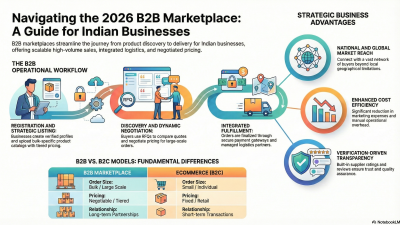
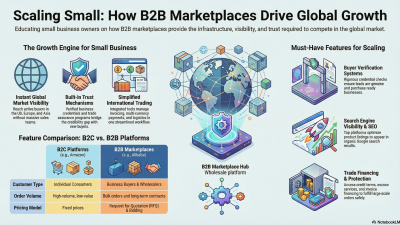
Online B2B platforms are digital ecosystems where businesses buy and sell products or services directly with other businesses. Unlike B2C (business-to-consumer) channels, these platforms are built for bulk transactions, negotiated pricing, contract-based selling, and long-term supplier relationships.
They come in several forms:
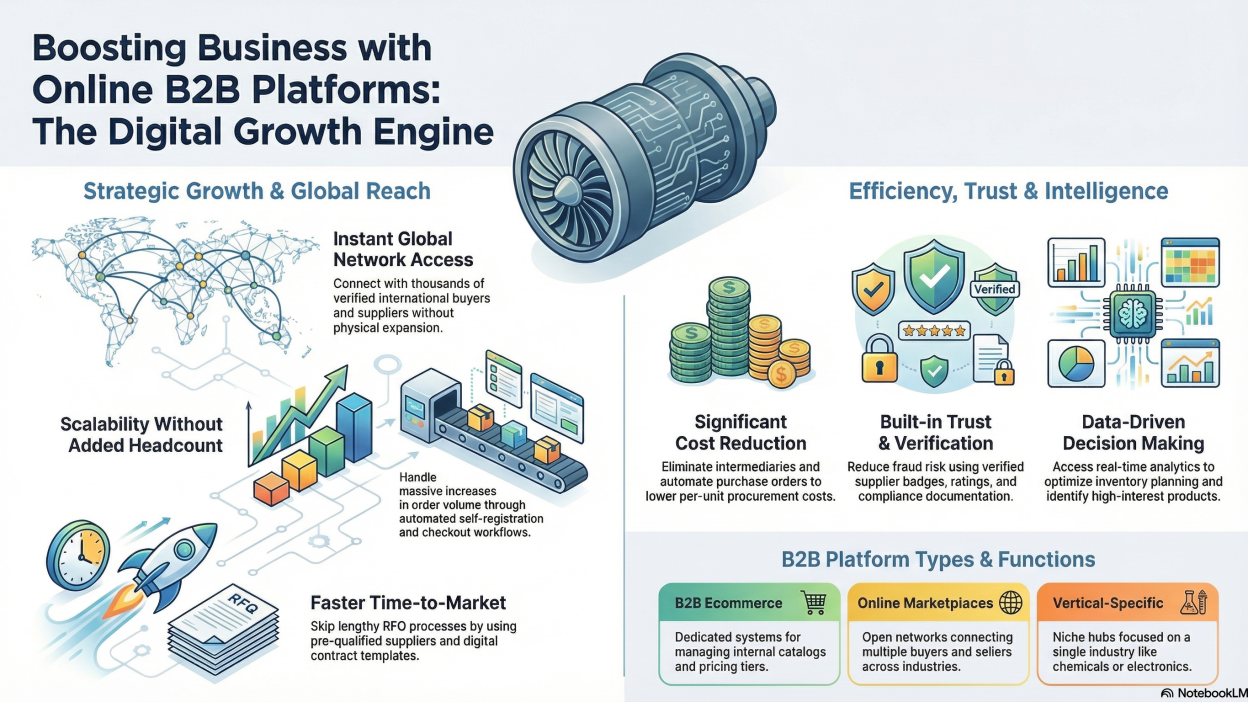
- B2B ecommerce platforms — dedicated systems where businesses manage catalogs, pricing tiers, and checkout workflows for business buyers
- B2B online marketplaces — open networks connecting multiple buyers and sellers across industries (similar to Amazon Business or Alibaba)
- Vertical-specific platforms — niche hubs focused on a single industry such as chemicals, textiles, or electronics
Understanding the type of platform best suited for your business is the first step toward unlocking real competitive advantage.
Benefit 1: Access to a Global Network of Buyers and Suppliers
One of the most powerful advantages of joining a B2B online marketplace is the instant access to a global trading network. Traditionally, expanding into new markets required trade shows, distributor agreements, and months of relationship-building. Today, a well-optimized profile on an online B2B platform can put your products in front of thousands of verified buyers and suppliers overnight.
This global exposure allows businesses to:
- Diversify their supplier base and reduce dependency on a single region
- Discover competitive pricing from international vendors
- Enter new markets without opening physical offices or warehouses
- Scale sourcing operations during peak demand without friction
For small and mid-sized businesses especially, this levels the playing field with larger enterprises that previously had exclusive access to global trade networks.
Benefit 2: Significant Cost Reduction Across Procurement
Cost efficiency is one of the top reasons businesses migrate to a B2B ecommerce platform. Traditional procurement involves multiple layers — sales reps, paper-based purchase orders, phone negotiations, and manual invoice reconciliation. Each step adds cost and creates opportunity for human error.
Online B2B platforms eliminate much of this overhead by:
- Automating purchase orders and approvals — reducing administrative workload
- Enabling price comparison across multiple vendors in real time
- Cutting out intermediaries — connecting buyers directly with manufacturers or primary suppliers
- Centralizing invoicing and payment — reducing accounting errors and processing delays
Businesses that transition to digital procurement consistently report lower per-unit costs, faster order cycles, and reduced operational overhead across their supply chain.
Benefit 3: Streamlined Order Management and Automation
Manual order processing is one of the biggest bottlenecks in B2B commerce. A single large order might require dozens of emails, phone calls, and spreadsheets before it is confirmed. A B2B ecommerce platform replaces this chaos with structured, automated order management workflows.
Key automation capabilities include:
- Bulk order processing with tiered pricing applied automatically
- Reorder triggers based on inventory thresholds
- Real-time order tracking visible to both buyer and seller
- ERP and accounting software integrations that eliminate double data entry
- Digital contract management with approval workflows
This level of automation not only speeds up fulfillment but also dramatically reduces errors, disputes, and the cost of customer service.
Benefit 4: Enhanced Transparency and Supplier Verification
Trust is the foundation of every successful B2B relationship. One challenge businesses face when sourcing new vendors is verifying legitimacy, quality standards, and reliability. A reputable B2B online marketplace addresses this by building verification, ratings, and compliance checks directly into the platform.
Most established online B2B platforms provide:
- Verified supplier badges based on documentation checks and audits
- Buyer and seller ratings and reviews from real transaction histories
- Dispute resolution mechanisms managed by the platform
- Compliance certifications for quality standards like ISO, CE, or FDA
- Transparent pricing history so buyers can spot inflated quotes
This built-in trust infrastructure significantly reduces the risk of fraud, substandard products, or unreliable delivery timelines — which are common pain points in traditional vendor sourcing.
Benefit 5: Data-Driven Decision Making and Analytics
Modern online B2B platforms are not just transactional tools — they are intelligence platforms. Buyers and sellers both gain access to rich data that supports smarter, faster business decisions.
For buyers, analytics dashboards can reveal:
- Which suppliers offer the best price-to-quality ratio over time
- Seasonal demand patterns to optimize inventory planning
- Spending trends by category, department, or product line
For sellers, platform analytics provide:
- Insights into which products attract the most buyer interest
- Conversion data from catalog views to confirmed orders
- Geographic demand patterns to prioritize market expansion
Businesses that leverage these insights gain a measurable edge over competitors still operating on intuition and historical spreadsheets.
Benefit 6: Faster Time-to-Market for Products and Services
Speed is a competitive weapon. The faster a business can source materials, finalize supplier agreements, and move products through its supply chain, the faster it reaches customers. Online B2B platforms compress every stage of this cycle.
A B2B online marketplace accelerates time-to-market by:
- Providing instant access to pre-qualified suppliers without lengthy RFQ processes
- Enabling digital sampling requests and approval workflows
- Supporting contract templates that speed up legal sign-off
- Allowing parallel negotiations with multiple suppliers simultaneously
For businesses in fast-moving industries — electronics, fashion, pharmaceuticals, or food — this speed advantage directly translates into higher revenue and stronger market positioning.
Benefit 7: Improved Customer Experience for B2B Buyers
The consumerization of B2B buying is real. Today’s business buyers expect the same seamless digital experience they enjoy as consumers. A modern B2B ecommerce platform delivers exactly that — personalized catalogs, self-service portals, and intuitive checkout experiences designed for business accounts.
This improved buyer experience includes:
- Custom pricing portals showing negotiated rates for each account
- Multi-user account management with role-based permissions
- Saved order lists and reorder shortcuts for repeat purchases
- Mobile-optimized interfaces for buying on the go
- 24/7 self-service access without needing to contact a sales rep
When business buyers find it easy to work with you digitally, they stay loyal, order more frequently, and refer others — compounding the growth impact of the platform investment.
Benefit 8: Scalability Without Proportional Cost Increases
One of the most compelling arguments for adopting an online B2B platform is scalability. Traditional sales and procurement teams scale linearly — more transactions require more people. Digital platforms break this constraint entirely.
A well-implemented B2B ecommerce platform allows businesses to:
- Handle 10x order volume without adding headcount
- Onboard new suppliers or buyers through self-registration workflows
- Expand into new product categories without rebuilding the sales infrastructure
- Support multiple languages and currencies for international growth
This scalability makes online B2B platforms especially attractive for growth-stage companies that need to move fast without ballooning their operational costs.
Benefit 9: Stronger Compliance and Risk Management
Regulatory compliance is a growing concern for businesses operating across borders. Managing product safety standards, customs documentation, and trade regulations manually is both time-consuming and error-prone. Online B2B platforms increasingly embed compliance tools directly into their workflows.
These tools help businesses:
- Verify export/import compliance before orders are placed
- Store and retrieve supplier compliance documentation digitally
- Receive automated alerts when certifications are expiring
- Generate audit trails for regulatory reporting
For industries with strict requirements — healthcare, food and beverage, chemicals, or defense — this built-in compliance support is not just convenient, it is essential for operating legally across markets.
How to Choose the Right Online B2B Platform
Not all platforms are created equal. Selecting the right B2B online marketplace or ecommerce solution depends on your specific business model, industry, and growth objectives.
Key factors to evaluate include:
- Industry fit — Does the platform specialize in your vertical or serve a broad range of categories?
- Supplier/buyer network size — How many verified trading partners are already active?
- Integration capabilities — Does it connect with your existing ERP, CRM, or accounting software?
- Pricing model — Commission-based, subscription, or transactional fees?
- Security and compliance — What data protection standards and certifications does the platform hold?
- Customer support — Is dedicated onboarding and technical support available?
Taking the time to evaluate these factors ensures you choose a platform that grows with your business rather than one you outgrow in 12 months.
Frequently Asked Questions
What is an online B2B platform?
An online B2B platform is a digital marketplace or ecommerce system designed for transactions between businesses. It facilitates bulk buying, supplier discovery, order management, and payment processing between companies rather than individual consumers.
How is a B2B ecommerce platform different from a B2C ecommerce platform?
A B2B ecommerce platform is built for business buyers and includes features like volume pricing, purchase order workflows, multi-user account access, contract-based pricing, and ERP integrations. B2C platforms are designed for individual consumers with simpler checkout experiences and standard retail pricing.
What are the top benefits of joining a B2B online marketplace?
The top benefits include access to global supplier networks, reduced procurement costs, faster order processing, improved supply chain transparency, data analytics, and scalability without proportional cost increases.
Are online B2B platforms suitable for small businesses?
Yes. Many online B2B platforms specifically cater to small and medium-sized businesses by providing access to supplier networks and automation tools that were previously only accessible to large enterprises.
How do online B2B platforms ensure supplier quality?
Reputable platforms use verified supplier badges, performance ratings, transaction history reviews, compliance certification checks, and dispute resolution systems to maintain quality standards across their marketplace.