Introduction
Running a small business has never been more competitive — or more full of opportunity. With the rise of the global B2B market, even the smallest suppliers, manufacturers, and wholesalers can now reach buyers across continents without a massive sales team or a large marketing budget. The key to unlocking this opportunity? The right small business support through a well-structured B2B marketplace.
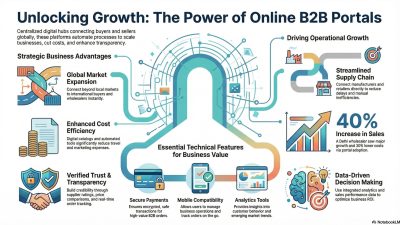
A business to business marketplace connects suppliers with buyers in a streamlined, scalable way. Unlike traditional sales channels, these platforms remove geographical barriers, reduce overhead costs, and give small businesses the tools they need to compete alongside industry giants. Whether you are just starting out or looking to scale internationally, B2B marketplaces have become indispensable for growth in today’s economy.
What Is a B2B Marketplace and Why Does It Matter?
A B2B marketplace is a digital platform where small businesses buy and sell products or services to one another — not to individual consumers. Think of it as a wholesale hub or a sourcing engine, but built for the internet age.
These platforms serve as the backbone of B2B trading in many industries. From raw materials and industrial equipment to technology products and logistics services, b2b marketplaces bring together thousands of verified buyers and sellers on a single platform.
For small businesses, this matters enormously. Instead of investing heavily in cold outreach, trade fairs, or traditional advertising, a small business can list its products or services on a platform for small businesses and start receiving inquiries from global buyers within days.
How B2B Marketplaces Differ from B2C Platforms
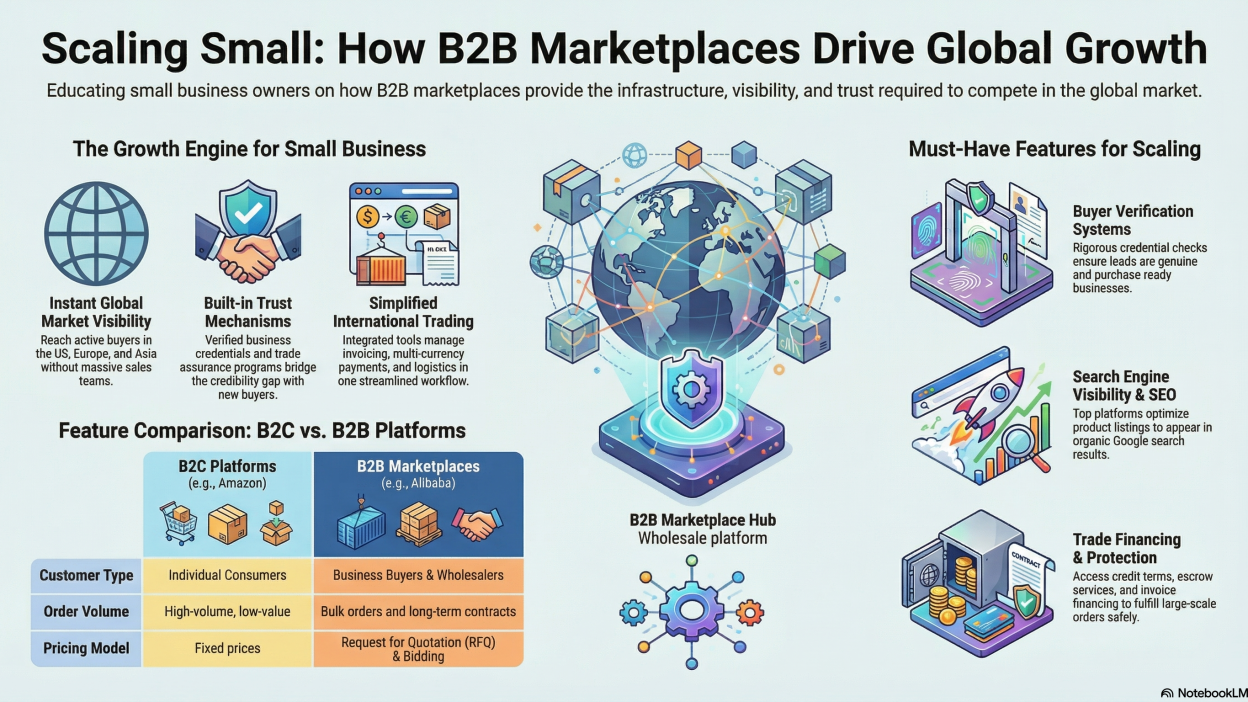
Understanding the distinction between B2B and B2C platforms is critical. B2C platforms like Amazon or Flipkart are designed for high-volume, low-value transactions with individual customers. A business to business marketplace, by contrast, is built for bulk orders, long-term supplier relationships, contract negotiations, and multi-stakeholder purchasing decisions.
This structural difference means that B2B platforms offer features specifically valuable to small businesses, including:
- Request for Quotation (RFQ) tools to invite competitive bids
- Verified buyer and seller credentials for trust-building
- Trade assurance and payment protection programs
- Industry-specific categorization for precise lead generation
- Multi-currency and multi-language support for international deals
How B2B Marketplaces Provide Small Business Support
Small businesses often operate with limited resources. They may have excellent products but struggle with visibility, distribution, or access to international networks. This is precisely where small business support through a B2B marketplace becomes a game-changer.
1. Increased Market Visibility at Lower Cost
Traditional marketing for B2B businesses requires substantial investment in sales teams, trade exhibitions, and cold outreach campaigns. A global B2B marketplace dramatically reduces this cost by providing a pre-built ecosystem of active buyers already searching for suppliers.
When a small business creates a profile on a reputable B2B platform, it instantly gains access to a global audience. Buyers from the United States, Europe, Southeast Asia, and the Middle East can discover your offerings through keyword-based searches, category listings, and recommendation algorithms.
This visibility, which would previously require months of effort and thousands of dollars, becomes accessible almost immediately.
2. Access to the Global B2B Market
One of the most transformative aspects of B2B marketplaces is their ability to connect small businesses with the global B2B market. Before the proliferation of digital trade platforms, international expansion was largely the domain of large corporations with established distribution channels and legal teams.
Today, a small textile manufacturer in India, a boutique electronics assembler in Vietnam, or a specialty food producer in Italy can participate in global trade through a single digital storefront. B2B marketplaces provide the infrastructure — payment systems, logistics integrations, compliance tools, and trade financing — that makes cross-border business manageable even for a team of ten people.
This democratization of international trade is one of the most significant contributions of b2b marketplaces to the modern economy.
3. Trust and Credibility Building
A persistent challenge for small businesses entering new markets is establishing credibility with unfamiliar buyers. Buyers are naturally cautious about sending large purchase orders to suppliers they have never worked with before.
B2B marketplaces solve this problem through structured trust mechanisms. These typically include:
- Verified business credentials: Platform-verified business registration and export licenses
- Customer reviews and ratings: Transparent feedback from previous buyers
- Trade assurance programs: Financial protection in case of supplier non-delivery or quality disputes
- Response rate tracking: Metrics that show how quickly and consistently a seller communicates
For small businesses grow strategies, nothing accelerates trust-building like a strong track record on a reputable marketplace. Buyers from across the world can evaluate your business based on objective data rather than assumptions.
4. Simplified B2B Trading Processes
Managing international B2B trading manually is complex. Negotiations, invoicing, shipping arrangements, customs documentation, and currency conversions are all part of the process. Doing this without a system is both time-consuming and error-prone.
Modern B2B marketplaces streamline this entire workflow. Integrated tools for communication, order management, invoicing, and logistics allow small businesses to manage deals efficiently without building separate operational infrastructure.
Some platforms even offer escrow services, where payment is held securely until the buyer confirms product delivery and quality. This reduces risk on both sides and makes it easier for small businesses to close deals with new partners they have not worked with previously.
Top Features to Look for in a Platform for Small Businesses
Not all B2B marketplaces are created equal. When selecting a platform for small businesses, it is important to evaluate features that align with your specific growth goals and industry.
Search Engine Visibility and SEO Tools
The best platforms invest heavily in their own search engine optimization, ensuring that product listings rank well on Google and other search engines. This means your products could appear in organic search results without any additional advertising spend. Look for platforms that allow rich product descriptions, custom metadata, and keyword-rich category tags.
Analytics and Performance Dashboards
Data-driven decision-making is critical for growth. A good B2B marketplace should offer dashboards that show how many buyers viewed your listing, which products attracted the most inquiries, and where your traffic is coming from geographically. These insights help small businesses refine their product offerings and target the right markets.
Buyer Verification Systems
Trust is the currency of B2B commerce. Choose a platform that rigorously verifies buyer credentials before allowing them to contact suppliers. This reduces spam inquiries and ensures that the leads you receive are from genuine, purchase-ready businesses.
Multilingual and Multi-Currency Support
If you are targeting the global B2B marketplace, your platform must support multiple languages and currencies. This reduces friction for international buyers and signals that your business is prepared to engage globally.
Trade Financing and Payment Protection
Access to trade financing can be a lifeline for small businesses that need to fulfill large orders without immediate payment. Some B2B marketplaces offer or partner with financing providers to offer credit terms, letters of credit, and invoice financing. Payment protection programs further reduce risk for both buyers and sellers.
How Small Businesses Grow Through Global B2B Marketplace Platforms
The phrase “small businesses grow” is not just aspirational — it is a measurable outcome for thousands of companies that have embraced global B2B marketplace platforms strategically.
Expanding Product Reach Without Physical Expansion
A small business does not need a physical office in Germany to sell to German buyers. A well-optimized marketplace listing, with localized content and competitive pricing, can generate inbound leads from international buyers around the clock. This allows small businesses to test new markets with minimal financial risk before committing to physical or operational expansion.
Building Long-Term Supplier-Buyer Relationships
Unlike one-time transactions on B2C platforms, B2B marketplace relationships often evolve into long-term partnerships. A buyer who places a small trial order may scale to regular bulk purchases if the quality and communication meet expectations. These repeat relationships form the foundation of stable, growing businesses.
Maintaining a professional, responsive profile on a B2B platform helps small businesses develop a reliable client base that reduces dependence on any single market or customer.
Competing With Larger Suppliers
On a level digital playing field, a small business with superior product quality, competitive pricing, and strong customer reviews can outperform larger competitors. The global B2B market rewards relevance and trust — not just company size. A small business that consistently delivers value will naturally rise in platform rankings and attract more buyers over time.
Choosing the Right Business to Business Marketplace
With dozens of B2B marketplaces operating globally, choosing the right one is an important strategic decision. The best choice depends on your industry, target geography, product type, and growth goals.
Global Platforms With Broad Reach
Platforms such as Vyaaparone, Alibaba, Global Sources, and ThomasNet serve millions of buyers and sellers across virtually every product category. These platforms are effective for small businesses targeting buyers in the United States, Europe, and Asia. Their massive user bases increase your chances of being discovered by relevant buyers.
Industry-Specific Marketplaces
Some businesses benefit more from niche or industry-specific platforms. There are dedicated marketplaces for sectors including healthcare, agriculture, automotive parts, textiles, chemicals, and more. These platforms attract highly targeted buyers and often result in better quality leads and higher conversion rates.
Regional Platforms for Emerging Markets
If your target market is in Africa, Southeast Asia, Latin America, or the Middle East, regional b2b marketplaces may offer better penetration. Platforms like Tradeling (Middle East), Jumia Business (Africa), and IndiaMART (India) are designed with local business cultures, payment preferences, and regulatory environments in mind.
Common Challenges and How to Overcome Them
Even with excellent small business support from B2B platforms, there are challenges that small businesses must navigate proactively.
Standing Out Among Thousands of Listings
Large B2B marketplaces host hundreds of thousands of product listings. To be discovered, small businesses must invest in optimizing their profiles. This includes using high-quality product images, detailed specifications, competitive pricing, and keyword-rich descriptions. Paid visibility options like sponsored listings can also provide a short-term boost while organic credibility builds.
Managing Response Time and Communication
Buyers on B2B platforms frequently evaluate sellers based on response time. Failing to reply promptly to inquiries signals unreliability and results in lost business. Small businesses should designate a team member or set up automated responses to ensure inquiries are acknowledged within hours, not days.
Navigating International Trade Regulations
B2B trading across borders involves customs regulations, export documentation, and compliance requirements that vary by country. Small businesses should familiarize themselves with the regulations applicable to their target markets and, where necessary, work with licensed freight forwarders or trade compliance consultants.
The Future of B2B Marketplaces and Small Business Growth
The global B2B market is undergoing rapid transformation, driven by artificial intelligence, automation, and the growing expectation of seamless digital experiences. For small businesses, this evolution brings even greater opportunity.
AI-powered matching algorithms now help connect buyers with the most relevant suppliers faster than ever before. Predictive analytics tools help sellers understand demand trends and adjust their offerings accordingly. Blockchain-based verification systems are making trade documentation faster and more reliable.
As these technologies mature, b2b marketplaces will become even more effective as growth engines for small businesses. The barriers to entry in international trade will continue to fall, and the quality of small business support offered by platforms will continue to improve.
Small businesses that establish their presence on these platforms today are building the digital infrastructure for sustainable global growth in the years ahead.
Conclusion
The rise of the global B2B marketplace is one of the most democratizing forces in modern commerce. For small businesses, these platforms offer a powerful combination of visibility, credibility, and operational tools that would have been unimaginable a generation ago.
Whether you are looking to expand into new international markets, find reliable buyers for your products, or streamline your B2B trading operations, a well-chosen business to business marketplace can accelerate every dimension of your growth.
The global B2B market is open. The platforms are accessible. The only question is whether your small business is ready to take its place in it.
Start by listing on a reputable platform for small businesses, optimize your profile with quality content, and engage consistently with incoming inquiries. Growth, in today’s connected world, is closer than you think.
Frequently Asked Questions
What is a B2B marketplace?
A B2B marketplace is a digital platform where businesses buy and sell products or services to other businesses. Unlike B2C platforms, these are designed for bulk orders, supplier relationships, and professional trade. Examples include Vyaaparone, Alibaba, Global Sources, and ThomasNet.
How do B2B marketplaces help small businesses grow?
B2B marketplaces provide small businesses with global visibility, verified buyer access, trust-building tools, and simplified trade processes — all without requiring large sales teams or expensive marketing budgets. They are among the most cost-effective channels for international growth.
What should I look for in a platform for small businesses?
Look for platforms that offer buyer verification, multilingual support, trade assurance programs, strong SEO visibility, and performance analytics for. Industry-specific platforms may also offer better-quality leads for niche products.
Is B2B trading on global platforms safe for small businesses?
Yes, when using reputable platforms with trade assurance programs, payment protection, and verified buyer systems. Always review buyer credentials, use platform-provided communication tools, and consider trade financing options for large orders.
Which global B2B marketplace is best for small businesses?
The best platform depends on your product type, target geography, and budget. Vyaaparone is ideal for global reach, Alibaba is ideal for broad global reach, IndiaMART for the Indian market, Tradeling for the Middle East, and industry-specific platforms for niche sectors. Many businesses list on multiple platforms simultaneously.