Introduction
Running a small business in today’s competitive market is no easy task. Finding reliable suppliers, reaching new buyers, and keeping operational costs low are daily challenges that can make or break a growing company. That’s exactly where b2b marketplaces come in.
B2B marketplaces are digital platforms that connect businesses with other businesses — allowing small companies to buy, sell, and collaborate at a scale that was previously only possible for large enterprises. Whether you’re a manufacturer looking for distributors or a retailer sourcing products in bulk, these platforms open doors that were once firmly shut for small business owners.
In this guide, you’ll discover how the best online B2B marketplace platforms work, which global B2B marketplaces are worth your attention, and how ecommerce platforms for small businesses can transform the way you grow.
What Is a B2B Marketplace and Why Does It Matter for Small Businesses?
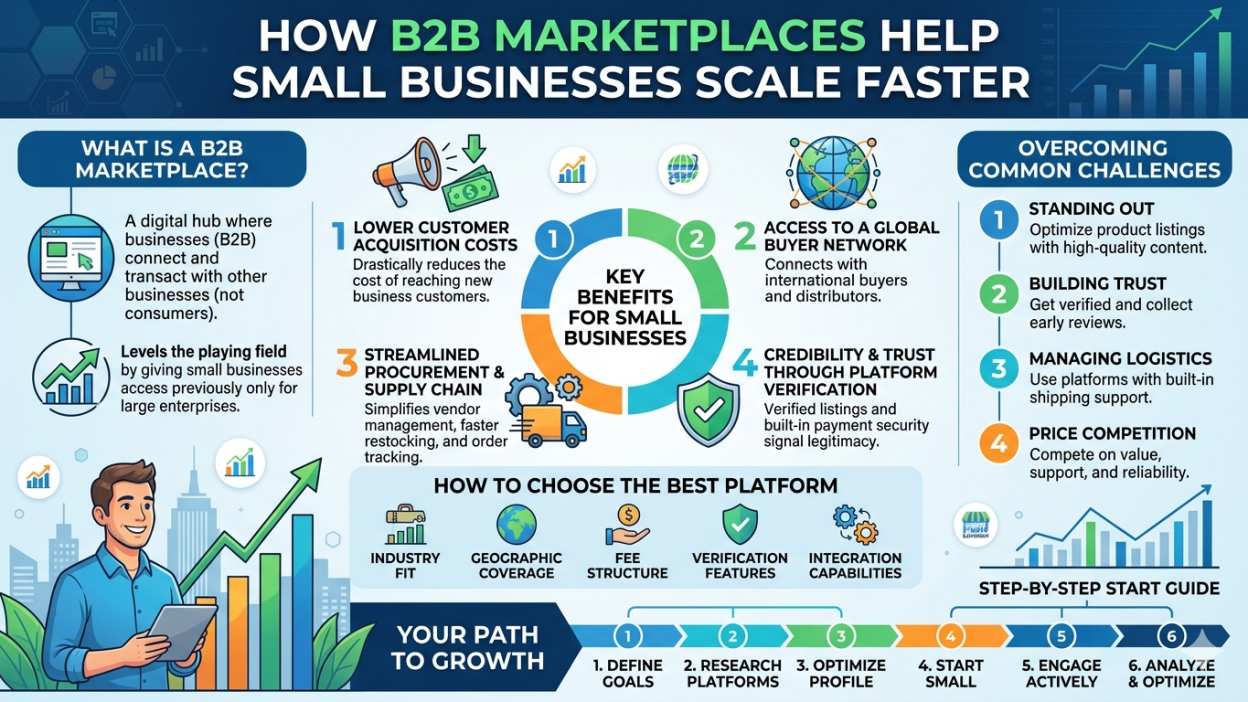
A b2b online marketplace is a digital hub where businesses transact with each other — not with individual consumers. Think of it as a wholesale trading floor that operates 24/7, accessible from anywhere in the world.
For small businesses, this distinction is crucial. Traditional B2B trade relied on personal relationships, trade shows, and phone calls. These channels favor large companies with bigger budgets and wider networks. B2B marketplaces level the playing field by giving small businesses:
- Instant access to verified buyers and sellers without expensive outreach
- Transparent pricing that eliminates unfair negotiation disadvantages
- Digital storefronts that replace the need for a large sales team
- Global reach that was previously unaffordable for small players
In short, a b2b marketplace puts small businesses in the same room as international buyers and top-tier suppliers — on equal footing.
The Key Benefits of B2B Marketplaces for Small Businesses
1. Lower Customer Acquisition Costs
Finding new business customers is expensive. Traditional marketing, trade shows, and cold outreach can drain a small business’s limited budget. The best online b2b marketplace platforms already attract millions of active buyers searching for products and services like yours.
By listing your business on an established b2b marketplace, you tap into an existing audience — drastically reducing the cost and effort of customer acquisition.
2. Access to a Global Buyer Network
One of the most powerful advantages of a global b2b marketplace is geographic reach. A small textile manufacturer in India can connect with a clothing brand in Germany. A specialty food producer in Mexico can find distributors across Southeast Asia.
This kind of cross-border trade used to require international sales teams, local agents, and months of relationship-building. Today, a well-optimized profile on a global B2B marketplace can generate international inquiries within days.
3. Streamlined Procurement and Supply Chain
On the buying side, small businesses benefit enormously from simplified procurement. Instead of managing multiple vendor relationships through phone calls and spreadsheets, the best ecommerce platform for small business procurement lets you:
- Compare suppliers side by side
- Request bulk quotes instantly
- Track orders from a single dashboard
- Access verified supplier ratings and reviews
This efficiency means faster restocking, fewer supply chain disruptions, and better cash flow management.
4. Credibility and Trust Through Platform Verification
Trust is the cornerstone of B2B transactions. Buyers won’t place large orders with unknown suppliers, and sellers won’t ship goods without payment confidence. The top b2b portals in the world solve this with built-in verification systems, escrow services, and buyer/seller ratings.
For a small business, being listed and verified on a reputable B2B portal instantly signals legitimacy to potential partners — something that would otherwise take years of reputation-building to achieve.
5. Data-Driven Business Decisions
Modern b2b marketplace platforms provide rich analytics dashboards. Small business owners can see which products attract the most inquiries, what price points resonate with buyers, and where their traffic is coming from geographically.
These insights empower smarter decisions around inventory, pricing, and marketing — all without hiring a data analyst.
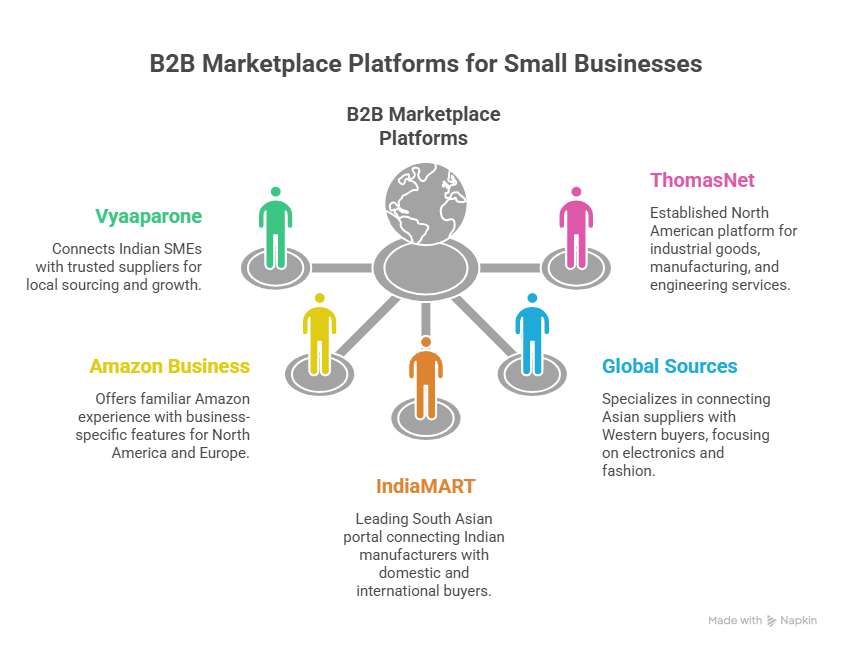
Best Online B2B Marketplace Platforms for Small Businesses
Choosing the right best online b2b marketplace depends on your industry, target geography, and business model. Here’s an overview of the most effective platforms small businesses should consider.
Vyaaparone
Vyaaparone is an emerging B2B marketplace designed to connect small and medium businesses with trusted suppliers across India. It simplifies product sourcing by offering a curated network of wholesalers, manufacturers, and service providers, making it easier for businesses to find reliable partners and competitive pricing in one place. With a focus on accessibility and growth, Vyaaparone helps small businesses scale efficiently in a digital-first marketplace.
Best for: Local supplier discovery, SME growth, reliable B2B connections in India
Amazon Business
Amazon Business extends the familiar Amazon experience into the B2B world. It’s one of the most trusted ecommerce platforms for small businesses operating in North America and Europe. Features like business pricing, multi-user accounts, and tax-exempt purchasing make it highly practical for small B2B buyers.
Best for: Office supplies, tech hardware, recurring procurement needs
IndiaMART
IndiaMART is one of the leading b2b portals in the world with a strong presence in South Asia. It connects Indian manufacturers, traders, and exporters with domestic and international buyers. With millions of product listings across hundreds of categories, it’s an excellent starting point for small businesses sourcing from India.
Best for: South Asian sourcing, manufacturing, trade services
Global Sources
Global Sources is a Hong Kong-based global b2b marketplace that specializes in connecting Asian suppliers with Western buyers. It focuses heavily on electronics, fashion, and hardware — industries where quality verification and supplier reliability are critical.
Best for: Electronics sourcing, fashion wholesale, trade shows
ThomasNet
ThomasNet is one of the most established b2b online marketplace platforms in North America, specializing in industrial goods, manufacturing, and engineering services. If your small business operates in manufacturing or needs industrial components, ThomasNet connects you directly with verified U.S. and Canadian suppliers.
Best for: Industrial procurement, manufacturing partnerships, engineering services
How to Choose the Best Ecommerce Platform for Small Business B2B Needs
Not every platform suits every business. When evaluating ecommerce platforms for small businesses, consider these five factors:
Industry Fit
Some platforms specialize in specific sectors. An agricultural business would find better opportunities on niche B2B portals than on a general marketplace. Always check whether your product category has significant representation on the platform.
Geographic Coverage
If you’re targeting domestic buyers, a local B2B portal may outperform a global one. If international expansion is your goal, a global b2b marketplace with strong cross-border logistics support is essential.
Fee Structure
Platforms charge differently — some use subscription models, others take transaction commissions. Understand the total cost of selling or sourcing on each platform before committing.
Verification and Trust Features
Look for platforms with supplier verification, trade assurance programs, and dispute resolution services. These protections are especially important for small businesses that can’t absorb financial losses from fraudulent transactions.
Integration Capabilities
The best ecommerce platform for small business operations will integrate with your existing inventory management, accounting, and CRM tools. Seamless integration saves time and reduces human error.
Common Challenges Small Businesses Face on B2B Marketplaces (And How to Overcome Them)
Challenge 1: Standing Out Among Thousands of Listings
Solution: Invest time in your product listings. Use high-quality images, detailed descriptions, competitive pricing, and respond quickly to inquiries. Platforms reward active, responsive sellers with higher visibility.
Challenge 2: Building Trust Without a Track Record
Solution: Start by completing all platform verification steps, collecting early reviews, and offering sample orders or smaller minimum order quantities. Trust is built incrementally — every positive transaction strengthens your profile.
Challenge 3: Managing International Logistics
Solution: Partner with experienced freight forwarders and use platforms that offer built-in logistics support. Many top b2b portals in the world have integrated shipping and customs assistance features that simplify cross-border trade.
Challenge 4: Price Competition from Larger Suppliers
Solution: Compete on value, not just price. Emphasize faster delivery times, better customer support, customization options, and reliability — advantages that large, volume-focused suppliers often can’t match.
The Future of B2B Marketplaces and Small Business Growth
The evolution of b2b marketplaces is accelerating. Artificial intelligence is transforming how buyers discover suppliers, with smart recommendation engines matching businesses based on purchase history, geography, and quality requirements. Blockchain technology is being integrated into the top b2b marketplace in the world platforms to enhance contract transparency and payment security.
For small businesses, these advancements mean even lower barriers to global trade. The automation of procurement, logistics, and compliance documentation will further reduce the operational complexity that has historically disadvantaged smaller players.
Sustainability is also emerging as a key differentiator. B2B buyers are increasingly prioritizing suppliers with verifiable ethical sourcing practices and environmental certifications. Small businesses that position themselves around sustainability on global B2B marketplaces will have a growing competitive advantage.
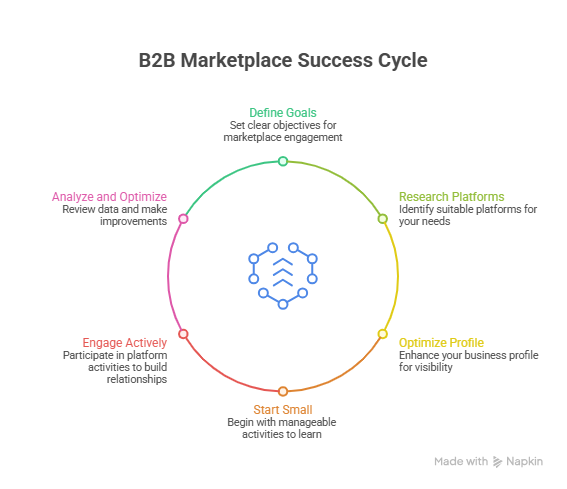
How to Get Started on a B2B Marketplace: A Step-by-Step Guide
Getting your small business active on the best online b2b marketplace doesn’t have to be complicated. Here’s a practical starting framework:
Step 1: Define Your Goals Are you buying, selling, or both? What geographies matter most? What’s your monthly budget for platform fees?
Step 2: Research and Shortlist Platforms Based on your industry and goals, identify two or three platforms that align with your needs. Register for free trials where available.
Step 3: Optimize Your Profile Complete every section of your business profile. Add certifications, high-quality visuals, and a clear value proposition. Treat it like your most important marketing asset.
Step 4: Start Small Begin with a manageable number of product listings or supplier relationships. Focus on learning the platform’s mechanics before scaling.
Step 5: Engage Actively Respond to inquiries within hours. Request and leave reviews. Participate in platform promotions and trade fairs. The most successful businesses on any b2b online marketplace are the most active ones.
Step 6: Analyze and Optimize Review your platform analytics monthly. Identify what’s working and double down on it. Adjust pricing, update listings, and expand into new categories based on demand signals.
Frequently Asked Questions
What is a B2B marketplace?
A B2B marketplace is an online platform that facilitates trade between businesses. Unlike B2C platforms that sell to individual consumers, B2B marketplaces enable wholesale buying and selling, bulk procurement, and business-to-business partnerships at scale.
Which is the best online B2B marketplace for small businesses?
The best platform depends on your industry and goals. Alibaba is ideal for global product sourcing, Amazon Business suits domestic procurement, IndiaMART is strong for South Asian trade, and ThomasNet leads in North American industrial sourcing. Evaluate each based on your specific needs.
Are B2B marketplaces free to use?
Most B2B marketplaces offer free basic memberships with paid upgrades for premium features like verified badges, higher listing visibility, and analytics access. Transaction fees may also apply depending on the platform.
How do B2B marketplaces protect small businesses from fraud?
Reputable platforms use supplier verification, trade assurance programs, escrow payment systems, and buyer/seller ratings to minimize fraud risk. Always use platforms with strong trust and verification infrastructure.
Can small businesses compete with large companies on B2B marketplaces?
Yes. B2B marketplaces equalize access to buyers and suppliers. Small businesses can compete effectively by focusing on responsiveness, customization, niche expertise, and superior customer service — areas where large companies often fall short.
What is the difference between a B2B marketplace and a B2B portal?
The terms are often used interchangeably. Generally, a B2B marketplace emphasizes transactional features (buying/selling), while a B2B portal may also include directories, industry news, and networking tools. The top b2b portals in world typically offer a combination of both.