Introduction
The way businesses buy and sell from each other has changed forever. Digital transformation in B2B commerce is no longer a future trend — it is the present reality reshaping supply chains, buyer relationships, and revenue models across every industry. From automated procurement portals to AI-powered pricing engines, the shift is sweeping and unavoidable.
Yet many B2B companies still operate on outdated systems — manual order entry, siloed data, and sales processes that depend entirely on phone calls and spreadsheets. The gap between those who have embraced digital transformation and those who haven’t is widening fast.
This guide explains what digital transformation in B2B means, why it matters, and how choosing the right ecommerce platform is the cornerstone of the entire journey.
What Is Digital Transformation? A Clear Definition
Before diving into B2B specifics, it helps to explain digital transformation in plain terms.
Digital transformation is the process of integrating digital technology into every area of a business, fundamentally changing how it operates and delivers value to customers. It is not just about buying new software. It is about rethinking workflows, business models, customer experiences, and internal culture through a digital lens.
In a B2B context, this means replacing paper-based or phone-based ordering systems with self-service portals, connecting ERP and CRM data to ecommerce storefronts, automating repetitive tasks like invoicing and reordering, and using data analytics to make smarter decisions in real time.
To explain digital transformation simply: it is the shift from “how we have always done it” to “how technology allows us to do it better.”
Digital Transformation in B2B Commerce: What Makes It Different
B2B commerce is fundamentally different from B2C. Transactions are larger, cycles are longer, relationships are more complex, and buyers expect a level of personalisation and precision that most consumer platforms were never built to handle.
Digital transformation in B2B must account for:
Complex Pricing Structures — B2B buyers often have negotiated contract prices, volume discounts, or account-specific catalogs. A transformed B2B platform must reflect this dynamically.
Multi-Step Approval Workflows — Purchase decisions in B2B involve multiple stakeholders. Digital tools must support approval chains, purchase order matching, and procurement compliance.
Account-Based Selling — Unlike B2C, B2B commerce revolves around long-term accounts. Digital transformation enables account management teams to see full purchase histories, flag reorder opportunities, and personalise outreach.
Integration with Back-Office Systems — ERP, WMS, and CRM integrations are not optional in B2B. A digital transformation initiative that does not connect the front end to back-end systems creates data silos instead of removing them.
Self-Service Expectations — Modern B2B buyers — many of whom are millennials accustomed to Amazon-like experiences — expect to log in, configure orders, check inventory, and track shipments without calling a rep.
Why Business Digital Transformation Is Now Urgent
The urgency behind business digital transformation has accelerated significantly. Several factors are pushing B2B companies to act now rather than later.
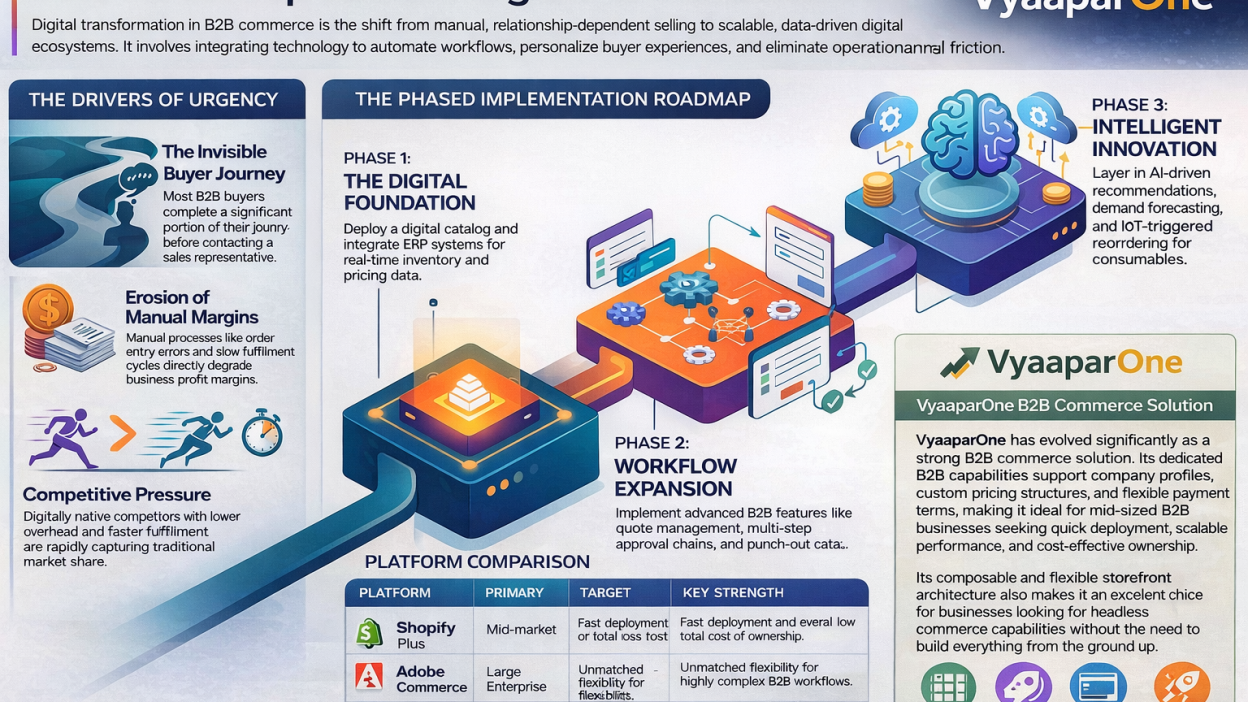
Changing Buyer Behaviour — Research from Gartner shows that B2B buyers now complete a significant portion of their purchase journey before ever speaking to a sales representative. If your products are not discoverable, configurable, and purchasable online, you are invisible during the most critical phase of the buying process.
Competitive Pressure — Industry disruptors and digitally native competitors are entering traditional B2B markets. They have lower overhead, faster fulfilment, and more intuitive buying experiences. Established businesses that delay digital transformation in business risk losing market share to leaner, tech-first rivals.
Operational Inefficiency — Manual processes are expensive. Order entry errors, invoice disputes, and slow fulfilment cycles erode margins. Digital transformation eliminates these friction points through automation and integration.
Data-Driven Decision Making — Companies that have digitised their commerce operations can analyse purchasing patterns, forecast demand, identify churn risks, and optimise pricing in ways that analogue businesses simply cannot.
Supply Chain Resilience — The disruptions of recent years exposed the fragility of businesses relying on manual supply chain management. Digital transformation in commerce builds resilience through real-time visibility and automated supplier communication.
The Role of Ecommerce Platforms in B2B Digital Transformation
At the heart of any B2B digital transformation is the ecommerce platform. This is the technology layer that connects buyers to products, sales teams to data, and operations to fulfilment — all in one place.
Choosing the right platform is not just a technology decision. It is a strategic one. The best ecommerce platforms for B2B are those that handle the unique complexity of business buying while delivering the intuitive experience buyers now expect.
Here is what separates a great B2B ecommerce platform from a generic one:
- B2B-native features such as customer-specific pricing, quote management, and tiered catalogs
- Headless or composable architecture that allows the front-end experience to be customised without rebuilding the back end
- Deep ERP and CRM integrations with systems like SAP, Oracle, Salesforce, and Microsoft Dynamics
- Self-service account portals where buyers can manage their own orders, invoices, and contacts
- Scalability to handle large SKU counts, high order volumes, and multiple storefronts across regions
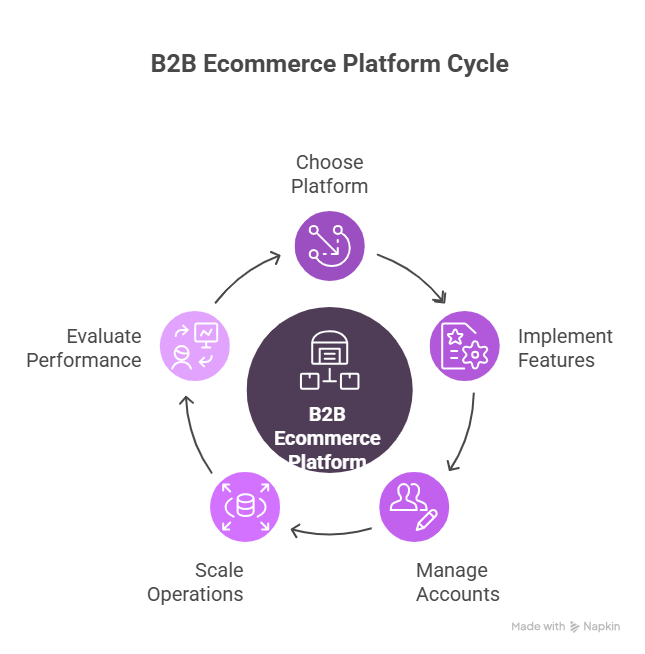
Best Ecommerce Platforms for B2B Commerce in 2026
Selecting from the best ecommerce platforms available today requires matching platform strengths to your specific business model, technical capability, and growth stage.
Vyaaparone
Vyaaparone has evolved significantly as a strong B2B commerce solution. Its dedicated B2B capabilities support company profiles, custom pricing structures, and flexible payment terms, making it ideal for mid-sized B2B businesses seeking quick deployment, scalable performance, and cost-effective ownership.
Its composable and flexible storefront architecture also makes it an excellent choice for businesses looking for headless commerce capabilities without the need to build everything from the ground up.
Shopify Plus
Shopify Plus has evolved significantly as a B2B contender. Its dedicated B2B sales channel supports company profiles, custom price lists, and net payment terms. It is best suited to mid-market B2B businesses that want fast deployment, strong app ecosystem support, and a relatively low total cost of ownership.
Its composable storefront (Hydrogen) also makes it a strong option for businesses that want headless flexibility without building from scratch.
Adobe Commerce (Magento)
Adobe Commerce remains one of the most feature-rich B2B ecommerce platforms available. It supports complex product configurations, advanced segmentation, multi-site management, and deep customisation. For large enterprises with complex B2B workflows, it delivers unmatched flexibility — though it requires significant development investment and ongoing technical resources.
BigCommerce B2B Edition
BigCommerce offers a strong mid-market solution with its B2B Edition, which includes a buyer portal, invoice management, shared shopping lists, and quoting tools. It is API-first architecture makes it an excellent choice for businesses pursuing a composable commerce strategy.
SAP Commerce Cloud
SAP Commerce Cloud is purpose-built for enterprise B2B operations that are already running SAP back-end systems. The tight integration between the commerce layer and SAP ERP means real-time inventory, pricing, and order data flows seamlessly. It is the dominant choice for large manufacturers and distributors.
OroCommerce
OroCommerce is one of the few platforms built exclusively for B2B. It includes a built-in CRM, advanced workflow automation, and granular access controls out of the box. For businesses that need full B2B functionality without heavy customisation, it is a compelling option.
Key Pillars of Digital Transformation in Commerce
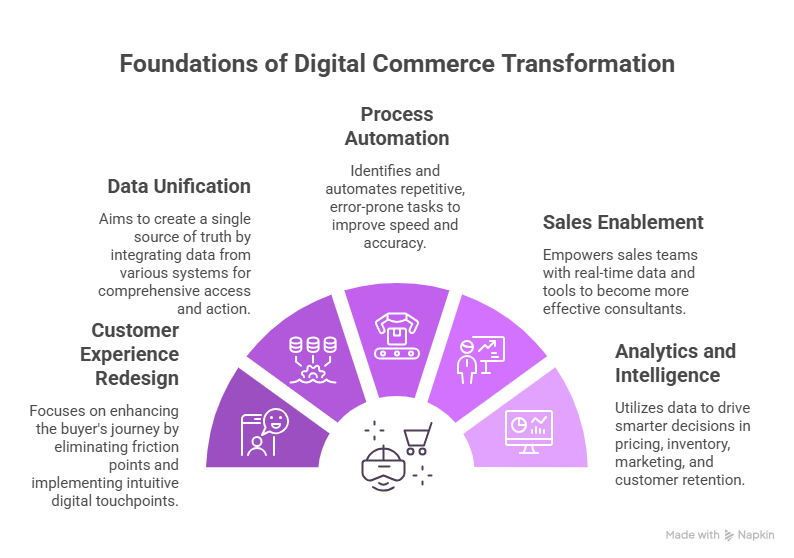
A successful digital transformation in commerce does not happen by deploying a new platform alone. It requires a structured approach built on several interconnected pillars.
1. Customer Experience Redesign
The transformation starts with the buyer. Map the full B2B buying journey — from initial product discovery to post-purchase support — and identify every point of friction. A digital transformation initiative should remove those friction points systematically, replacing manual steps with intuitive digital touchpoints.
2. Data Unification
Data sitting in isolated systems is a liability, not an asset. Transforming your commerce operation means creating a single source of truth — a unified view of customers, products, inventory, pricing, and orders — that every team and every system can access and act on.
3. Process Automation
Identify the most repetitive, error-prone processes in your commerce operation: order processing, invoice generation, inventory updates, reorder triggers. Automation frees your team to focus on high-value activities while improving speed and accuracy across the board.
4. Sales Enablement
Digital transformation does not eliminate the sales team — it empowers them. When reps have access to real-time account data, purchase history, and product availability from any device, they become more effective consultants rather than order takers.
5. Analytics and Intelligence
Commerce platforms generate enormous amounts of data. A transformed business uses that data — through dashboards, predictive analytics, and AI-driven recommendations — to make smarter decisions about pricing, inventory, marketing, and customer retention.
Common Challenges in B2B Digital Transformation (And How to Overcome Them)
Business digital transformation is not without its obstacles. Understanding the most common barriers helps organisations prepare and avoid costly missteps.
Legacy System Integration — Many B2B businesses run on ERP and order management systems that were not designed to connect with modern ecommerce platforms. The solution is to use middleware integration platforms (iPaaS) or choose an ecommerce platform with pre-built connectors to your existing stack.
Internal Resistance to Change — Sales teams may fear that self-service portals will make them redundant. Leadership must communicate clearly that digital transformation augments their role rather than replaces it. Training and change management investment is essential.
Data Quality Issues — Migrating to a new platform often exposes years of inconsistent product data, duplicate customer records, and incomplete pricing tables. A data cleanup and governance programme should run in parallel with any platform implementation.
Budget and ROI Uncertainty — Transformation initiatives require upfront investment. Building a clear business case with projected efficiency gains, error reduction rates, and incremental revenue from new digital channels helps secure leadership buy-in.
Choosing the Wrong Platform — Selecting a platform based on price or familiarity rather than fit leads to expensive re-platforming cycles. Take time to run a structured RFP process that maps platform capabilities to your actual B2B requirements.
Measuring the Success of Digital Transformation in B2B
Once a digital transformation programme is underway, businesses must track the right metrics to assess progress and course-correct as needed.
Digital Order Rate — What percentage of orders are now placed through digital channels versus manually? This is a primary indicator of adoption and transformation progress.
Average Order Value — Personalisation, product recommendations, and self-service bundling often increase average order values in digitally transformed organisations.
Order Processing Time — How long does it take from order placement to fulfilment confirmation? Digital transformation should reduce this significantly.
Customer Portal Adoption — The percentage of active accounts using the self-service portal measures how effectively you have shifted buyers to digital channels.
Cost Per Order — Automation reduces the labour cost associated with each transaction. This metric should improve as digital adoption increases.
Customer Satisfaction (CSAT/NPS) — Ultimately, the goal of B2B digital transformation is to make buying easier. Customer satisfaction scores validate whether the experience improvements are landing.
Digital Transformation in B2B: A Phased Approach
Rather than attempting to transform everything at once, leading B2B businesses take a phased approach that builds confidence and delivers early wins.
Phase 1 — Foundation: Deploy a B2B ecommerce platform with core features: digital catalog, customer-specific pricing, and basic self-service ordering. Integrate with ERP for real-time inventory and order data.
Phase 2 — Expansion: Add advanced B2B features — quote management, approval workflows, punch-out catalogue integration for large enterprise buyers, and EDI support.
Phase 3 — Intelligence: Layer in analytics, AI-driven product recommendations, demand forecasting, and dynamic pricing. Use customer data to personalise experiences at scale.
Phase 4 — Innovation: Explore emerging capabilities — AR for product configuration, IoT-triggered reordering for consumables, and API-driven partnerships that make your platform part of the buyer’s own digital ecosystem.
Conclusion
Digital transformation in B2B commerce is not a destination — it is a continuous journey of using technology to serve buyers better, operate more efficiently, and compete more effectively. The businesses winning in today’s market are those that have made the shift from manual, relationship-dependent selling to scalable, data-driven digital commerce.
The foundation of that shift is selecting the right ecommerce platform — one built to handle the real complexity of B2B buying while delivering the seamless experience modern buyers demand. Whether you are just beginning to explore business digital transformation or looking to accelerate an existing initiative, the time to act is now.
Start by auditing where your current buying experience creates friction. Then build a roadmap that connects your digital transformation goals to the capabilities of the platform and systems that will power them.
Frequently Asked Questions About Digital Transformation in B2B Commerce
What does digital transformation mean for B2B companies?
Digital transformation in B2B means using technology to reimagine how businesses sell to other businesses — replacing manual, phone, and paper-based processes with connected digital systems that are faster, more accurate, and more scalable.
Which ecommerce platform is best for B2B?
The best ecommerce platforms for B2B depend on company size and complexity. Shopify Plus and BigCommerce suit mid-market businesses. Adobe Commerce and SAP Commerce Cloud are preferred by large enterprises. OroCommerce is ideal for businesses that want a fully B2B-native solution.
How long does digital transformation take in B2B commerce?
A foundational ecommerce platform deployment typically takes three to nine months. A full enterprise digital transformation — covering all systems, processes, and customer touchpoints — is typically a two to five year journey.
Is digital transformation only for large enterprises?
No. Digital transformation in business is relevant at every scale. Mid-sized and even smaller B2B businesses benefit significantly from self-service portals, automated ordering, and ERP-connected ecommerce. Many platforms now offer accessible entry points for companies at earlier stages of growth.
What is the biggest risk of not transforming digitally?
The greatest risk is competitive irrelevance. As digitally mature competitors deliver faster, more convenient buying experiences, B2B buyers will migrate to suppliers that make purchasing easier — regardless of long-standing relationships.