
Introduction
Every supplier knows the pain of a thin pipeline. Orders slow down, outreach goes cold, and the question becomes urgent: where do the next buyers come from? The answer, increasingly, is B2B platforms — digital marketplaces and ecosystems purpose-built to connect suppliers with business buyers at scale.
But understanding B2B lead generation techniques goes beyond simply listing your products on a platform and waiting. Today’s competitive landscape demands a clear grasp of lead generation methodology, the difference between prospects vs leads, and what separates a casual inquiry from a truly qualified lead that converts.
This guide breaks down exactly how leading B2B platforms generate leads for suppliers — from foundational concepts to advanced tactics — so you can build a predictable, high-quality pipeline.
What Is a Lead in Business? Laying the Foundation
Before diving into techniques, it helps to answer the most basic question: what is a lead in business?
A lead is any individual or company that has expressed some level of interest in your product or service. That interest can be as simple as downloading a catalog, submitting a contact form, or clicking on a pricing page. The key distinction is that a lead has moved beyond being a complete stranger — there is a signal, however faint, of potential intent.
On a B2B platform, leads typically appear as:
- Inquiry messages from buyers asking about specifications or pricing
- RFQ submissions (Request for Quotation) targeting your product category
- Profile views from registered buyers actively sourcing products
- Sample requests or product brochure downloads
Understanding what constitutes a lead in your context shapes every subsequent step of your lead generation methodology. Without this clarity, suppliers often waste resources chasing contacts that were never genuinely interested.
Prospects vs Leads: Why the Distinction Matters for Suppliers
Many suppliers use the terms interchangeably, but prospects vs leads represent meaningfully different stages in the buyer journey — and treating them the same way costs you deals.
What Is a Prospect?
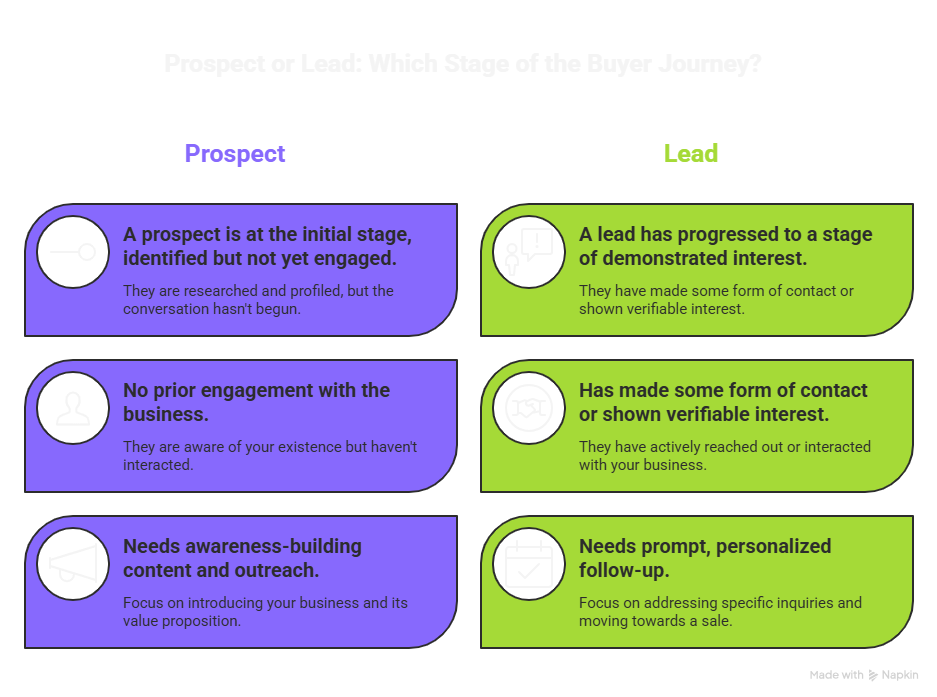
A prospect is a potential buyer who fits your ideal customer profile but has not yet engaged with your business. They are researched, identified, and profiled — but the conversation has not started. Think of a procurement manager at a manufacturing company in your target market. They are a prospect. You know they exist and likely need what you sell, but they have not raised their hand.
What Is a Lead?
A lead, by contrast, has already made some form of contact or shown verifiable interest. On a B2B platform, the moment a buyer sends you an inquiry or requests a quote, they transition from prospect to lead.
Why does this matter?
Because your response time, messaging, and nurturing strategy should differ dramatically based on where a contact sits. Prospects need awareness-building content and outreach. Leads need prompt, personalized follow-up. Conflating the two stages leads to misaligned communication that kills conversion rates.
What Is a Qualified Lead — and Why Most Suppliers Ignore This Step
Generating leads is only half the battle. The real competitive advantage comes from identifying what is a qualified lead early — and focusing your resources accordingly.
A qualified lead is one that meets specific criteria indicating a reasonable probability of becoming a paying customer. In B2B contexts, qualification typically falls into two categories:
Marketing Qualified Lead (MQL)
An MQL has engaged with your content or platform presence at a level that suggests genuine interest. They have viewed multiple product listings, downloaded your profile, or interacted with your catalog more than once. They are not yet sales-ready, but they are warm.
Sales Qualified Lead (SQL)
An SQL has demonstrated clear buying intent. They have submitted a detailed RFQ, asked about minimum order quantities, requested a sample, or initiated a pricing conversation. These are the leads your sales team should prioritize immediately.
B2B platforms generate both types through structured engagement flows — but the most sophisticated platforms help suppliers distinguish between the two automatically, using behavioral data and buyer verification systems.
Core B2B Lead Generation Techniques Used by Platforms
Now let us look at the actual B2B lead generation techniques that top platforms deploy to fill supplier pipelines.
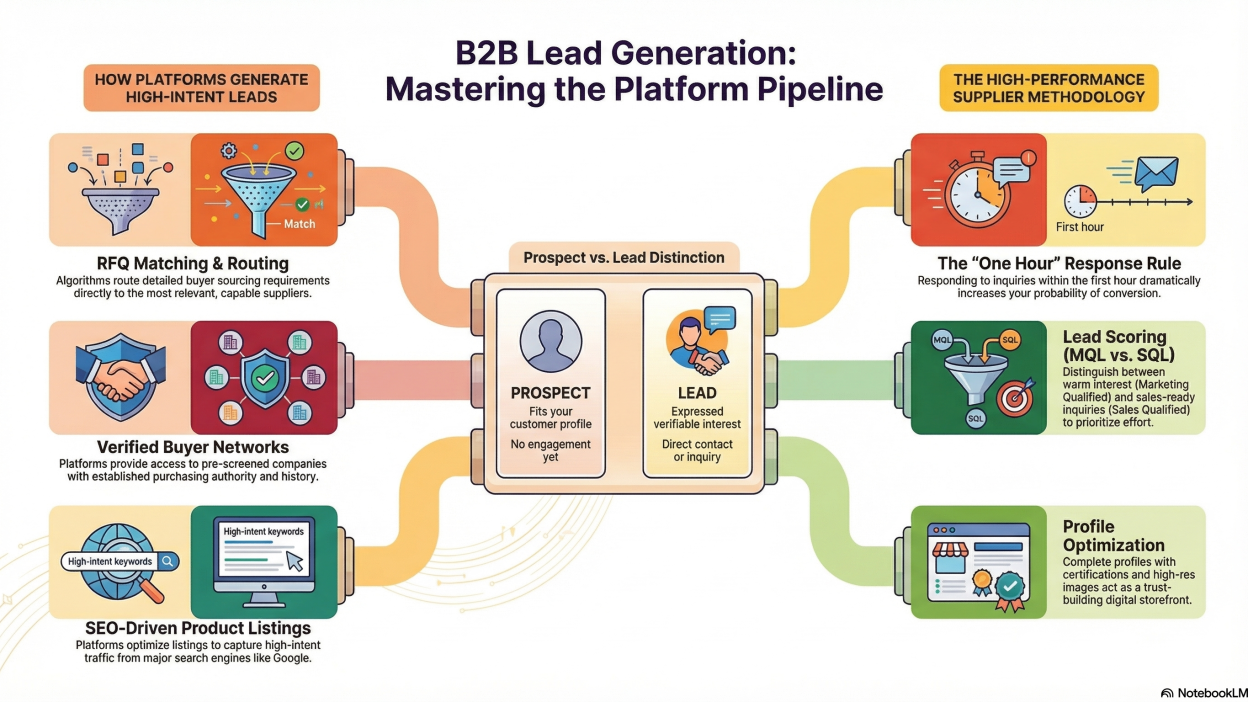
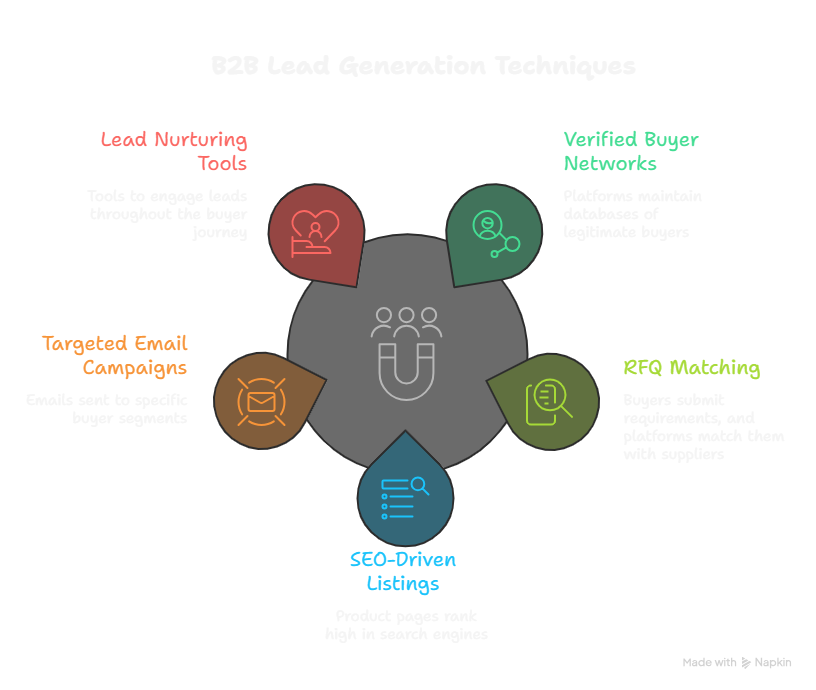
1. Verified Buyer Networks
The most fundamental technique is curation. Leading platforms like Alibaba, IndiaMART, TradeIndia, and ExportersIndia maintain databases of verified business buyers — companies that have been screened for legitimacy, purchasing authority, and sourcing activity.
When a supplier lists on such a platform, their products become visible to this pre-qualified network. This is one of the most powerful sources of leads because the intent is already present — buyers are on the platform actively looking.
2. RFQ (Request for Quotation) Matching
RFQ matching is arguably the highest-intent lead generation method available to suppliers. Buyers submit detailed sourcing requirements, and the platform’s algorithm routes these RFQs to the most relevant suppliers.
For suppliers, receiving an RFQ means the buyer has already defined:
- What they want
- How much they need
- Their timeline
This is a near-perfect example of a qualified lead delivered directly to your inbox. Platforms that offer RFQ matching — and allow suppliers to respond quickly — generate some of the strongest conversion rates in B2B commerce.
3. SEO-Driven Product Listings
B2B platforms invest heavily in search engine optimization to ensure their product pages rank on Google and Bing for commercial keywords. When a procurement officer types “industrial hydraulic pumps supplier India” into a search engine, a well-optimized platform listing appears.
The traffic this generates becomes a critical source of leads for suppliers. Unlike paid ads, organic search traffic delivers consistent, high-intent visitors at no incremental cost to the supplier. This is passive lead generation at scale — and it compounds over time.
4. Targeted Email Campaigns to Buyer Segments
Many B2B platforms run segmented email campaigns on behalf of suppliers or categories, targeting registered buyers who have searched for related products. These campaigns surface supplier profiles, new product launches, and promotional offers directly to decision-makers.
This method falls under methods of lead generation that leverage platform-owned audience data — something individual suppliers cannot replicate on their own.
5. Lead Nurturing Through Buyer Engagement Tools
Modern platforms offer messaging tools, inquiry management dashboards, and auto-response features that help suppliers stay engaged with leads across the buyer journey. Timely, relevant communication is essential because B2B buying cycles are long and involve multiple stakeholders.
Platforms that provide automated follow-up prompts or CRM integrations make it easier for suppliers to move leads from initial inquiry through to closed order.
Lead Generation Methodology: The Systematic Approach
Individual tactics only work when embedded in a coherent lead generation methodology. Here is the framework that high-performing suppliers use on B2B platforms:
Step 1: Profile Optimization
Your platform profile is your storefront. Suppliers with complete profiles — high-resolution product images, detailed specifications, certifications, response rate badges, and verified business credentials — attract significantly more inquiries. Optimization is the foundation of any lead generation methodology.
Step 2: Category and Keyword Targeting
B2B platforms use internal search algorithms. Suppliers who map their listings to the right product categories and use the language buyers actually search for — not just internal jargon — show up more frequently in relevant results.
Step 3: Rapid Lead Response
Studies consistently show that responding to an inquiry within the first hour dramatically increases conversion probability. Many platforms track and display response time publicly — making speed a competitive differentiator and a quality signal for buyers.
Step 4: Lead Qualification and Scoring
Not every inquiry deserves equal attention. Suppliers should develop a simple scoring system — based on order volume, buyer location, company type, and message quality — to prioritize their follow-up. This is where understanding what is a qualified lead pays direct dividends.
Step 5: Nurture and Convert
For leads that are not yet ready to buy, nurturing matters. Share technical datasheets, case studies from similar buyers, or limited-time sampling offers. The goal is to stay visible and valuable until the buyer is ready to commit.
Sources of Leads on B2B Platforms: A Supplier’s Overview
Understanding your sources of leads allows you to allocate attention intelligently. On a B2B platform, leads typically come from:
- Organic search traffic — buyers finding your listings through Google or the platform’s internal search
- RFQ board responses — you proactively responding to buyer requirements
- Direct platform outreach — buyers browsing and messaging suppliers directly
- Paid promotion features — sponsored listings, banner ads, or featured supplier placements that increase visibility
- Platform newsletters and buyer alerts — the platform notifying registered buyers about relevant suppliers or new listings
- Trade show integrations — some platforms have physical event counterparts that drive digital follow-up inquiries
Diversifying across multiple lead sources reduces dependency on any single channel and creates a more resilient pipeline.
B2B Sales Leads: What Makes Them Different from B2C
It is worth pausing on what makes B2B sales leads fundamentally different from consumer leads — because the implications shape your entire approach.
In B2C, a lead is often a single decision-maker with a short consideration cycle and an emotional purchasing motivation. In B2B, a lead typically represents:
- Multiple stakeholders — procurement, finance, technical teams, and senior management may all be involved
- Longer sales cycles — weeks or months, not minutes
- Higher transaction values — meaning more due diligence and negotiation
- Relationship-driven decisions — trust, reliability, and track record carry enormous weight
B2B platforms address these dynamics by providing tools for verification, credibility signaling (certifications, reviews, audit reports), and sustained engagement — all of which support longer, more complex sales journeys.
Advanced Techniques: What the Best Platforms Do Differently
Not all B2B platforms are equal. The most effective ones for supplier lead generation share several advanced capabilities:
Buyer Intent Data
Top platforms analyze buyer behavior — search patterns, category browsing, repeat visits — to surface high-intent leads before a buyer even submits an inquiry. Suppliers with access to this data can proactively reach out at the right moment.
AI-Powered Matching
Increasingly, platforms use artificial intelligence to match buyer RFQs with the most relevant suppliers based on capacity, location, product fit, and historical response quality. This reduces wasted leads and improves conversion rates on both sides.
Verified Trade Data Integration
Some platforms integrate with customs and trade databases to surface companies that are actively importing or exporting in specific product categories. These contacts are among the highest-quality B2B sales leads available — because their purchasing behavior is a matter of record.
Lead Analytics Dashboards
The best platforms give suppliers visibility into where their leads come from, which product listings drive the most inquiries, and how their response performance compares to category benchmarks. This data closes the feedback loop and makes lead generation methodology continuously improvable.
Common Mistakes Suppliers Make with B2B Lead Generation
Even with access to strong platforms, suppliers often underperform due to avoidable errors:
Ignoring lead qualification — treating every inquiry identically regardless of quality wastes time and demoralizes sales teams.
Slow response times — buyers on B2B platforms often contact multiple suppliers simultaneously. The first credible response frequently wins.
Incomplete or generic profiles — a profile with no certifications, vague product descriptions, or stock photos signals low trustworthiness and drives buyers elsewhere.
No follow-up system — many inquiries do not convert on the first contact. Without a structured follow-up process, warm leads go cold unnecessarily.
Confusing prospects vs leads — sending sales-heavy messages to cold prospects before they have shown any interest is a fast way to generate opt-outs, not orders.
Conclusion
B2B platforms have fundamentally changed the economics of supplier lead generation. What once required expensive trade show attendance, cold calling campaigns, and relationship-building over years can now happen digitally — at scale, with measurable results, and with built-in qualification signals.
But technology is only the enabler. Understanding B2B lead generation techniques, distinguishing between prospects vs leads, knowing what is a qualified lead, and operating from a coherent lead generation methodology are the skills that separate high-performing suppliers from those perpetually chasing their next order.
Start by optimizing your platform presence, respond to every inquiry quickly, score and prioritize your leads systematically, and use the data your platform provides to sharpen your approach over time. The pipeline you build will be more predictable, more efficient, and — most importantly — more profitable.
Frequently Asked Questions
What is a lead in business?
A lead is any person or company that has expressed some level of interest in your product or service, typically by making contact or engaging with your content.
What is the difference between prospects vs leads?
A prospect is a potential buyer who fits your ideal customer profile but has not yet engaged with your business. A lead has already made contact or shown verifiable interest.
What is a qualified lead?
A qualified lead is one that meets specific criteria — budget, authority, need, and timeline — indicating a realistic probability of converting into a paying customer.
What are the main sources of leads on B2B platforms?
Primary sources include organic search traffic to listings, RFQ board responses, direct buyer outreach, sponsored placements, platform email campaigns, and trade event integrations.
What is lead generation methodology?
Lead generation methodology is the systematic process — from profile optimization and keyword targeting to lead scoring and nurturing — that suppliers use to attract, qualify, and convert business buyers consistently.
What makes B2B sales leads different from B2C leads?
B2B sales leads involve multiple stakeholders, longer decision cycles, higher transaction values, and stronger emphasis on trust and supplier credibility compared to consumer leads.