Introduction
The rise of the marketplace business model has completely transformed how businesses source products, find partners, and scale operations across borders. Gone are the days of cold calls and trade fairs as the primary means of business procurement. Today, a single digital platform can connect thousands of buyers and sellers in real time, across industries and continents.
Whether you are a manufacturer looking to expand distribution or a procurement manager hunting for the most reliable suppliers, understanding the marketplace business model is your first step toward smarter, faster business growth.
In this guide, we break down exactly how the B2B marketplace model works, what makes it profitable, and which platforms are leading the charge globally.
What Is a B2B Online Marketplace?
A marketplace business model is a digital platform where businesses buy and sell products or services to one another — not to individual consumers. Think of it as a large virtual trade hall where manufacturers, wholesalers, distributors, and retailers come together to conduct commerce at scale.
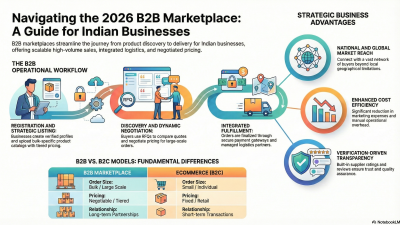
Unlike B2C (business-to-consumer) platforms, B2B marketplaces deal with bulk orders, longer sales cycles, contract-based pricing, and complex negotiations. The key value lies in aggregating supply and demand in one place, making it significantly easier for businesses to discover, evaluate, and transact with each other.
How Does It Differ from B2C?
| Feature | B2B Marketplace | B2C Marketplace |
| Buyer Type | Businesses | Individual consumers |
| Order Volume | Bulk / large orders | Single / small orders |
| Pricing | Negotiated / tiered | Fixed |
| Decision Cycle | Weeks to months | Minutes to days |
| Relationship | Long-term contracts | One-time or repeat |
The Core Marketplace Business Model: How Revenue Is Generated
The marketplace business model in B2B is fundamentally about creating a two-sided network — connecting buyers and sellers — and monetizing that connection. There are several proven revenue strategies that successful platforms use.
1. Commission-Based Model
The platform charges a percentage fee on every transaction completed between a buyer and seller. This model aligns platform success with user success — the more business users do, the more the platform earns. It is common among platforms with high transaction volumes.
2. Subscription/Membership Model
Sellers or buyers pay a recurring fee — monthly or annually — to access the marketplace’s features, leads, and tools. This provides predictable, stable revenue for the platform. Many of the best b2b portals use a tiered membership system offering different levels of visibility and access.
3. Listing Fees
Sellers pay to list their products or company profiles on the platform. This is often combined with a freemium model, where basic listings are free but premium placements come at a cost.
4. Lead Generation Model
The platform connects buyers with potential suppliers and charges for verified leads or quote requests. This model suits platforms focused on high-value, low-frequency transactions.
5. Value-Added Services
Beyond the core marketplace, platforms monetize through additional services such as:
- Escrow and payment processing
- Logistics and freight management
- Trade finance and credit solutions
- Verified supplier certifications
- Analytics and market intelligence
How the Global B2B Marketplace Has Evolved
The marketplace business model has seen explosive growth over the past decade, accelerated sharply by the COVID-19 pandemic which forced businesses to digitize procurement processes overnight. What was once a niche concept is now a trillion-dollar ecosystem.
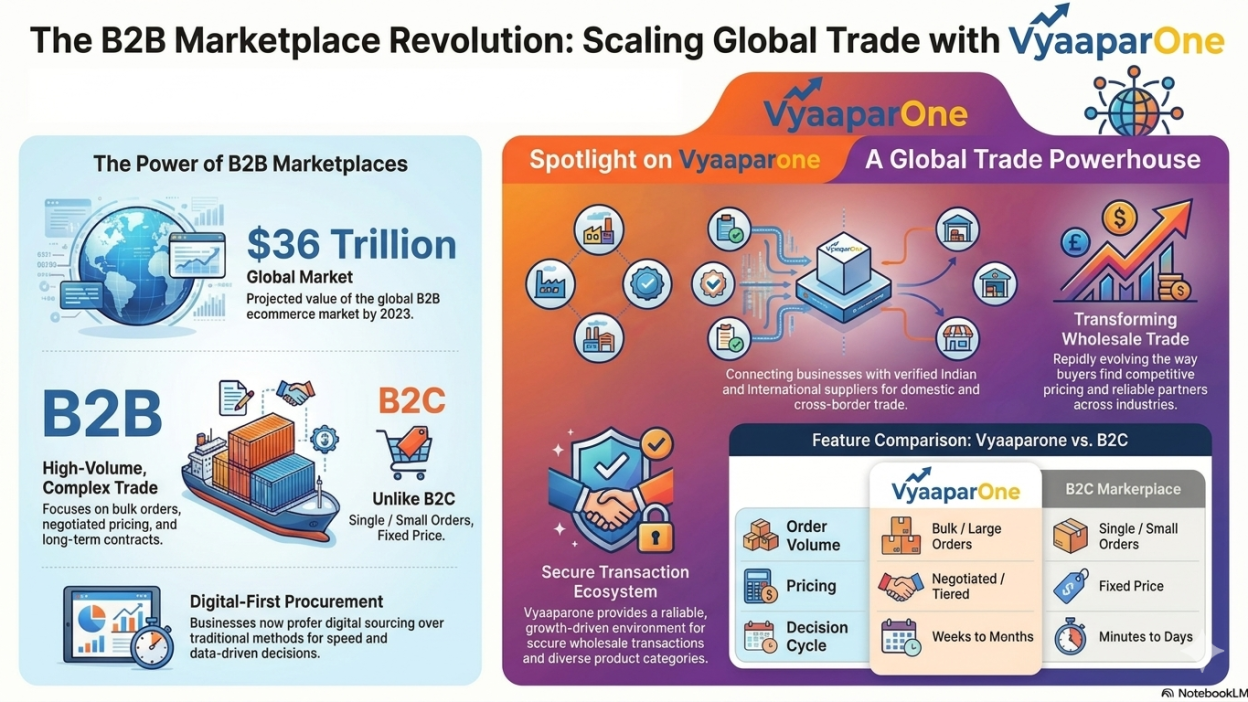
According to industry estimates, the global B2B ecommerce market is projected to exceed $36 trillion by 2026, dwarfing the B2C market by a significant margin. This growth is driven by several macro forces:
- Digitization of procurement: Businesses increasingly prefer digital sourcing over traditional methods.
- Cross-border trade expansion: SMEs now have access to global suppliers and buyers with minimal friction.
- Mobile-first commerce: Mobile apps and responsive platforms allow procurement on the go.
- Data-driven decision making: Platforms offer analytics that help buyers compare suppliers more intelligently.
The shift is clear — the global b2b marketplace is no longer an emerging trend. It is the dominant paradigm for business trade.
Key Components of a Successful B2B Marketplace
Not all B2B platforms achieve the same levels of adoption and trust. The most successful ones share several critical features.
Supplier Verification and Trust Signals
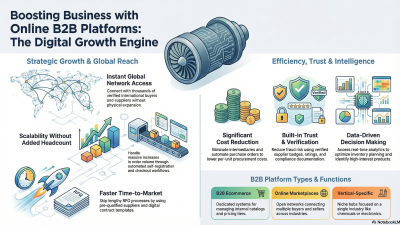
Buyers need confidence that the sellers they engage with are legitimate. Top platforms invest heavily in supplier verification, trade assurance programs, and reviews. Without trust, no marketplace can sustain long-term growth.
Advanced Search and Filtering
With thousands of products and suppliers, powerful search and filtering capabilities are non-negotiable. Buyers should be able to narrow results by MOQ (minimum order quantity), price range, certifications, shipping regions, and more.
Secure Payment Infrastructure
The marketplace business model only works when payments are safe. Escrow services, trade finance options, and multi-currency support are essential for facilitating large B2B transactions.
RFQ (Request for Quotation) System
B2B purchases rarely happen at fixed prices. A robust RFQ system allows buyers to describe their needs and invite competitive bids from multiple suppliers — saving time and driving better pricing.
Logistics and Fulfillment Integration
Shipping large volumes internationally is complex. Platforms that integrate freight solutions, customs documentation, and last-mile delivery options reduce friction significantly for both buyers and sellers.
Best B2B Marketplaces in the World Today
The landscape of the marketplace business model includes a mix of global giants and specialized niche platforms. Here is a look at the most prominent players.
1. Vyaaparone
Emerging as a powerful force in the global B2B marketplace space, Vyaaparone connects businesses with verified Indian and international suppliers. Known for its diverse product categories, competitive pricing, and secure transaction ecosystem, it is rapidly transforming cross-border and domestic wholesale trade by offering a reliable and growth-driven platform for buyers and sellers alike.
2. Amazon Business
Amazon Business brings the familiar consumer experience to enterprise procurement. With features like bulk pricing, multi-user accounts, approval workflows, and spend analytics, it has become one of the marketplace business model for North American businesses.
3. Global Sources
A strong competitor in the Asia-Pacific region, Global Sources focuses on verified suppliers and trade shows, offering quality sourcing for electronics, fashion, and consumer goods.
4. ThomasNet
A go-to platform for industrial buyers in the United States, ThomasNet specializes in manufacturing and engineering. It is one of the best b2b portals for buyers sourcing custom parts, machinery, and industrial components domestically.
5. IndiaMART
India’s largest b2b online marketplace, IndiaMART serves millions of buyers and sellers across categories including industrial, consumer, and agricultural products. It is a critical gateway for accessing India’s vast manufacturing ecosystem.
6. EC21
A South Korean-founded global platform, EC21 focuses on exporters and importers worldwide. It is particularly popular in Asia and is considered one of the best b2b portals for SMEs looking to enter new markets.
Advantages of the B2B Marketplace Model for Businesses
Whether you are a buyer, seller, or investor, the marketplace business model offers compelling advantages.
For Buyers:
- Access to a global pool of verified suppliers
- Competitive pricing through multi-supplier comparisons
- Streamlined procurement with digital tools
- Reduced time-to-sourcing
For Sellers:
- Expanded market reach without heavy marketing spend
- Reduced customer acquisition costs
- Access to international buyers from day one
- Data insights to improve offerings
For Platform Operators:
- Scalable revenue through commissions and subscriptions
- Asset-light business model
- Network effects drive compounding growth
- Diversified monetization options
Challenges in Running a B2B Online Marketplace
While the opportunity is immense, building and scaling a marketplace business model comes with its share of challenges.
The Chicken-and-Egg Problem
Every new marketplace must solve the classic supply-demand bootstrapping challenge. Without buyers, sellers won’t join. Without sellers, buyers won’t come. Successful platforms typically solve this by focusing on one side first — usually supply — before activating demand.
Quality Control and Fraud Prevention
As transaction volumes grow, so does the risk of counterfeit products, misrepresented suppliers, and payment fraud. Continuous investment in verification, AI-based fraud detection, and dispute resolution is essential.
Complex Logistics
Cross-border trade involves customs regulations, import duties, shipping delays, and compliance issues. Platforms that do not address these complexities lose users who find the friction too high.
Building Trust in New Markets
Entering a new geographic or vertical market requires re-establishing trust from scratch. Local partnerships, language support, and region-specific compliance are critical for expansion.
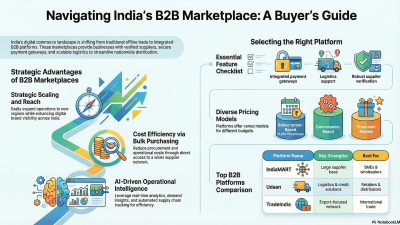
How to Choose the Right B2B Marketplace for Your Business
With so many platforms available, selecting the right one depends on your specific needs.
Ask these questions before committing:
- What is your industry? Some platforms specialize by vertical (industrial, agricultural, tech), while others are generalist. The best marketplace business model for a textile manufacturer may differ entirely from one for a software reseller.
- Where are your buyers/suppliers located? For cross-border trade, platforms like Alibaba or Global Sources excel. For domestic US sourcing, ThomasNet or Amazon Business may suit better.
- What is your order volume? Platforms with MOQ minimums may not work for small or mid-size buyers. Look for platforms that match your transaction scale.
- What services do you need? If trade finance, escrow, or logistics support are priorities, choose platforms that offer these built-in.
- What is the platform’s reputation? Check supplier verification processes, dispute resolution track records, and user reviews before committing.
The Future of the B2B Online Marketplace
The next decade will bring significant transformation to the global b2b marketplace ecosystem. Several trends are reshaping how platforms operate and compete.
AI-Powered Matching and Procurement
Artificial intelligence is enabling smarter supplier-buyer matching, automated purchase order generation, and predictive procurement analytics. Platforms leveraging AI will deliver significantly faster sourcing outcomes.
Embedded Finance
Buy Now Pay Later (BNPL), invoice factoring, and real-time credit lines are being integrated directly into B2B marketplace flows. This removes one of the biggest friction points — payment terms — in large commercial transactions.
Vertical Marketplaces on the Rise
While horizontal platforms like Alibaba serve every category, vertical-specific marketplace business model focused on healthcare supplies, construction materials, or food ingredients are gaining traction. Depth of focus creates stronger trust and better-matched supply chains.
Sustainability and ESG Compliance
Buyers increasingly demand visibility into supplier sustainability practices. Platforms that offer carbon tracking, ethical sourcing certifications, and supply chain transparency will have a significant competitive edge.