For small and medium‑size enterprises (SMEs), breaking into international markets often feels like scaling a wall without a ladder. You may have great products and competitive pricing, but getting in front of real global buyers is the real challenge. This is exactly where a global B2B marketplace for SME exporters becomes a game‑changer.
Unlike generic classifieds or local directories, a B2B marketplace for exporters connects SME‑sized suppliers directly with importers, distributors, and wholesalers from around the world. Many of these platforms act as a global sourcing platform, vetting both buyers and sellers so businesses can trade with more confidence.
In this guide, you’ll learn how these digital marketplaces work, how they help SMEs access international demand, and what to look for when choosing the best global B2B marketplace for SME exporters. Whether you’re already exporting or just starting, this will help you build a smarter, more scalable cross‑border strategy.
What Is a Global B2B Marketplace for SME Exporters?
A global B2B marketplace for SME exporters is an online platform that connects small and medium‑sized suppliers with international buyers looking for products in bulk. These platforms sit between manufacturers and importers, creating a centralized hub where businesses can showcase products, generate export leads, and negotiate orders.
Core Features
- Product catalogs where SMEs list items with specifications, MOQs, and pricing.
- Global buyer search tools that let exporters filter by country, industry, or company size.
- Lead and inquiry management to track buyer requests and convert them into sales.
- Basic trade verification, such as company profiles, export history, and sometimes documentary checks.
Unlike traditional trade databases or offline trade fairs, a global B2B marketplace for SME exporters operates 24/7 and reduces the cost of prospecting by making buyer discovery digital and data‑driven.
Why SMEs Need This
Many SMEs struggle with high marketing costs, limited brand visibility, and fragmented buyer networks. A dedicated global B2B marketplace for SME exporters gives them:
- Access to a pre‑built base of international buyers.
- Lower entry barriers into new markets.
- Tools to showcase capabilities beyond what a simple website can show.
This is especially valuable for SMEs in emerging markets who may not have strong overseas distribution networks yet.
How a B2B Marketplace for Exporters Works
A B2B marketplace for exporters is more than just a classifieds site; it’s a structured ecosystem designed for repetitive business‑to‑business transactions.
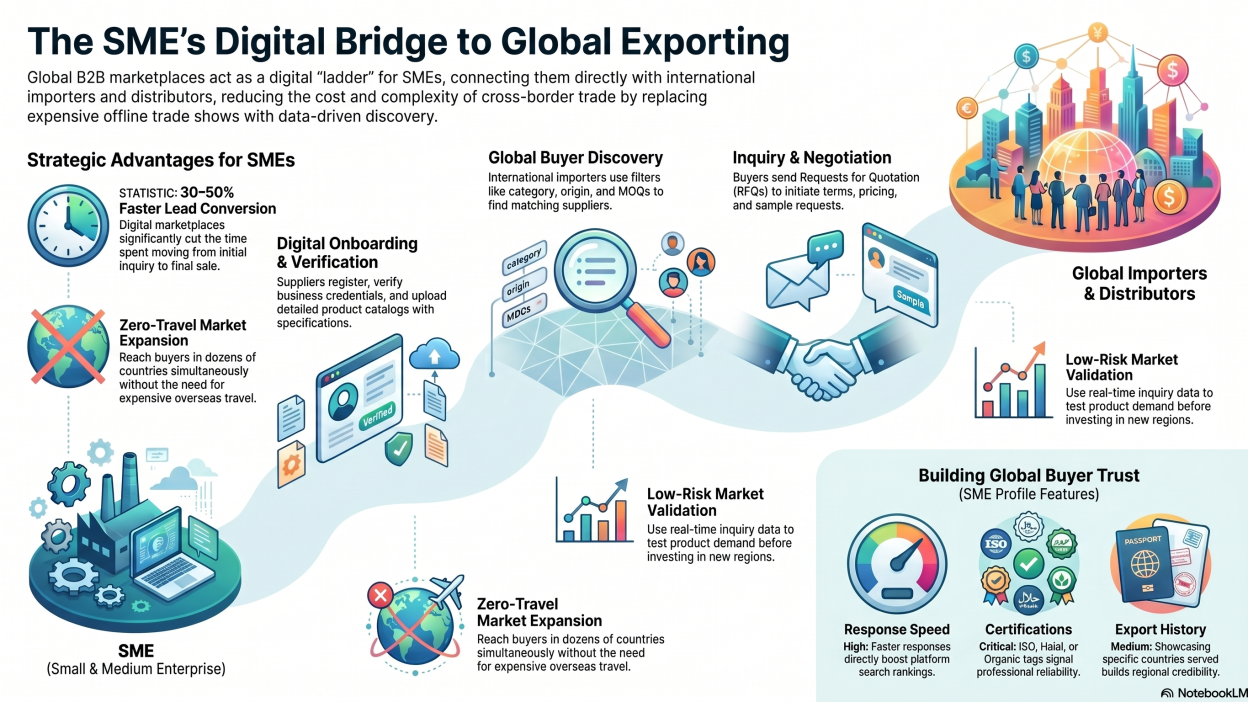
The Typical Workflow
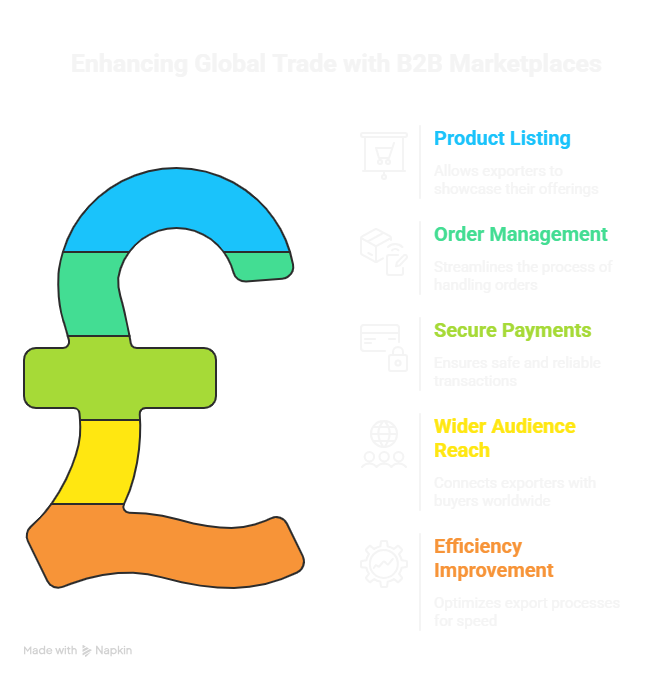
- Supplier Onboarding
SMEs register, verify their business details, and upload factory profiles, certifications, and product catalogs. - Buyer Discovery
Importers search using filters such as product category, country of origin, MOQ, and HS codes. - Inquiry & Negotiation
Buyers send RFQs (requests for quotation) through the platform, and suppliers respond with quotes, terms, and samples. - Order Management
Once agreed, many platforms allow basic order tracking, messaging, and sometimes connected logistics or payment escrow options.
This streamlined process helps turn random chance meetings at trade shows into consistent, repeatable export pipelines.
Role of a Global Sourcing Platform
A global sourcing platform usually adds extra layers:
- Buyer verification (e.g., company registration, tax IDs, or trade references).
- Supplier screening (documents such as GST, export licenses, or factory audits).
- Category‑specific sourcing teams that help buyers shortlist trusted exporters.
For SMEs, this reduces the risk of chasing fake buyers while improving the credibility of their offers.
Why SME Exporters Should Use a Global B2B Marketplace
Using a global B2B marketplace for SME exporters offers several concrete advantages over older, offline methods.
1. Reach International Buyers Without Heavy Travel
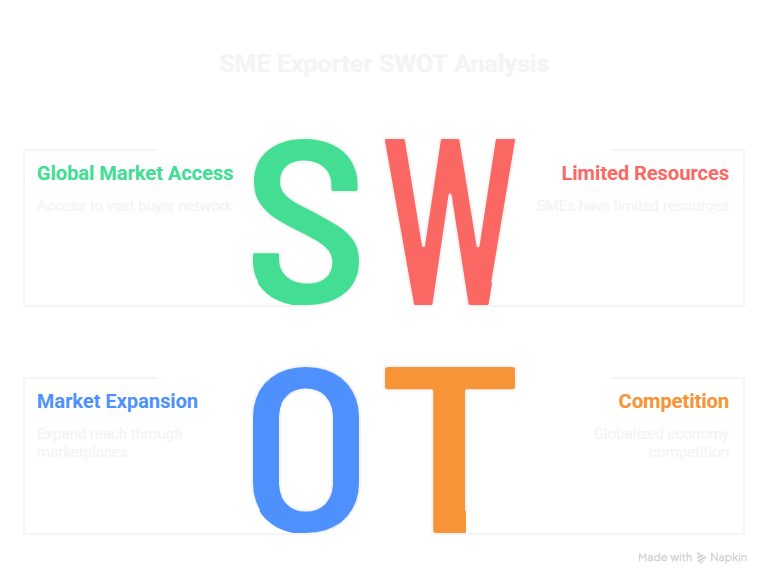
Traditional export growth often depends on overseas visits, trade fairs, and agent networks. A global B2B marketplace for SME exporters replaces part of that effort by letting you showcase products to buyers in dozens of countries from a single dashboard.
- Example: An Indian SME manufacturing personal care products can target buyers in the Middle East, Africa, and Southeast Asia without flying to each region.
2. Faster Lead Generation
Instead of cold‑calling hundreds of prospects, a B2B marketplace for exporters lets buyers find you. When you keep your catalog updated and respond quickly to inquiries, you cut the sales cycle time from weeks to days.
- Statistic: Some exporters report a 30–50% drop in lead conversion time after joining a well‑curated B2B export marketplace.
3. Lower Marketing Costs
Running campaigns across multiple countries in multiple languages is expensive. A global B2B marketplace for SME exporters shares the marketing load by aggregating international traffic under one umbrella brand.
- You pay once (membership or listing fee) and appear in front of thousands of buyers.
4. Easier Market Validation
Before you invest in a full‑scale export plan for a new country, you can test demand:
- List products on a global B2B marketplace for SME exporters.
- Monitor which countries send the most RFQs.
- Adjust pricing, packaging, or product mix based on real buyer interest.
This is a low‑risk way to validate new markets before committing to big investments.
Choosing the Best Global B2B Marketplace for SME Exporters
Not every marketplace is equally useful for SMEs. To find the best global B2B marketplace for SME exporters, you should ask the following questions.
1. Target Audience and Geography
- Does the platform focus on SMEs or only large manufacturers?
- Which countries dominate the buyer base (e.g., USA, UAE, UK, EU, ASEAN)?
- Is there local language or regional support for your target markets?
A marketplace skewed toward large corporations may not be the best fit for a small‑scale exporter.
2. Drop‑Off and Verification Levels
Look for:
- Verified buyer badges or screening of company profiles.
- Document verification such as GST, business registration, or export licenses.
- Clear anti‑fraud policies and dispute‑handling mechanisms.
These features are common in serious global sourcing platform models.
3. Category Niche vs. General Marketplace
- Niche marketplaces (e.g., food & agri, textiles, chemicals) usually have more targeted buyers but fewer categories.
- General marketplaces give you exposure across industries but may diffuse your visibility.
If you’re an SME with a specialized product, niche platforms often deliver higher‑quality leads.
4. Tools and Support
Check whether the platform offers:
- Catalog management tools (bulk upload, multilingual descriptions).
- Lead analytics (inquiry trends, response time KPIs).
- Training or onboarding webinars for new exporters.
These features help SMEs with limited export teams operate more efficiently.
How to Optimize Your Presence on a B2B Marketplace for Exporters
Setting up a basic profile is not enough to stand out on a B2B marketplace for exporters. You need to optimize your visibility and credibility.
1. Create Detailed Product Listings
Each product page should include:
- Clear product name and category.
- High‑quality images from multiple angles.
- Technical specifications, MOQ, packaging, and variants.
- Incoterms and available payment methods.
Think of your listing as a mini‑sales page tailored for international buyers.
2. Highlight Your Export Capabilities
Buyers care about reliability as much as price. Add sections such as:
- Years of export experience.
- Major destinations served (e.g., “exported to 15+ countries since 2020”).
- Certifications (ISO, FSSC, HALAL, organic, etc.).
This builds trust and positions you as a serious exporter on a global B2B marketplace for SME exporters.
3. Use Time as a Competitiveness Signal
Many platforms rank suppliers based on:
- Response speed to RFQs.
- Inquiry‑conversion rate.
- Profile completeness.
Aim to respond within 24 hours and keep your catalog updated. This indirectly boosts your ranking on the B2B marketplace for exporters.
International Trade Tips for SMEs Using a Global Sourcing Platform
Once you’re listed on a global sourcing platform, focus on making your export operations buyer‑friendly.
1. Standardize Quotations and Terms
Create templates for:
- Quotations (product, price, MOQ, payment terms, delivery time).
- Standard clauses on quality, samples, and returns.
This saves time and reduces confusion with buyers from different legal systems.
2. Offer Virtual Samples
Instead of shipping physical samples to every interested buyer, consider:
- High‑resolution video demos.
- Detailed specification sheets.
- Free or paid sample programs with clear conditions.
This reduces costs while still building confidence.
3. Use Incremental Order Scaling
Start with:
- Small trial orders from new buyers.
- Letter of credit (LC) or partial advance for larger orders.
This reduces risk and helps you build a track record that makes you more attractive on a global B2B marketplace for SME exporters.
How an SME Grew Exports Using a Global B2B Marketplace
Consider a hypothetical Indian SME manufacturing packaging films:
- Before joining a global B2B marketplace for SME exporters, they relied on local distributors and occasional trade‑fair contacts, with exports below 15% of revenue.
- After creating a professional profile on a B2B marketplace for exporters, they listed 10 core SKUs, added certifications, and responded quickly to RFQs.
- Within 12 months, they secured five regular buyers in the Middle East and Southeast Asia, increasing exports to 40% of total sales.
The key was not just the platform itself, but how they optimized listings, communicated quickly, and treated the marketplace as a core global sourcing platform for their export pipeline.
Common Mistakes to Avoid on a Global B2B Marketplace
Even on a well‑designed global B2B marketplace for SME exporters, some mistakes can kill opportunities.
1. Incomplete or Generic Profiles
Profiles with missing contact details, blurry photos, or vague “we sell everything” descriptions perform poorly. Treat your profile as a brand‑level showcase for international buyers.
2. Ignoring Follow‑Up
Buyers often compare multiple suppliers. If you don’t respond promptly or send incomplete quotes, they move on. Design a simple follow‑up workflow for every inquiry.
3. Overpromising on Price
Undercutting for visibility can backfire if you cannot maintain quality or margins. Instead, focus on:
- Clear value propositions (certifications, customization, reliability).
- Transparent pricing and terms.
This builds trust on a global sourcing platform and supports long‑term relationships.
Final Words
A global B2B marketplace for SME exporters is no longer a luxury; it’s a practical tool for businesses serious about scaling exports without exploding their marketing budget. By combining this with a B2B marketplace for exporters that offers genuine buyer access and working with a global sourcing platform that supports trade verification, SMEs can build repeatable, low‑risk international pipelines.
To get the most from these platforms, focus on profile quality, response speed, and clear commercial terms. If you’re looking for the best global B2B marketplace for SME exporters, prioritize platforms that are SME‑friendly, transparent, and backed by real buyer activity in your target markets.
FAQs
Q1: What is a global B2B marketplace for SME exporters?
A global B2B marketplace for SME exporters is an online platform that connects small and medium‑sized suppliers with international buyers, enabling them to showcase products, receive export leads, and manage trade inquiries in one place.
Q2: How does a B2B marketplace for exporters help SMEs?
A B2B marketplace for exporters gives SMEs access to pre‑built international buyer networks, reduces marketing costs, and speeds up lead generation by letting buyers discover and contact suppliers digitally.
Q3: What should I look for in the best global B2B marketplace for SME exporters?
Look for buyer verification, SME‑friendly pricing, strong category coverage, good customer support, and tools such as analytics and catalog management that help you manage export leads efficiently.
Q4: Is a global sourcing platform safe for SMEs?
A reputable global sourcing platform usually includes company verification, basic anti‑fraud checks, and dispute‑handling mechanisms, which can reduce the risk of dealing with fake buyers or suppliers.
Q5: Can I use a B2B marketplace for exporters if I’m just starting?
Yes. Many B2B marketplaces for exporters have tiered plans or free listings that let new SMEs test international demand before investing heavily in overseas marketing or logistics.
Q6: How much does it cost to join a global B2B marketplace for SME exporters?
Pricing varies—some platforms charge annual membership fees, others charge per listing or per inquiry. Always check for hidden add‑ons or renewal terms before signing up.
Q7: How can I improve my visibility on a B2B marketplace for exporters?
Optimize product listings, respond quickly to RFQs, keep your catalog updated, and use any ranking signals the platform provides (response time, profile completeness, and transaction history).