Introduction
The global garments industry is one of the most dynamic and competitive sectors in international trade. Whether you are a manufacturer in Bangladesh, a wholesaler in Turkey, or a retail buyer in the United States, accessing accurate garments trade leads can be the difference between landing a high-value deal and missing it entirely.
Garments trade data gives businesses — from startups to established exporters — the intelligence they need to identify buyers, suppliers, pricing trends, and market opportunities. In today’s data-driven world, relying on guesswork simply does not work. You need real, verified garment export data, garment import data, and properly classified garments HS codes to make informed business decisions.
This comprehensive guide covers everything you need to know about garments trade data, how to leverage import export leads, which countries dominate global garment trade, and how to use this intelligence to scale your business.
What Are Garments Trade Leads?
Garments trade leads refer to verified business opportunities in the buying and selling of garments across borders. These leads connect exporters with importers, manufacturers with wholesale buyers, and suppliers with distributors worldwide.
A garment trade lead typically includes:
- Buyer or Seller Name: The company or individual seeking to import or export garments.
- Product Description: Specific garment category — T-shirts, denim, formal wear, sportswear, etc.
- Quantity and Packaging Details: Volume of the order in pieces, kilograms, or containers.
- Target Price or Budget Range: Negotiated or expected price per unit or lot.
- Country of Origin/Destination: Where the goods are being shipped from and to.
- HS Code: The harmonized system code used for customs classification.
For businesses engaged in international garment trade, these leads are invaluable. They save time, reduce cold outreach efforts, and directly connect sellers with buyers who are ready to transact.
Trade leads differ from generic marketing. They are intent-driven signals from real companies. When a buyer posts a garment import lead, they are already in the decision phase — they need a supplier now.
Understanding Garments Trade Data
Garments trade data is the structured, often government-sourced information on every shipment of garments crossing international borders. It is compiled by customs authorities and made available through trade intelligence platforms.
This data typically includes:
- Exporter Name and Address
- Importer Name and Address
- HS Code / Product Classification
- Shipment Date
- Port of Loading and Discharge
- Invoice Value (USD)
- Net Weight and Gross Weight
- Bill of Lading Number
Why Garments Trade Data Matters
Trade data removes the uncertainty from global business. Instead of reaching out to hundreds of unknown contacts, businesses can use garments trade data to:
- Identify Active Buyers: Find companies that are regularly importing garments and reach out with a targeted pitch.
- Analyze Competitor Shipments: See which manufacturers your competitors are sourcing from, what they are paying, and how frequently they reorder.
- Discover New Markets: Identify emerging countries with rising garment imports — potential new markets for your products.
- Track Pricing Trends: Monitor invoice values over time to understand market pricing.
- Evaluate Suppliers: Verify supplier credibility by reviewing their export history before signing a sourcing agreement.
For anyone serious about garment trading internationally, access to trade data is no longer optional — it is a strategic necessity.
Garment Export Data: Key Metrics and Sources
Garment export data details the outbound shipments of clothing and apparel from one country to another. It is the foundation for any export strategy in the textile and garments sector.
Key Metrics in Garment Export Data
When analyzing garment export data, pay close attention to these core metrics:
Export Volume: The total quantity of garments shipped, measured in pieces, dozens, or kilograms. Tracking this over months reveals growth trends and seasonal peaks.
Export Value (FOB/CIF): The monetary value of shipments — either Free on Board (FOB) or Cost, Insurance, and Freight (CIF). These values help benchmark pricing and calculate margins.
Destination Country: Understanding where a country’s garments are going helps identify primary demand centers. China, Bangladesh, and Vietnam, for example, send the majority of their garment exports to the US, EU, and UK.
Buyer and Supplier Names: Raw export data often includes the names of actual trading companies, which is gold for B2B prospecting.
HS Code Distribution: Which categories of garments — knitwear, woven apparel, accessories — are being exported most from a given country.
Top Sources for Garment Export Data
- Customs Authorities: Countries like India, the US, Mexico, and several South American nations release detailed shipment-level data.
- Trade Intelligence Platforms: Services like Import Genius, Volza, Panjiva, and Zauba compile raw customs data into searchable databases.
- ITC Trade Map: The International Trade Centre’s Trade Map offers aggregated export data by country and HS code.
- WTO Statistics Portal: Useful for macro-level garment export trends by region.
Garment Import Data: What Buyers Need to Know
On the flip side, garment import data captures all inbound garment shipments entering a country. For retailers, wholesalers, and distributors, this data reveals who is importing what — and from where.
Using Garment Import Data Strategically
Finding Reliable Suppliers: If you need to source garments from India, China, or Bangladesh, import data tells you which manufacturers are already shipping to buyers in your target country. These are proven, active exporters.
Competitive Benchmarking: Know your competitors’ supply chain. If a rival retailer is sourcing premium knitwear from a specific mill in South Korea, import data can reveal that relationship.
Spotting Demand Shifts: Rising import volumes for a specific garment category in a country signals growing consumer demand — an opportunity to enter early.
Price Intelligence: Import data often includes invoice values, helping you gauge whether you are paying a competitive price for your garments.
Countries with Publicly Available Garment Import Data
Several countries provide rich, searchable customs import data:
- United States: The US Customs and Border Protection (CBP) releases detailed import manifests. This is some of the most widely used garment import data globally.
- India: India’s Directorate General of Commercial Intelligence and Statistics (DGCI&S) publishes detailed import/export records.
- Brazil, Mexico, Chile, Colombia: These Latin American markets offer some of the most transparent customs data.
- Russia and Vietnam: Also publish regular shipment-level data available through third-party platforms.
European Union countries tend to provide aggregated rather than shipment-level data, but Eurostat offers reliable macro-level import statistics.
Garments HS Code: A Complete Guide
The Harmonized System (HS) Code is an internationally standardized system for classifying traded products. For garments, the correct HS code is essential for customs clearance, duty calculation, and trade data analysis.
Understanding the HS Code Structure
HS codes are structured in a hierarchical format:
- 2-digit Chapter: Broad product category (e.g., Chapter 61 – Knitted or Crocheted Clothing)
- 4-digit Heading: More specific product type (e.g., 6109 – T-shirts, singlets, and other vests)
- 6-digit Subheading: International standard specific classification
- 8/10-digit National Code: Country-specific extensions for duties and statistics
Key Garments HS Codes to Know
| HS Code | Product Description |
| 6101 | Men’s overcoats, carcoats, capes — knitted |
| 6104 | Women’s suits, jackets, dresses — knitted |
| 6105 | Men’s shirts — knitted or crocheted |
| 6109 | T-shirts, singlets, other vests — knitted |
| 6110 | Jerseys, pullovers, sweatshirts — knitted |
| 6201 | Men’s overcoats, windcheaters — woven |
| 6204 | Women’s suits, jackets, dresses — woven |
| 6205 | Men’s shirts — woven |
| 6206 | Women’s blouses, shirts — woven |
| 6211 | Track suits, ski suits, swimwear |
| 6302 | Bed linen, table linen — woven |
| 6217 | Made-up clothing accessories |
Chapter 61 vs Chapter 62
One of the most important distinctions in garments HS codes is between Chapter 61 (knitted or crocheted garments) and Chapter 62 (woven garments). Misclassifying a shipment can lead to:
- Incorrect duty assessment
- Customs delays and penalties
- Trade data inaccuracies
For example, a polo shirt made of knitted cotton falls under HS 6105, while a formal woven cotton shirt for men falls under HS 6205. The fabric construction — knitted vs woven — determines the chapter.
Why HS Codes Are Critical for Trade Leads
When sourcing garment export leads or garment import leads, the HS code filters your search to exactly the right product. Without this classification, you may receive leads for entirely different product categories. Always confirm the HS code with your supplier or buyer before finalizing any order.
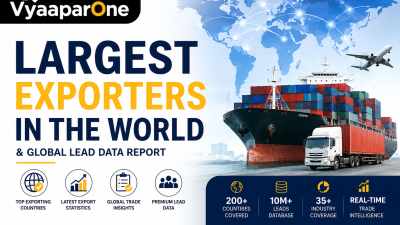
Largest Garment Exporters in the World
Understanding who the largest garment exporters in the world are helps both buyers (who want to source competitively) and sellers (who want to understand their competition and potential partnerships).
1. China — The Undisputed Leader
China remains the biggest exporter of garments globally, accounting for roughly 31–35% of total world garment exports. With its vast manufacturing infrastructure, skilled labor, and massive supply chain ecosystem, China produces everything from low-cost basics to high-end fashion.
Key export destinations: United States, EU countries, Japan, UK, and Australia.
2. Bangladesh — The Value Powerhouse
Bangladesh is the second-largest garment exporter, contributing approximately 6–8% of global garment exports. Its competitive labor costs and growing compliance standards have made it the go-to source for major Western retailers like H&M, Zara, and Walmart.
Key export destinations: Germany, UK, USA, France, Spain.
3. Vietnam — Rising Fast
Vietnam has grown dramatically as a garment export hub over the past decade. With trade agreements like CPTPP and EVFTA, Vietnam enjoys preferential tariffs in several major markets.
Key export destinations: United States, Japan, South Korea, EU.
4. India — Diversified Product Range
India is a significant garment exporter known for its diverse product portfolio — from cotton knitwear and embroidered fabrics to technical textiles and sustainable fashion. India exports heavily under HS chapters 61 and 62.
Key export destinations: USA, UAE, UK, EU.
5. Turkey — Europe’s Nearest Supplier
Turkey is a major exporter of high-quality garments, particularly to EU countries, due to its geographic proximity and customs union agreement with the EU. Turkish manufacturers are known for quality denim, knitwear, and fashion basics.
Key export destinations: Germany, UK, Spain, Netherlands.
6. Cambodia, Pakistan, Sri Lanka, and Indonesia
These countries form the next tier of significant garment exporters. Cambodia and Sri Lanka have strong compliance cultures; Pakistan excels in cotton-based textiles; and Indonesia serves major brands in the US and EU markets.
Biggest Importers of Garments Globally
On the demand side, knowing who the biggest importers of garments are helps exporters prioritize their sales efforts and market entry strategies.
1. United States — The World’s Largest Garment Importer
The US imports more garments than any other country in the world. American consumers’ appetite for affordable fashion, combined with the country’s largely import-dependent retail industry, makes it the most sought-after destination for garment export leads.
Top sourcing countries for US garment imports: China, Vietnam, Bangladesh, India, Indonesia.
2. European Union — A Unified Mega-Market
The EU, while comprising individual nations, functions as a single customs territory. Germany, the UK, France, Spain, and the Netherlands are among the top individual importers within Europe.
EU sustainability requirements, including the European Green Deal, are increasingly shaping sourcing decisions — favoring suppliers with strong ESG credentials.
3. Japan — Quality-First Market
Japan is a premium garment import market. Japanese retailers and brands prioritize quality, fit, and craftsmanship. Suppliers from China, Vietnam, and ASEAN countries are the primary sources.
4. United Kingdom — Post-Brexit Opportunities
Post-Brexit, the UK has developed its own independent trade policy, including preferential tariff agreements with countries like India and Bangladesh. This creates new opportunities for exporters seeking direct access to the UK market.
5. Canada and Australia — Growing Markets
Both Canada and Australia are stable, high-income garment import markets. Their reliance on imports is near-total, making them consistent buyers of garments from Asia and beyond.
How to Find Garment Export Leads and Import Leads
Now that you understand the landscape, here is how to actively find garment export leads and garment import leads that convert.
1. Trade Data Platforms
Platforms like Volza, Panjiva, Import Genius, and Zauba give you direct access to shipment-level customs data. You can search by HS code, country, product, and company name to find active buyers and sellers.
Steps to find garment leads via trade data:
- Select the target country (e.g., USA or Germany).
- Enter the relevant garments HS code (e.g., 6109 for T-shirts).
- Filter by date range (last 3–6 months for active leads).
- Review importer/exporter names, shipment values, and volumes.
- Build your prospect list and begin outreach.
2. B2B Trade Portals
Platforms like Vyaaparone, Alibaba, Global Sources, TradeIndia, and ExportHub host active import export leads posted by real buyers and sellers. Garment-specific sections allow you to filter by product type, MOQ, and country.
3. Trade Fairs and Exhibitions
Events like Canton Fair, Texworld, MAGIC Las Vegas, Première Vision, and Sourcing at MAGIC are excellent venues for generating verified trade leads in person.
4. Government Export Promotion Agencies
Most countries have trade promotion agencies that actively share garment export leads with domestic manufacturers:
- OTEXA (USA) — Office of Textiles and Apparel
- AEPC (India) — Apparel Export Promotion Council
- BGMEA (Bangladesh) — Bangladesh Garment Manufacturers and Exporters Association
- IHKIB (Turkey) — Istanbul Apparel Exporters’ Association
5. LinkedIn and Direct Outreach
LinkedIn remains an underrated tool for generating garment import leads. Search for procurement managers, sourcing directors, and supply chain officers at major retailers. A personalized, data-backed outreach using shipment data insights dramatically improves response rates.
Using Import Export Leads to Grow Your Garments Business
Having leads is only the first step. Converting import export leads into actual orders requires a systematic approach.
Build a Targeted Prospect List
Use garments trade data to build a list of companies that are:
- Actively importing/exporting in your product category.
- Operating in your target country.
- Ordering volumes that match your capacity.
Quality beats quantity here. A list of 50 well-researched prospects outperforms a cold list of 5,000.
Personalize Your Outreach
When you contact a buyer, reference their actual trade activity. For example: “We noticed you’ve been importing woven cotton shirts from Vietnam under HS 6205. We are a certified manufacturer in India offering similar quality at competitive rates with shorter lead times.”
This level of specificity signals professionalism and earns trust immediately.
Offer Product Samples and Data Sheets
Back your outreach with tangible value:
- Product samples: Physical samples close deals faster than any catalog.
- Tech packs: Detailed technical specifications build buyer confidence.
- Compliance certifications: GOTS, OEKO-TEX, BSCI, and other certifications reduce sourcing risk for buyers.
Follow Up Consistently
Most deals in garment trade don’t close on the first contact. A structured follow-up cadence — email, WhatsApp, and phone — across 4–6 touchpoints significantly improves conversion.
Negotiate Smart Using Market Data
Use garment import data to benchmark your pricing. If buyers know the market rate, you should too. Data-backed negotiations — where you justify your pricing with market evidence — build credibility.
Final Thought
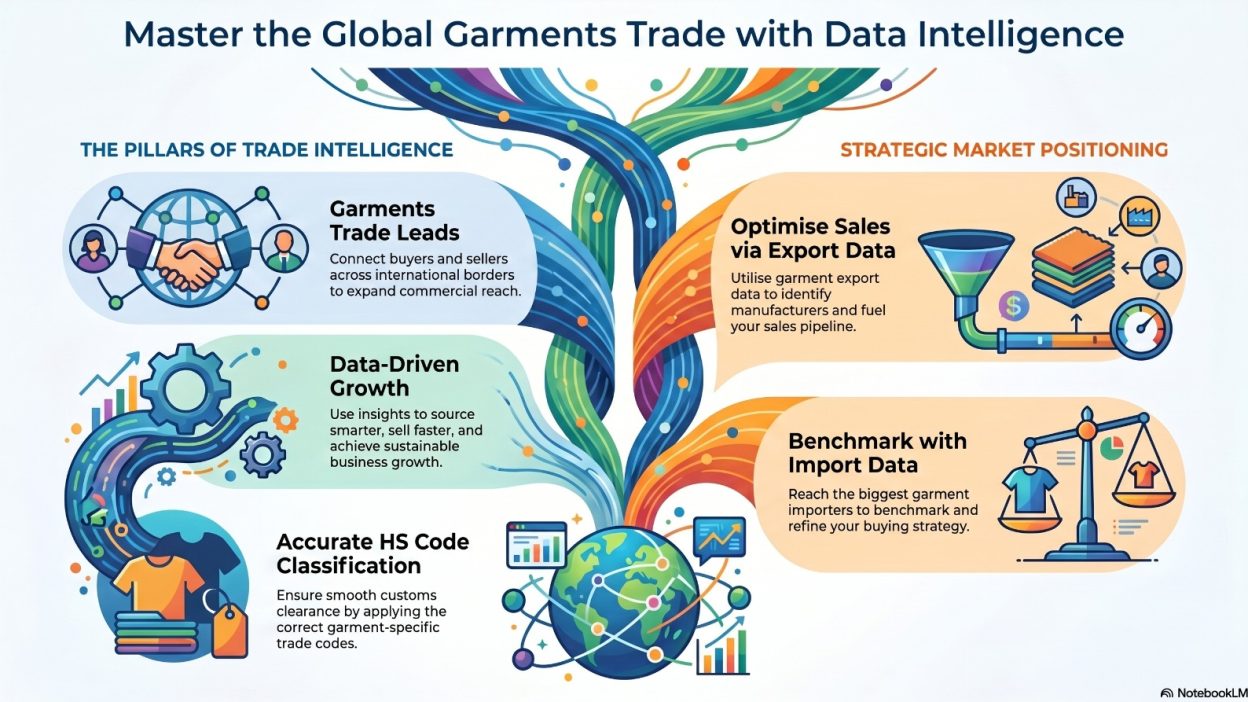
The global garments trade is vast, fast-moving, and full of opportunity — but only for those equipped with the right intelligence. Garments trade leads connect buyers and sellers across borders, while garments trade data gives businesses the insights they need to source smarter, sell faster, and grow sustainably.
From understanding the correct garments HS code for smooth customs clearance, to identifying the largest garment exporters in the world for sourcing, to reaching the biggest importers of garments as a manufacturer — every element of this guide is designed to help you act with confidence.
Whether you are looking for garment export data to fuel your sales pipeline or garment import data to benchmark your buying strategy, the data exists and the tools are accessible. The question is: are you using them?
Frequently Asked Questions
Q1: What is garments trade data?
Garments trade data is customs-sourced information on shipments of clothing and apparel crossing international borders. It includes buyer and seller names, HS codes, shipment values, quantities, and ports.
Q2: How do I find garment export leads?
You can find garment export leads through trade data platforms (Panjiva, Volza), B2B portals (Alibaba, TradeIndia), government export agencies, trade fairs, and LinkedIn outreach.
Q3: What are the main garments HS codes?
Key garments HS codes include Chapter 61 (knitted apparel) and Chapter 62 (woven apparel). Common examples include HS 6109 (T-shirts), HS 6110 (knitwear), HS 6205 (men’s woven shirts), and HS 6204 (women’s woven suits and dresses).
Q4: Who is the largest garment exporter in the world?
China is the largest garment exporter in the world, followed by Bangladesh, Vietnam, India, and Turkey.
Q5: Who are the biggest importers of garments?
The United States is the world’s biggest importer of garments, followed by the European Union (collectively), Japan, the United Kingdom, and Canada.
Q6: How is garment import data useful for buyers?
Garment import data helps buyers verify supplier credibility, compare pricing across different source countries, identify reliable manufacturers, and benchmark their sourcing strategy against competitors.
Q7: What is the difference between garment export leads and import leads?
Garment export leads come from sellers looking for buyers in foreign markets. Garment import leads come from buyers looking for overseas suppliers. Both types are essential for connecting the global garments supply chain.
Q8: Can I access US garment import data for free?
Partial US garment import data is publicly available through customs agencies, but detailed, searchable shipment-level data with company names typically requires a paid trade intelligence platform subscription.