Introduction
The global aftermarket for commercial vehicle spare parts is booming. From Asia’s manufacturing hubs to Africa’s rapidly expanding road networks, demand for quality vehicle parts has never been higher. For exporters, this translates into a massive and measurable business opportunity — but only if you know how to tap into it correctly.
Whether you are a manufacturer, trader, or logistics professional, understanding spare parts export leads is the first step toward scaling your export revenue. These leads connect you with verified buyers across international markets who are actively looking for heavy truck parts, engine components, braking systems, and much more.
This guide is built for businesses that want real results. It walks you through what export leads are, how spare parts export data can sharpen your targeting, which global markets offer the strongest demand, and how platforms like Vyaapar One can give you a competitive edge. By the time you finish reading, you will have a clear roadmap to grow your commercial vehicle spare parts export business with confidence.
What Are Commercial Vehicle Spare Parts Export Leads?
Defining Export Leads in the Spare Parts Industry
An export lead is a sales opportunity that connects a supplier or manufacturer with a potential international buyer. In the context of commercial vehicle spare parts, a Heavy Vehicle Spare Parts Export lead typically includes:
- Buyer name and country of origin
- Type and quantity of parts required
- Preferred price range and delivery timelines
- Contact details for direct outreach
These leads are generated through trade portals, customs data, government trade bodies, and industry events. A quality Heavy Vehicle Spare Parts Export lead is verified, current, and matched to your product category — saving you months of cold outreach.
Types of Spare Parts Covered Under Export Leads
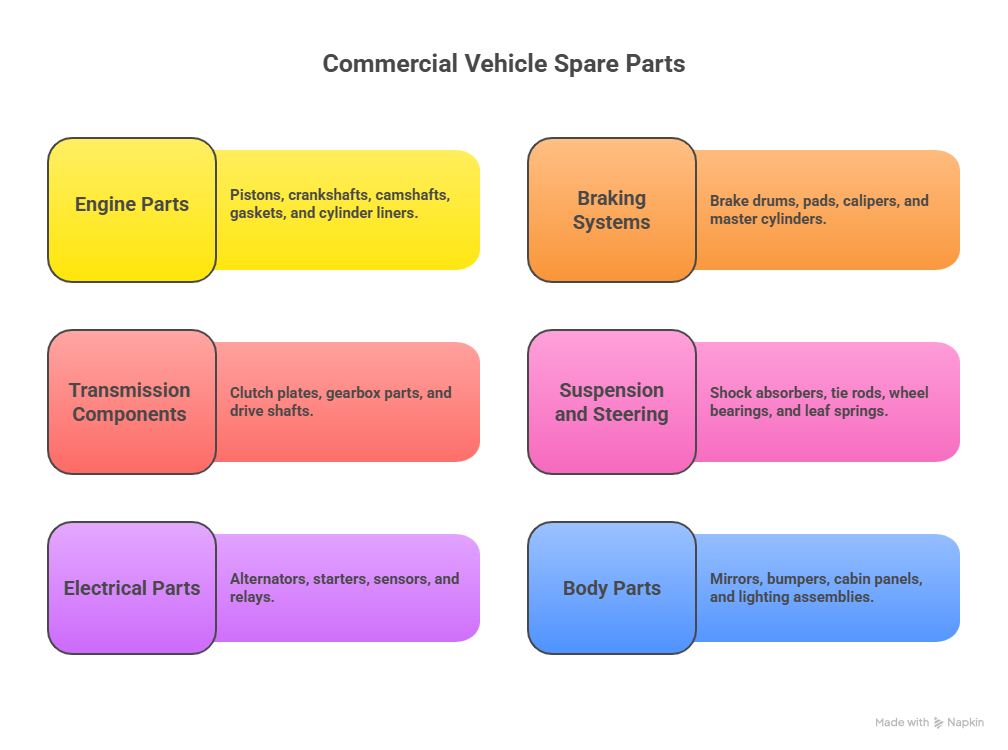
Commercial vehicle spare parts span a wide product range. The most actively traded categories include:
- Engine parts: Pistons, crankshafts, camshafts, gaskets, and cylinder liners
- Braking systems: Brake drums, pads, calipers, and master cylinders
- Transmission components: Clutch plates, gearbox parts, and drive shafts
- Suspension and steering: Shock absorbers, tie rods, wheel bearings, and leaf springs
- Electrical parts: Alternators, starters, sensors, and relays
- Body parts: Mirrors, bumpers, cabin panels, and lighting assemblies
Each category has its own buyer profile and demand cycle. Understanding which vehicle spare parts are most in demand in your target market is critical to qualifying leads and closing export deals faster.
Why Export Leads Matter More Than Cold Prospecting
Searching for buyers without leads is like driving without GPS. Heavy Truck Parts Export leads give you verified intelligence about who is buying, what they need, and when they need it. This converts your sales effort from a scattershot approach into a targeted, conversion-focused system.
Companies that use spare parts export leads consistently report:
- Shorter sales cycles
- Higher deal conversion rates
- Better buyer-product alignment
- Lower customer acquisition costs
The data-driven approach is no longer optional — it is the baseline for serious exporters of heavy auto parts and commercial components.
Why Heavy Truck Parts and Heavy Auto Parts Drive Global Trade
The Scale of Commercial Vehicle Usage Worldwide
Heavy trucks, buses, tippers, trailers, and construction vehicles operate in virtually every country on earth. These machines experience intense wear and tear, which means their components need regular replacement. Unlike passenger cars, commercial vehicles often run 300 to 500 kilometers per day, requiring more frequent servicing and parts replacement.
This intensity of usage creates consistent, year-round demand for heavy truck parts and heavy auto parts. Unlike seasonal products, spare parts for commercial vehicles are non-negotiable purchases. A truck that breaks down is a business problem. That makes buyers urgent, serious, and ready to pay fair prices for reliable parts.
Why Developing Markets Are the Fastest-Growing Export Destinations
Countries in Africa, Southeast Asia, the Middle East, and Latin America are expanding their road infrastructure and commercial vehicle fleets at a rapid pace. However, many of these markets lack sufficient local manufacturing capacity for commercial vehicle spare parts. They depend heavily on imports.
This supply-demand gap makes them prime destinations for Heavy Truck Parts Export leads. Indian exporters, in particular, are well-positioned because:
- Indian manufacturers produce cost-competitive, high-quality heavy auto parts
- India has strong trade relationships with African and Middle Eastern nations
- Indian parts meet international quality standards like ISO and TS 16949
- Logistics corridors like the Middle East trade route are well-established
For businesses using platforms like Vyaapar One, this global demand can be captured through smart use of Heavy auto parts Export leads and Spare Parts Export Data.
The Aftermarket vs. OEM Dynamic
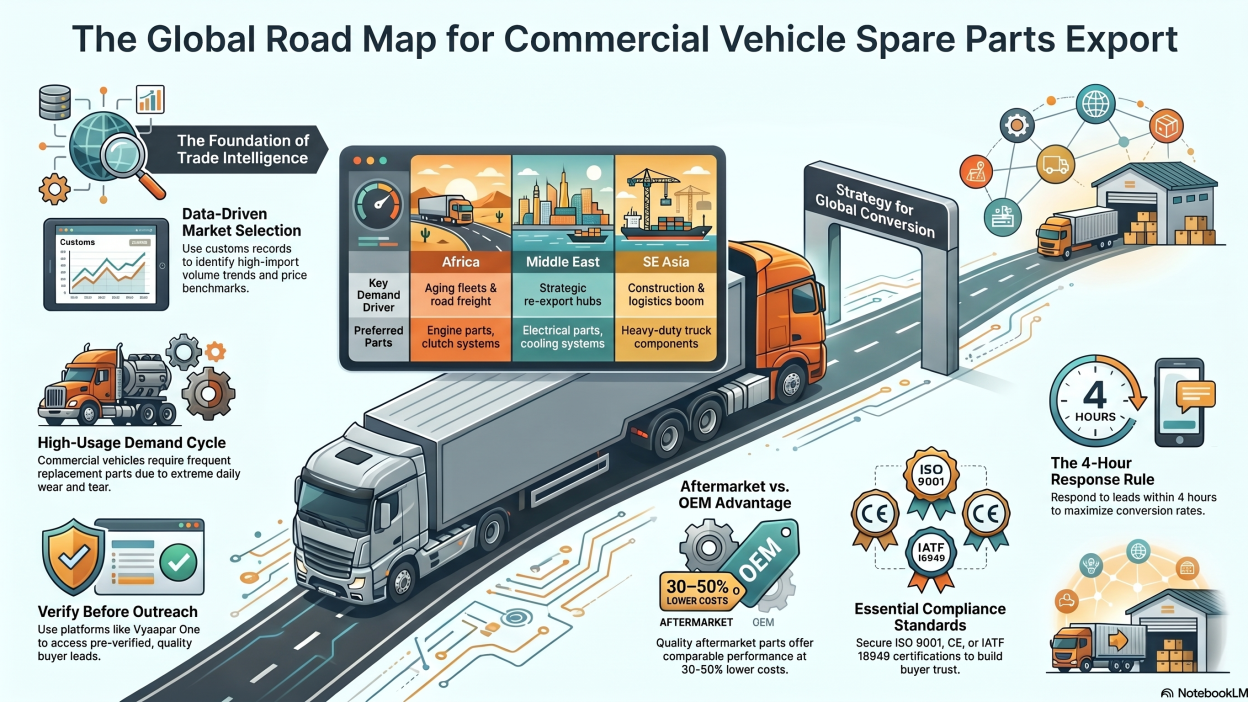
The global spare parts market splits between OEM (Original Equipment Manufacturer) parts and aftermarket alternatives. For export purposes, the aftermarket segment is the larger and faster-growing opportunity. Buyers in price-sensitive markets actively seek quality aftermarket commercial vehicle spare parts that offer performance comparable to OEM parts at 30–50% lower cost.
Understanding this dynamic helps you position your products accurately when responding to spare parts export leads. Highlight quality certifications, material standards, and compatibility data in every export pitch.
How to Read and Use Spare Parts Export Data
What Is Spare Parts Export Data?
Spare Parts Export Data refers to structured trade information derived from customs records, shipping manifests, and official trade databases. This data tells you:
- Which countries are importing specific commercial vehicle spare parts
- The volume and value of shipments over a defined period
- Which suppliers are currently serving those markets
- Price benchmarks and freight trends
Heavy Vehicle Spare Part Export Data is the raw material for strategic decision-making. When you analyze it correctly, it shows you where opportunity exists and where competition is strongest.
How to Analyze Spare Parts Export Data for Business Decisions
Start with the basics. Pull data on your primary product category — say, heavy truck parts like brake systems or suspension components — and filter by destination country. Look for:
- Import volume trends: Is demand rising, stable, or falling?
- Supplier concentration: Are a few large players dominating, or is the market fragmented?
- Price benchmarks: What FOB or CIF prices are buyers paying today?
- Shipping frequency: Are orders seasonal or consistent throughout the year?
Platforms that provide Spare Parts Export Data — including trade intelligence tools and government export portals — can give you this information at a granular level. Cross-reference it with your own capacity and pricing to identify the markets where you can compete effectively.
Combining Export Data with Export Leads
Spare Parts Export Data and spare parts export leads work best together. Data tells you where demand exists. Leads give you the names and contacts of the buyers creating that demand.
A practical workflow looks like this:
- Step 1: Use Heavy Vehicle Spare Part Export Data to identify your top three target countries
- Step 2: Filter Heavy auto parts Export leads for buyers in those countries
- Step 3: Match lead requirements to your product catalog
- Step 4: Personalize outreach with market-specific data points
- Step 5: Track response rates and refine your targeting quarterly
This data-lead combination is one of the most effective strategies for consistent export growth in the commercial vehicle spare parts sector.
Top Global Markets for Heavy Vehicle Spare Parts
Africa: A High-Growth Opportunity
Africa’s commercial vehicle fleet is aging, and road freight is the backbone of intra-continental trade. Countries like Nigeria, Kenya, South Africa, Ethiopia, and Tanzania import significant volumes of heavy truck parts and commercial vehicle spare parts annually.
Key products in demand include engine parts, clutch systems, and brake components. Buyers prefer suppliers who can offer consistent quality, flexible MOQs (minimum order quantities), and reliable delivery timelines. Heavy Vehicle Spare Parts Export leads targeting Africa are among the most active on global trade platforms.
Middle East: High Volume, Quality-Conscious Buyers
The UAE, Saudi Arabia, and Oman are major hubs for vehicle spare parts trade. These markets re-export to neighboring countries, making them strategic entry points for exporters. Middle Eastern buyers are quality-conscious and prefer suppliers with ISO certifications and proven track records.
Spare Parts Export Data shows strong demand for electrical components, suspension parts, and cooling systems for trucks and buses. The Middle East also has a significant construction equipment sector, creating parallel demand for heavy auto parts used in machinery like excavators and loaders.
Southeast Asia: Volume-Driven Markets
Countries like Vietnam, Indonesia, the Philippines, and Myanmar have rapidly growing logistics and construction sectors. They import large volumes of commercial vehicle spare parts, particularly for heavy-duty trucks and public transport vehicles.
For exporters targeting this region, Heavy Truck Parts Export leads from Southeast Asia typically involve high-volume repeat orders. Building long-term relationships with buyers here can translate into stable, recurring export revenue.
Latin America: Emerging Potential
Brazil, Colombia, and Mexico operate large commercial vehicle fleets. While these markets have some domestic production capacity, they still import substantial volumes of heavy auto parts — especially for older truck models that are no longer supported by local OEM supply chains.
Spare Parts Export Data for Latin America shows growing demand for transmission parts, engine rebuild kits, and body components. Exporters who can navigate import regulations and establish reliable distribution partnerships will find strong long-term opportunities here.
How to Generate Heavy Vehicle Spare Parts Export Leads
Use Trade Intelligence Platforms
Trade intelligence platforms aggregate customs data and buyer inquiry data to give exporters a ready pool of Heavy Vehicle Spare Parts Export leads. Platforms like Vyaapar One make this process seamless by curating leads based on your product categories, target markets, and business size.
When using these platforms, filter leads by:
- Product HS code (harmonized system code for commercial vehicle spare parts)
- Country of destination
- Buyer size and order volume
- Lead recency (fresh leads convert faster)
Participate in International Trade Fairs
Physical and virtual trade fairs remain one of the most powerful lead generation tools for heavy auto parts exporters. Events like Automechanika (Germany), AAPEX (USA), and Automechanika Dubai draw thousands of qualified buyers from across the globe.
At these events, you can collect direct buyer contacts, showcase your product range, and convert inquiries into formal spare parts export leads within days. Follow up within 48 hours of any trade event to maximize conversion.
Leverage Government Export Promotion Bodies
India’s EEPC (Engineering Export Promotion Council) and APEDA, along with global equivalents, regularly publish export opportunity listings and buyer inquiries for vehicle spare parts. These are often free or low-cost resources that give you legitimate spare parts export leads backed by government-verified buyer data.
Build a Digital Presence Optimized for International Buyers
Many Heavy Truck Parts Export leads now begin with an online search. Buyers use Google, Alibaba, and industry-specific portals to find suppliers. A well-optimized product catalog on your website and on B2B marketplaces ensures that your business appears when buyers search for heavy auto parts suppliers in your region.
How to Buy Car Parts Online for Wholesale Export
The Shift to Digital Sourcing
The ability to buy car parts online has transformed sourcing for both domestic buyers and international importers. Digital-first platforms now allow buyers to compare prices, view product certifications, and place orders — all without visiting a physical market or trade fair.
For exporters, this shift means that your digital catalog and online presence directly influence whether you receive spare parts export leads from international buyers. A professionally managed online storefront builds buyer confidence and increases inquiry volumes.
How Online Procurement Works for Commercial Parts
When buyers decide to buy car parts online for large commercial vehicle fleets, they typically follow this process:
- Search for verified suppliers by product type and country
- Request product specifications and certificates (ISO, TS 16949, CE)
- Compare pricing for FOB, CIF, and DDP terms
- Request sample shipments before placing bulk orders
- Negotiate payment terms (LC, TT, advance payment)
- Place orders and track shipments through supplier portals
Exporters who streamline this buyer journey — with clear product listings, fast response times, and readily available documentation — convert far more spare parts export leads into actual orders.
Platforms Where Buyers Source Heavy Auto Parts Online
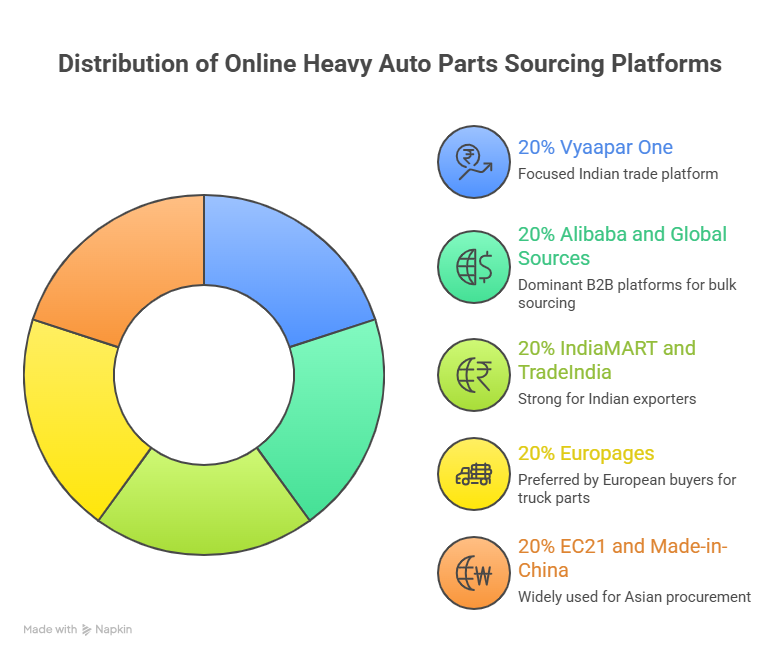
Key platforms where buyers look to buy car parts online for commercial fleets include:
- Vyaapar One: A focused trade platform connecting Indian suppliers with export buyers through curated spare parts export leads
- Alibaba and Global Sources: Dominant B2B platforms for bulk commercial vehicle spare parts sourcing
- IndiaMART and TradeIndia: Strong for Indian exporters of heavy auto parts
- Europages: Preferred by European buyers for heavy truck parts sourcing
- EC21 and Made-in-China: Widely used for Asian spare parts procurement
Your product listings on these platforms must include complete technical specifications, high-resolution images, packaging details, and MOQ information to maximize inquiry conversion.
Building a Winning Export Strategy for Commercial Vehicle Spare Parts
Define Your Product-Market Fit
Not every commercial vehicle spare parts exporter should target every market. Start by identifying the intersection of three factors:
- Products where you have a clear quality and pricing advantage
- Markets where Heavy Vehicle Spare Part Export Data shows strong import demand
- Countries where your logistics partners offer reliable and cost-effective shipping
This product-market fit analysis ensures that your export efforts are concentrated where you have the highest probability of success.
Price Your Parts Competitively for International Markets
International buyers of heavy truck parts and heavy auto parts typically benchmark prices across three or four suppliers before committing. Your pricing must account for:
- Production cost and margin
- Export packing and labeling
- Freight and insurance (CIF or FOB terms)
- Import duties in the destination country
- Currency exchange fluctuations
Use Spare Parts Export Data to benchmark your prices against competitors currently serving your target markets. Being 10–15% below market rate while maintaining quality is often the tipping point that converts a prospect into a regular buyer.
Build Certifications That Buyers Demand
Serious buyers of commercial vehicle spare parts demand certifications before placing large orders. The most important include:
- ISO 9001:2015: Quality management system certification
- TS 16949 / IATF 16949: Automotive quality management standard
- CE Marking: Required for exports to European markets
- REACH Compliance: Chemical safety compliance for EU exports
- Country-specific certifications: Some markets require additional local approvals
Having these certifications readily documented shortens the buyer verification process and increases the speed at which spare parts export leads convert into closed deals.
Create a Follow-Up System for Export Leads
Many spare parts export leads go cold because exporters fail to follow up consistently. A structured follow-up system should include:
- Initial response within 4 hours of receiving a lead
- Customized product proposal within 24 hours
- Sample shipment coordination within 5 business days
- Pricing negotiation and terms finalization within 2 weeks
- Post-sample follow-up call to confirm quality satisfaction
Using a CRM (Customer Relationship Management) system to track all Heavy Vehicle Spare Parts Export leads ensures that no opportunity falls through the cracks.
Key Challenges in Spare Parts Export and How to Solve Them
Challenge 1: Finding Verified Buyers
Solution: Use curated platforms like Vyaapar One that pre-verify buyer inquiries before sharing spare parts export leads. This filters out time-wasting inquiries and focuses your efforts on serious buyers.
Challenge 2: Navigating Customs and Documentation
Exporting commercial vehicle spare parts involves significant paperwork — commercial invoices, packing lists, certificates of origin, technical documentation, and compliance certificates. Mistakes in documentation cause shipment delays and demurrage costs.
Solution: Partner with a licensed customs house agent (CHA) and invest in export management software that automates document generation based on your shipment details.
Challenge 3: Quality Disputes and Returns
International buyers of heavy truck parts have no room for parts that fail in the field. A single quality dispute can cost you a long-term buyer relationship.
Solution: Implement pre-shipment inspection protocols. Third-party inspection agencies can verify product quality before goods leave your facility, giving buyers confidence and reducing the risk of costly returns.
Challenge 4: Currency Fluctuation Risk
Exchange rate movements can erode your export margins significantly when you are selling heavy auto parts in foreign currencies.
Solution: Use forward contracts or currency hedging tools to lock in exchange rates for large orders. Invoice in USD where possible, as it is the most stable and widely accepted export currency.
Challenge 5: Building Buyer Trust in New Markets
New buyers in unfamiliar markets are naturally cautious. They are reluctant to send advance payments to unknown commercial vehicle spare parts suppliers.
Solution: Offer smaller trial orders, use Letters of Credit (LC) for payment security, and build a portfolio of testimonials and case studies from existing export clients. Registering with recognized export bodies and using escrow payment services also helps establish trust.
How Vyaapar One Helps You Find Export Leads
A Dedicated Platform for Indian Exporters
Vyaapar One is designed specifically to help Indian businesses connect with verified international buyers across multiple sectors, including commercial vehicle spare parts, heavy truck parts, and heavy auto parts. The platform aggregates and curates spare parts export leads to help exporters move from prospecting to pitching in the shortest possible time.
Key Features for Spare Parts Exporters
- Verified Buyer Database: Access to Heavy Vehicle Spare Parts Export leads sourced from real buyer inquiries, trade events, and customs data
- Spare Parts Export Data Insights: Market-level analysis powered by Heavy Vehicle Spare Part Export Data to help you identify demand trends before entering a new market
- Lead Filtering Tools: Filter Heavy Truck Parts Export leads and Heavy auto parts Export leads by country, product type, order volume, and buyer verification status
- Supplier Profile Management: Build a credible supplier profile that attracts inbound spare parts export leads from international buyers searching for vehicle spare parts on the platform
- Export Advisory Support: Guidance on documentation, compliance, and pricing to help you convert leads into completed export deals
Why Choose Vyaapar One for Your Export Growth
The commercial vehicle spare parts export market is highly competitive. Success depends on speed, data accuracy, and buyer verification. Vyaapar One addresses all three by combining clean Spare Parts Export Data with a constantly refreshed pool of curated spare parts export leads.
Whether you are looking for your first international buyer or scaling an existing export operation, Vyaapar One gives you the tools to compete globally — without the guesswork.
Conclusion
The global market for commercial vehicle spare parts presents one of the most consistent and scalable export opportunities available to Indian businesses today. With the right combination of spare parts export leads, Spare Parts Export Data, and a disciplined sales strategy, exporters of heavy truck parts and heavy auto parts can build durable, high-revenue international trade relationships.
The key takeaways from this guide are straightforward: use data before entering new markets, invest in verified spare parts export leads rather than random cold outreach, ensure your certifications are in order, and build a digital presence that helps international buyers find you.
Platforms like Vyaapar One make this entire process faster and more reliable — from discovering your first Heavy Vehicle Spare Parts Export lead to closing repeat orders from trusted international buyers.
Start exploring your export potential today. Your next buyer is already looking for exactly what you manufacture — make sure they can find you.
Frequently Asked Questions
1. What types of commercial vehicle spare parts are most in demand for export?
Engine components, braking systems, suspension parts, transmission components, and electrical parts are consistently in high demand across global markets. Heavy truck parts such as clutch assemblies, brake drums, and engine gaskets have particularly strong export demand from Africa, the Middle East, and Southeast Asia.
2. How do I get genuine spare parts export leads?
You can access genuine spare parts export leads through trade intelligence platforms like Vyaapar One, government export promotion councils, B2B marketplaces, and international trade fairs. Always verify lead authenticity before investing significant sales resources.
3. What documents are required to export heavy auto parts from India?
Core documents include: commercial invoice, packing list, bill of lading, certificate of origin, shipping bill, and any technical compliance certificates required by the destination country. Some markets require additional product-specific certifications.
4. How is Spare Parts Export Data useful for my business?
Spare Parts Export Data reveals import demand trends, buyer countries, competitor suppliers, and price benchmarks. It helps you prioritize markets, set competitive prices, and identify gaps in global supply that your products can fill.
5. Can small exporters access Heavy Vehicle Spare Part Export Data?
Yes. Several platforms offer Heavy Vehicle Spare Part Export Data at different subscription levels, making it accessible for small and medium exporters. Vyaapar One offers scalable plans that suit businesses at every stage of export growth.
6. What is the best way to find buyers to buy car parts online?
List your products on established B2B platforms, optimize your online catalog with full specifications and certifications, and use a dedicated trade platform like Vyaapar One to connect with buyers who are actively looking to buy car parts online for commercial fleet maintenance and distribution.
7. What certifications do I need to export commercial vehicle spare parts?
The minimum recommended certifications are ISO 9001:2015 and IATF 16949. For European markets, CE marking and REACH compliance are essential. Always check the specific import requirements of your target country before shipping.