Introduction
India is one of the world’s most dynamic manufacturing hubs. From textiles and pharmaceuticals to electronics and heavy machinery, manufacturers in India produce a staggering range of products at globally competitive prices. But with thousands of vendors spread across the country, the real challenge is knowing how to find manufacturers that are genuinely reliable, quality-focused, and scalable enough to grow with your business.
Whether you are a startup placing your first order or an established enterprise looking to diversify your supply chain, sourcing from India can be a game-changer — if done right. This guide walks you through every proven strategy to find reliable suppliers in India, evaluate them properly, and build long-term partnerships that deliver consistent value.
Why India Is a Top Destination for Global Sourcing
Before diving into the how, it is worth understanding the why. India’s manufacturing sector has expanded dramatically in recent years, supported by government programs like “Make in India” and “PLI” (Production Linked Incentive) schemes. These initiatives have attracted global investment and modernized facilities across multiple industries.
Here is what makes India stand out as a sourcing destination:
- Cost competitiveness: Labor costs in India remain significantly lower than in the US, Europe, and even China for many product categories.
- English proficiency: Most Indian manufacturers communicate fluently in English, reducing friction in negotiations and project management.
- Diverse industrial base: India manufactures everything from bulk commodities to precision engineering components.
- Large supplier ecosystem: Hundreds of thousands of manufacturers operate across industrial clusters in cities like Pune, Surat, Ludhiana, Coimbatore, and Ahmedabad.
- Regulatory improvements: Ease of doing business has improved significantly, making cross-border trade smoother.
For businesses looking to find a manufacturer that balances quality, cost, and reliability, India offers a compelling proposition.
Step 1: Define Your Manufacturing Requirements Clearly
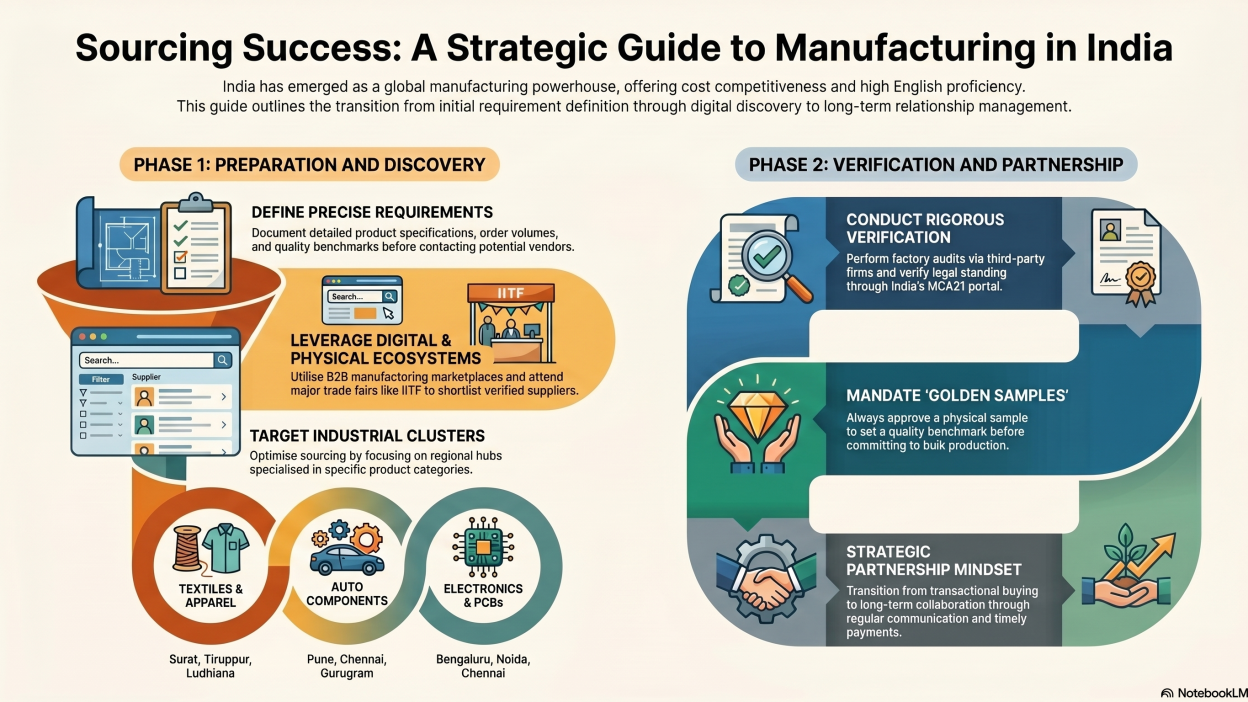
The most common mistake businesses make when trying to find a manufacturer is starting the search before they have defined exactly what they need. Vague inquiries attract vague vendors.
Before reaching out to a single supplier, document the following:
Product Specifications
Write a detailed product brief. Include dimensions, materials, tolerances, finishes, certifications needed (ISO, CE, BIS, etc.), and packaging requirements. The more specific you are, the more accurately a manufacturer can quote — and the easier it is to compare suppliers on equal footing.
Order Volume
Are you placing a trial order of 100 units or a monthly order of 50,000? Your order volume directly affects which manufacturers are willing to work with you and at what price. Larger manufacturers often have high minimum order quantities (MOQs), while smaller workshops are more flexible but may lack capacity to scale.
Quality Standards
What quality benchmarks must your product meet? If you are sourcing for export, you may need compliance with international standards. Define your acceptable defect rate (AQL level), inspection preferences, and whether you need factory audits before production begins.
Timeline and Delivery
Do you need products in 30 days or 90 days? Production lead times vary by product category and factory workload. Being upfront about your deadlines filters out suppliers who cannot meet them.
This groundwork makes every subsequent step far more efficient and dramatically increases your chances of finding reliable suppliers who fit your actual needs.
Step 2: Use a B2B Manufacturing Marketplace to Discover Suppliers
The fastest and most structured way to find manufacturers in India today is through a dedicated B2B manufacturing marketplace. These platforms aggregate verified suppliers, provide product listings, enable RFQ (Request for Quotation) submissions, and often offer tools for comparing vendors side by side.
What Is a B2B Manufacturing Platform?
A B2B manufacturing platform is a digital ecosystem connecting buyers with industrial suppliers and manufacturers. Unlike general e-commerce sites, these platforms are built specifically for bulk procurement, custom manufacturing, and long-term business partnerships.
Top features to look for in a B2B manufacturing platform include:
- Verified supplier profiles with factory certifications and export history
- RFQ tools for sending the same brief to multiple manufacturers simultaneously
- Product catalogues with pricing indicatives and lead times
- Buyer reviews and ratings from previous clients
- Sample order facilitation before committing to bulk production
- Escrow or trade finance options for secure transactions
Using such a platform reduces the time to find a manufacturer from weeks of cold outreach to just a few days of structured discovery.
Benefits of Using a B2B Manufacturing Marketplace
Compared to cold-calling factories or hiring sourcing agents, a B2B manufacturing marketplace offers several clear advantages:
- Transparency: Supplier credentials, certifications, and production capacity are publicly listed.
- Speed: You can contact dozens of verified manufacturers with a single RFQ.
- Trust signals: Platforms invest in verifying suppliers, reducing the risk of dealing with fraudulent vendors.
- Price benchmarking: Multiple quotes allow you to understand what fair market pricing looks like.
- Traceability: Digital communication logs make it easier to manage supplier relationships over time.
For businesses learning how to find a supplier in India, using a dedicated B2B platform is now the industry-standard starting point.
Step 3: Leverage Industrial Clusters and Trade Directories
India’s manufacturing strength is concentrated in specific geographic clusters. Knowing where to look by product category can dramatically narrow your search and connect you with specialized manufacturers.
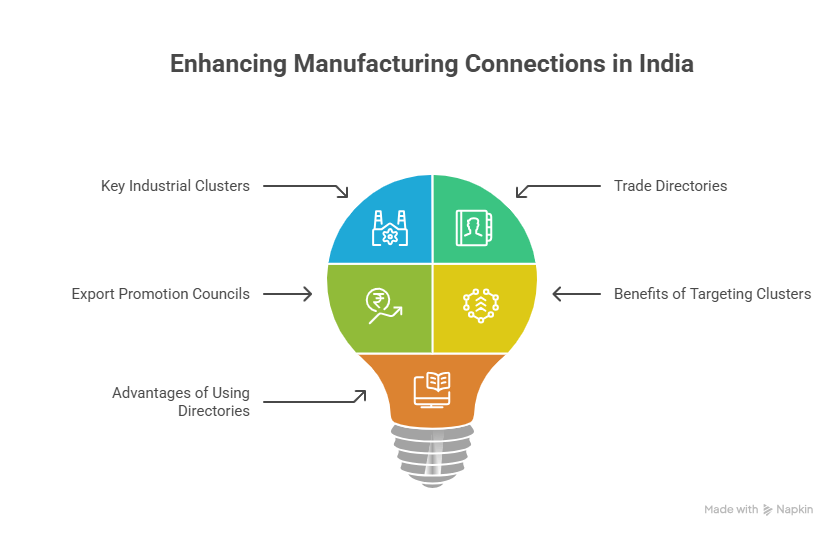
Key Industrial Clusters in India
| Product Category | Major Manufacturing Hubs |
| Textiles & Apparel | Surat, Tiruppur, Ludhiana, Jaipur |
| Auto Components | Pune, Chennai, Gurugram, Nashik |
| Pharmaceuticals | Hyderabad, Ahmedabad, Mumbai |
| Electronics & PCBs | Bengaluru, Noida, Chennai |
| Leather Goods | Agra, Kanpur, Chennai |
| Engineering & Machinery | Coimbatore, Rajkot, Faridabad |
| Gems & Jewellery | Surat, Jaipur, Mumbai |
| Plastics & Packaging | Daman, Haridwar, Ahmedabad |
Targeting the right cluster ensures you are dealing with manufacturers who have deep expertise in your product category, access to the right raw materials, and an established network of sub-contractors.
Trade Directories and Export Promotion Councils
India’s government-backed Export Promotion Councils (EPCs) maintain directories of registered exporters and manufacturers. These include:
- FIEO (Federation of Indian Export Organisations)
- EEPC India (Engineering Export Promotion Council)
- APEDA (Agricultural and Processed Food Products Export Development Authority)
- TEXPROCIL (Cotton Textiles Export Promotion Council)
Searching these directories gives you access to manufacturers who are already experienced in international trade, export documentation, and quality compliance.
Step 4: Attend Trade Fairs and Industry Exhibitions
Physical presence still matters when learning how to find manufacturers. India hosts several large-scale trade exhibitions throughout the year where you can meet hundreds of manufacturers under one roof, inspect samples in person, and build relationships that no digital platform can fully replicate.
Major Trade Fairs in India for Sourcing
- India International Trade Fair (IITF) – New Delhi, November
- Vibrant Gujarat Summit – Gandhinagar, biannual
- India Garment Fair – Multiple cities
- Auto Expo – Greater Noida, biannual
- Plastindia – Gandhinagar
- IMTEX (Machine Tools) – Bengaluru
If traveling to India is not feasible, India-based manufacturers frequently exhibit at international trade shows in Dubai (GITEX, Arab Health), Germany (Hannover Messe), and the United States (MAGIC, CES).
Meeting a manufacturer in person, seeing their samples, and having direct conversations builds the kind of trust that shortens due diligence time significantly.
Step 5: Conduct Rigorous Supplier Verification
Once you have a shortlist of potential manufacturers from your B2B manufacturing platform searches, directories, or trade show contacts, the real work of verification begins. This is where many buyers cut corners — and it is also where most sourcing problems originate.
Company Registration and Legal Standing
Always verify that the manufacturer is a legitimate, registered business. In India, companies are registered under the Ministry of Corporate Affairs (MCA). You can use the MCA21 portal to look up a company’s registration number, directors, and filing history.
Ask for:
- GST registration certificate
- Import Export Code (IEC) if sourcing for export
- Company registration certificate
- PAN card (for Indian tax purposes)
Factory Audit
For orders above a certain value, a factory audit is non-negotiable. A factory audit involves physically visiting the manufacturer’s facility — or hiring a third-party inspection firm to do so — to verify:
- Production capacity: Does the factory have the machines and manpower to fulfill your order on time?
- Quality management systems: Is there a documented QC process? Do they conduct in-process inspections?
- Working conditions: Compliance with labor laws protects your brand reputation.
- Raw material sourcing: Do they source materials from reliable, traceable vendors?
Third-party audit firms like SGS, Bureau Veritas, QIMA, and Intertek have a strong presence in India and can conduct audits on your behalf within a week.
Reference Checks and Buyer Reviews
Ask every shortlisted manufacturer for references from existing international clients. A genuine, reliable manufacturer will have multiple buyers they have worked with and will not hesitate to share contacts.
On B2B platforms, pay close attention to verified buyer reviews, response rates, and the age of the supplier profile. A manufacturer with years of consistent reviews is a far safer bet than a newly listed vendor with no track record.
Step 6: Request Samples Before Committing to Bulk Orders
No matter how impressive a manufacturer’s profile, factory, or pitch looks, always order samples before placing a bulk purchase order. Samples serve several critical purposes:
- They reveal the actual quality of materials and workmanship.
- They allow you to test the product against your specifications.
- They confirm the manufacturer’s understanding of your brief.
- They set the quality benchmark for future production batches.
When placing a sample order, be very specific about the exact specifications you want the sample to meet. Once approved, document that approved sample thoroughly — photos, measurements, materials — so it becomes your golden sample for quality control during mass production.
Reputable manufacturers will also be transparent about sample lead times and costs. Be cautious of vendors who rush sample delivery or show reluctance to make minor modifications.
Step 7: Negotiate Terms and Draft a Clear Purchase Agreement
Once you have found a manufacturer who passes verification and sample approval, formalizing the relationship with a clear agreement protects both parties.
Key Terms to Negotiate
- Price per unit based on agreed specifications and order volume
- Minimum Order Quantity (MOQ) and flexibility for scaling
- Payment terms: Typical structures include 30% advance + 70% before shipment, or LC (Letter of Credit) for larger orders
- Lead time and delivery milestones
- Quality acceptance criteria and AQL levels
- Penalty clauses for late delivery or quality failures
- IP protection: Especially important if your product design is proprietary
Use Written Contracts
Verbal agreements are common in India’s business culture, but for international trade, always insist on a written Purchase Order (PO) and ideally a Supplier Agreement. This document should be governed by mutually agreed jurisdiction and include dispute resolution mechanisms.
Step 8: Build Long-Term Supplier Relationships
Finding reliable suppliers is not a one-time event — it is an ongoing relationship management process. The manufacturers who become your most valuable partners are those with whom you invest time, communication, and mutual respect.
Best Practices for Supplier Relationship Management
- Communicate regularly: Even between orders, stay in touch with your key suppliers. Share your business roadmap so they can plan their capacity accordingly.
- Pay on time: Timely payments build enormous goodwill and often result in priority treatment during peak production seasons.
- Provide feedback: After every order, give constructive feedback on quality, delivery, and communication. The best manufacturers will use this to improve.
- Visit periodically: Annual or biannual factory visits maintain the relationship and allow you to see firsthand how the facility evolves.
- Avoid over-dependence: Qualify at least two manufacturers for each critical product category to protect your supply chain from disruptions.
Businesses that treat their Indian manufacturers as strategic partners — rather than transactional vendors — consistently report better quality, priority lead times, and preferential pricing over time.
Common Mistakes to Avoid When Sourcing from India
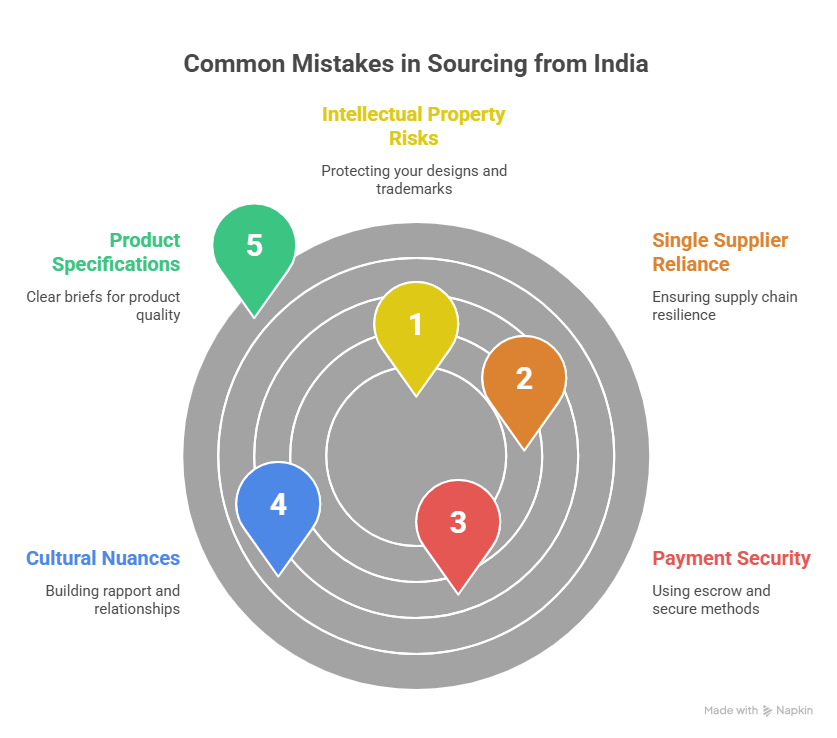
Even experienced procurement professionals make avoidable mistakes. Here are the most common pitfalls when trying to find manufacturers in India:
- Choosing the lowest price without verification: A significantly cheaper quote is often a red flag, not a bargain.
- Skipping factory audits: Visiting or auditing a factory before placing a bulk order is non-negotiable for first-time suppliers.
- Poor product specifications: Vague briefs lead to products that do not meet expectations. Over-communicate in writing.
- Ignoring cultural nuances: Indian business culture values relationship-building. Rushing into transactions without building rapport can backfire.
- Not using escrow or secure payment methods: Always use traceable, secure payment channels for international transfers.
- Relying on a single supplier: Supply chain resilience requires qualified backup suppliers.
- Ignoring intellectual property risks: Register trademarks and designs before sharing sensitive product information with manufacturers.
Conclusion
India’s vast and diverse manufacturing ecosystem offers genuine opportunities for businesses of all sizes — but only for those who approach sourcing systematically. Knowing how to find manufacturers in India is ultimately about combining smart digital tools with rigorous due diligence, clear communication, and long-term relationship thinking.
Start by defining your requirements precisely. Use a B2B manufacturing platform to discover and shortlist verified suppliers efficiently. Verify credentials, audit factories, and always order samples before committing to bulk production. Then, formalize agreements, pay on time, and treat your best manufacturers as strategic partners.
Finding reliable suppliers in India is not just a procurement task — it is a competitive advantage. Businesses that master this process unlock cost-effective, scalable manufacturing that fuels growth for years to come.
Frequently Asked Questions
How do I find a manufacturer in India without visiting in person?
Use a trusted B2B manufacturing platform to discover verified suppliers, submit RFQs, and review credentials digitally. Hire a third-party inspection firm to conduct factory audits and sample inspections on your behalf. Video calls, virtual factory tours, and reference checks can supplement the process.
What is the best B2B manufacturing marketplace for India?
Several platforms specialize in connecting international buyers with Indian manufacturers. The best B2B manufacturing marketplace for your needs depends on your product category. Look for platforms that offer supplier verification, RFQ tools, and buyer protection mechanisms.
How long does it take to find reliable suppliers in India?
With a clear product brief and the right platform, you can shortlist manufacturers within 1–2 weeks. Verification, sampling, and negotiation typically add another 4–8 weeks before your first order is placed.
What payment terms are standard with Indian manufacturers?
The most common payment structure is 30% advance + 70% before shipment for smaller orders. Larger buyers often use Letters of Credit (LC). Always use bank transfers or trade finance instruments — avoid cash payments.
Is MOQ negotiable with Indian manufacturers?
Yes, especially for first-time buyers who demonstrate growth potential. Starting with a small trial order at a higher per-unit price, with a clear roadmap to scale volume, is a widely accepted approach among reputable manufacturers.