Introduction
Small businesses have always faced an uphill battle when it comes to competing with larger corporations. Limited budgets, restricted supplier networks, and a lack of international reach have historically kept small enterprises locked in local markets. Today, that story is changing — fast.
Thanks to the rise of the b2b online marketplace, small businesses now have the same access to global buyers, verified suppliers, and bulk procurement tools that were once reserved only for industry giants. Whether you are a manufacturer, wholesaler, retailer, or service provider, a b2b online marketplace can be your most powerful growth engine in 2024 and beyond.
This comprehensive guide covers everything you need to know — what a B2B marketplace is, how to use one strategically, the measurable benefits it brings to small businesses, and how to select the best platform for your specific goals. By the end, you will understand exactly why thousands of small businesses are scaling faster than ever using these digital trade platforms.
What Is a B2B Online Marketplace?
Defining the B2B Online Marketplace
A b2b online marketplace is a digital platform where businesses buy from and sell to other businesses. Unlike B2C (business-to-consumer) platforms like Amazon or eBay — which connect sellers directly to individual shoppers — a b2b online marketplace focuses exclusively on business transactions: bulk orders, wholesale deals, sourcing agreements, and long-term supplier relationships.
Think of it as a virtual trade fair that never closes. Thousands of verified buyers and sellers meet on a single platform, negotiate deals, place orders, and manage transactions — all without leaving their office.
Well-known examples include Alibaba, IndiaMART, Global Sources, ThomasNet, and TradeIndia. Each of these operates as a global b2b marketplace, enabling cross-border commerce at scale. Sellers from India, China, the United States, and dozens of other countries list their products, while buyers from around the world browse, compare, and order from a single digital hub.
How B2B Differs from B2C
Understanding the distinction matters for small businesses making strategic decisions:
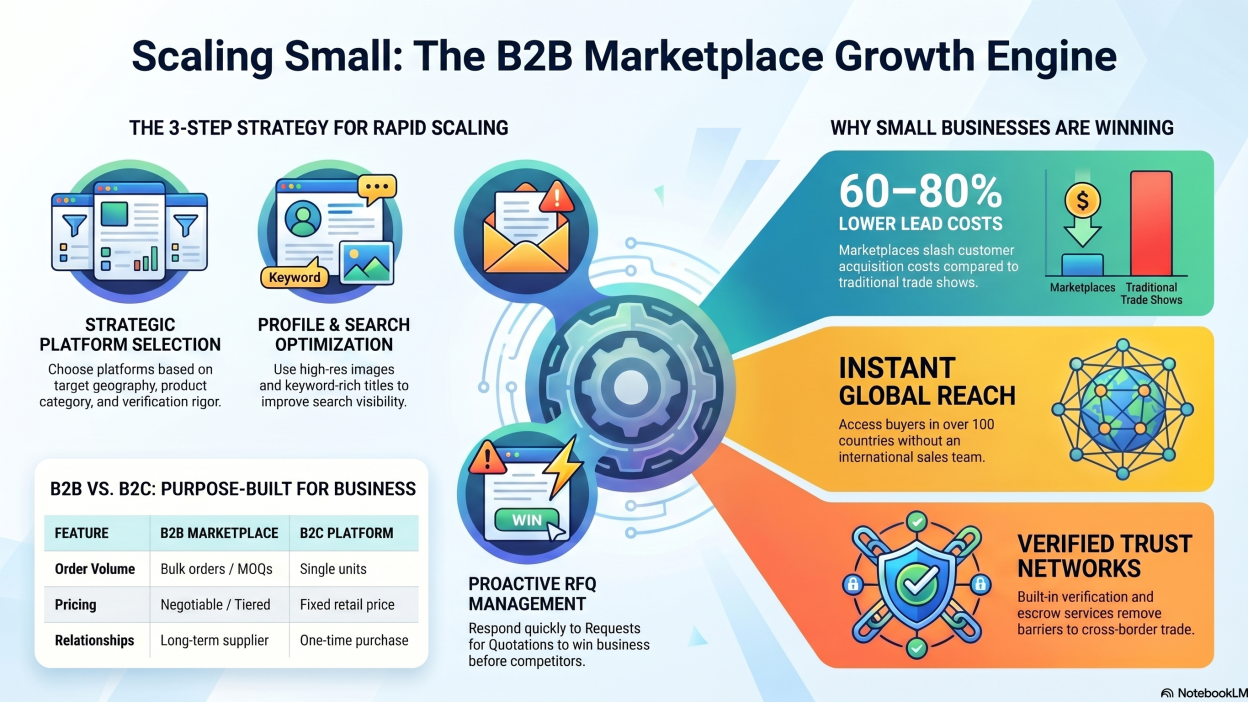
| Feature | B2B Online Marketplace | B2C Platform |
| Buyer Type | Businesses, wholesalers, retailers | Individual consumers |
| Order Volume | Bulk orders, MOQs | Single units |
| Pricing | Negotiable, tiered, wholesale | Fixed retail price |
| Relationships | Long-term supplier-buyer | One-time purchase |
| Product Listings | Technical specs, trade terms | Consumer-friendly |
For small businesses seeking suppliers, expanding distribution, or tapping into international demand, a b2b online marketplace is purpose-built for those needs.
The Scale of the Global B2B Marketplace
The numbers speak loudly. The global B2B eCommerce market was valued at over $18 trillion in 2023 and is projected to grow at a compound annual growth rate (CAGR) of over 18% through 2030. The global b2b marketplace is no longer a niche concept — it is the backbone of international trade.
Small businesses that tap into this ecosystem gain access to a pool of buyers and suppliers they could never reach through traditional channels. They compete on equal footing with larger enterprises, simply by listing on the right b2b marketplace platform.
How a B2B Online Marketplace Works
The Core Mechanics
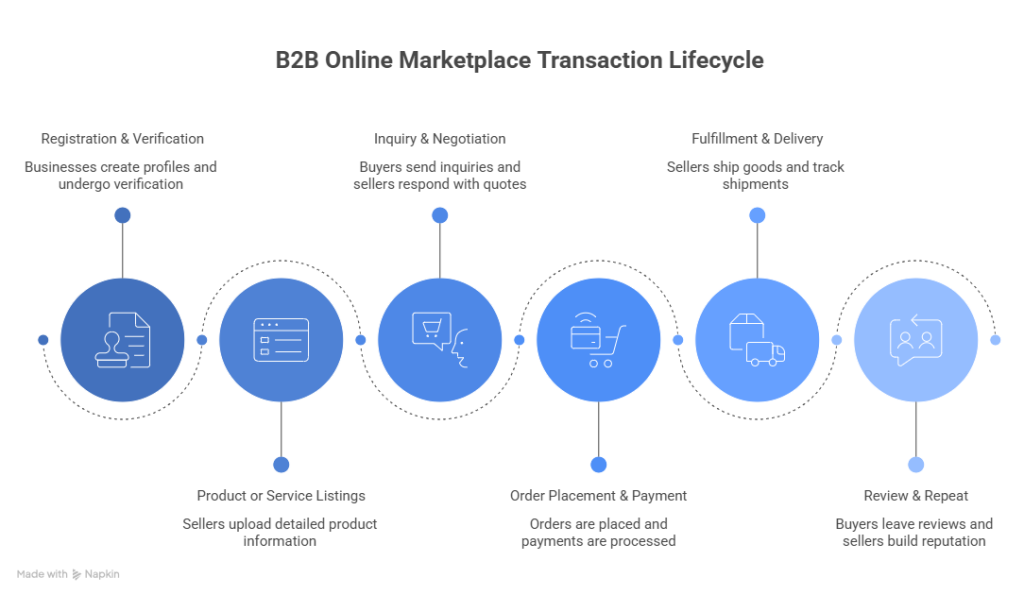
A b2b online marketplace connects buyers and sellers through a structured digital platform. Here is a simplified view of how the typical transaction lifecycle unfolds:
Step 1 — Registration & Verification: Businesses create a profile on the platform. Most reputable platforms verify company legitimacy, trade licenses, and contact information. This builds trust between parties.
Step 2 — Product or Service Listings: Sellers upload detailed product listings, including specifications, minimum order quantities (MOQs), pricing tiers, shipping terms, and photos. Buyers browse these listings using filters and search functions.
Step 3 — Inquiry & Negotiation: Interested buyers send inquiries or Request for Quotations (RFQs). Sellers respond with custom quotes. Unlike B2C platforms, pricing is often negotiable, especially for high-volume orders.
Step 4 — Order Placement & Payment: Once terms are agreed upon, orders are placed through the platform. Payment systems range from bank transfers and letters of credit to platform-managed escrow services that protect both parties.
Step 5 — Fulfillment & Delivery: Sellers ship the goods. Advanced b2b marketplace platforms often include logistics tools, freight calculators, and shipment tracking.
Step 6 — Review & Repeat: Buyers leave ratings and reviews. Successful transactions build seller reputation, which attracts more buyers. Strong relationships lead to repeat orders and long-term contracts.
The Role of Technology
Modern b2b marketplace platforms use artificial intelligence, machine learning, and data analytics to improve the buyer-seller matching process. AI-driven recommendation engines suggest relevant products to buyers. Predictive analytics help sellers identify high-demand periods. Automated RFQ systems reduce manual effort. These technology layers make the best b2b marketplace platform far more efficient than traditional trade directories or in-person trade shows.
How to Use a B2B Marketplace Platform to Grow Your Small Business
Step 1: Choose the Right B2B Online Marketplace
Not all platforms are created equal. The first and most critical step is identifying the best online b2b marketplace that aligns with your industry, target geography, and business model.
Ask yourself:
- Are you primarily buying or selling — or both?
- Which regions or countries are your target markets?
- Does the platform specialize in your product category (electronics, textiles, food, machinery, etc.)?
- What are the fees and subscription models?
Research platforms like Alibaba (global reach), IndiaMART (South Asia focused), Global Sources (Asia-Pacific), and ThomasNet (North America industrial). Compare their buyer traffic, seller tools, and trust mechanisms before committing.
Step 2: Build a Complete and Compelling Seller Profile
Your profile on a b2b online marketplace is your digital storefront. An incomplete profile is the single biggest mistake small businesses make. Buyers make instant judgments based on what they see.
Include:
- Company overview with your founding year, location, certifications, and manufacturing capacity
- High-resolution product images with multiple angles
- Detailed product specifications including materials, dimensions, MOQ, and lead times
- Trade certifications and quality badges (ISO, CE, FDA, etc.)
- Response rate and response time — platforms display these metrics publicly
Profiles with verified credentials, professional photography, and complete descriptions receive significantly more inquiries than incomplete listings.
Step 3: Optimize Your Product Listings for Search
A b2b marketplace platform operates like a search engine. Buyers type in what they need, and the platform’s algorithm decides which listings appear first. Optimize your listings by:
- Using keyword-rich product titles (include material, type, use case)
- Writing detailed descriptions that answer common buyer questions
- Filling in all attribute fields (size, color, certifications, packaging)
- Keeping pricing competitive and clearly structured
- Adding buyer testimonials and trade references
Think of this process like SEO for your storefront — the more relevant and detailed your listings, the higher you rank within the platform.
Step 4: Use the RFQ System Proactively
Most b2b online marketplace platforms include an RFQ (Request for Quotation) system. As a seller, actively monitor this section daily. When a buyer posts an RFQ that matches your product range, respond quickly with a detailed, customized quote.
Speed matters enormously. Buyers often contact the first three to five sellers who respond. A fast, professional response can win you business before the competition even reads the notification.
Step 5: Leverage Paid Promotions and Premium Listings
Organic visibility is valuable, but paid promotion accelerates growth. Most platforms offer:
- Sponsored listings that appear at the top of search results
- Verified supplier badges that increase buyer confidence
- Trade show participation tied to the platform’s online events
- Featured placement in newsletters and email campaigns
For small businesses on limited budgets, start with the most cost-effective paid option and track ROI carefully before scaling spend.
Step 6: Build Long-Term Buyer Relationships
The global b2b marketplace rewards consistency and relationship-building. Once you complete a successful order, do not let that buyer go cold. Follow up with:
- A personal thank-you message
- Details on upcoming product launches
- Loyalty pricing for repeat orders
- Exclusive previews of new inventory
Long-term buyers place larger and more frequent orders. They also refer other buyers. A single strong relationship on a best b2b marketplace platform can be worth more than dozens of one-time transactions.
Step 7: Track Performance and Refine Your Strategy
Every serious b2b online marketplace provides seller analytics. Review your data regularly:
- Which products receive the most views but fewest inquiries? (Pricing or listing quality issue)
- Which categories drive the highest conversion? (Double down here)
- Which geographies send the most buyer traffic? (Prioritize those regions)
- What is your average response time? (Aim for under 24 hours)
Data-driven refinement separates high-performing sellers from those who simply list products and wait.
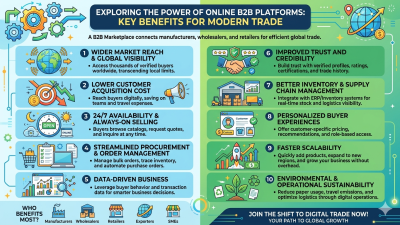
Key Benefits of a B2B Online Marketplace for Small Businesses
Benefit 1: Access to a Global Customer Base
The most transformative benefit of a b2b online marketplace is immediate access to international buyers. A small textile manufacturer in Surat, a furniture maker in Foshan, or a software vendor in Nairobi can each list their offerings on a global b2b marketplace and receive inquiries from buyers in over 100 countries — without a single international sales trip.
This geographic reach was previously possible only for companies with large export departments, international agents, and trade show budgets. Today, it requires nothing more than a well-optimized product listing.
Benefit 2: Lower Cost of Customer Acquisition
Traditional B2B sales involve expensive trade shows, travel, printed catalogs, and dedicated sales teams. A b2b online marketplace slashes this cost dramatically.
Most platforms charge a flat annual subscription or a percentage of transactions. For a fraction of what a single trade show booth costs, a small business gains year-round visibility in front of thousands of active buyers. The cost-per-lead on a best online b2b marketplace is typically 60–80% lower than offline alternatives.
Benefit 3: Verified Buyer and Supplier Networks
Trust is the biggest barrier in B2B trade — especially cross-border. Scams, payment defaults, and quality disputes are real risks. The best b2b marketplace platform addresses this through rigorous verification programs.
Buyers know they are engaging with verified, credible sellers. Sellers know they are dealing with legitimate business buyers. This trust infrastructure removes a major obstacle for small businesses that lack the brand recognition to command trust independently.
Benefit 4: Streamlined Procurement and Sourcing
For small businesses on the buying side, a b2b online marketplace simplifies the entire procurement process. Instead of calling dozens of suppliers, attending trade shows, or relying on personal referrals, buyers can:
- Compare hundreds of suppliers side by side
- Filter by price, MOQ, location, and certifications
- Read verified reviews from other business buyers
- Request samples with a single click
This efficiency reduces sourcing time by days or even weeks, freeing your team to focus on higher-value activities.
Benefit 5: Scalable Infrastructure Without Overhead
Physical expansion — opening new offices, hiring regional sales teams, establishing local warehouses — is expensive and risky. A b2b marketplace platform provides scalable distribution infrastructure without the overhead.
A small business in one city can effectively sell nationally or internationally using a platform’s established buyer network, logistics integrations, and payment systems. Scaling on a digital platform means increasing your product catalog or marketing spend — not hiring 20 new employees.
Benefit 6: Data-Driven Market Insights
The best b2b marketplace platform gives sellers access to market intelligence that was previously available only to large corporations with dedicated research teams. Platforms provide:
- Real-time demand trends by product category
- Buyer behavior analytics
- Competitive pricing benchmarks
- Geographic demand mapping
Small businesses that use this data intelligently can identify new product opportunities, time their promotions strategically, and price competitively — all based on actual market signals rather than guesswork.
Benefit 7: Faster Sales Cycles
Long sales cycles kill momentum for small businesses. Traditional B2B deals can take months to close. On a b2b online marketplace, the buyer has already done their research before contacting you. They know what they want, how much they expect to pay, and when they need delivery.
This pre-qualified intent shortens the sales cycle dramatically. Many deals on the global b2b marketplace close within days of first contact, compared to weeks or months through traditional channels.
Benefit 8: Brand Building at Scale
Consistent presence on a reputable b2b online marketplace builds brand credibility over time. Verified ratings, completed transactions, and buyer testimonials function as social proof. Over time, your profile becomes a powerful brand asset that attracts new buyers organically.
Small businesses that maintain active, high-quality profiles on the best online b2b marketplace often find that inbound inquiries increase naturally — reducing dependence on outbound prospecting.
How to Choose the Best B2B Marketplace Platform
Not every platform is right for every business. Here is a practical framework for selecting the best b2b marketplace platform for your needs:
Evaluate Buyer Traffic Volume
More buyers mean more opportunities. Check the platform’s published statistics on active buyers, monthly visits, and registered members. A larger platform offers more exposure but also more competition. Niche platforms may offer higher conversion rates for specialized products.
Assess Industry and Category Fit
Some platforms are horizontal (all industries) while others are vertical (one industry). Horizontal platforms like Alibaba and Global Sources offer broad reach. Vertical platforms like ThomasNet (industrial manufacturing) or Kompass (B2B directory) offer deeper penetration in specific sectors.
Match the platform to your product category for the best buyer-seller alignment.
Review Trust and Verification Mechanisms
The quality of a b2b marketplace platform is largely determined by how seriously it takes verification. Look for:
- Identity verification for sellers and buyers
- Business license validation
- Trade assurance or escrow payment protection
- Dispute resolution mechanisms
- Buyer review systems
Weak verification means low-quality leads and higher risk. Strong verification signals a trustworthy, professional trading environment.
Compare Pricing and ROI Potential
Marketplace fees vary widely. Some charge a flat annual subscription; others take a transaction commission; many combine both. Compare:
- Subscription tiers and what each includes
- Featured listing and advertising costs
- Payment processing fees
- Value-added services (logistics, trade finance, analytics)
Calculate your break-even point. How many additional orders do you need to recoup your platform investment? If the math works, it is a worthwhile channel.
Check Seller Support and Resources
Especially for small businesses new to digital trade, support matters. The best online b2b marketplace will offer:
- Onboarding assistance and training resources
- Dedicated account managers for premium sellers
- Seller community forums and knowledge bases
- Technical support for listing management
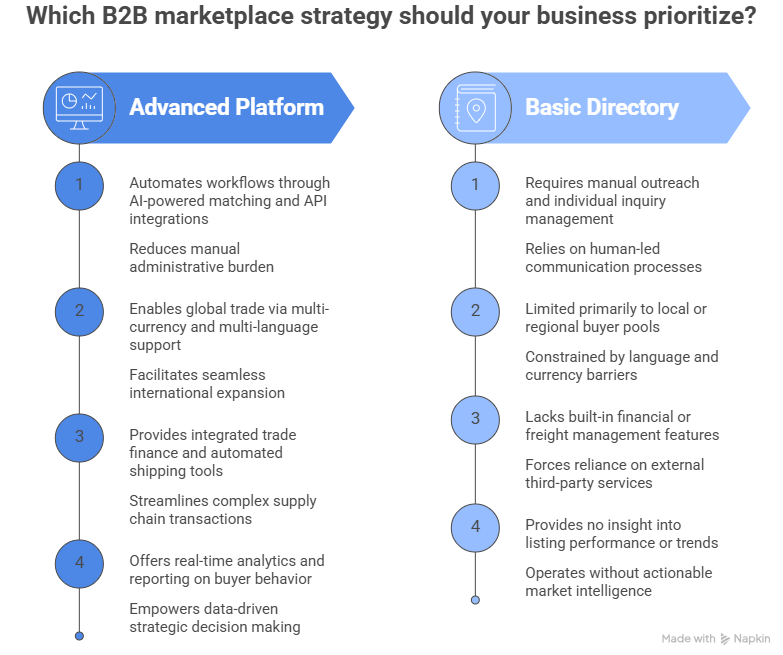
Top Features to Look for in the Best Online B2B Marketplace
When evaluating any b2b online marketplace, these features separate the best from the rest:
- AI-Powered Matching: Algorithms that connect your listings to the most relevant buyers automatically
- Multi-Currency and Multi-Language Support: Critical for accessing international markets
- Integrated Logistics and Shipping Tools: Freight calculators, carrier integrations, tracking systems
- Trade Finance Options: Letters of credit, invoice financing, trade insurance
- Mobile App Availability: Manage your business on the go
- RFQ Management Dashboard: Centralized system for tracking and responding to inquiries
- Analytics and Reporting: Real-time data on listing performance, buyer behavior, and market trends
- API Integration: Connect the marketplace with your ERP, inventory, or CRM system
Small businesses that fully leverage these tools gain a significant competitive advantage over those who treat the platform as a simple listing directory.
Real-World Success Stories: Small Businesses Thriving Globally
Case Study 1: Artisan Textile Exporter Goes Global
A family-owned textile business in Jaipur with fewer than 50 employees listed their handloom products on a global b2b marketplace. Within six months, they received verified inquiries from buyers in Germany, the United States, and Australia. Twelve months later, their export revenue had grown by 340%. Their only new investment was a premium seller subscription on the platform.
Case Study 2: Small Electronics Manufacturer Finds International Distributors
A mid-sized electronics components manufacturer based in Taiwan used a b2b online marketplace to find distributors in Southeast Asia. Traditional outreach had yielded little results for years. On the platform, they connected with five verified distributors in Malaysia, Thailand, and Vietnam within 90 days. International sales now represent 45% of their total revenue.
Case Study 3: Food Ingredients Supplier Cuts Procurement Costs
A specialty food brand in the United States used a b2b marketplace platform to source organic ingredients directly from farmers and processors in India and Turkey. By eliminating multiple middlemen, they reduced their raw material costs by 28% — savings that went directly back into product development and marketing.
These stories are not exceptional — they represent what thousands of small businesses experience when they engage strategically with the right best b2b marketplace platform.
Common Challenges and How to Overcome Them
Challenge 1: Standing Out in a Crowded Marketplace
With thousands of sellers on any given b2b online marketplace, differentiation is critical.
Solution: Invest in professional photography, write detailed and benefit-focused product descriptions, earn and display certifications, and respond to every inquiry within hours. Quality and speed create separation from the competition.
Challenge 2: Managing Cross-Border Communication
Language barriers and time zone differences can slow down deals.
Solution: Use the platform’s built-in translation tools. Keep communication clear and simple. Use bullet points and structured templates for responses. Hire a part-time multilingual customer service representative if your international volume justifies it.
Challenge 3: Navigating International Trade Compliance
Export regulations, customs requirements, and product compliance standards vary by country.
Solution: Partner with a freight forwarder experienced in international trade. Use the platform’s built-in compliance guides. Consult a trade lawyer for markets with complex regulations. Many global b2b marketplace platforms provide trade compliance resources directly in their seller dashboards.
Challenge 4: Building Trust Without Brand Recognition
Small businesses without an established brand face skepticism from international buyers.
Solution: Accumulate reviews and ratings proactively. Offer verified samples at cost. Use the platform’s trade assurance programs. Publish detailed factory inspection reports and third-party quality certifications. Trust is built one successful transaction at a time.
Conclusion
The rise of the b2b online marketplace represents one of the most significant shifts in global trade in a generation. For small businesses, this shift is not just an opportunity — it is a strategic imperative.
Access to international buyers, lower customer acquisition costs, verified supplier networks, and data-driven market intelligence are no longer privileges reserved for large corporations. Every small business with a quality product, a competitive price, and the discipline to build and maintain a strong platform presence can compete on the global b2b marketplace and win.
Whether you are looking to source better raw materials, find new distribution partners, or expand into international markets, the right b2b marketplace platform gives you the tools to grow faster than traditional channels ever could. Selecting the best b2b marketplace platform for your specific industry and geography, optimizing your presence, and committing to consistent engagement will deliver compounding returns over time.
The businesses that act now — building their presence on the best online b2b marketplace, accumulating verified reviews, and forming lasting buyer relationships — will be the ones leading their categories five years from now.
Start your journey on a trusted b2b online marketplace today. Your next best customer is already searching for what you offer.
Frequently Asked Questions
What exactly is a B2B online marketplace?
A b2b online marketplace is a digital platform that enables businesses to buy from and sell to other businesses at scale. Unlike consumer platforms, these marketplaces focus on bulk transactions, wholesale pricing, and long-term supply relationships. Examples include Alibaba, IndiaMART, Global Sources, and ThomasNet.
How is a global B2B marketplace different from a local one?
A global b2b marketplace connects buyers and sellers across multiple countries and continents, enabling international trade. A local B2B platform is limited to a specific region or country. For small businesses seeking to expand beyond their domestic market, a global platform offers dramatically higher growth potential.
What is the best B2B marketplace platform for small businesses?
The best b2b marketplace platform depends on your industry, target geography, and budget. Alibaba is ideal for global reach and manufacturing products. IndiaMART works best for South Asian markets. ThomasNet is strong for North American industrial buyers. The best approach is to test two or three platforms simultaneously before concentrating resources on the one that delivers the best ROI.
How much does it cost to list on a B2B online marketplace?
Costs vary widely by platform. Basic listings on many platforms are free, but premium memberships — which provide higher visibility and advanced selling tools — typically range from $500 to $5,000 per year. Some platforms charge a transaction commission of 2–5% per order. Calculate your expected return before investing in a premium tier.
How do I know if a buyer on a B2B marketplace platform is legitimate?
Reputable b2b marketplace platforms verify buyer identities, trade licenses, and business credentials. Look for buyers with verified badges, a completed profile, and a transaction history on the platform. For large orders, use the platform’s trade assurance or escrow services to protect payment. Never send goods before confirming payment through a secure, platform-approved method.
Can small businesses really compete with large companies on a global B2B marketplace?
Absolutely. The global b2b marketplace levels the playing field in several important ways. Buyers evaluate sellers based on product quality, pricing, response time, and verified ratings — not company size. A small business with excellent products, a well-optimized profile, and fast customer service will consistently outperform a large competitor with a neglected marketplace presence.
What types of businesses benefit most from a B2B online marketplace?
Manufacturers, wholesalers, distributors, raw material suppliers, component makers, and service providers all benefit significantly. The best online b2b marketplace is particularly valuable for businesses in manufacturing, agriculture, textiles, electronics, chemicals, food ingredients, and industrial equipment. Service-based businesses — including software, logistics, and consulting — are also increasingly finding success on these platforms.
How long does it take to see results on a B2B marketplace platform?
Most small businesses begin receiving inquiries within the first four to eight weeks of listing on a well-established b2b marketplace platform. Converting those inquiries into closed orders typically takes an additional one to three months as buyers conduct due diligence, request samples, and finalize trade terms. Patience and persistence are essential — the compounding effect of strong ratings and growing visibility produces increasingly faster results over time.
Is the best online B2B marketplace only for international trade?
Not at all. While the best online b2b marketplace does excel at facilitating international commerce, domestic B2B marketplaces are equally valuable for small businesses seeking national distribution, regional buyers, or cost-effective procurement partners within their own country. Many platforms serve both domestic and international markets simultaneously.
What is the difference between a B2B marketplace platform and a traditional trade directory?
A traditional trade directory is a static listing database — buyers find contact information and reach out offline. A b2b marketplace platform is a fully interactive digital environment with real-time messaging, RFQ systems, payment processing, order management, logistics tools, and analytics. The platform actively facilitates the transaction, while a directory simply facilitates discovery.