Introduction
Manufacturing companies face a unique paradox. They build world-class products but often struggle to find the right buyers. In a marketplace crowded with competitors and evolving buyer behavior, B2B lead generation has become the lifeline for manufacturers who want to grow their order books and scale their business.
Gone are the days when a sales rep with a printed catalog could walk into a buyer’s office and close a deal. Today, procurement managers research suppliers online, compare multiple vendors, and shortlist only those who show up at the right moment with the right message. This is where B2B lead generation platforms play a transformative role.
Whether you run a small metal fabrication unit or a large-scale industrial manufacturer, having a reliable system to attract, identify, and convert business to business leads is no longer optional — it’s mission-critical. This guide walks you through everything you need to know about lead generation for manufacturers, the best platforms available, and how to choose the right b2b lead generation services to fuel your growth.
Let’s get started.
What Is B2B Lead Generation for Manufacturers?
B2B lead generation refers to the process of identifying and attracting potential business customers who may be interested in purchasing your manufacturing products or services. Unlike B2C (business-to-consumer) lead generation, the B2B process is longer, more complex, and involves multiple decision-makers.
For manufacturers, a “lead” typically means a purchasing manager, procurement officer, supply chain head, or business owner actively looking for a supplier, vendor, or contract manufacturer. These are not casual browsers — they are serious buyers with specific requirements, budgets, and timelines.
The goal of lead generation for manufacturers is to:
- Identify companies actively searching for manufacturing partners
- Connect with the right decision-makers within those companies
- Nurture interest until prospects are ready to place an order or sign a contract
- Convert high-quality b2b business leads into paying clients
Effective B2B lead generation combines both inbound and outbound strategies — from SEO-driven content marketing and directory listings to cold outreach, trade shows, and email campaigns.
Why Manufacturing Lead Generation Is Different
Manufacturing lead generation differs from other industries because:
Longer sales cycles: Industrial procurement decisions can take weeks or months, involving multiple rounds of evaluation, vendor audits, and price negotiations.
Niche audiences: Your ideal buyers may be a very specific type of business — such as electronics OEMs looking for PCB manufacturers or automotive companies seeking precision machined parts.
Technical complexity: Leads need detailed product specifications, certifications, and compliance information before they engage.
High contract values: A single b2b lead in manufacturing can translate into lakhs or crores of rupees in annual revenue.
Understanding these nuances is why generic lead generation strategies often fail for manufacturers — and why specialized b2b lead generation platforms built for industrial and manufacturing sectors deliver far better results.
Why Manufacturers Cannot Afford to Ignore B2B Lead Generation
Many traditional manufacturers still rely on referrals, word-of-mouth, and personal relationships to generate business. While these remain valuable, they are not scalable. Here’s why investing in b2b lead generation services is critical:
1. Your Buyers Are Now Online
According to multiple industry studies, over 70% of B2B buyers begin their supplier search online. If your manufacturing company doesn’t appear in search results, directories, or industry platforms, you’re invisible to a majority of potential buyers.
2. Competition Is Intensifying
Globalization means manufacturers in India now compete not just with local players but with suppliers from China, Vietnam, and Eastern Europe. Without a proactive lead generation strategy, you risk losing market share to competitors who are more visible and digitally active.
3. Referrals Alone Can’t Sustain Growth
Word-of-mouth is powerful but unpredictable. You can’t forecast revenue based on referrals alone. Structured lead generation for manufacturers gives you a predictable pipeline of business to business leads you can work and convert.
4. B2B Lead Generation Platforms Offer Measurable ROI
Unlike traditional advertising, digital lead generation platforms allow you to track exactly how many leads you received, where they came from, and what they cost — making it easier to optimize your investment.
5. The Market for B2B Leads Is Growing
India’s manufacturing sector is booming, driven by initiatives like Make in India and PLI (Production Linked Incentive) schemes. Companies across sectors — automotive, electronics, pharmaceuticals, textiles, chemicals — are actively scouting for reliable domestic manufacturing partners. This is the best time to establish your presence on lead generation platforms in India.
Types of B2B Lead Generation Strategies for Manufacturers
Before diving into specific platforms, it helps to understand the major types of lead generation strategies used in manufacturing:
Inbound Lead Generation
Inbound strategies attract buyers to you, rather than you going out to find them. These include:
- Search Engine Optimization (SEO): Ranking on Google for keywords like “precision machining manufacturer India” or “custom packaging manufacturer”
- Content Marketing: Publishing technical blogs, case studies, and white papers that answer buyers’ questions
- Directory Listings: Getting listed on B2B marketplaces and industry directories where buyers actively search for suppliers
- Social Media: LinkedIn is particularly powerful for manufacturing B2B lead generation
Outbound Lead Generation
Outbound strategies involve proactively reaching out to potential buyers:
- Cold Email Campaigns: Targeted emails to procurement heads and purchase managers
- Telemarketing: Calling decision-makers at target companies
- LinkedIn Outreach: Connecting and messaging potential buyers on LinkedIn
- Trade Shows and Exhibitions: Exhibiting at industry events to meet qualified buyers in person
Account-Based Marketing (ABM)
ABM is a focused approach where you identify specific high-value target accounts (companies) and run customized campaigns aimed at winning their business. It’s particularly effective for manufacturers targeting Fortune 500 companies or large enterprises.
Partnership and Referral Programs
Building formal referral networks with industry associations, trade bodies, consultants, and complementary businesses can generate a steady stream of warm b2b leads for manufacturers.
The most effective manufacturers combine multiple approaches — and leverage b2b lead generation platforms to automate, scale, and optimize their efforts.
Top B2B Lead Generation Platforms for Manufacturers
Not all lead generation platforms are created equal. Manufacturers need platforms that cater specifically to industrial buyers and offer features like product catalog listing, RFQ (Request for Quotation) management, and buyer intent signals. Here are the leading platforms:
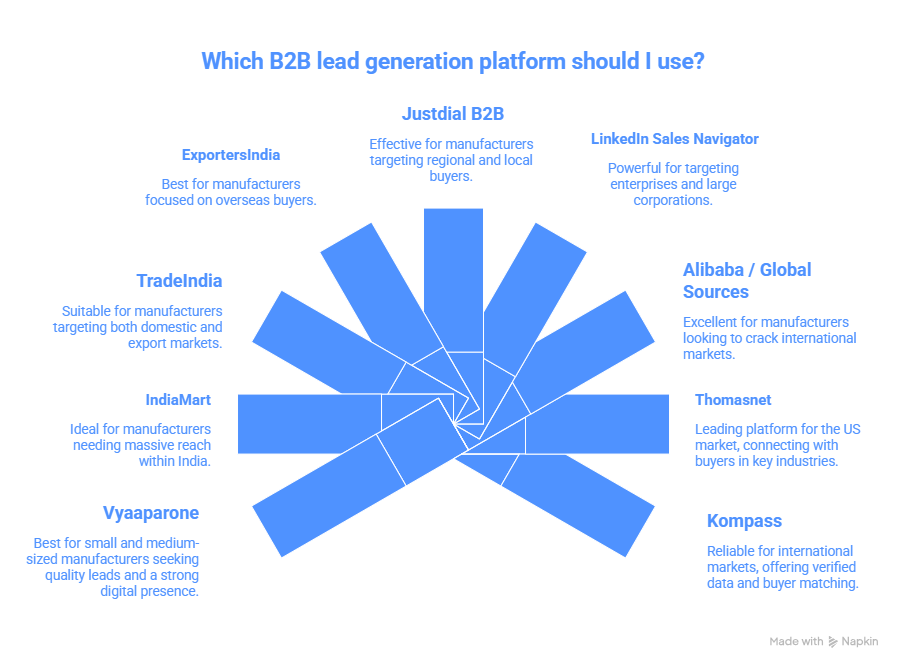
1. Vyaaparone
Vyaaparone is an emerging B2B lead generation and digital marketplace platform designed to help manufacturers connect directly with genuine buyers across multiple industries. It focuses on simplifying business discovery, improving lead quality, and giving manufacturers a strong digital presence in a competitive market.
Best for:
Small and medium-sized manufacturers in sectors such as automotive components, industrial equipment, packaging solutions, chemicals, textiles, and electronics.
Key Features:
- Detailed product listings with high-quality images, specifications, and descriptions
- Direct buyer inquiries (RFQs) delivered straight to your dashboard or inbox
- Advanced Lead Management System (LMS) for tracking, organizing, and converting leads efficiently
- Featured and priority listing options to increase product visibility
- Access to a verified and targeted buyer network
Why Manufacturers Prefer It:
Vyaaparone is gaining popularity among manufacturers due to its focused approach to quality leads rather than just volume. The platform helps businesses showcase their offerings professionally while ensuring they receive relevant and high-intent inquiries. With a well-optimized profile, manufacturers can consistently generate qualified leads and build long-term business relationships.
2. IndiaMart
IndiaMart is India’s largest B2B lead generation platform and a go-to marketplace for manufacturers looking to connect with buyers across industries. With over 7.7 crore registered buyers and 75 lakh supplier listings, it offers massive reach.
Best for: Small and medium manufacturers across all sectors — auto components, industrial machinery, packaging, chemicals, textiles, electronics.
Key Features:
- Product catalog listing with images and specifications
- Direct buyer inquiries (RFQs) delivered to your inbox
- Lead Management System (LMS) to track and follow up on leads
- Priority listing for enhanced visibility
- Verified buyer database
Why Manufacturers Love It: The sheer volume of active buyers on IndiaMart makes it one of the most efficient lead generation platforms in India for manufacturers. A well-optimized listing can generate dozens of qualified inquiries every month.
3. TradeIndia
TradeIndia is another well-established B2B lead generation platform focused on connecting Indian manufacturers with domestic and global buyers. It serves over 1 crore registered users and covers more than 2,500 product categories.
Best for: Manufacturers looking to reach buyers in both domestic and export markets.
Key Features:
- Product and company listings
- Buyer inquiry management
- Digital catalog creation
- Trade show integration
- Featured supplier placement
Why Manufacturers Love It: TradeIndia’s strong presence in export markets makes it valuable for manufacturers targeting international buyers alongside domestic ones.
4. ExportersIndia
ExportersIndia is a specialized lead generation platform for Indian manufacturers and exporters. It focuses on connecting Indian suppliers with international buyers, making it ideal for manufacturers with export ambitions.
Best for: Manufacturers targeting overseas buyers in the Middle East, Africa, Southeast Asia, and beyond.
Key Features:
- Global buyer database
- RFQ management system
- Multi-language support
- Export documentation guidance
- Dedicated account managers
5. Justdial B2B
Justdial’s B2B vertical has evolved significantly, offering b2b lead generation services to manufacturers and industrial companies. Leveraging Justdial’s massive search traffic, it connects local buyers with nearby suppliers.
Best for: Manufacturers targeting regional and local buyers; companies that rely on proximity-based procurement.
Key Features:
- Local buyer targeting
- Verified reviews and ratings
- Phone inquiry tracking
- Industry-specific categories
- Sponsored listing options
6. LinkedIn Sales Navigator
For manufacturers targeting enterprises, mid-market companies, and large corporations, LinkedIn Sales Navigator is one of the most powerful b2b lead generation platforms available globally.
Best for: Manufacturers selling high-value contracts to enterprises; companies focused on Account-Based Marketing.
Key Features:
- Advanced search filters (industry, company size, job title)
- Lead recommendations based on target criteria
- Real-time buyer intent alerts
- CRM integration
- InMail for direct messaging
Why Manufacturers Love It: LinkedIn gives you direct access to procurement managers, supply chain directors, and business owners — the exact decision-makers who influence B2B purchasing. Combined with content marketing, it’s a powerful engine for generating business to business leads.
7. Alibaba / Global Sources
For manufacturers with export-ready products, Alibaba and Global Sources are among the world’s largest B2B lead generation platforms. They connect Indian manufacturers with global buyers, particularly from the US, Europe, Middle East, and Southeast Asia.
Best for: Manufacturers looking to crack international markets; companies with export documentation and compliance in place.
Key Features:
- Global buyer reach (millions of registered buyers)
- RFQ marketplace
- Product showcase with certifications
- Trade Assurance and verification programs
- Gold Supplier memberships
8. Thomasnet (for US Market)
Thomasnet is a leading industrial platform in North America, connecting manufacturers with buyers across sectors like aerospace, defense, automotive, and electronics. For Indian manufacturers targeting the US market, a Thomasnet listing can generate high-quality b2b leads for manufacturers.
9. Kompass
Kompass is a global B2B directory with strong presence in Europe and Asia. It offers verified company data, product catalogs, and buyer matching services — making it a reliable choice for manufacturers seeking b2b lead generation services in international markets.
Lead Generation Platforms in India: A Closer Look
India’s manufacturing sector generates billions of dollars in procurement activity every year. Lead generation platforms in India have become essential infrastructure for connecting buyers and sellers in this fast-growing market.
Here’s what sets Indian platforms apart:
Understanding the Indian B2B Buyer
Indian B2B buyers tend to:
- Prefer relationship-based selling alongside digital discovery
- Request quotes from multiple vendors before deciding
- Value price competitiveness along with quality assurance
- Rely on platforms like IndiaMart, TradeIndia, and industry-specific portals
Tier 2 and Tier 3 Market Penetration
Unlike global platforms, Indian lead generation platforms have deep penetration into Tier 2 and Tier 3 cities — where a significant portion of India’s manufacturing base and buyer base operates. This means manufacturers in cities like Rajkot, Ludhiana, Coimbatore, or Pune can access buyers they might never reach through cold outreach alone.
GST and Compliance Integration
Many b2b lead generation platforms in India now incorporate GST verification, making it easier for buyers to identify verified and compliant suppliers — giving listed manufacturers a credibility advantage.
Regional Language Support
Platforms like IndiaMart and Justdial offer support in Hindi and regional languages, helping manufacturers and buyers in non-English-speaking regions communicate more effectively.
Government and PSU Procurement
Several lead generation platforms in India are integrated with GeM (Government e-Marketplace), helping manufacturers access government and PSU contracts — a massive and growing source of b2b business leads for the manufacturing sector.
How B2B Lead Generation Services Work for Manufacturers
Many manufacturers prefer to outsource their lead generation for manufacturers to specialized agencies or service providers. Here’s how professional b2b lead generation services typically work:
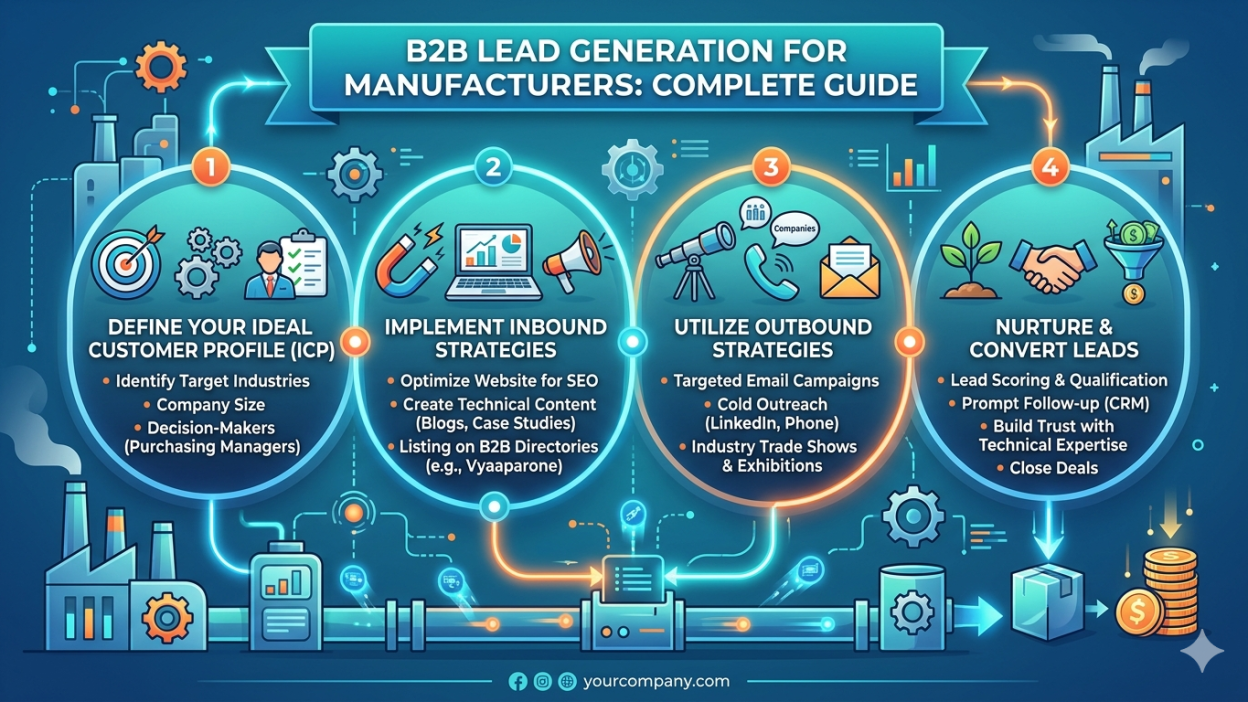
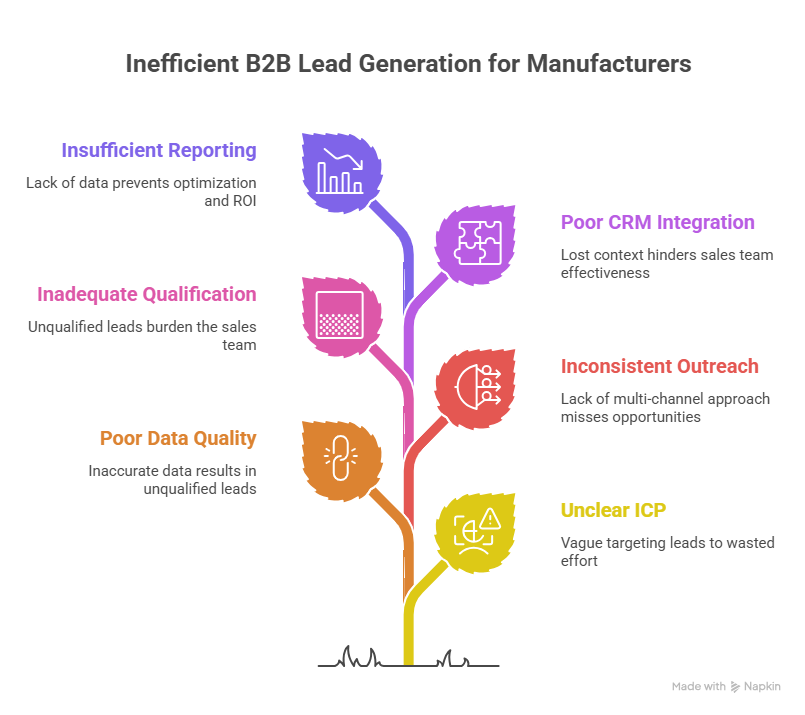
Step 1: Ideal Customer Profile (ICP) Definition
The first step is defining who your ideal buyer is. A b2b lead generation service will help you answer:
- What industries need your products?
- What size companies are best suited to buy from you?
- Who within those companies makes the purchasing decision?
- What pain points does your product solve?
This creates a precise target profile that guides all lead generation activities.
Step 2: Data Research and Lead List Building
Using a combination of databases, LinkedIn, industry directories, and proprietary tools, the lead generation team builds a list of target companies and decision-makers. This gives you a curated pool of potential b2b leads for manufacturers to work with.
Step 3: Multi-Channel Outreach
Outreach happens across multiple channels:
- Email: Personalized, value-driven emails to procurement contacts
- LinkedIn: Connection requests and InMail messages
- Phone: Follow-up calls to warm leads
- Platform RFQ Management: Responding promptly to inquiries on B2B platforms
Step 4: Lead Qualification
Not every inquiry is a good fit. B2b lead generation services filter leads based on criteria like budget, purchase timeline, and product fit — ensuring your sales team only spends time on genuinely qualified business to business leads.
Step 5: CRM Integration and Handoff
Qualified leads are entered into your CRM (Customer Relationship Management) system with full context — company name, contact details, requirement summary, and follow-up schedule. Your sales team takes over from here to close the deal.
Step 6: Reporting and Optimization
Professional lead generation services provide regular reports on:
- Number of leads generated
- Lead quality scores
- Conversion rates
- Cost per lead
- Pipeline value
This data-driven approach ensures continuous improvement and better ROI over time.
Key Features to Look for in B2B Lead Generation Platforms
When evaluating b2b lead generation platforms, manufacturers should look for these critical features:
Buyer Intent Data
The best platforms show you which buyers are actively searching for products like yours — not just browsing. Buyer intent signals dramatically increase your conversion rates because you’re reaching out at the right moment.
RFQ (Request for Quotation) Management
A platform with built-in RFQ management lets you receive, track, and respond to buyer inquiries efficiently. Look for platforms that send instant notifications and allow you to manage multiple inquiries from a single dashboard.
Product Catalog with Specifications
Manufacturers need to showcase detailed product information — including materials, dimensions, certifications, MOQ (Minimum Order Quantity), and lead times. A rich catalog helps buyers self-qualify before contacting you, improving lead quality.
Verified Buyer Database
Ensure the platform verifies the buyers it lists. Verified b2b business leads mean you’re talking to real companies — not bots or scammers wasting your sales team’s time.
Analytics and Lead Tracking
Look for platforms that provide analytics on your listing performance — views, inquiries, conversion rates, and ROI. This data helps you optimize your profile and investment.
CRM Integration
If the platform can integrate with popular CRMs like Salesforce, Zoho, or HubSpot, you can manage your b2b leads without manually entering data — saving time and reducing errors.
Customer Support
Responsive customer support is essential, especially when you’re new to a platform. Look for dedicated account managers who can help you optimize your listing and maximize lead quality.
Pricing Transparency
Avoid platforms that hide fees or lock you into long contracts without clear ROI expectations. The best lead generation platforms offer transparent pricing with clear deliverables.
Proven Strategies to Generate High-Quality B2B Leads for Manufacturers
Beyond platform listings, manufacturers can implement these strategies to boost their b2b lead generation results:
1. Optimize Your Company Website for SEO
Your website is your most important lead generation asset. To attract b2b leads for manufacturers, your website must:
- Load fast (under 3 seconds)
- Be mobile-friendly
- Feature product pages with detailed specifications
- Include case studies and customer testimonials
- Have clear calls to action (CTA) — “Request a Quote,” “Send Inquiry,” “Get Samples”
- Rank for keywords buyers use when searching for your products
Invest in on-page SEO, technical SEO, and quality backlinks to make your website a consistent source of inbound business to business leads.
2. Create Technical Content That Answers Buyer Questions
B2B buyers research extensively before making a decision. Create content that answers their questions:
- Blog posts: “How to Choose a Sheet Metal Fabrication Partner”
- White papers: “Quality Standards in CNC Machining”
- Videos: Virtual factory tours, product demo videos
- Case studies: How you solved a specific problem for a buyer
This content builds trust, demonstrates expertise, and attracts buyers who are already in evaluation mode.
3. Run LinkedIn Advertising Campaigns
LinkedIn’s B2B targeting capabilities are unmatched. You can run ads targeting:
- Procurement managers in specific industries
- Companies within a certain revenue range
- Decision-makers in specific geographies
LinkedIn Lead Gen Forms make it easy for prospects to share their contact information without leaving the platform — a frictionless way to generate b2b leads for manufacturers.
4. Participate in Trade Shows and Industry Events
While digital strategies dominate, trade shows remain one of the most effective channels for lead generation for manufacturers. Events like Hannover Messe India, Excon, IMTEX, and India Chem attract thousands of serious industrial buyers under one roof.
Complement your trade show presence with:
- Pre-event outreach to set up meetings
- Engaging booth design with product displays
- Post-event follow-up campaigns
5. Build a Referral Partner Network
Identify complementary businesses — logistics companies, machine suppliers, quality consultants — and build formal referral partnerships. When they encounter a client needing manufacturing services, they refer them to you — and vice versa. Structured referral programs can generate a steady stream of warm b2b business leads.
6. Use Email Marketing to Nurture Leads
Most b2b leads don’t convert immediately. Email nurturing keeps your manufacturing company top-of-mind until the prospect is ready to buy. A good nurturing sequence includes:
- Welcome email with company overview
- Product-specific emails with specifications
- Case study emails proving your capabilities
- Periodic “are you ready to discuss your requirements?” outreach
Use marketing automation tools like Mailchimp, HubSpot, or Zoho Campaigns to run these sequences efficiently.
7. Leverage Google Ads for High-Intent Buyers
Pay-Per-Click (PPC) advertising on Google allows you to appear at the top of search results for high-intent keywords like “brass fittings manufacturer India” or “automotive plastic components supplier.” While there’s a cost per click, these are buyers actively looking for what you offer — making Google Ads a high-ROI channel for b2b lead generation.
How to Choose the Right Lead Generation Platform for Your Manufacturing Business
With so many b2b lead generation platforms available, how do you decide which one is right for you? Here’s a practical framework:
Assess Your Target Market
Domestic buyers: Platforms like IndiaMart and TradeIndia dominate the domestic Indian market. If most of your buyers are Indian companies, these platforms should be your priority.
Export buyers: Alibaba, Global Sources, ExportersIndia, and Kompass are better suited for reaching international buyers.
Enterprise buyers: LinkedIn Sales Navigator and ABM-focused b2b lead generation services are ideal for manufacturers targeting large corporations.
Evaluate Platform Activity
A platform is only valuable if your target buyers are actively using it. Before committing, research:
- Monthly active buyers in your product category
- Average number of RFQs in your segment
- Buyer reviews and testimonials from similar manufacturers
Consider Your Budget
Lead generation for manufacturers can range from a few thousand rupees per month (basic IndiaMart listing) to several lakhs per year (premium memberships + digital advertising). Set a realistic budget and prioritize platforms with clear ROI metrics.
Start Small, Scale Up
Don’t commit to long-term contracts on multiple platforms simultaneously. Start with one or two platforms, measure your results for 3-6 months, and then scale investment into what’s working.
Integrate with Your Sales Process
Choose platforms and services that integrate with your existing sales process. If your team uses a CRM, ensure the platform can send leads directly into it. Automation saves time and prevents leads from falling through the cracks.
Common Challenges in B2B Lead Generation for Manufacturers and How to Solve Them
Even with the best b2b lead generation platforms, manufacturers often face these challenges:
Challenge 1: Poor Lead Quality
Problem: You’re getting inquiries, but most of them are from small buyers, resellers, or non-serious prospects.
Solution: Add qualifying filters to your listing — specify your MOQ, target industries, and ideal order values. On outbound campaigns, tighten your ICP to focus on higher-value targets.
Challenge 2: Slow Response Time
Problem: By the time your sales team follows up on an inquiry, the buyer has already engaged with a competitor.
Solution: Set up instant inquiry notifications via SMS and email. Aim to respond to every b2b lead within 1 hour — studies show that response speed is one of the biggest factors in conversion rates.
Challenge 3: Incomplete Product Information
Problem: Buyers send generic inquiries because your product listings lack details.
Solution: Invest in rich, detailed product pages with high-quality images, full specifications, certifications, and downloadable brochures. The more information buyers can find upfront, the more serious the inquiries you’ll receive.
Challenge 4: No Systematic Follow-Up
Problem: Your sales team follows up once or twice and then moves on, leaving money on the table.
Solution: Implement a structured CRM-based follow-up process. Most b2b business leads require 5-12 touchpoints before converting. Create a sequence of calls, emails, and LinkedIn messages spread over 4-8 weeks.
Challenge 5: Difficulty Measuring ROI
Problem: You’re spending money on multiple platforms but don’t know which one is generating the best results.
Solution: Use UTM tracking links, platform-specific inquiry codes, and CRM reporting to attribute leads and revenue to specific channels. Review ROI quarterly and reallocate budget accordingly.
Measuring the ROI of Your B2B Lead Generation Efforts
To justify your investment in b2b lead generation services and platforms, you need to track the right metrics:
Key Metrics to Track
Cost Per Lead (CPL): Total investment ÷ Number of leads generated. Compare CPL across platforms to identify the most cost-efficient sources of b2b leads for manufacturers.
Lead-to-Opportunity Rate: What percentage of your leads convert into active sales opportunities? A higher rate indicates better lead quality.
Opportunity-to-Close Rate: How many opportunities turn into actual orders? This measures your sales team’s effectiveness and the quality of inbound business to business leads.
Average Contract Value (ACV): The average revenue per converted lead. Higher ACV makes it worthwhile to pay more per lead.
Customer Acquisition Cost (CAC): Total marketing and sales spend ÷ Number of new customers acquired. Track this over time to ensure your b2b lead generation is becoming more efficient.
Pipeline Value: Total potential revenue in your lead pipeline. This helps forecast future revenue and justify continued investment.
Return on Investment (ROI): (Revenue generated from leads – Lead generation cost) ÷ Lead generation cost × 100. Aim for a minimum of 3x ROI from any lead generation platform you invest in.
Build a Lead Generation Dashboard
Use tools like Google Looker Studio, HubSpot, or Zoho Analytics to build a real-time dashboard showing your key lead generation metrics. Review it weekly with your sales team to identify bottlenecks and opportunities.
B2B Lead Generation in India: The Future Outlook
India is at a pivotal moment in its manufacturing evolution. With the government’s aggressive push through schemes like PLI, Make in India, and China+1 supply chain diversification, global and domestic buyers are increasingly turning to Indian manufacturers as reliable, cost-effective partners.
This creates an enormous opportunity — but only for manufacturers who show up where buyers are looking. The future of b2b lead generation in India will be shaped by:
AI-Powered Lead Scoring: Platforms will increasingly use artificial intelligence to score leads based on buyer intent, company profile, and behavioral signals — giving manufacturers a prioritized list of the most promising b2b leads.
Video and Virtual Showrooms: Manufacturers who create virtual factory tours and product demonstration videos will have a significant edge on lead generation platforms, as buyers increasingly want to “see” before they commit.
WhatsApp and Conversational Marketing: Given WhatsApp’s ubiquity in Indian business communication, b2b lead generation services are integrating WhatsApp-based lead capture and nurturing into their workflows.
Data-Driven Personalization: Generic product listings are giving way to personalized outreach that speaks to the specific needs of each target buyer — driven by better data and automation.
Integration of Offline and Online: Successful manufacturers will seamlessly blend trade show presence with digital platforms, LinkedIn outreach, and email nurturing into a unified b2b lead generation machine.
Conclusion
The manufacturing sector is evolving rapidly, and B2B lead generation has become the backbone of sustainable growth for manufacturers of every size. Whether you’re a small precision engineering firm or a large industrial manufacturer, having a structured approach to attracting and converting b2b leads for manufacturers will determine your competitive position in the years ahead.
B2B lead generation platforms like IndiaMart, TradeIndia, LinkedIn, and Alibaba give you direct access to millions of active buyers — buyers who are actively searching for reliable manufacturing partners. Complemented by professional b2b lead generation services, digital marketing, content strategy, and a systematic sales follow-up process, you can build a predictable, scalable pipeline of high-quality business to business leads.
The manufacturers who invest in building strong digital visibility, optimize their presence on lead generation platforms in India and globally, and back it up with responsive sales teams will be the ones who grow their order books, expand their client base, and thrive in an increasingly competitive marketplace.
Start by listing on two or three of the platforms mentioned in this guide. Optimize your profiles, respond to every inquiry within the hour, and track your results diligently. The b2b business leads you need to grow your manufacturing company are out there — it’s time to go find them.
Frequently Asked Questions
What is B2B lead generation for manufacturers?
B2B lead generation for manufacturers is the process of identifying, attracting, and converting potential business buyers — such as procurement managers, distributors, and OEMs — into qualified sales leads. It involves using platforms, content, outreach, and digital marketing to build a pipeline of serious buyers interested in your manufacturing products or services.
Which is the best B2B lead generation platform in India for manufacturers?
IndiaMart is widely considered the most effective b2b lead generation platform in India for manufacturers due to its massive buyer base, industry coverage, and RFQ management features. TradeIndia and ExportersIndia are also excellent alternatives, especially for manufacturers targeting export markets.
How long does it take to see results from B2B lead generation platforms?
Most manufacturers start seeing inquiries within the first 2-4 weeks of optimizing their listing on platforms like IndiaMart. However, building a consistent pipeline of high-quality b2b leads for manufacturers typically takes 3-6 months of sustained effort across multiple channels.
What is the difference between B2B lead generation services and platforms?
B2B lead generation platforms are marketplaces or directories (like IndiaMart or LinkedIn) where buyers actively search for suppliers. B2B lead generation services are managed services provided by agencies or consultants who handle everything — lead research, outreach, qualification, and pipeline management — on behalf of the manufacturer.
Can small manufacturers benefit from B2B lead generation platforms?
Absolutely. In fact, lead generation platforms level the playing field by giving small manufacturers access to the same buyers that large players pursue. A well-optimized listing on IndiaMart or TradeIndia can generate meaningful business to business leads even for manufacturers with limited marketing budgets.
How do I improve the quality of B2B leads for my manufacturing business?
To improve lead quality: refine your Ideal Customer Profile, add detailed product specifications and certifications to your listing, specify your MOQ and target industries, respond quickly to inquiries, and use lead qualification criteria to filter out poor-fit prospects before engaging them further.