Introduction
Every product that leaves a factory floor carries the reputation of the manufacturer behind it. A single defective batch can damage supplier relationships, trigger costly recalls, and erode consumer trust overnight. That is why quality control in manufacturing is not a department function — it is a business survival strategy.
Whether you run a small-batch production line or a large-scale industrial facility, understanding quality control in the manufacturing industry is essential for staying competitive in today’s demanding marketplace. From automotive parts to pharmaceutical tablets to consumer electronics, manufacturing and quality control work hand in hand to ensure that every unit meets defined standards before it reaches the customer.
This comprehensive guide covers everything you need to know — from core principles and proven quality control methods in manufacturing, to the step-by-step quality control process in manufacturing, and the advanced technologies powering industrial quality control today.
What Is Quality Control in Manufacturing?
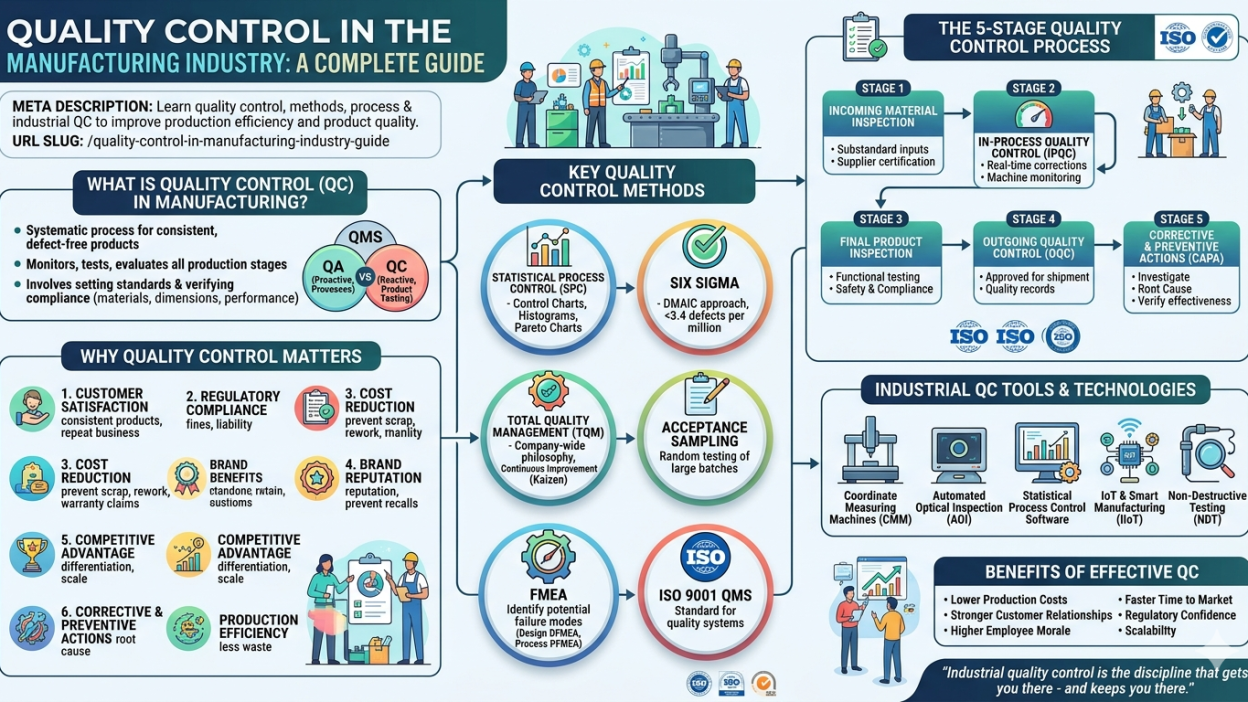
Quality control in manufacturing refers to the systematic process of ensuring that products are produced consistently, meet specified requirements, and are free from defects. It involves monitoring, testing, and evaluating every stage of production — from raw material intake to final product inspection — to catch and correct errors before they become costly problems.
At its core, manufacturing and quality control is about setting standards and verifying that those standards are met. This includes:
- Defining acceptable specifications for materials, dimensions, and performance
- Monitoring production variables in real time
- Conducting inspections and testing at critical checkpoints
- Identifying the root causes of defects and eliminating them
- Documenting findings and driving continuous improvement
Quality control is often confused with quality assurance (QA). While QA focuses on the processes used to create products, quality control and manufacturing are linked through direct product testing and inspection. QA is proactive; QC is reactive — but both are critical components of a comprehensive quality management system.
Industrial quality control extends this concept to the operational and regulatory level. It includes compliance with international standards, equipment calibration, personnel training, and the use of statistical tools to maintain process stability across large-scale manufacturing environments.
Why Quality Control in the Manufacturing Industry Matters
Quality issues cost money — sometimes enormous amounts of it. According to industry estimates, poor quality can account for 5–30% of a manufacturer’s total revenue loss through scrap, rework, warranty claims, and lost customers. For high-volume producers, this translates into millions of dollars annually.
Here is why quality control in the manufacturing industry is non-negotiable:
Customer Satisfaction and Retention
Customers expect products to work as intended, every single time. A defective product does not just lose a sale — it loses a customer. Effective quality control and manufacturing processes ensure consistency, which builds trust and drives repeat business.
Regulatory Compliance
Industries such as aerospace, medical devices, automotive, and food production are subject to strict regulatory frameworks — from ISO certifications to FDA regulations. Non-compliance can result in heavy fines, facility shutdowns, and legal liability. Industrial quality control ensures manufacturers stay on the right side of the law.
Cost Reduction
Catching a defect at the raw material stage costs significantly less than detecting it after a product has been assembled, packaged, and shipped. A robust quality control process in manufacturing prevents expensive rework, reduces scrap rates, and minimizes warranty claims.
Brand Reputation
Recalls and product failures make headlines. A single high-profile quality failure can take years to recover from — if at all. Manufacturing and quality control safeguard brand equity by preventing defective products from ever reaching the market.
Competitive Advantage
In global markets, quality is a differentiator. Manufacturers who consistently deliver defect-free products at competitive prices win contracts, retain clients, and scale faster than those who don’t invest in robust quality systems.
Key Quality Control Methods in Manufacturing
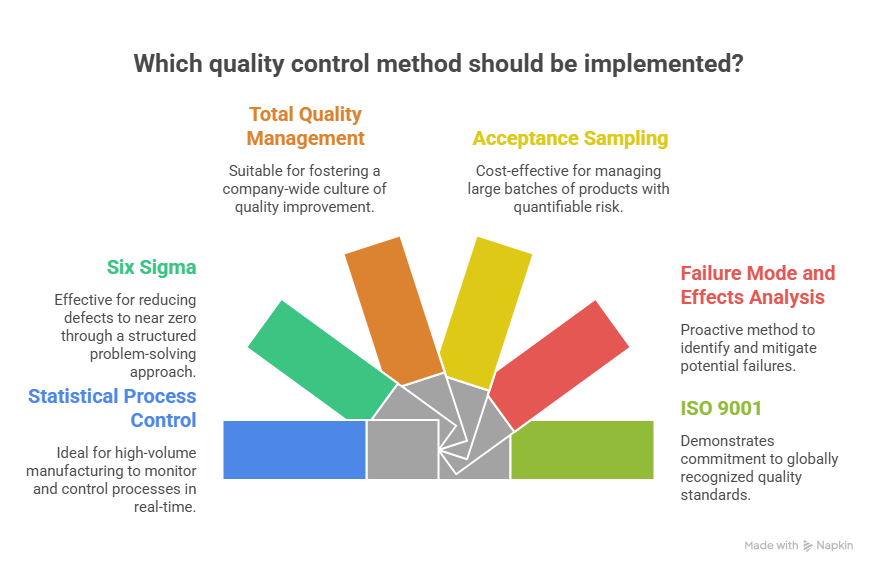
There is no one-size-fits-all approach to quality control. Manufacturers choose methods based on their industry, product complexity, production volume, and risk tolerance. Here are the most widely used quality control methods in manufacturing today.
1. Statistical Process Control (SPC)
Statistical Process Control uses statistical methods to monitor and control production processes. By analyzing real-time data collected from manufacturing operations, SPC helps identify when a process is drifting out of control — before defects are produced.
Core SPC tools include:
- Control Charts (X-bar and R charts): Visualize process variation over time and flag when results fall outside acceptable control limits
- Histograms: Show the frequency distribution of process data to reveal patterns and outliers
- Pareto Charts: Identify the most common sources of defects using the 80/20 rule
- Cause-and-Effect (Fishbone) Diagrams: Map potential root causes of quality problems
SPC is especially powerful in high-volume manufacturing environments like automotive, electronics, and plastics, where even small process shifts can produce thousands of defective units before manual inspection catches them.
2. Six Sigma
Six Sigma is a data-driven methodology that aims to reduce defects to fewer than 3.4 per million opportunities. It uses a structured problem-solving framework known as DMAIC — Define, Measure, Analyze, Improve, and Control.
Six Sigma projects are led by trained practitioners (Green Belts and Black Belts) who use advanced statistical tools to identify variability in manufacturing processes and eliminate its root causes. When applied effectively, Six Sigma dramatically reduces waste, improves cycle times, and drives measurable cost savings.
Many leading manufacturers — including General Electric, Motorola, and Toyota — have built their quality reputations on Six Sigma principles.
3. Total Quality Management (TQM)
Total Quality Management is a company-wide philosophy that places quality at the center of every business function — not just production. TQM involves all employees, from the shop floor to the executive suite, in a continuous effort to improve processes, products, and customer satisfaction.
Key principles of TQM include:
- Customer-focused quality standards
- Employee involvement and empowerment
- Process-centered thinking
- Integrated management systems
- Continuous improvement (Kaizen)
- Fact-based decision making
TQM is less of a specific tool and more of a cultural commitment. Companies that successfully implement TQM tend to see sustained long-term improvements in quality control in the manufacturing industry rather than short-term gains.
4. Acceptance Sampling
Acceptance sampling is a statistical method used to determine whether a batch of products should be accepted or rejected based on the inspection of a random sample. Rather than testing every unit — which is impractical for large production runs — inspectors test a predetermined sample size and apply acceptance/rejection criteria.
This method is governed by standards such as ANSI/ASQ Z1.4 (for attribute sampling) and Z1.9 (for variable sampling). While acceptance sampling does not eliminate defects, it provides a cost-effective way to manage incoming materials and finished goods with quantifiable risk levels.
5. Failure Mode and Effects Analysis (FMEA)
FMEA is a proactive quality control method used to identify potential failure modes in a product or process, assess their likelihood and impact, and prioritize corrective actions before failures occur.
There are two primary types used in manufacturing:
- Design FMEA (DFMEA): Applied during product design to catch weaknesses before production begins
- Process FMEA (PFMEA): Applied to production processes to identify where and how defects might occur
Each failure mode is rated on three factors — Severity, Occurrence, and Detection — to calculate a Risk Priority Number (RPN). High-RPN failures receive immediate attention, ensuring that the most critical risks are mitigated first.
FMEA is mandatory in industries such as automotive (per IATF 16949), aerospace, and medical devices.
6. ISO 9001 Quality Management System
ISO 9001 is the world’s most widely recognized quality management standard, applicable to manufacturers of all sizes and industries. Certification demonstrates that a manufacturer has implemented a documented quality management system that consistently provides products and services meeting customer and regulatory requirements.
ISO 9001 covers eight quality management principles:
- Customer focus
- Leadership commitment
- Engagement of people
- Process approach
- Improvement
- Evidence-based decision making
- Relationship management
- System approach to management
Achieving and maintaining ISO 9001 certification signals to customers, partners, and regulators that your quality control in the manufacturing industry meets globally recognized benchmarks.
The Quality Control Process in Manufacturing
Understanding the quality control process in manufacturing requires looking at quality holistically — not just as a final inspection step, but as a discipline embedded throughout the entire production lifecycle.
Stage 1: Incoming Material Inspection
Quality control begins before production starts. Raw materials, components, and purchased parts must be inspected and tested upon arrival to verify they meet specifications. This stage — known as Incoming Quality Control (IQC) — prevents substandard inputs from entering the production line.
IQC typically involves:
- Visual inspection for damage or labeling errors
- Dimensional verification against engineering drawings
- Material testing (hardness, tensile strength, composition)
- Comparison against approved sample standards
- Supplier certification review
Stage 2: In-Process Quality Control
Once production begins, In-Process Quality Control (IPQC) monitors manufacturing operations at defined checkpoints. The goal is to detect deviations from standards while products are still being made — enabling real-time corrections before defects propagate.
IPQC activities include:
- First Article Inspection (FAI) at the start of each production run
- Operator self-checks using control charts and gauges
- Supervisor audits at critical process steps
- Machine parameter monitoring (temperature, pressure, speed)
- Sampling and measurement at set intervals
Stage 3: Final Product Inspection and Testing
Before products are packaged and shipped, they undergo Final Quality Control (FQC) — a comprehensive inspection and functional test of finished goods. This stage validates that every unit or batch meets all customer and regulatory requirements.
FQC may include:
- 100% inspection for high-risk or low-volume products
- AQL (Acceptable Quality Level) sampling for high-volume runs
- Functional performance testing
- Safety and compliance testing
- Cosmetic and appearance evaluation
- Packaging and labeling verification
Stage 4: Outgoing Quality Control and Documentation
The final gate in the quality control process in manufacturing is Outgoing Quality Control (OQC). Products cleared at this stage are approved for shipment, with all quality records — inspection reports, test certificates, non-conformance reports — filed and traceable.
Good documentation is not just a regulatory requirement — it is the foundation of continuous improvement. Quality data collected over time reveals patterns that drive process optimizations, supplier improvements, and product enhancements.
Stage 5: Corrective and Preventive Actions (CAPA)
When defects or non-conformances are identified, a formal Corrective and Preventive Action (CAPA) process is triggered. CAPA involves:
- Documenting the non-conformance
- Investigating the root cause (using tools like 5-Why or Fishbone analysis)
- Implementing corrective actions to fix the immediate problem
- Establishing preventive actions to stop recurrence
- Verifying effectiveness and closing the CAPA
A well-executed CAPA system transforms quality failures into learning opportunities — driving the continuous improvement that lies at the heart of industrial quality control.
Industrial Quality Control Tools and Technologies
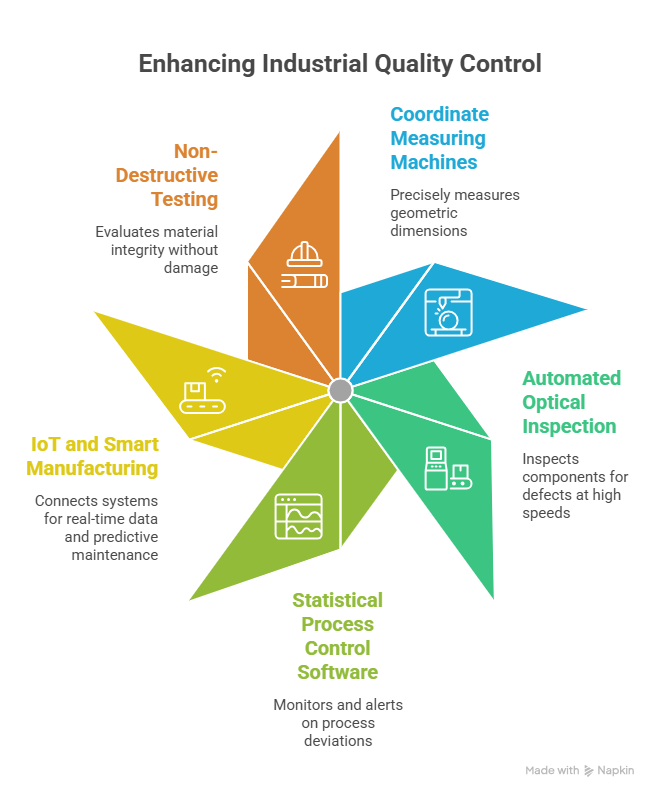
Modern industrial quality control has been transformed by technology. Manufacturers now have access to a wide range of tools that make inspection faster, more precise, and more data-rich than ever before.
Coordinate Measuring Machines (CMM)
CMMs use touch probes and laser sensors to precisely measure the geometric dimensions of physical parts in three dimensions. They are essential in industries like aerospace and automotive, where dimensional tolerances are measured in thousandths of an inch.
Automated Optical Inspection (AOI)
AOI systems use high-resolution cameras and machine vision algorithms to inspect components for surface defects, dimensional deviations, and assembly errors at production-line speeds. AOI is widely used in PCB manufacturing and semiconductor production.
Statistical Process Control Software
Modern SPC software collects real-time process data from sensors and machines, automatically calculates control limits, generates control charts, and triggers alerts when processes drift out of control. This gives quality engineers instant visibility into production health without manual data entry.
IoT and Smart Manufacturing
The Industrial Internet of Things (IIoT) connects machines, sensors, and systems across the factory floor to a centralized data platform. In the context of manufacturing and quality control, IIoT enables:
- Real-time monitoring of process variables
- Predictive maintenance to prevent equipment-related defects
- Automatic traceability of every product batch
- AI-driven anomaly detection
Non-Destructive Testing (NDT)
NDT methods — including ultrasonic testing, X-ray inspection, and dye penetrant testing — allow manufacturers to evaluate the integrity of materials and components without damaging them. NDT is critical in industries where structural failures carry life-safety implications, such as aerospace, oil and gas, and civil construction.
Common Challenges in Manufacturing and Quality Control
Even well-designed quality systems face real-world obstacles. Understanding these challenges helps manufacturers build more resilient quality programs.
Supplier Quality Variability: When suppliers deliver inconsistent materials, the entire production chain is affected. Strong supplier qualification programs, regular audits, and supplier scorecards help mitigate this risk.
Skill Gaps and Training: Quality control is only as effective as the people implementing it. Inadequate training leads to inspection errors, missed defects, and inconsistent application of standards. Ongoing training programs and visual work instructions are essential.
Data Silos: Many manufacturers collect quality data in disconnected systems — paper logs, spreadsheets, standalone software — making it difficult to get a complete view of production quality. Integrated quality management systems (QMS) break down these silos.
Resistance to Change: Introducing new quality control methods in manufacturing often meets resistance from operators and supervisors accustomed to existing workflows. Strong change management, clear communication, and visible leadership support are key to successful adoption.
Balancing Speed and Quality: Production pressure can create tension between throughput goals and quality standards. Manufacturers who treat quality as a production bottleneck — rather than an integral part of the process — often pay the price in rework and customer complaints. The long-term math always favors investing in quality.
Building a Quality-First Culture in Manufacturing
Tools and processes alone do not create great quality. Culture does. The most effective quality control in manufacturing organizations share a set of cultural characteristics that make quality everyone’s responsibility.
Leadership Commitment: Quality culture starts at the top. When senior leaders visibly prioritize quality — attending quality reviews, investing in quality resources, recognizing quality achievements — the message cascades throughout the organization.
Employee Empowerment: Operators on the shop floor often have the best insight into quality problems. Empowering them to stop the line, flag defects, and contribute ideas for improvement is one of the most powerful things a manufacturer can do.
Transparency and Visual Management: Posting quality metrics — defect rates, customer complaints, first-pass yields — in production areas makes performance visible and creates natural accountability.
Celebrate Improvement: Recognizing teams and individuals who identify problems and drive improvements reinforces the behaviors that make quality programs successful.
Continuous Improvement Mindset: Industrial quality control is not a destination — it is a journey. Companies that embrace Kaizen (the philosophy of continuous small improvements) consistently outperform those that settle for “good enough.”
Benefits of Effective Quality Control and Manufacturing
When quality control and manufacturing are tightly integrated, the benefits extend far beyond defect reduction.
- Lower Production Costs: Fewer defects mean less scrap, less rework, and lower warranty costs. Studies consistently show that the cost of prevention is far lower than the cost of failure.
- Faster Time to Market: Stable, predictable processes enable faster production cycles without quality trade-offs.
- Stronger Customer Relationships: Consistent product quality builds the kind of trust that turns customers into long-term partners.
- Higher Employee Morale: Workers take pride in producing quality products. A quality-focused culture reduces frustration caused by rework and defect firefighting.
- Regulatory Confidence: A documented, auditable quality system makes regulatory inspections and certifications smoother and less stressful.
- Scalability: A manufacturer with robust quality systems can scale production without proportionally scaling defect rates — enabling profitable growth.
Conclusion
Quality control in manufacturing is not a cost center — it is a value creator. When integrated effectively across every stage of production, it reduces costs, strengthens customer relationships, ensures regulatory compliance, and builds a culture of excellence that becomes a genuine competitive advantage.
The quality control process in manufacturing is not static. As products grow more complex, supply chains become more global, and customer expectations continue to rise, manufacturers must continuously evolve their quality systems — embracing new methods, technologies, and cultural practices to stay ahead.
Whether you are implementing quality control methods in manufacturing for the first time or looking to strengthen an existing program, the principles in this guide provide a solid foundation. Start with clarity — define your quality standards, map your process, and involve your people. From there, continuous improvement takes over.
Industrial quality control is not a destination. It is the discipline that gets you there — and keeps you there.
Frequently Asked Questions
What is the difference between quality control and quality assurance in manufacturing?
Quality assurance (QA) is process-oriented — it focuses on designing and managing processes to prevent defects. Quality control (QC) is product-oriented — it involves testing and inspecting actual products to detect defects. Both are components of a complete Quality Management System (QMS). In practice, quality control in manufacturing sits within a broader QA framework.
What are the most common quality control methods in manufacturing?
The most widely used quality control methods in manufacturing include Statistical Process Control (SPC), Six Sigma, Total Quality Management (TQM), Failure Mode and Effects Analysis (FMEA), Acceptance Sampling, and ISO 9001-based Quality Management Systems. The best method depends on the industry, production volume, and specific quality objectives.
How does the quality control process in manufacturing work?
The quality control process in manufacturing typically follows five stages: incoming material inspection, in-process quality control (IPQC), final product inspection, outgoing quality control (OQC), and corrective/preventive action (CAPA). Each stage has defined checkpoints, inspection criteria, and documentation requirements to ensure consistent product quality.
Why is industrial quality control important for compliance?
Many industries — including automotive, aerospace, medical devices, and food production — are subject to strict regulatory requirements. Industrial quality control systems provide the documented evidence that manufacturers are meeting these requirements. Certifications like ISO 9001, IATF 16949, and AS9100 demonstrate compliance to customers and regulators alike.
How can small manufacturers implement quality control effectively?
Small manufacturers can implement effective quality control without large budgets by starting with the basics: defining product specifications clearly, training operators in self-inspection, implementing simple SPC charts for critical process parameters, using CAPA to investigate and resolve defects, and pursuing ISO 9001 certification as a structured framework. Even modest investments in quality systems deliver significant returns.
What role does technology play in modern manufacturing and quality control?
Technology has fundamentally transformed manufacturing and quality control. Automated optical inspection (AOI), coordinate measuring machines (CMM), real-time SPC software, and IoT-connected sensors now allow manufacturers to detect and respond to quality issues faster, with greater precision and less human error. AI-powered analytics are increasingly being used to predict quality failures before they occur.