Introduction
India has emerged as one of the world’s most powerful and dynamic manufacturing destinations. Whether you run a bootstrapped startup or manage procurement for a multinational enterprise, partnering with a manufacturer in India can dramatically reduce costs, strengthen your supply chain, and give you access to exceptional production quality across dozens of industries.
But with thousands of suppliers scattered across multiple industrial corridors, the real challenge isn’t whether to source from India — it’s knowing exactly how to find a manufacturer in India that aligns with your specific business needs, quality benchmarks, and growth goals.
This comprehensive guide walks you through every critical step of the process. From understanding why India dominates global manufacturing to evaluating the best manufacturer in India for your unique requirements, we cover everything you need to know. Whether you’re a first-time global sourcing buyer or looking to replace an underperforming supplier, this blog will help you make smarter, more confident procurement decisions.
Why India Is a Top Global Manufacturing Destination
Before diving into how to find a manufacturer in India, it’s worth understanding what makes India stand out from other global sourcing markets like China, Vietnam, or Bangladesh.
1. Cost-Competitive, Skilled Labor
India offers a highly skilled and educated labor pool at a fraction of the cost compared to Western countries. For labor-intensive industries like textiles, engineering, and electronics, this cost advantage directly translates to improved margins for international buyers.
2. Diverse and Deep Manufacturing Capabilities
India’s industrial base is remarkably broad. Textiles, pharmaceuticals, electronics, auto components, chemicals, food processing, furniture, machinery — the depth of India’s manufacturing capabilities means that almost any business, in any sector, can find a relevant manufacturer in India capable of meeting their needs.
3. Strong Government Backing
The Indian government has launched major initiatives to strengthen manufacturing — from the flagship “Make in India” campaign to sector-specific PLI (Production Linked Incentive) schemes in electronics, pharmaceuticals, and textiles. These programs have upgraded industrial infrastructure, attracted foreign investment, and raised production quality standards significantly.
4. English-Speaking Business Environment
India’s widespread use of English in business and commerce makes international sourcing significantly more manageable. Negotiating contracts, resolving quality issues, and communicating delivery requirements are all far simpler when language barriers are minimal.
5. Rise of B2B Digital Platforms
The rapid growth of digital B2B manufacturing marketplaces has fundamentally changed how global buyers connect with Indian suppliers. You no longer need a local agent or a costly trade visit to start your sourcing journey — a reputable B2B marketplace puts hundreds of verified manufacturers in India right at your fingertips.
Types of Manufacturers in India You Should Know
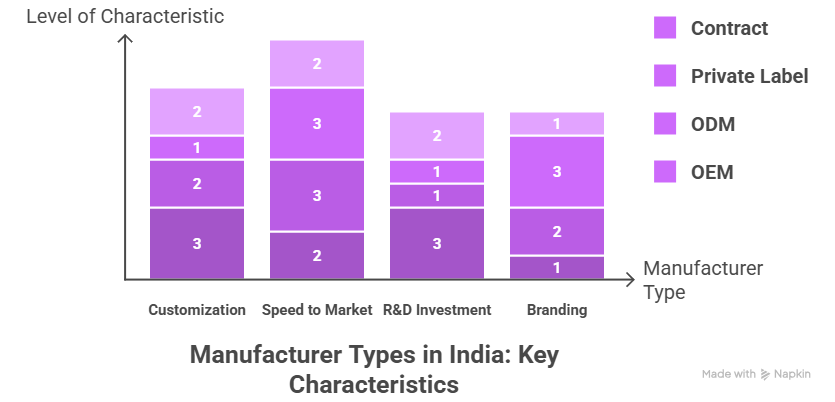
Understanding the different types of manufacturers will help you narrow your search and find the model that fits your product and business needs.
OEM Manufacturers (Original Equipment Manufacturers)
OEM manufacturers produce goods based on your exact specifications and design files. Working with an OEM manufacturer in india is ideal when you have a proprietary product blueprint and need a factory to produce it at scale. OEMs typically operate under Non-Disclosure Agreements (NDAs) and offer deep customization capabilities.
ODM Manufacturers (Original Design Manufacturers)
ODM manufacturers handle both design and production. If you want to launch a product quickly without heavy R&D investment, partnering with an ODM B2B manufacturer in India gives you access to ready-made designs that can be adapted or rebranded for your market.
Private Label Manufacturers
These manufacturers produce standardized products that you rebrand under your own label. Private label manufacturing in India is extremely popular in beauty and personal care, FMCG, and food categories. It’s one of the fastest routes to getting a branded product to market.
Contract Manufacturers
Contract manufacturers take on production tasks on behalf of other businesses. This model allows companies to scale output without owning factory infrastructure. Finding a reliable contract manufacturer in India is a common objective for mid-sized and large enterprises looking to optimize production costs.
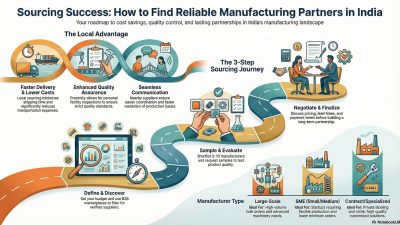
How to Find a Manufacturer in India: A Step-by-Step Guide
Now let’s get into the heart of what you’re here for — a practical, actionable, step-by-step approach to finding a manufacturer in India that fits your business perfectly.
Step 1: Define Your Product Requirements in Detail
Before reaching out to a single supplier, document everything about your product. Include:
- Exact dimensions, weight, and materials
- Required certifications (ISO, BIS, CE, FDA, GMP, etc.)
- Target production volume and Minimum Order Quantity (MOQ)
- Packaging and labeling requirements
- Delivery timelines and preferred shipping Incoterms
Detailed product documentation saves hours for both you and potential manufacturers. It also filters out unsuitable suppliers early in the process — before you invest time in conversations that go nowhere.
Step 2: Choose the Right Sourcing Channel
There are several pathways to find a manufacturer in India. Your choice depends on your budget, timeline, and risk appetite.
Channel A: B2B Manufacturing Marketplaces
The most efficient and scalable modern approach is to use a dedicated B2B manufacturing marketplace. Platforms like Vyaaparone, TradeIndia, Exporters India, and GlobalLinker list hundreds of thousands of verified manufacturers across all product categories.
These platforms allow you to:
- Filter manufacturers by industry, location, company size, and certifications
- Review detailed product catalogs with pricing ranges and MOQs
- Send bulk RFQ requests to multiple manufacturers simultaneously
- Read verified buyer reviews and compare manufacturer ratings
If you want to know how to find a manufacturer in India efficiently, starting on a trusted B2B manufacturing marketplace is the most practical first move for any buyer.
Channel B: Trade Fairs and Industry Exhibitions
India hosts major trade events throughout the year — the India International Trade Fair (IITF), Auto Expo, Plastivision, Pharma India, and numerous sector-specific expos. Attending these events lets you meet manufacturers face-to-face, inspect product samples in person, and build supplier relationships that digital channels sometimes can’t replicate.
Channel C: Government Directories and Industry Associations
Bodies like the Federation of Indian Export Organisations (FIEO), Confederation of Indian Industry (CII), and various Export Promotion Councils (EPCs) maintain curated directories of certified manufacturers. These sources are particularly valuable for buyers sourcing from regulated sectors like pharmaceuticals, food, or aerospace.
Channel D: Trade Agents and Sourcing Companies
Hiring a local sourcing agent gives you personalized, on-ground support — especially valuable if you’re navigating an unfamiliar industry or region. However, this option adds costs and requires careful selection of a trustworthy agent to avoid conflicts of interest.
Step 3: Shortlist 5 to 10 Manufacturers
Using your preferred channel, create a focused shortlist of 5–10 potential suppliers. When evaluating who makes the cut, look for:
- Years in operation and total production capacity
- Export experience with international clients
- Relevant certifications for your product
- Professional, complete listings on B2B platforms
- Speed and quality of initial communication
A genuinely capable B2B manufacturer in India will respond quickly, communicate clearly, and be upfront about what they can and cannot deliver.
Step 4: Send Detailed Requests for Quotations (RFQs)
Issue a well-structured RFQ to each shortlisted manufacturer. An effective RFQ covers:
- Full product specifications (linked to your documentation from Step 1)
- Required MOQ and anticipated annual order volume
- Quality certifications and testing standards required
- Packaging, labeling, and branding expectations
- Preferred payment terms (LC, T/T, etc.)
- Target delivery timeline and shipping terms
When comparing responses, remember that the best manufacturer in India won’t automatically offer the lowest price. Look for accuracy, professionalism, and evidence that they’ve read and understood your requirements carefully.
Step 5: Request and Evaluate Product Samples
Never commit to bulk production without physically reviewing samples. Most reputable manufacturers in India provide samples on request — sometimes free of charge, sometimes at a small cost. Use samples to evaluate:
- Build quality, material integrity, and workmanship
- Consistency with your product specification sheet
- Packaging quality and presentation
- Compliance with applicable safety and quality standards
This step is non-negotiable for any new supplier relationship, regardless of how impressive the factory’s profile looks online.
Step 6: Conduct a Factory Audit or Third-Party Inspection
Before signing any production contract, verify the manufacturer’s actual facility. Your options include:
- An in-person factory visit (highly recommended for large or ongoing orders)
- A third-party factory audit through agencies like SGS, Bureau Veritas, or Intertek
- A virtual factory tour (offered by many manufacturers in India on leading B2B platforms)
A factory audit confirms that the manufacturer genuinely has the equipment, workforce, and quality systems to deliver at the scale you need. This due diligence step protects your investment and dramatically reduces production risk.
Step 7: Negotiate Commercial Terms and Sign a Contract
Once you’ve confirmed the right manufacturer, move into formal negotiations. Key contract elements to address include:
- Unit pricing, payment milestones, and credit terms
- Production lead times and penalty clauses for delays
- Intellectual property and NDA provisions
- Quality acceptance criteria and rework/return policies
- Dispute resolution mechanisms (arbitration jurisdiction)
Always have a legal professional review contracts, especially for cross-border procurement. A well-structured contract is your strongest safeguard if disputes arise during production or delivery.
Top B2B Manufacturing Marketplaces to Find Manufacturers in India
Using a B2B manufacturing marketplace is the most scalable way for international buyers to discover and evaluate Indian manufacturers. Here are the most trusted platforms:
Vyaaparone
is an emerging B2B marketplace helping businesses connect with trusted suppliers and manufacturers across India. The platform is designed to simplify sourcing by offering access to verified business listings, product catalogs, and direct buyer-seller communication tools. It’s becoming a useful platform for companies looking to find a reliable manufacturer in India across multiple industries.
Standout features:
- Verified business profiles and trusted supplier listings
- Product catalogs with detailed specifications and business information
- Direct inquiry, call, and quotation request options for buyers
- Easy supplier discovery for manufacturers, wholesalers, and distributors
- Industry-focused listings to support B2B sourcing and networking
- User-friendly platform for connecting with manufacturers across India
TradeIndia
TradeIndia is a well-established B2B manufacturing marketplace particularly strong in industrial goods, engineering products, raw materials, and hardware. It’s a reliable alternative to IndiaMART, especially for buyers in manufacturing-heavy sectors.
Exporters India
Exporters India connects global buyers with Indian manufacturers and exporters across a wide range of product categories. It’s especially popular among buyers sourcing handicrafts, handlooms, agri-products, and specialty food items.
GlobalLinker
GlobalLinker is a modern B2B network built for small and medium enterprises. It features verified business profiles, product catalogs, and networking tools that make it straightforward to identify and approach a suitable B2B manufacturer in India — particularly for buyers interested in niche or artisan categories.
Alibaba — India Supplier Section
While Alibaba is China-headquartered, its India supplier section hosts thousands of experienced manufacturers in India who are well-versed in international export documentation and procedures. This platform is convenient for buyers already familiar with Alibaba’s sourcing interface.
Sector-Specific Niche Platforms
Beyond generalist platforms, several sector-specific B2B marketplaces serve niche sourcing needs — platforms covering raw materials, specialty textiles, packaging, plastics, and agricultural commodities. Depending on your product category, a niche B2B manufacturing marketplace may offer more relevant and better-vetted listings than a generalist directory.
How to Evaluate the Best Manufacturer in India for Your Business
Finding candidates is only the beginning. The bigger challenge is objectively selecting the best manufacturer in India for your unique business requirements.
Verify Certifications and Regulatory Compliance
The best manufacturer in India for your product will hold the certifications appropriate to your sector:
- ISO 9001 — Quality Management Systems (broadly applicable)
- ISO 14001 — Environmental Management Systems
- IATF 16949 — Automotive Quality Management
- GMP / WHO GMP / US FDA — Pharmaceutical and food product manufacturing
- BIS Certification — Indian Standards compliance
- CE Marking — European conformity for exports to EU markets
- OEKO-TEX — Textile safety certification
Always request copies of relevant certificates and cross-verify their validity directly with the issuing body.
Assess Real Production Capacity
Your chosen manufacturer must be able to scale alongside your business growth. During evaluation, ask:
- Current maximum monthly output (units or tonnage)
- Peak season production capacity
- Lead time to scale up with advance notice
- Number of active production lines and age of key equipment
A manufacturer already operating at near-full capacity may struggle to fulfill urgent reorders or growth-driven volume increases.
Evaluate Communication Quality and Responsiveness
The responsiveness and clarity of a manufacturer’s communication during the evaluation stage is a reliable predictor of how they’ll perform as a production partner. Specifically, look for:
- Replies within 24–48 hours to RFQs and queries
- Clear, specific answers rather than vague or evasive responses
- Proactive disclosure of relevant limitations or constraints
- A dedicated account manager or point of contact
Poor communication during the sourcing process is one of the strongest predictors of production problems down the line.
Review Financial Stability and Business Longevity
An unstable manufacturer may cut corners under financial pressure, delay shipments, or cease operations mid-order. To assess financial health:
- Request references from current international buyers
- Ask about their banking relationships and payment history with suppliers
- Review annual reports or audited financials for large, strategic sourcing engagements
Examine Quality Control Infrastructure
The best manufacturer in India will have a structured, documented Quality Control (QC) system — not just a verbal assurance of quality. Ask specifically about:
- In-process inspection checkpoints during production
- Final Quality Assurance (QA) procedures before dispatch
- Reported defect rates and how defective goods are handled
- Whether the QC team is in-house or contracted externally
Red Flags to Watch Out For When Sourcing from India
Not every supplier you discover — on a B2B manufacturing marketplace or elsewhere — will prove trustworthy. Protect your business by watching for these warning signs:
Unusually Low Pricing
Prices significantly below market benchmarks almost always signal a compromise — whether in raw materials, labor conditions, quality control, or ethical practices. Compare quotes from multiple manufacturers before accepting any offer that seems too good to be true.
Reluctance to Share Business Documentation
A legitimate manufacturer in India will readily provide GST registration, company incorporation documents, export licences, and quality certifications. Evasiveness about documentation is a serious warning sign.
No Verifiable Online Presence or Reviews
Reputable B2B manufacturers maintain active, detailed profiles on major B2B manufacturing marketplaces and accumulate real buyer reviews over time. A manufacturer with no digital footprint — or exclusively generic, unverifiable reviews — warrants careful scrutiny.
Inconsistent or Unreliable Communication
Irregular response patterns, constantly shifting delivery promises, and frequent changes in the primary contact person suggest organizational instability that will eventually impact your production timelines.
Resistance to Third-Party Audits or Factory Visits
Any manufacturer in India that refuses independent inspection or blocks factory visits should be treated with extreme caution. Legitimate, confident manufacturers welcome audits — they view them as an opportunity to demonstrate their capabilities.
Industries with the Strongest Manufacturing Ecosystems in India
Knowing which sectors have the deepest manufacturing infrastructure helps you focus your supplier search more effectively.
Textiles and Apparel
India is the world’s second-largest textile producer. Key manufacturing hubs include Tiruppur (knitwear and cotton garments), Surat (synthetic fabrics and sarees), Ludhiana (woolen goods and hosiery), and Jaipur (block prints and ethnic wear). Buyers sourcing clothing, home textiles, or technical fabrics will find an enormous pool of experienced B2B manufacturers across these clusters.
Pharmaceuticals and Specialty Chemicals
India is the world’s largest exporter of generic pharmaceuticals. Manufacturing hubs in Hyderabad, Ahmedabad, and Mumbai host thousands of pharma manufacturers, many holding US FDA, WHO GMP, and European GMP certifications. The chemicals sector — centered in Gujarat — is similarly mature and internationally competitive.
Engineering and Auto Components
India’s auto component ecosystem is massive and globally competitive. Pune, Chennai, and Gurugram serve as major automotive manufacturing clusters, with Indian B2B manufacturers supplying to global OEMs including Toyota, Suzuki, Volkswagen, and Bosch.
Electronics and Electrical Equipment
Supported by India’s PLI scheme, electronics manufacturing has accelerated significantly. Noida (UP), Bengaluru, and Chennai are key electronics production hubs. India now manufactures smartphones, LED lighting, PCBs, wiring harnesses, and consumer electronics at scale.
Food Processing and Agri-Products
India is a leading global exporter of rice, spices, processed fruits, dairy derivatives, and marine products. If you need food manufacturing or private label food products, finding a manufacturer in India in this segment offers both competitive pricing and a massive product range.
Furniture, Handicrafts, and Home Décor
Jodhpur and Jaipur in Rajasthan and Moradabad in UP are world-famous for handcrafted furniture, metalware, ceramics, and home décor. These regions are ideal for brands sourcing artisanal, design-forward, and heritage-craft products.
Tips for Building a Long-Term Partnership with a B2B Manufacturer
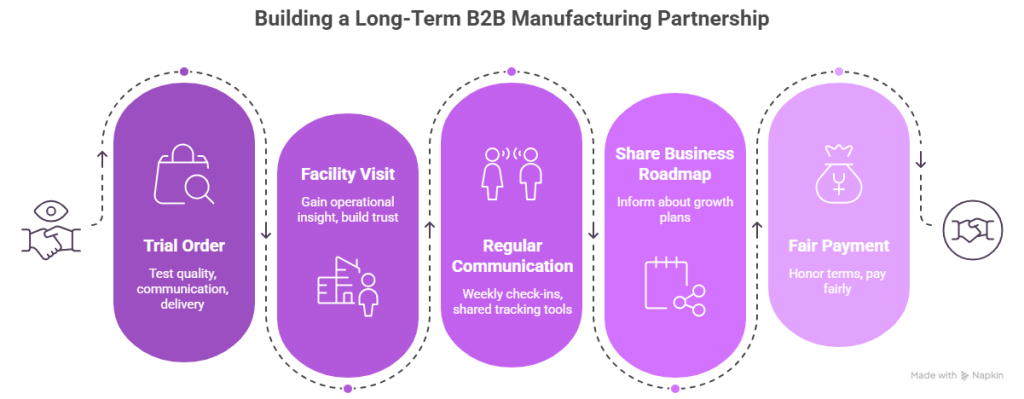
The most successful sourcing relationships in India aren’t transactional — they’re long-term partnerships built on trust, transparency, and mutual investment. Here’s how to build one:
Start With a Trial Order Before Committing to Volume
Place a smaller initial order to test quality consistency, communication efficiency, and on-time delivery before scaling volume. This approach de-risks the relationship while building mutual trust and understanding.
Visit the Facility at Least Once
Even if you manage everything through a B2B manufacturing marketplace, a single in-person visit to your manufacturer’s facility creates a level of relationship depth and operational insight that digital tools simply cannot replicate. Many global buyers credit factory visits as the turning point in supplier relationships.
Establish Clear and Regular Communication Rhythms
Set up weekly or bi-weekly check-ins, use shared project tracking tools, and maintain a dedicated communication thread for urgent issues. Structured communication prevents misunderstandings and keeps production timelines on track.
Share Your Business Roadmap Honestly
Tell your manufacturer about your growth plans. If you expect order volumes to double over the next 12 months, give them advance notice so they can plan production capacity accordingly. Manufacturers who understand your business trajectory are far more likely to prioritize your orders.
Pay Fairly and Honor Your Payment Terms
Negotiating aggressively on price is legitimate — but pushing a manufacturer to unsustainable margins often backfires through quality compromises, delayed prioritization, or supplier attrition. Pay a fair price and honor your payment schedule to earn priority treatment.
Document Every Agreement in Writing
Whether it’s a revised specification, a price adjustment, or a modified delivery date — always confirm it in writing. Documented agreements protect both parties and eliminate ambiguity if disputes arise later.
Conclusion
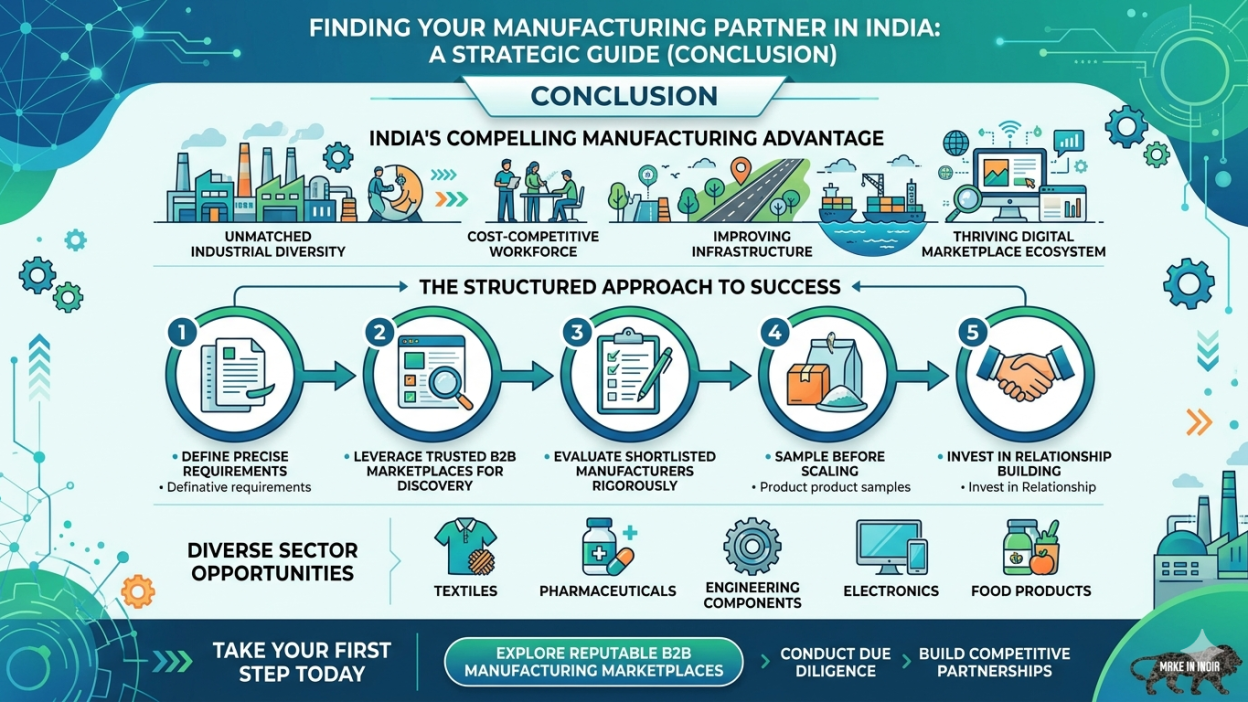
India’s manufacturing sector represents one of the most compelling sourcing opportunities in the global economy today. With its unmatched industrial diversity, cost-competitive workforce, improving infrastructure, and thriving digital marketplace ecosystem, finding a manufacturer in India has never been more accessible — or more strategically valuable.
The key to getting it right lies in taking a structured, disciplined approach. Define your requirements precisely, leverage trusted B2B manufacturing marketplaces for discovery, evaluate shortlisted manufacturers rigorously, sample before scaling, and invest in building relationships that grow with your business over time.
Whether you are searching for the best manufacturer in India for textiles, pharmaceuticals, engineering components, electronics, or food products, the right partner is out there. Take your first step today — explore a reputable B2B manufacturing marketplace, conduct thorough due diligence, and build the kind of manufacturing partnership that becomes a true competitive advantage for your business.
Frequently Asked Questions
Q1. What is the best B2B manufacturing marketplace to find manufacturers in India?
Vyaaparone is widely recognized as India’s largest and most trusted B2B manufacturing marketplace, with millions of verified supplier listings across all sectors. Other strong options include TradeIndia, Exporters India, and GlobalLinker. For international buyers with existing Alibaba experience, the India supplier section on Alibaba is also widely used.
Q2. How can I verify whether a manufacturer in India is legitimate?
Ask for GST registration certificates, company incorporation documents, ISO or sector-specific certifications, and recent client references. Cross-check their profile on reputable B2B platforms, verify certifications with the issuing body, and commission a third-party factory audit through agencies like SGS, Intertek, or Bureau Veritas.
Q3. What is the typical Minimum Order Quantity (MOQ) for a manufacturer in India?
MOQ varies significantly by product, industry, and manufacturer scale. Small and medium manufacturers may accept orders starting from 50–200 units, while large-scale factories in sectors like automotive or pharma may require 1,000 units or more. Always clarify MOQ in your initial inquiry.
Q4. Is it safe to make advance payments to a manufacturer in India?
Partial advance payments of 30–50% are standard practice and generally safe with verified manufacturers. Avoid paying 100% upfront for new supplier relationships. For higher-value orders, explore trade finance instruments like Letters of Credit (LC) or use escrow payment platforms to add protection.
Q5. How long does it typically take to find and onboard a manufacturer in India?
The timeline can range from 4 weeks to 4 months depending on your product complexity, sampling requirements, audit scope, and contract negotiation. Begin sourcing well in advance of your production deadline to avoid delays.
Q6. Can small businesses and startups work with B2B manufacturers in India?
Absolutely. A large number of manufacturers in India actively cater to small and medium-sized businesses with lower MOQs, flexible payment terms, and personalized service. B2B manufacturing marketplaces have significantly lowered the barrier to entry for smaller buyers looking to source professionally from India.