Introduction
The rise of digital commerce has made one thing clear — the marketplace business model is among the most powerful and scalable ways to build a sustainable online business. From global giants like Amazon and Alibaba to niche platforms serving specific industries, marketplace models are reshaping how buyers and sellers connect.
But what exactly is a marketplace business model? How do different types work? And which one suits your business goals?
Whether you are an entrepreneur planning to launch a platform, an investor studying viable e-commerce strategies, or a business owner looking to expand your digital footprint, understanding the nuances of each marketplace business model is essential.
In this comprehensive guide, we break down every major type of marketplace business model, explore the growing landscape of the online marketplace business model, examine how the marketplace business model in India is evolving, compare the marketplace model vs inventory model, and dive into the booming world of the B2B online marketplace. By the end, you will have everything you need to make an informed, strategic decision.
What Is a Marketplace Business Model?
A marketplace business model is a platform-based approach where a business connects buyers and sellers without necessarily owning the products or services being exchanged. The platform acts as an intermediary, creating value for both sides of the transaction while generating revenue through fees, commissions, subscriptions, or other monetisation strategies.
Think of it as a digital town square. Sellers list their goods or services, buyers discover and purchase them, and the marketplace owner earns a percentage or fee for facilitating the exchange. This model eliminates the need for inventory management, reducing operational risk while enabling massive scalability.
The core strength of every marketplace business model lies in network effects — the more sellers you attract, the more buyers come, and vice versa. This self-reinforcing loop is what helps marketplace platforms grow rapidly and create durable competitive moats.
The online marketplace business model extends this concept into digital commerce, allowing platforms to operate across geographies, categories, and customer segments without the constraints of physical infrastructure.
Why Marketplace Business Models Are Thriving
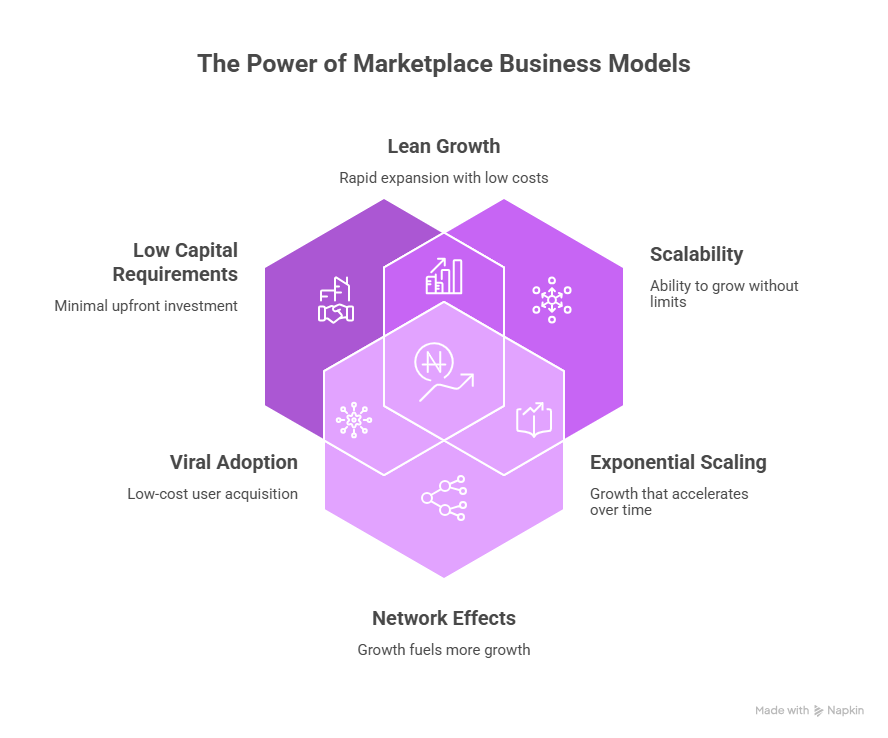
Before diving into the types, it is worth understanding why the marketplace business model has become such a dominant force in modern commerce:
- Low Capital Requirements: The platform does not need to own inventory or physical assets.
- Scalability: A single platform can serve millions of users simultaneously.
- Network Effects: Growth compounds as more participants join the ecosystem.
- Diverse Revenue Streams: Commissions, subscriptions, ads, and data monetisation all create multiple income channels.
- Reduced Risk: Unlike the inventory model, the marketplace owner is not exposed to unsold stock or supply chain issues.
For businesses looking to build the next major platform, choosing the right marketplace business model is the first critical step.
Core Types of Marketplace Business Models
1. Commission-Based Marketplace Business Model
The commission-based approach is the most widely adopted marketplace business model in e-commerce today. Under this model, the platform charges a percentage of each transaction completed between buyers and sellers.
How it works: A seller lists a product or service. A buyer makes a purchase. The marketplace deducts a commission (typically 5% to 30%) before transferring the balance to the seller.
Examples: Amazon Marketplace, Etsy, Airbnb, Uber.
Why it works: This marketplace business model aligns the platform’s earnings with the success of its sellers. The more transactions completed, the more revenue the marketplace generates — creating a shared incentive for growth.
Key considerations:
- Commission rates must be competitive enough to attract quality sellers
- High commissions can push sellers to build their own channels
- Works best in high-frequency transaction environments
This is one of the most scalable versions of the online marketplace business model, particularly for consumer-facing platforms with high transaction volumes.
2. Subscription or Membership-Based Marketplace Model
In the subscription-based marketplace business model, participants pay a recurring fee (monthly or annual) to access the platform’s buyer or seller ecosystem.
How it works: Sellers pay a subscription fee to list their products or services. Buyers may also pay for premium access, curated content, or exclusive deals. Revenue is predictable and not dependent on individual transactions.
Examples: Alibaba’s Gold Supplier memberships, Amazon Prime (buyer side), Angie’s List.
Advantages:
- Predictable, recurring revenue for the platform
- Lowers the barrier for individual transactions (no per-sale commission)
- Attracts serious, committed participants over casual users
Challenges:
- Harder to onboard new sellers who must pay before proving value
- Requires strong platform value proposition to justify ongoing fees
In the context of the marketplace business model in India, subscription-based platforms are growing rapidly, especially in B2B segments where buyers and sellers seek long-term relationships over one-off deals.
3. Listing Fee Marketplace Business Model
Under the listing fee model, sellers pay a fixed fee every time they list a product or service on the marketplace. This fee is charged regardless of whether a transaction occurs.
How it works: The platform charges sellers upfront to publish listings. Volume of listings directly drives platform revenue.
Examples: eBay (listing fees for certain categories), OLX (premium listings), Justdial.
Why some businesses prefer this model:
- Immediate revenue upon listing, not dependent on conversion
- Simple, transparent pricing for sellers
- Encourages sellers to actively manage and optimise listings
Limitations:
- Sellers may resist paying if listings don’t convert
- Requires a large, engaged buyer base to justify listing investments
- Can limit the quality and diversity of listings if fees are too high
This version of the marketplace business model is popular in classifieds and real estate platforms, where listings have inherent value even before a transaction happens.
4. Freemium Marketplace Business Model
The freemium marketplace business model offers basic access for free while charging for premium features, advanced analytics, enhanced visibility, or priority support.
How it works: Sellers and buyers can join and use core features at no cost. Revenue comes from those who upgrade to paid tiers for additional benefits.
Examples: LinkedIn (recruiter tools), Fiverr (promoted gigs), Upwork (connects purchase system).
Why this marketplace business model works:
- Low barrier to entry attracts a large user base quickly
- The free tier creates a self-sustaining growth engine
- Conversion from free to paid users generates scalable revenue
Key challenges:
- Requires significant investment in free features to attract users
- Monetisation depends on successfully demonstrating premium value
- Free users may never convert if the free tier is too generous
The freemium online marketplace business model is particularly effective for service marketplaces, freelance platforms, and SaaS-enabled marketplace hybrids.
5. Featured Listing and Lead Generation Marketplace Model
Some marketplace platforms generate revenue by charging sellers for premium placement, featured listings, or direct customer leads.
How it works: Basic listings are free or low-cost. Sellers pay extra to appear at the top of search results, gain a “verified” badge, or receive direct buyer inquiries.
Examples: Sulekha, IndiaMART, JustDial, Practo.
Why it’s popular in India: This marketplace business model in India thrives in local service industries — home repair, healthcare, legal services, education — where sellers value qualified leads more than impressions.
Benefits:
- Sellers only pay when they receive measurable value (leads or visibility)
- Easy to onboard sellers with minimal upfront cost
- Scales well in service-heavy, fragmented markets
Challenges:
- Lead quality can vary significantly
- Sellers may dispute charges if leads don’t convert
- Requires robust verification to maintain trust
6. Data and SaaS-Enabled Marketplace Business Model
An emerging and increasingly lucrative marketplace business model involves monetising platform data and offering SaaS tools alongside the marketplace.
How it works: The marketplace collects transactional, behavioral, and market data from its ecosystem. This data is sold (in aggregate, anonymised form) to brands, manufacturers, and market researchers. Additionally, the platform may offer inventory management, CRM, or analytics tools to sellers on a subscription basis.
Examples: Amazon’s seller analytics tools, Shopify Markets, TradeIndia.
Why it’s gaining momentum:
- Creates a diversified, high-margin revenue stream beyond transactions
- Increases seller dependency on and loyalty to the platform
- Generates revenue even during slow transaction periods
This model is becoming especially relevant for B2B online marketplace platforms where actionable data carries enormous commercial value.
The Online Marketplace Business Model: A Digital-First Framework
The online marketplace business model takes the core marketplace concept and supercharges it with the capabilities of digital infrastructure. Unlike traditional marketplaces limited by geography or physical footprint, online marketplace platforms operate at internet scale.
What Makes the Online Marketplace Business Model Unique?
- Global reach with local relevance: A single platform can serve hyper-local markets while also going international.
- Real-time matching: Advanced algorithms match buyers with the most relevant sellers instantly.
- Automated trust mechanisms: Reviews, ratings, escrow payments, and dispute resolution systems operate automatically.
- Data-driven growth: Every user interaction generates data that can be used to improve matching, pricing, and experience.
- Multi-sided value creation: The online marketplace business model creates simultaneous value for buyers, sellers, and the platform itself.
Revenue Layers in the Online Marketplace Business Model
Modern online marketplace business model platforms rarely rely on a single revenue stream. A mature platform typically combines:
- Transaction Commissions — Core revenue from every completed sale
- Advertising Revenue — Sponsored listings and banner ads from sellers
- Payment Processing Fees — Charging for integrated payment solutions
- Logistics and Fulfilment Fees — For platforms offering end-to-end delivery
- Financial Services — Seller loans, buyer credit, and insurance products embedded in the marketplace
This layered approach makes the online marketplace business model resilient, diversified, and extraordinarily scalable.
Marketplace Business Model in India: A Growing Ecosystem
India is one of the world’s fastest-growing markets for digital commerce, and the marketplace business model in India is at the heart of this transformation. With over 800 million internet users and a booming SME sector, India represents a massive opportunity for both horizontal and vertical marketplace platforms.
The Indian Marketplace Landscape
The marketplace business model in India is shaped by unique factors:
- Digital India Initiative: Government-driven internet penetration has brought millions of new users online.
- UPI and Digital Payments: The widespread adoption of UPI (Unified Payments Interface) has removed barriers to online transactions.
- Smartphone Penetration: Mobile-first behaviour means marketplace platforms must be optimised for mobile experiences.
- Diverse Consumer Base: India’s linguistic, cultural, and economic diversity demands localised marketplace experiences.
Key Categories Driving the Marketplace Business Model in India
Horizontal Marketplaces: Platforms like Flipkart and Meesho operate as large-scale horizontal marketplaces covering a wide range of categories. These platforms have refined the marketplace business model in India to serve both urban and tier-2 and tier-3 city consumers.
Vertical Marketplaces: Niche platforms focused on specific categories — fashion (Myntra), groceries (BigBasket), healthcare (Practo), agriculture (AgriBazaar) — are gaining ground. These vertical marketplace business model platforms build deep expertise in their domain, offering superior buyer and seller experiences compared to horizontal giants.
Hyperlocal Marketplaces: Platforms connecting local businesses with nearby customers are growing rapidly. The marketplace business model in India is increasingly localised, with platforms enabling kirana stores, local restaurants, and service providers to go digital.
Government-Backed Platforms: India’s ONDC (Open Network for Digital Commerce) is reshaping the marketplace business model in India by creating an open, interoperable commerce network that reduces dependency on large marketplace monopolies and empowers small sellers.
Regulatory Considerations for the Marketplace Business Model in India
The marketplace business model in India operates under specific regulatory frameworks, particularly FDI (Foreign Direct Investment) guidelines. Foreign-funded marketplace platforms are required to operate under a pure marketplace model — they cannot hold inventory or directly influence prices. This distinction has had significant implications for how platforms like Amazon India and Flipkart structure their operations.
B2B Online Marketplace: A High-Growth Frontier
While much attention focuses on B2C platforms, the B2B online marketplace is one of the fastest-growing segments in global digital commerce.
What Is a B2B Online Marketplace?
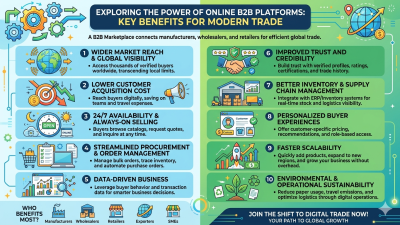
A B2B online marketplace is a platform where businesses buy from and sell to other businesses. Unlike B2C platforms, B2B online marketplace platforms deal with larger order values, longer sales cycles, bulk purchasing, custom pricing, and complex logistics.
Why B2B Online Marketplace Models Are Booming
- Large Transaction Values: Average order values in B2B online marketplace platforms are significantly higher than B2C, making even small commission rates highly lucrative.
- Repeat Business: B2B relationships tend to be long-term, driving high customer lifetime value.
- Fragmented Supply Chains: Many industries — manufacturing, chemicals, agriculture, raw materials — are served by fragmented supplier networks that B2B online marketplace platforms can efficiently aggregate.
- Digital Procurement: Enterprises are increasingly using B2B online marketplace platforms to digitalise their procurement processes, reducing costs and improving efficiency.
Types of B2B Online Marketplace Models
Vertical B2B Marketplaces: These B2B online marketplace platforms focus on a single industry — steel, textiles, pharmaceuticals, electronics. Examples include IndiaMART, TradeIndia, and MetalMandi. Deep industry expertise allows these platforms to serve complex B2B needs better than horizontal alternatives.
Horizontal B2B Marketplaces: Platforms like Alibaba and Amazon Business operate across multiple industries and product categories. They offer convenience and scale for businesses seeking a one-stop procurement solution.
Managed B2B Marketplace Services: Some B2B online marketplace platforms go beyond simple listing to offer managed services — quality verification, logistics coordination, trade finance, and after-sale support — in exchange for higher fees.
Private B2B Marketplaces: Large enterprises sometimes build private B2B online marketplace platforms for their own supplier ecosystems, improving procurement visibility, compliance, and efficiency.
Challenges in the B2B Online Marketplace
- Trust and Verification: B2B transactions involve high stakes; robust supplier verification is critical.
- Customisation Needs: B2B buyers often require custom specifications, pricing, and fulfilment terms.
- Payment Terms: Net-30 or Net-60 payment cycles complicate cash flow for marketplace operators.
- Long Sales Cycles: Unlike B2C impulse purchases, B2B procurement involves multiple stakeholders and decision stages.
Despite these challenges, the B2B online marketplace represents an enormous, underpenetrated opportunity — especially in emerging markets like India.
Marketplace Model vs Inventory Model: Key Differences
One of the most fundamental strategic decisions for any e-commerce business is choosing between the marketplace model vs inventory model. Each approach has distinct economics, risk profiles, and growth trajectories.
What Is the Inventory Model?
In the inventory model, the business purchases products from manufacturers or suppliers, stocks them in warehouses, and sells them directly to customers. The business owns the goods from procurement to sale.
Examples: Early Amazon (before the marketplace), Flipkart’s Wholesale Direct, most traditional e-retailers.
What Is the Marketplace Model?
In the marketplace model vs inventory model comparison, the marketplace does not own any inventory. Instead, it enables third-party sellers to list and sell products, earning a commission or fee for facilitating each transaction.
Marketplace Model vs Inventory Model: Side-by-Side Comparison
| Factor | Marketplace Model | Inventory Model |
| Inventory Ownership | No — sellers own inventory | Yes — business owns inventory |
| Capital Requirement | Low | High |
| Gross Margin | Lower (commission-based) | Higher (full price spread) |
| Scalability | Very High | Moderate (limited by capital) |
| Quality Control | Challenging — seller-dependent | Full control |
| Customer Experience | Variable by seller | Consistent, controlled |
| Risk Exposure | Lower (no unsold stock) | Higher (stock risk, markdowns) |
| Supply Chain Complexity | Outsourced to sellers | Full in-house management |
| Regulatory Flexibility | More flexible (India FDI) | More restricted |
| Speed to Scale | Faster | Slower |
When to Choose Marketplace Model vs Inventory Model
Choose the Marketplace Model if:
- You want to scale quickly with limited capital
- Your category has many fragmented suppliers
- You want to reduce inventory and logistics risk
- You are building a platform-first business
Choose the Inventory Model if:
- You need full control over product quality and customer experience
- You operate in a niche where curated selection is the value proposition
- Your margins can absorb the cost of inventory management
- You are building a private-label or own-brand strategy
Many successful businesses today operate a hybrid marketplace model — combining their own inventory with third-party seller listings to balance quality control with scale. Amazon is the most famous example of this hybrid approach.
In India, the marketplace model vs inventory model debate has particular regulatory significance. FDI regulations restrict foreign-funded companies from operating a pure inventory model, pushing most large players toward the marketplace approach.
How to Choose the Right Marketplace Business Model for Your Business
Selecting the right marketplace business model is not a one-size-fits-all decision. It depends on your industry, target audience, competitive landscape, capital availability, and long-term vision.
Step 1: Define Your Value Proposition
What problem are you solving? Are you aggregating fragmented supply (B2B marketplace)? Creating a trusted buyer-seller environment (commission model)? Or offering specialised access to a professional community (subscription model)?
Step 2: Understand Your Users’ Economics
How frequently do your users transact? High-frequency, low-value transactions favour commission models. Low-frequency, high-value transactions may favour subscription or listing fee models. Your marketplace business model must reflect the economics of your participants.
Step 3: Assess Capital Availability
If capital is constrained, the marketplace business model is significantly more capital-efficient than the inventory model. If you have funding and want quality control, a hybrid or inventory-first approach may work better initially.
Step 4: Consider Regulatory Environment
If you are building in India with foreign investment, the marketplace business model in India regulatory framework is important. Ensure your chosen model complies with FDI guidelines, GST obligations, and consumer protection regulations.
Step 5: Design for Network Effects
The most durable marketplace business model platforms are those where network effects compound growth. Design your model to make the platform more valuable as more buyers and sellers join.
Pros and Cons of the Marketplace Business Model
Pros
- Capital efficiency: No inventory investment required
- Scalability: Grow without proportional cost increases
- Network effects: Value compounds with scale
- Revenue diversity: Multiple monetisation levers available
- Risk reduction: No exposure to unsold inventory
Cons
- Quality control challenges: Difficult to enforce consistent standards across third-party sellers
- Trust and safety: Platforms must invest in robust fraud prevention and dispute resolution
- Chicken-and-egg problem: Hard to attract sellers without buyers and vice versa
- Platform leakage: Buyers and sellers may transact off-platform once they’ve connected
- Regulatory scrutiny: Large marketplace business model platforms increasingly attract government attention
Real-World Examples of Successful Marketplace Business Models
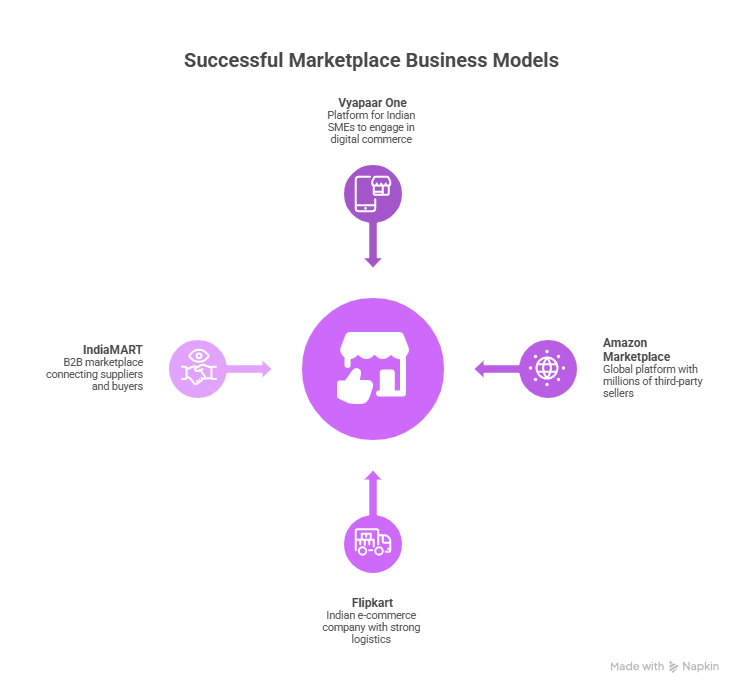
Vyapaar One
Platforms like VyaaparOne (vyaaparone.com) represent the new generation of marketplace business model in India solutions — designed for Indian SMEs, facilitating digital commerce across B2B and B2C segments, and empowering local businesses to scale online.
Amazon Marketplace
The world’s most successful marketplace business model platform, Amazon Marketplace now hosts millions of third-party sellers contributing to over 60% of Amazon’s total unit sales. Its commission and FBA (Fulfilment by Amazon) hybrid model is a masterclass in online marketplace business model design.
Flipkart
India’s leading e-commerce company operates a robust marketplace business model in India, leveraging its logistics network (Ekart) to offer seamless fulfilment for third-party sellers while maintaining buyer trust.
IndiaMART
IndiaMART is India’s largest B2B online marketplace, connecting over 7 million suppliers with more than 150 million buyers. It operates a freemium subscription model where basic listings are free, and premium memberships unlock advanced features and verified badges.
Conclusion
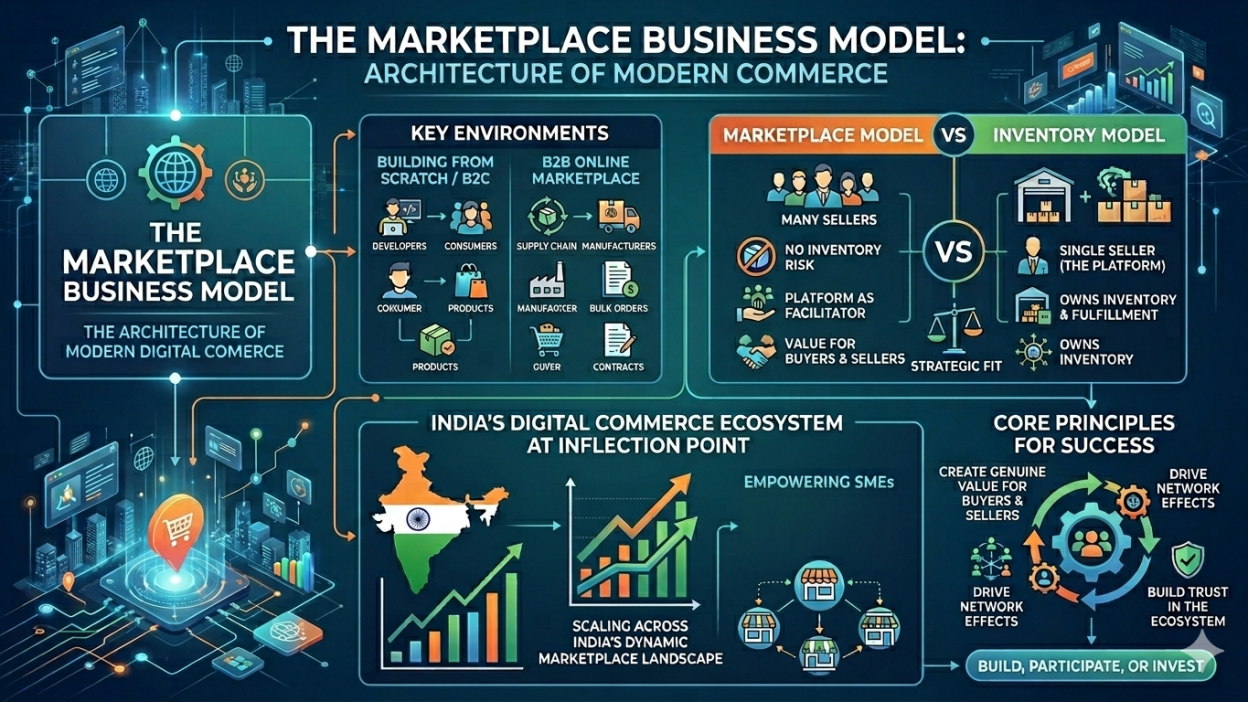
The marketplace business model is not just a business strategy — it is the architecture of modern digital commerce. Whether you are building an online marketplace business model from scratch, entering the B2B online marketplace space, scaling across the dynamic marketplace business model in India landscape, or weighing the marketplace model vs inventory model decision, the core principle remains constant: platforms that create genuine value for both buyers and sellers will win.
India’s digital commerce ecosystem is at an inflection point. With platforms like VyaaparOne (vyaaparone.com) democratising marketplace access for Indian SMEs, the opportunity to build, participate in, or invest in the right marketplace business model has never been greater.
Understanding the types, mechanics, and strategic fit of each marketplace business model gives you a decisive edge. Choose wisely, build for network effects, and design your platform to earn the trust of everyone in your ecosystem.
Frequently Asked Questions
Q1: What is the main difference between the marketplace model vs inventory model?
In the marketplace model vs inventory model comparison, the core difference is ownership. The marketplace does not own the products it sells — it connects buyers and sellers for a fee. The inventory model involves the business purchasing and owning products before selling them to customers. The marketplace model is more scalable and capital-efficient, while the inventory model offers greater quality control.
Q2: Which marketplace business model is best for startups?
For most startups, the commission-based or freemium marketplace business model is ideal because it requires minimal capital and scales well. The commission model aligns revenue with growth, while the freemium model attracts users quickly. The best choice depends on your industry and the economics of your target users.
Q3: How does the B2B online marketplace differ from B2C?
A B2B online marketplace serves businesses buying from other businesses. Transactions are typically larger in value, more complex in nature, and require features like bulk pricing, custom catalogues, credit terms, and RFQ (Request for Quotation) tools. B2C marketplaces focus on individual consumers and prioritise simplicity, speed, and convenience.
Q4: Is the marketplace business model in India regulated differently?
Yes. The marketplace business model in India operates under FDI regulations that distinguish between marketplace and inventory e-commerce. Foreign-funded companies are permitted to operate marketplace models but face restrictions on holding inventory or directly influencing prices. The ONDC (Open Network for Digital Commerce) initiative is also reshaping the regulatory and competitive landscape.
Q5: Can a business combine the marketplace model and inventory model?
Absolutely. A hybrid approach — sometimes called the “managed marketplace” — is increasingly popular. Businesses may own inventory in high-demand or private-label categories while allowing third-party sellers to list other products. Amazon is the most famous example of this successful hybrid marketplace business model.