Introduction
The way businesses buy and sell has changed forever. Online B2B platforms have become the backbone of modern trade, connecting manufacturers, wholesalers, and retailers across the globe with unmatched speed and efficiency.
Whether you are a small supplier looking to expand your reach or a large enterprise streamlining procurement, a B2B online marketplace offers tools that traditional sales channels simply cannot match. From automating orders to accessing thousands of verified buyers, the benefits of using online B2B platforms touch every corner of your business.
In this guide, we break down the key advantages of B2B ecommerce and show you why businesses everywhere are making the switch to digital-first trade.
What Are Online B2B Platforms?
An online B2B platform is a digital marketplace where businesses buy from and sell to other businesses. Unlike B2C (business-to-consumer) models, B2B transactions typically involve bulk orders, negotiated pricing, long-term contracts, and multiple decision-makers.
A B2B ecommerce platform brings all of this into one centralized digital space. Buyers can browse catalogs, request quotes, place bulk orders, and manage invoices — all without a single phone call or paper form.
Popular examples include global marketplaces like Alibaba, IndiaMART, and TradeIndia, as well as industry-specific platforms serving sectors like agriculture, chemicals, electronics, and textiles.
Top Benefits of Using Online B2B Platforms
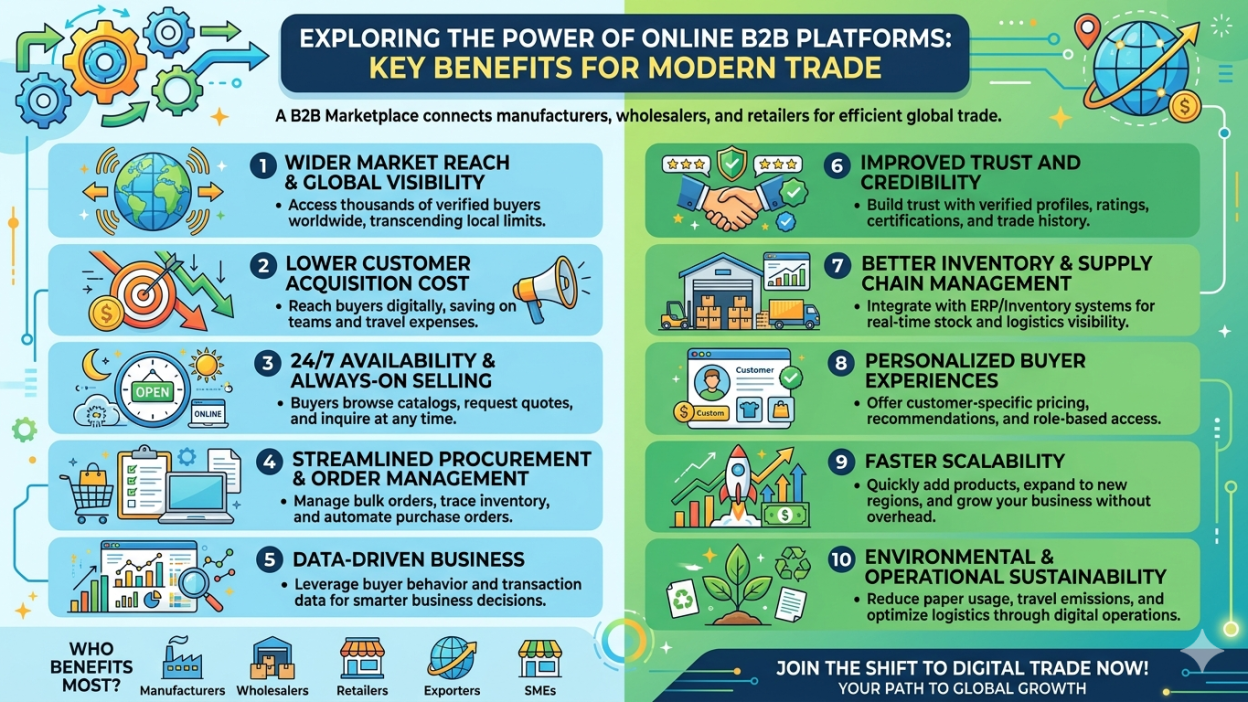
1. Wider Market Reach and Global Visibility
One of the biggest benefits of B2B online marketplaces is the ability to reach buyers beyond your local geography.
With a traditional sales model, your reach is limited by your salesforce, distributor network, and marketing budget. A B2B online marketplace removes those walls. Your products become visible to thousands of verified buyers — from neighboring cities to international markets — 24 hours a day.
For exporters and manufacturers, this global visibility is a game-changer. You no longer need a physical presence in every market. Your digital storefront does the work for you.
2. Lower Cost of Customer Acquisition
Running a field sales team is expensive. Travel, accommodation, salaries, and commissions add up quickly. Online B2B platforms dramatically cut these costs by bringing buyers directly to your digital storefront.
One of the clearest ecommerce business benefits is cost efficiency. Paid listings, lead generation tools, and catalog promotions on a B2B platform often cost a fraction of what traditional sales campaigns require — with far better tracking and ROI visibility.
Smaller businesses especially benefit here. They can compete with larger players without matching their marketing budgets.
3. 24/7 Availability and Always-On Selling
Your sales team works 8 hours a day. Your online B2B platform works around the clock.
Buyers can browse your catalog, check product specifications, compare prices, and even submit inquiries at midnight, on weekends, or during public holidays. This “always-on” model is one of the most practical benefits of ecommerce for a business.
It also accelerates the buying cycle. Instead of waiting for a salesperson to call back, buyers get immediate access to the information they need — speeding up decisions and shortening sales cycles.
4. Streamlined Procurement and Order Management
For buyers, the advantages of B2B ecommerce platforms go well beyond just browsing. Modern platforms offer integrated procurement tools that make purchasing faster and less error-prone.
Features like:
- Bulk order management
- Automated purchase orders
- Real-time inventory tracking
- Digital invoicing and payment processing
- Reorder reminders and scheduled deliveries
…all reduce manual work, eliminate paperwork, and cut down on costly errors. This level of operational efficiency is one of the strongest benefits of ecommerce for businesses that deal in high volumes.
5. Data-Driven Business Insights
When you operate through a B2B ecommerce platform, every interaction generates data. Which products get the most views? Which buyers are returning? What price points drive conversions?
This data is gold.
Traditional sales rarely give you this level of visibility. Online platforms track buyer behavior, search patterns, and purchase history — enabling smarter pricing, better inventory planning, and more targeted marketing.
The ecommerce business benefits of analytics extend to both sellers and buyers. Sellers optimize their offerings; buyers make better procurement decisions with spend tracking and vendor comparisons.
6. Improved Trust and Credibility
Verified profiles, buyer and seller ratings, transaction histories, and certifications — leading B2B online marketplaces build trust into the platform itself.
For new suppliers entering a market, this is invaluable. Instead of spending months building a reputation through cold outreach, a well-rated profile on a credible platform signals legitimacy to buyers immediately.
Trust verification tools also protect buyers. They can check compliance certifications, product quality reports, and business credentials before placing a large order — reducing the risk of fraud or poor quality.
7. Better Inventory and Supply Chain Management
Online B2B platforms increasingly integrate with inventory and ERP systems, giving businesses real-time visibility across the supply chain.
Sellers can automate stock updates, set low-inventory alerts, and coordinate with logistics partners — all from one dashboard. Buyers benefit too, with accurate stock availability shown before purchase.
This connectivity is one of the advantages of B2B ecommerce that directly reduces delays, prevents stockouts, and improves customer satisfaction. Fewer surprises, faster fulfillment, and a more reliable supply chain overall.
8. Personalized Buyer Experiences
Modern B2B ecommerce platforms have moved well beyond basic catalogs. They now offer:
- Customer-specific pricing
- Personalized product recommendations
- Custom catalogs for repeat buyers
- Role-based access for procurement teams
These features mirror the personalized experience of B2C shopping — but built for the complexity of business buying. The result is a smoother, more satisfying purchasing experience that encourages loyalty and repeat orders.
Personalization is rapidly becoming one of the defining benefits of B2B for businesses focused on long-term customer relationships.
9. Faster Scalability
Scaling a traditional sales operation takes time — hiring, training, onboarding, territory mapping. Scaling on a B2B online marketplace is far more agile.
Add new product categories, expand to new regions, or launch seasonal promotions in days — not months. Digital platforms give businesses the flexibility to grow without proportional increases in overhead.
This scalability makes online B2B platforms especially attractive for growth-stage businesses that need to move quickly and efficiently.
10. Environmental and Operational Sustainability
Digitizing procurement reduces paper usage, minimizes travel for sales and purchasing meetings, and optimizes logistics through data-driven route planning.
Many businesses are finding that the ecommerce business benefits include measurable sustainability improvements — fewer printed catalogs, reduced carbon footprint from fewer site visits, and more efficient shipping coordination.
As ESG (Environmental, Social, and Governance) becomes a priority for businesses worldwide, the green advantages of B2B ecommerce platforms add another compelling reason to make the digital shift.
Who Benefits Most from B2B Online Marketplaces?
The benefits of using online B2B platforms are not limited to any single type of business. Across industries, companies are finding tangible value:
Manufacturers gain direct access to bulk buyers without relying entirely on distributors. They can showcase their product range, share technical specs, and receive inquiries at scale.
Wholesalers and Distributors can manage a larger catalog digitally, track orders in real time, and serve retailers more efficiently — reducing administrative overhead significantly.
Retailers and Resellers benefit from a wider supplier base, easier price comparison, and faster restocking — all through a single platform interface.
Exporters and Importers find international trade far more accessible. Verified buyer/seller profiles, multi-currency support, and logistics integration remove many of the traditional barriers to cross-border trade.
Small and Medium Enterprises (SMEs) gain the most relative advantage. A well-optimized profile on a strong B2B platform levels the playing field with much larger competitors.
Key Features to Look for in a B2B Ecommerce Platform
Not all platforms are equal. When choosing a B2B online marketplace for your business, prioritize:
- Verified Buyer/Seller Profiles — Reduces fraud and builds trust
- Catalog Management Tools — Easy product uploads, updates, and categorization
- Lead Management System — Track, qualify, and follow up on inquiries efficiently
- Secure Payment Gateway — Supports trade credit, escrow, and multi-currency transactions
- Analytics Dashboard — Insights on traffic, inquiries, and conversion performance
- Mobile Accessibility — Buying and selling on the go
- Integration Capability — Connects with your ERP, CRM, or inventory software
- Customer Support — Responsive help for disputes, technical issues, and onboarding
Choosing the right platform determines how quickly you unlock the full benefits of ecommerce for your business.
Challenges to Be Aware Of
Being realistic about the challenges of B2B ecommerce helps businesses prepare properly.
Competition is high. On popular marketplaces, you are not the only supplier in your category. Standing out requires strong product content, competitive pricing, and excellent reviews.
Onboarding takes effort. A complete, high-quality digital presence does not happen overnight. Catalog optimization, profile setup, and early lead generation require dedicated time and resources.
Trust must be built digitally. Without face-to-face interaction, trust must be earned through platform credibility signals, prompt responses, and consistent service quality.
The good news: businesses that invest properly in their B2B online marketplace presence typically see measurable returns within 3 to 6 months.
How to Maximize the Benefits of Using Online B2B Platforms
Getting the most out of your B2B ecommerce platform investment requires a strategic approach:
- Optimize Your Product Listings — Use clear titles, detailed descriptions, high-quality images, and accurate specifications. Buyers compare multiple sellers; yours must stand out.
- Respond to Inquiries Quickly — Speed signals professionalism. Aim to respond to every lead within 24 hours, ideally sooner.
- Collect and Display Reviews — Positive ratings from verified buyers build credibility far faster than any marketing copy.
- Use Platform Analytics — Review your traffic and inquiry data regularly. Identify which products attract the most attention and double down on those.
- Offer Flexible Pricing — Many buyers expect negotiation. Use platform tools to offer tiered pricing, bulk discounts, or quote-based pricing to attract serious buyers.
- Keep Inventory Updated — Inaccurate stock information is one of the fastest ways to lose buyer trust. Sync your inventory in real time wherever possible.
- Invest in Premium Listings — Most platforms offer paid promotion options. For competitive categories, premium placement can significantly increase inquiry volume.
Final thought
The shift to digital trade is not a future trend — it is happening right now, across every industry and every market. Online B2B platforms offer businesses an unparalleled combination of reach, efficiency, cost savings, and intelligence that traditional channels simply cannot replicate.
From cutting sales costs and accelerating order cycles to unlocking global markets and improving customer loyalty, the benefits of using online B2B platforms are both wide and deep. Whether you are just beginning your digital journey or looking to scale an existing presence, a well-chosen B2B ecommerce platform is one of the highest-return investments you can make.
Start exploring your options today — and position your business where the buyers are already looking.
Frequently Asked Questions
What is a B2B online marketplace?
A B2B online marketplace is a digital platform where businesses buy products or services from other businesses. It connects suppliers, manufacturers, wholesalers, and retailers in a verified digital environment, enabling bulk transactions, negotiated pricing, and streamlined procurement.
What are the main benefits of B2B ecommerce platforms?
The main benefits include wider market reach, lower customer acquisition costs, 24/7 availability, streamlined order management, data-driven insights, enhanced trust mechanisms, and scalable business growth — all within a single digital platform.
Are online B2B platforms suitable for small businesses?
Absolutely. Small businesses often gain the most relative advantage from B2B online marketplaces. Access to a large buyer base, built-in credibility tools, and affordable listing options allow SMEs to compete with larger players without matching their resources.
How do B2B platforms differ from B2C platforms?
B2B platforms are designed for business-to-business transactions — bulk orders, custom pricing, long-term supplier relationships, and multi-stakeholder procurement processes. B2C platforms focus on individual consumer purchases, typically at fixed prices and smaller quantities.
What should I look for when choosing a B2B ecommerce platform?
Prioritize verified buyer/seller profiles, strong catalog management tools, a secure payment gateway, a lead management system, analytics capabilities, and integration with your existing business software.
How long does it take to see results on a B2B platform?
Most businesses that invest in complete profile setup, catalog optimization, and active lead follow-up begin seeing consistent inquiries within 60 to 90 days. Significant revenue impact typically follows within 3 to 6 months.