
Introduction
The global olive oil trade is one of the most dynamic segments of the edible oils market — and pomace olive oil sits right at the heart of an explosive growth opportunity. Whether you are a trader hunting fresh pomace olive oil export leads, a procurement manager researching pomace olive oil import data, or a business analyst mapping olive oil exports by country, this guide gives you everything you need to act with confidence.
Pomace olive oil is extracted from the residual paste left after primary olive pressing. It combines affordability with the nutritional profile of Mediterranean oils, making it a high-demand commodity in foodservice, industrial cooking, and consumer retail worldwide. Understanding where the olive oil export flows originate — and where demand is surging — is the strategic edge every serious buyer and seller needs right now.
This comprehensive resource breaks down real trade data, country-level insights, and market intelligence so you can identify verified leads and make smarter sourcing or selling decisions in the global pomace olive oil market.
What Is Pomace Olive Oil and Why Does It Matter for Global Trade?
Before diving into trade data, it helps to understand exactly what sets pomace olive oil apart in the export market.
When olives are cold-pressed to produce extra virgin or virgin olive oil, a solid residue called “pomace” remains. This pomace still contains between 5% and 8% residual oil, which is extracted using food-grade hexane solvents and subsequently refined. The result is pomace olive oil — a neutral-flavored, high-smoke-point oil that is significantly more affordable than virgin grades.
For global trade, this matters enormously. Pomace olive oil is not a lower-quality afterthought — it is a precisely positioned product for high-volume markets. Restaurants, food manufacturers, and hotel chains across Asia, the Middle East, and Latin America rely on it as a cost-effective olive oil solution. The volume numbers in pomace olive oil export data confirm this: it accounts for a substantial share of total olive oil shipments in countries like Spain, Greece, and Tunisia.
Key characteristics driving its trade appeal:
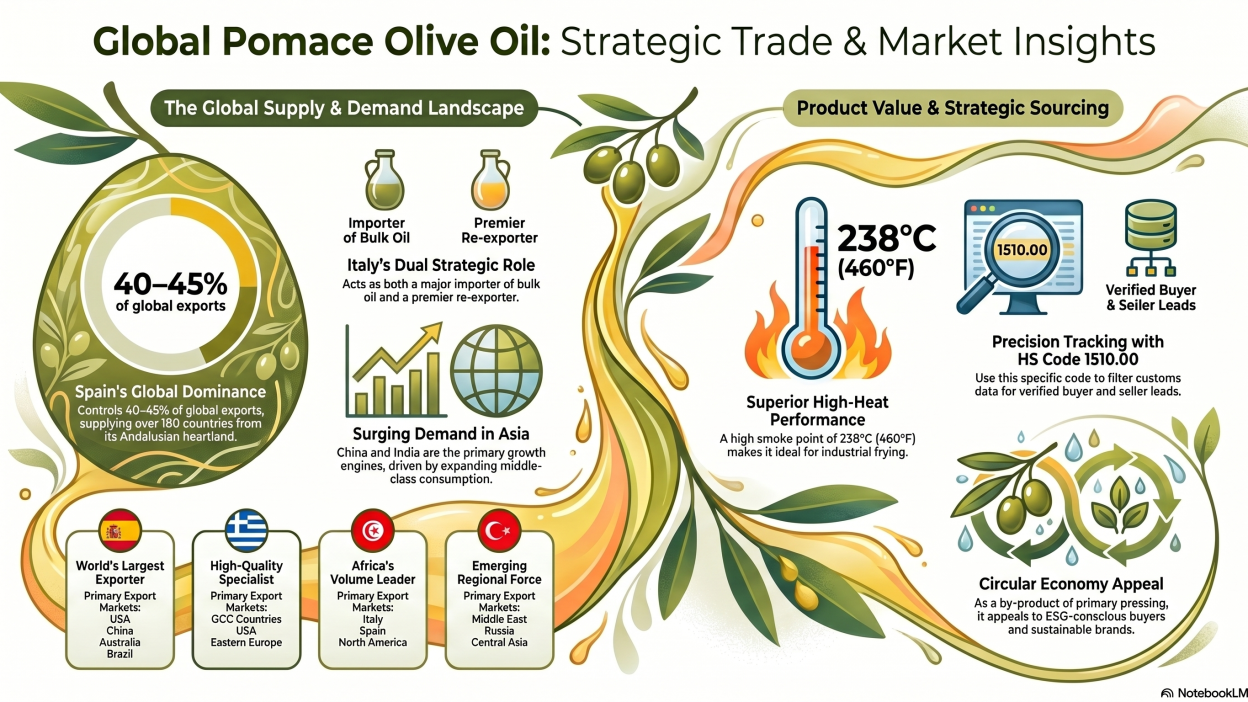
- High smoke point (approx. 238°C / 460°F) — ideal for deep frying and industrial cooking
- Lower price point compared to extra virgin olive oil — broader market accessibility
- Long shelf life — favorable for international shipping and storage logistics
- Blending versatility — often blended with virgin olive oil for improved flavor profiles
- Consistent supply — derived from a by-product, ensuring year-round availability
For businesses seeking the best pomace olive oil sources globally, understanding production geography and shipment data is the first essential step.
Global Overview: Olive Oil Export by Country
Mapping olive oil exports by country reveals a market heavily concentrated in the Mediterranean basin, with a handful of nations dominating global supply.
Spain — The World’s Largest Exporter of Olive Oil
Spain is, without question, the largest exporter of olive oil in the world. It accounts for roughly 40–45% of global olive oil exports in volume terms, and pomace olive oil is a critical component of those shipments. Andalusia, home to millions of olive trees, is the production heartland. Spanish exporters ship to over 180 countries, with top destinations including the United States, Italy, France, China, Australia, and Brazil.
Spanish pomace olive oil export data consistently shows strong shipment volumes to Asian markets, where demand for affordable, high-quality cooking oils is growing rapidly. Key Spanish exporting companies operate out of Jaén, Córdoba, and Sevilla provinces, and their HS codes under 1510.00 are trackable through customs databases.
Italy — Europe’s Premier Olive Oil Importer and Re-Exporter
Italy holds an interesting dual position: it is both a top producer and the largest olive oil importer in Europe. Italy imports bulk olive oil — including pomace grades — primarily from Spain, Greece, and Tunisia, refines and packages it, then re-exports it under Italian brands. This makes Italy central to olive oil import data as well as olive oil export data simultaneously.
For traders looking at pomace olive oil import leads, Italy represents a significant buying market for raw and semi-processed pomace oil. Its food processing industry is a major consumer, and Italian brands command premium positioning in export markets worldwide.
Greece — High Quality, High Volume Exporter
Greece is the world’s third-largest olive oil producer and a consistent top-five largest olive oil exporter. Greek pomace olive oil is particularly sought after in the Middle East, the United States, and Eastern Europe. Greek exporters have benefited from increasing international awareness of Greek origin as a quality signal, and shipment data reflects growing volumes to the Gulf Cooperation Council (GCC) countries.
Greek pomace olive oil export leads are especially active in the B2B segment, with Cretan and Peloponnesian producers supplying large-volume buyers in Saudi Arabia, UAE, and Qatar.
Tunisia — Africa’s Dominant Olive Oil Exporter
Tunisia is the largest olive oil exporter in Africa and a globally significant player overall. Tunisian pomace olive oil is competitively priced and moves in high volumes to the EU (especially Italy, Spain), the Middle East, and North America. Its export data shows strong growth in recent years, driven by increased processing capacity and favorable trade agreements with the EU under the DCFTA framework.
For importers looking for value-driven pomace olive oil import data, Tunisia is a market worth monitoring closely. Many European brands source Tunisian pomace oil as a cost-efficient base for blended products.
Turkey — An Emerging Force in Olive Oil Exports
Turkey has expanded olive cultivation aggressively over the past decade, making it a growing exporter of pomace olive oil. Turkish shipment data shows increasing volumes heading to the Middle East, Russia, and Central Asia. Turkish producers offer competitive FOB prices, and their proximity to major importers in the region makes logistics favorable.
Morocco — Rising Export Potential
Morocco is emerging as a notable contributor to global olive oil exports by country data. With significant investment in olive cultivation and processing infrastructure, Moroccan pomace olive oil is beginning to appear more frequently in international trade databases. Its primary export markets include France, the Netherlands, and Gulf states.
Top Importing Countries: Where Is Pomace Olive Oil Demand Strongest?
Understanding where to find active pomace olive oil import leads requires a clear view of which countries are buying — and buying in volume.
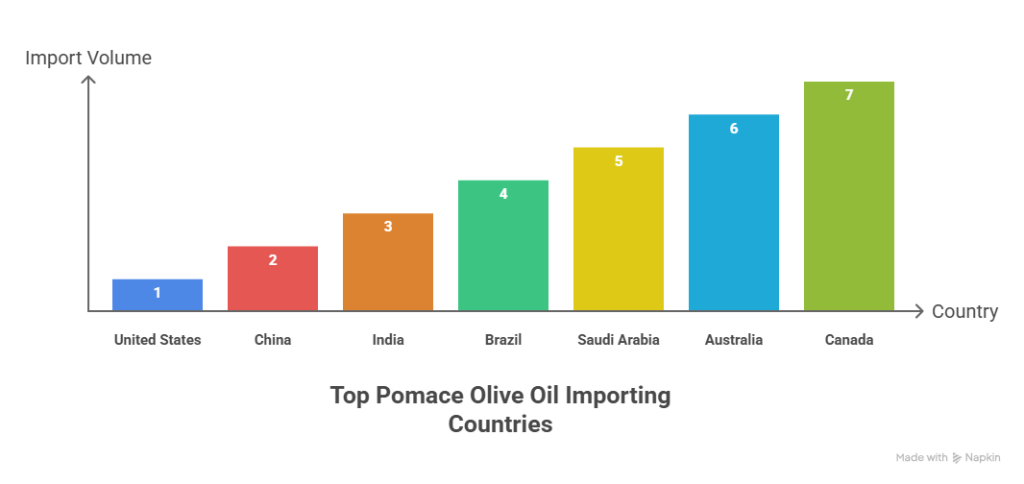
United States
The US is one of the largest olive oil import markets globally. American consumers and food manufacturers import billions of dollars worth of olive oil annually, with pomace grades forming a significant commercial segment. Major buyers include restaurant chains, food processing companies, and institutional kitchens. US pomace olive oil import data from customs records shows consistent high-volume shipments arriving from Spain, Italy, Greece, and Tunisia.
China and India
Both China and India represent massive growth markets for pomace olive oil. China’s middle class has developed a strong appetite for Mediterranean cooking oils, driving year-on-year increases in olive oil import volumes. India’s foodservice sector — particularly the hotel and quick-service restaurant industries — has adopted pomace olive oil extensively due to its high smoke point and relative affordability. Indian pomace olive oil import data indicates growing demand from Mumbai, Delhi, and Chennai-based importers.
Brazil
Brazil is South America’s leading olive oil importer and one of the fastest-growing markets globally. Brazilian consumers have a cultural affinity for olive oil, and domestic production is minimal, making the country entirely dependent on imports. Pomace olive oil export leads targeting Brazil typically originate from Spain and Portugal.
Saudi Arabia and the Gulf States
The GCC region is a high-value market for pomace olive oil, driven by large expatriate populations, thriving hospitality industries, and strong cultural preferences for olive oil in cooking. Saudi Arabia, UAE, and Kuwait consistently appear in top-tier pomace olive oil import leads datasets. Greek and Tunisian exporters have particularly strong footprints here.
Australia and Canada
Both markets show growing consumer sophistication around olive oil, with pomace grades gaining traction in food manufacturing. Australian and Canadian olive oil import data points to Spain and Greece as dominant suppliers.
How to Find Verified Pomace Olive Oil Export Leads
Finding quality pomace olive oil export leads is not just about knowing which countries trade — it is about accessing verified, shipment-level data tied to real buyers and sellers.
1. B2B Trade Portals
Platforms like Tradeling, GlobalTrade.net, and regional B2B marketplaces list verified exporters and importers of pomace olive oil. These portals often include buyer request listings that function as ready-to-act pomace olive oil import leads for exporters seeking new customers.
2. Customs Import-Export Trade Databases
The most reliable source of pomace olive oil export data and pomace olive oil import data is government customs records. These databases capture bill of lading (B/L) data, including:
- Exporter and importer company names
- Shipment quantities (kg / metric tons)
- HS Code (typically 1510.00 for pomace olive oil)
- Port of loading and discharge
- FOB / CIF values
- Vessel and shipment dates
Platforms that aggregate this customs data allow traders to filter by product, country, and date range to extract live pomace olive oil export leads and identify active buyers in target markets.
3. HS Code Targeting for Pomace Olive Oil
The correct Harmonized System (HS) code for pomace olive oil is 1510.00 (Other oils and their fractions, obtained solely from olives). Some databases may use sub-codes depending on the country’s tariff schedule. Using the right HS code when querying pomace olive oil export data or pomace olive oil import data ensures you capture the right product category and avoid contaminating your lead list with unrelated olive oil grades.
4. Trade Fair and Industry Networks
International food and commodities trade fairs — such as SIAL Paris, Gulfood Dubai, ANUGA Cologne, and the World Olive Oil Exhibition — are prime venues for generating in-person pomace olive oil export leads. These events attract verified buyers and sellers from all major markets and provide a human connection that digital databases alone cannot replace.
5. Export Promotion Councils and Trade Bodies
Country-specific export promotion councils (such as Spain’s ICEX, Italy’s ICE Agency, or Tunisia’s CEPEX) maintain directories of certified exporters. These are excellent starting points for identifying the best pomace olive oil producers and establishing first contact with reliable suppliers.
Reading Pomace Olive Oil Trade Data: Key Metrics to Track
Once you have access to pomace olive oil export data and pomace olive oil import data, knowing which metrics to prioritize will sharpen your market intelligence.
Shipment Volume Trends
Track monthly and quarterly shipment volumes from key origins. A sustained upward trend in shipments from a specific country signals healthy supply and potentially increased competition (which can pressure prices). A sudden volume spike from an emerging origin like Morocco or Turkey can indicate a supply disruption opportunity or a new, cost-competitive source entering the market.
Average Unit Price (FOB/CIF)
Monitoring the average FOB price per metric ton in pomace olive oil export data allows you to benchmark your negotiation position. Prices fluctuate based on olive harvest yields, energy costs for solvent extraction, and global edible oil price indices. Tracking price trends across origins gives you leverage in procurement conversations.
Top Trading Companies
Customs data reveals the most active exporters and importers by shipment frequency and volume. Identifying which companies appear consistently at the top of pomace olive oil export leads databases tells you who the dominant players are — and equally, which mid-sized players might be accessible partners for new business relationships.
Origin-Destination Trade Corridors
Understanding which specific country pairs generate the highest trade volumes — e.g., Spain → China, Tunisia → Italy, Greece → Saudi Arabia — helps you design your market entry strategy and logistics planning around established corridors that already have shipping routes, regulatory familiarity, and banking relationships in place.
What Makes the Best Pomace Olive Oil for Export Markets?
When sourcing the best pomace olive oil for export or import, several quality and compliance parameters determine suitability for different markets.
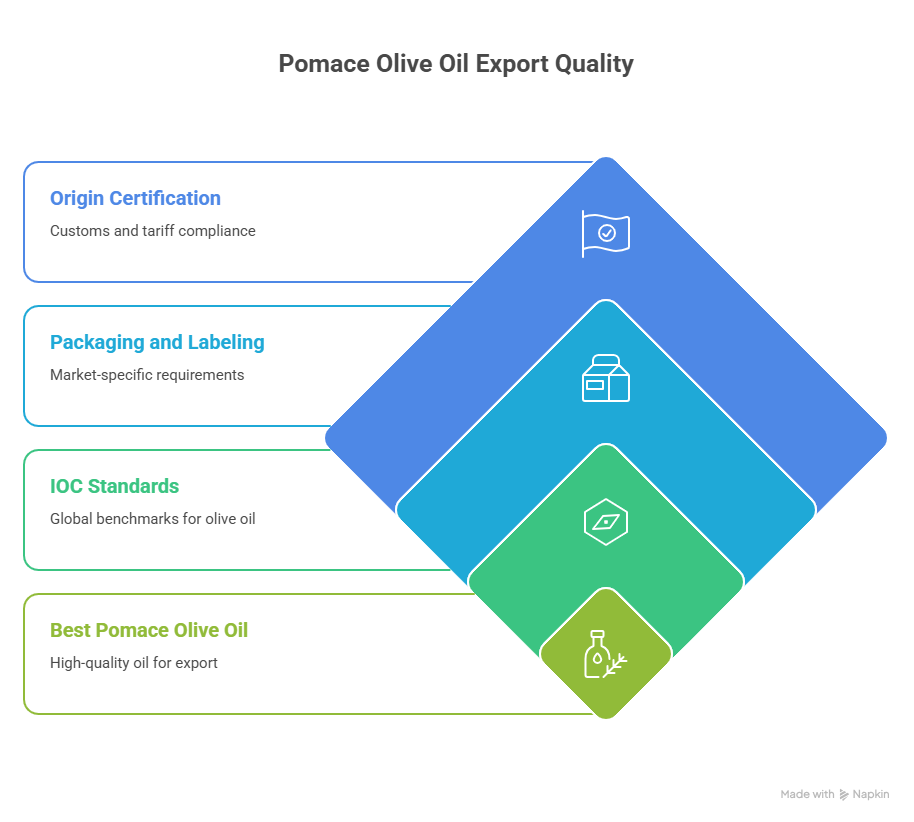
International Olive Council (IOC) Standards
The IOC sets the globally recognized standards for pomace olive oil composition, including limits on free fatty acid content, peroxide value, and UV absorbance. Shipments destined for EU markets must comply with EU Regulation 1348/2013 (and its updates), which sets strict quality benchmarks. Buyers should always request a Certificate of Analysis (CoA) aligned with IOC specifications.
Packaging and Labeling Compliance
The best pomace olive oil for export comes in packaging designed for the destination market. Bulk shipments typically travel in flexi-tanks or IBC totes. Retail packaging requires country-specific label compliance — including correct product classification, origin labeling, allergen declarations, and language requirements.
Origin Certification and PDO/PGI Status
While pomace olive oil does not typically carry PDO (Protected Designation of Origin) status the way extra virgin grades do, the declared country of origin in export documentation is critical for customs classification and tariff treatment. Incorrect origin declarations are a common compliance risk in olive oil export documentation.
Organic and Specialty Certifications
A growing segment of pomace olive oil export leads involves organic-certified or specialty pomace oils. Buyers in the US, Germany, and Australia increasingly seek organic-certified pomace oil for natural food brands. Exporters with relevant certifications (USDA Organic, EU Organic, etc.) can access a premium price tier even within the pomace category.
Key Trends Shaping Pomace Olive Oil Trade
Understanding macro trends helps you position your trade strategy ahead of market shifts.
Climate Impact on Olive Harvests
The olive oil market has experienced significant supply volatility due to drought conditions across Spain, Italy, and Greece in recent seasons. Reduced extra virgin production has pushed some buyers toward pomace grades as a budget alternative — creating stronger demand signals in pomace olive oil import data even as raw material availability fluctuated. Monitoring harvest forecasts from the IOC and national agricultural ministries is essential for anticipating supply-driven price movements.
Asian Market Expansion
The olive oil export market’s most significant growth story over the next decade is Asia. China, India, South Korea, and Japan are all increasing olive oil consumption at scale. Pomace olive oil import leads from Asian buyers are intensifying, and exporters who establish relationships and logistics corridors into Asia now are positioning for outsized returns as the market matures.
Sustainability and Circular Economy Positioning
Pomace olive oil’s story as a by-product utilization fits neatly into the circular economy narrative that is gaining traction among food industry buyers globally. Exporters who can document their sustainability credentials — reduced waste, efficient energy use in extraction, responsible water management — are better positioned to win contracts with ESG-conscious importers in Northern Europe and North America.
E-Commerce and DTC Channels
Retail-grade pomace olive oil is increasingly moving through e-commerce platforms in markets like India, China, and Brazil. This creates a new category of pomace olive oil import data from small-parcel and express courier shipments — distinct from traditional bulk container trade — that represents the growing direct-to-consumer segment.
Turn Data Into Trade Decisions
The pomace olive oil market rewards traders, buyers, and exporters who operate with precision intelligence. Whether you are building your pipeline with pomace olive oil export leads, interrogating pomace olive oil import data to find new supplier relationships, or benchmarking your position against the largest exporter of olive oil — the data is there. The difference between a good trader and a great one is knowing how to read it, validate it, and act on it faster than the competition.
From Spain’s dominant shipment volumes to India’s surging demand, from Greece’s high-value GCC relationships to Tunisia’s competitive pricing power — olive oil exports by country data tells a nuanced story that rewards careful analysis. Pair that with a clear understanding of quality standards, compliance requirements, and emerging market trends, and you have the foundation for a durable, scalable position in the global pomace olive oil trade.
Start with verified data. Build relationships with certified suppliers. Stay ahead of harvest and price trends. And use every pomace olive oil export lead as an opportunity to create a long-term commercial partnership, not just a one-off transaction.
The global olive oil trade is growing. Make sure your business grows with it.
Frequently Asked Questions About Pomace Olive Oil Trade
What is the HS code for pomace olive oil exports?
The standard HS code for pomace olive oil is 1510.00, which covers oils obtained from olives other than those classified under 1509 (virgin and extra virgin grades). Some national tariff schedules use sub-codes such as 1510.00.10 or 1510.00.90, so always verify the destination country’s specific classification.
Who is the largest exporter of olive oil in the world?
Spain is consistently the largest exporter of olive oil globally, accounting for approximately 40–45% of world export volumes. It leads in both extra virgin and pomace categories, supplying markets across five continents.
How do I access pomace olive oil import data?
Pomace olive oil import data is available through customs data platforms that aggregate bill of lading records from government trade databases. Filtering by HS code 1510.00 and the destination country allows you to extract buyer-level import data including company names, volumes, and shipment frequency.
What is the difference between pomace olive oil and extra virgin olive oil for export purposes?
From a trade and customs perspective, they fall under different HS codes: extra virgin olive oil under 1509.10 and pomace olive oil under 1510.00. They also attract different tariff rates in many importing countries and are subject to different IOC quality standards. Mislabeling between grades is a serious compliance risk that can result in customs rejection and reputational damage.
Which countries are the top importers of pomace olive oil?
Based on current pomace olive oil import data, the top importing countries include the United States, China, India, Brazil, Saudi Arabia, UAE, Italy, Australia, and Canada. Each market has distinct demand drivers, price sensitivities, and regulatory requirements.
How can I find reliable pomace olive oil export leads?
The most effective methods combine customs trade data platforms (for shipment-level lead intelligence), participation in international food trade fairs, engagement with country export promotion councils, and active monitoring of B2B trade portals. Combining these sources gives you both data-driven leads and relationship-based pipeline development.