
Introduction
Turkish Delight — the legendary confection known as Lokum — has been enchanting taste buds across the globe for centuries. But beyond its sugary charm and cultural heritage, it has quietly become one of Turkey’s most formidable trade assets. For businesses worldwide, discovering the right export leads in the Turkish Delight market can open doors to extraordinary profit margins and long-term trade partnerships.
In recent years, the global demand for premium confectionery has skyrocketed. As health-conscious and culturally curious consumers grow across Europe, the Americas, and Asia, Turkish Delight has transitioned from a niche novelty into a mainstream gourmet product. This dramatic shift means that import export leads in the Turkish Delight sector are more valuable now than ever before.
Whether you are an importer searching for reliable suppliers or a trade intelligence analyst mining Turkey export data, understanding the anatomy of this booming industry is your first step toward capitalizing on one of the world’s most flavorful trade opportunities. In this comprehensive guide, we explore the remarkable growth trajectory of Turkish Delight exports, unpack the latest Turkish Delight Export data, and show you exactly how to leverage export leads online for your business.
Why Turkish Delight Has Become a Global Trade Powerhouse
The Deep Roots of a Cultural Confection
Turkish Delight’s commercial journey began long before modern trade routes were mapped. Crafted from sugar, starch, and a rich medley of flavors ranging from rosewater to pistachio, the confection has been a staple of Turkish culture since the 18th century. The Ottoman Palace popularized it as a royal delicacy, and the name Lokum itself derives from Arabic, meaning “mouthful of contentment.”
When C.S. Lewis immortalized it in The Lion, the Witch and the Wardrobe, Western audiences got their first literary taste. But it was globalization, modern logistics, and rising interest in world foods that truly fueled delight exports from Turkey into a competitive international trade category.
Today, Turkish manufacturers export millions of kilograms annually. Access to reliable Turkish Delight Export data helps businesses understand just how massive this market has become — and how quickly it is still growing.
Global Confectionery Trends Fueling Demand
The global confectionery market is projected to surpass USD 300 billion by 2030, with artisan and culturally rooted sweets outpacing mass-produced products. Turkish Delight taps directly into the fastest-growing segments:
- Premium gifting: Turkish Delight packaged in ornate, culturally themed boxes has become a top-tier gift item across European and Middle Eastern markets.
- Vegan and gluten-free confections: Traditional Turkish Delight formulas are naturally vegan and gluten-free, giving them a competitive edge in health-conscious markets.
- Ethnic and specialty food retail: Supermarket chains in the UK, Germany, France, and the US are increasingly stocking Turkish Delight in ethnic food aisles and gourmet sections.
For companies tracking import export leads, these trends represent actionable intelligence. Businesses that access fresh export leads online can position themselves ahead of competitors by identifying suppliers, pricing benchmarks, and emerging import corridors before the broader market catches on.
Understanding Turkish Delight Export Data
What Does Turkish Delight Export Data Tell You?
Turkish Delight Export data is a structured dataset sourced from customs authorities, port filings, and shipping records. When properly analyzed, this data reveals:
- Volume shipped: How many kilograms or metric tons are exported per quarter or year.
- Destination countries: Which nations are the primary importers of Turkish Delight.
- HS (Harmonized System) codes: The classification codes that identify Turkish Delight in global customs systems.
- Unit pricing and total value: Benchmarks for negotiating competitive pricing.
- Exporter profiles: Names, registration numbers, and contact data for verified Turkish manufacturers and trading companies.
Platforms like Vyaaparone.com aggregate this Turkey export data to provide actionable export leads to importers and trade professionals. Instead of spending weeks cold-calling distributors, businesses can use curated export leads online to connect directly with verified Turkish Delight exporters.
Key HS Codes for Turkish Delight
For anyone conducting trade intelligence, Turkish Delight is typically classified under:
- HS Code 1704.90 — Sugar confectionery not containing cocoa (includes Lokum/Turkish Delight)
- HS Code 1704.10 — Chewing gum (not typically applicable but sometimes cross-listed)
- HS Code 2106.90 — Food preparations not elsewhere specified (for mixed or specialty formulations)
Using these codes when querying Turkish Delight import data or filtering Turkey export data ensures accuracy and relevance in your trade analysis.
Volume and Value Trends in Turkish Delight Exports
According to aggregated Turkish Delight Export data, Turkey’s confectionery exports have seen consistent year-on-year growth. The country exports Turkish Delight to over 100 nations, with the top destinations including:
- United States — The largest single importer, driven by the diaspora community and growing mainstream acceptance.
- Germany — Home to one of Europe’s largest Turkish diaspora populations; the demand for authentic Turkish confections is persistent and strong.
- United Kingdom — A historically significant market, with Turkish Delight beloved as a traditional holiday treat.
- Saudi Arabia and UAE — Gulf nations represent premium gifting markets where ornate packaging commands high price points.
- France and the Netherlands — Growing specialty food markets where delight exports from Turkey are gaining shelf space in gourmet retail chains.
Businesses that regularly access turkish delight import data for these regions can track purchasing patterns, seasonal demand spikes, and emerging buyer profiles.
How to Find the Best Export Leads for Turkish Delight
The Old Way vs. The Smart Way
Traditionally, identifying trading partners meant attending trade fairs in Istanbul, relying on chambers of commerce, or paying costly consultants. These methods are slow, expensive, and prone to outdated contacts.
Today, smart traders use export leads online to cut through the noise. Platforms powered by real-time customs data provide verified import export leads that include:
- Company name and registration number
- Shipment history and frequency
- Products shipped with HS codes
- Destination ports and consignee information
- Contact details (email, phone, address)
When you access export leads through Vyaaparone.com, you are leveraging one of the most comprehensive trade intelligence engines available. The platform synthesizes Turkey export data from multiple customs databases, giving you a 360-degree view of who is buying, how much, and at what price.
Steps to Source Export Leads Online for Turkish Delight
Here is a practical step-by-step guide to finding high-quality export leads online for Turkish Delight:
Step 1 — Define Your Target Market Decide which region you want to supply to. Are you an importer in the US looking for exporters? Or are you a Turkish manufacturer seeking buyers in Southeast Asia? Your direction shapes how you filter import export leads.
Step 2 — Search by HS Code Filter Turkish Delight Export data by HS code 1704.90 to identify relevant shipments. This narrows your dataset to Turkish Delight-specific transactions.
Step 3 — Analyze Exporter Profiles Review the list of exporters in the filtered Turkey export data. Check their shipment frequency, volume consistency, and destination diversity. Regular exporters are more reliable trading partners than one-off shippers.
Step 4 — Review Turkish Delight Import Data for Buyer Intelligence Cross-reference turkish delight import data from target countries to identify which importers are actively sourcing. These are your warmest import export leads — companies with a proven purchase history.
Step 5 — Reach Out with Data-Backed Pitches Armed with verified contact data from your export leads online platform, approach potential partners with specific data: “We noticed your company imported X metric tons of Turkish Delight in Q3. Our client can supply at Y price point with Z delivery lead time.”
Data-backed outreach dramatically improves response rates compared to cold emails.
The Top Turkish Delight Exporting Companies and Regions in Turkey
Geographic Concentration of Production
Understanding where delight exports from Turkey originate helps importers build direct relationships with producers rather than intermediaries. The main production hubs include:
Istanbul: The commercial capital accounts for the highest volume of Turkish Delight exports. Major confectionery companies headquartered here maintain direct export operations.
Afyon (Afyonkarahisar): Known for its unique lokum made with natural starch from locally grown crops, Afyon’s Turkish Delight is considered among the finest in the world.
Sakarya: A growing hub for industrial-scale confectionery production, particularly for sugar-based sweets destined for mass-market retail.
Bursa and Konya: These central Anatolian cities are emerging producers, with factories increasingly geared toward halal-certified exports for Gulf and Southeast Asian markets.
Turkish Delight Export data consistently shows Istanbul-registered companies dominating the export ledger, but regional producers are capturing growing market share as international buyers seek artisanal and origin-specific products.
Notable Export-Oriented Turkish Confectionery Companies
While publicly traded data is available through Turkey export data platforms, some of the most consistent exporters operate in the mid-to-large segment. Key company types to look for in your import export leads research include:
- Industrial manufacturers producing private-label Turkish Delight for global retail chains
- Artisanal confectioners focused on premium gifting markets in Europe and North America
- Halal-certified exporters targeting Muslim-majority nations in Asia, Africa, and the Gulf
- Organic and natural product companies addressing health-conscious consumer segments
Each of these categories represents distinct export leads opportunities. Vyaaparone.com’s trade data tools allow you to filter by company size, shipment value, and destination to match your specific sourcing needs.
Turkish Delight Import Data: What Buyers Around the World Are Spending
Mapping Global Import Activity
Turkish delight import data tells the story from the buyer’s side. By studying this data, exporters can identify:
- Which countries are increasing their imports year-over-year
- The price points buyers are accepting
- Seasonal spikes (Ramadan, Christmas, Valentine’s Day)
- Shift in preferred product types (e.g., pistachio vs. rose vs. mixed boxes)
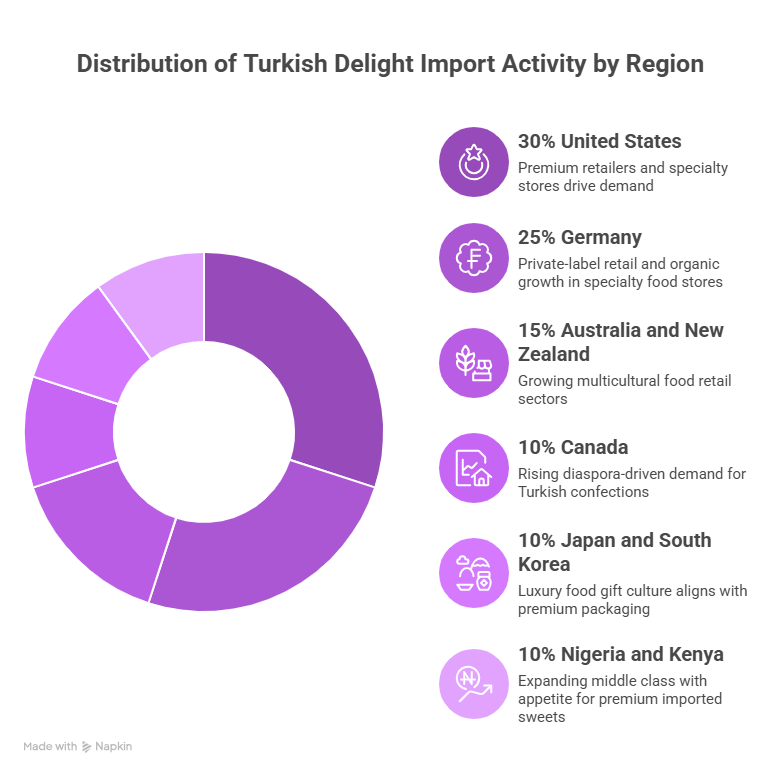
The United States leads in turkish delight import data volume by value, with premium retailers and specialty stores driving demand. Germany follows closely, with both private-label retail demand and organic growth in specialty food stores.
Emerging markets in turkish delight import data reports include:
- Australia and New Zealand — Growing multicultural food retail sectors
- Canada — Rising diaspora-driven demand for Turkish confections
- Japan and South Korea — Luxury food gift culture aligns perfectly with premium Turkish Delight packaging
- Nigeria and Kenya — Expanding middle class with appetite for premium imported sweets
For businesses seeking high-potential import export leads, these emerging markets represent ground-floor opportunities. Getting in early — before major brands saturate these channels — is where the real competitive advantage lies.
Seasonal Demand and How It Shapes Export Leads
Timing your outreach around peak seasons can dramatically improve your conversion rate from export leads online. Here is the seasonal map of Turkish Delight demand:
| Season / Event | Key Import Markets | Peak Volume |
| Ramadan (April–May) | Middle East, North Africa, Southeast Asia | Very High |
| Christmas & New Year | Europe, North America | High |
| Valentine’s Day | United States, UK, Australia | Medium-High |
| Eid Al-Adha | Gulf States, UK | High |
| Easter | Central & Eastern Europe | Medium |
By aligning your export leads outreach with these seasonal windows, you ensure your pitches land when buyers are actively in sourcing mode — not when they’ve already placed their orders.
How Vyaaparone.com Powers Your Turkish Delight Trade Intelligence
A One-Stop Platform for Export and Import Leads
Vyaaparone.com is designed specifically to help businesses access verified export leads and import export leads across hundreds of product categories — including Turkish confectionery. The platform’s Turkish Delight trade data functionality covers:
- Real-time shipment records filtered by HS code, country, and date range
- Exporter and importer profiles with verified contact information
- Price trend analysis based on actual customs-cleared transaction values
- Market share breakdowns showing which exporters dominate each destination
With this intelligence, sourcing professionals can build targeted outreach lists, verify new suppliers, and benchmark their current trade relationships — all from one dashboard.
Accessing Turkish Delight Export Data Efficiently
When you search Turkish Delight Export data on Vyaaparone.com, the process is streamlined:
- Input your HS code (1704.90 for Turkish Delight)
- Select origin country (Turkey)
- Filter by date range (monthly, quarterly, or yearly)
- Sort by volume or value to identify top-tier exporters
- Export your leads list in CSV or Excel for CRM integration
This workflow converts raw Turkey export data into actionable export leads online in minutes — not days.
Why Data-Driven Export Leads Outperform Traditional Methods
The advantage of platform-generated import export leads over traditional trade directories is precision. Trade directories are static, often outdated, and lack transaction verification. Export and import customs data is legally filed and independently verified.
When you contact a potential partner identified through Turkish Delight Export data, you know they have actually shipped the product, at the volume declared, to the destination recorded. There is no guesswork — just verified trade activity converted into quality export leads.
Challenges and Opportunities in the Turkish Delight Export Market
Challenges Facing Turkish Delight Exporters
Despite its growth, the Turkish Delight export market is not without friction. Understanding these challenges helps importers set realistic expectations and helps exporters address buyer concerns:
1. Shelf Life and Cold Chain Requirements Turkish Delight has a moderate shelf life of 6–12 months under proper conditions. Humidity and heat are enemies of quality. Exporters must invest in proper packaging and cold chain logistics, especially for long-haul routes to North America and Asia.
2. Labeling and Regulatory Compliance Different countries have strict food labeling regulations. The US FDA, EU food safety authorities, and Gulf countries’ halal certification bodies all require different documentation. Businesses that track Turkey export data know that compliance failures can result in shipment rejections — costly for both parties.
3. Currency Volatility Turkey’s lira has experienced significant fluctuation, creating pricing uncertainty for long-term supply contracts. Buyers using turkish delight import data platforms can track price-per-kg trends to better forecast and hedge against currency risk.
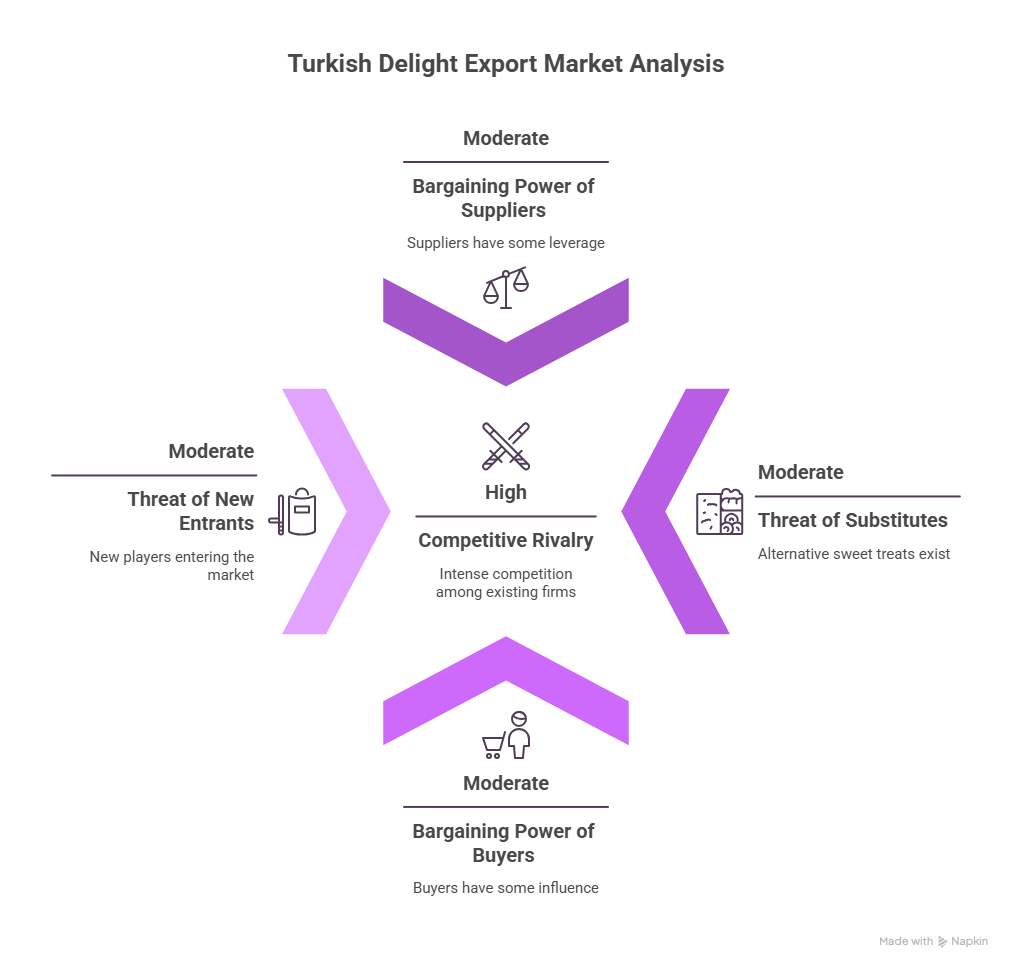
4. Competition from Regional Producers Countries like Lebanon, Greece, and Iran produce similar confections. As these regions improve their own export capabilities, Turkish Delight producers must continually differentiate through quality, branding, and certification.
Opportunities That Make This Market Worth Pursuing
Despite these challenges, the opportunities in delight exports from Turkey are substantial and growing:
E-commerce Expansion: Direct-to-consumer Turkish Delight brands are thriving on Amazon, Etsy, and specialty food platforms. For importers who identify the right export leads online, this channel can yield high margins with relatively low minimum order quantities.
Private Label Partnerships: Global retail chains increasingly source private-label Turkish Delight. Connecting with verified manufacturers through import export leads platforms enables scalable private-label sourcing agreements.
Gifting and Hospitality Sectors: Hotels, airlines, and corporate gifting companies are active buyers. Monitoring turkish delight import data for these verticals reveals niche but highly profitable buyer segments.
Functional and Fortified Variants: Producers are innovating with sugar-free, low-calorie, and vitamin-fortified Turkish Delight. These premium variants command higher prices and open doors to health and wellness retail channels.
Practical Tips for Importers Using Turkish Delight Export Data
Due Diligence Before Closing a Deal
Finding a great lead through Turkish Delight Export data is just the beginning. Before committing to a supplier, importers should:
- Verify export licenses and food safety certifications (HACCP, ISO 22000, halal)
- Request product samples before placing bulk orders
- Cross-check shipment history on the Turkey export data platform to confirm consistency
- Check buyer references from other importers in your country
- Review financial terms carefully — most Turkish exporters work on letter of credit (LC) or 30% advance, 70% balance on bill of lading
Negotiating Pricing Using Import Data
One of the most underutilized advantages of turkish delight import data is its role in price negotiation. When you know that Exporter A has been selling at USD 3.20/kg to German buyers while quoting you USD 4.10/kg, you have a factual basis for negotiation. This level of transparency is only possible when you have access to export leads online platforms with real customs pricing data.
Building Long-Term Supplier Relationships
The best import export leads are not one-time transactions — they are the beginning of long-term relationships. Once you identify a quality Turkish Delight exporter through Turkey export data, invest in the relationship:
- Visit the factory in Turkey if possible
- Participate in Istanbul Food Fairs and trade exhibitions
- Agree on annual volume commitments in exchange for better pricing
- Co-develop product innovations suited to your market
Long-term partnerships reduce sourcing risk, improve product consistency, and often unlock exclusive product variants that are not available on the open market.
The Future of Turkish Delight Exports: What the Data Predicts
Growth Projections Backed by Trade Data
The trajectory visible in Turkish Delight Export data over the past five years points strongly upward. Several macro trends suggest this growth will continue and accelerate:
1. Rising Global Sugar Confectionery Demand Global sugar confectionery demand is expected to grow at a CAGR of 3.5–4.5% through 2030. Turkish Delight, with its artisanal credentials and cultural cachet, is well-positioned to outpace this average.
2. Turkish Government Export Incentives Turkey’s Ministry of Trade actively promotes food exports through subsidy programs, trade missions, and international exhibition support. These incentives encourage Turkish manufacturers to pursue export leads more aggressively, expanding supply into new markets.
3. The Rise of Specialty and Ethnic Food Retail As multicultural demographics grow in Western nations, specialty food retail is booming. Delight exports from Turkey benefit directly from this demographic shift, as diaspora communities seek authentic products and mainstream consumers experiment with global flavors.
4. E-commerce as a New Export Channel Digital trade is enabling small and mid-size Turkish confectioners to access export leads online directly, bypassing traditional wholesale intermediaries. This democratization of trade intelligence means more exporters are competing for more buyers in more markets simultaneously.
5. Sustainability and Ethical Sourcing Buyers increasingly want to know where their food comes from and how it is made. Turkish Delight producers who can document their supply chain and certify sustainable practices will command premium pricing and priority shelf space in leading markets.
Emerging Import Markets to Watch
Based on the latest trends in turkey export data and turkish delight import data, the following markets are emerging as high-growth destinations:
- Indonesia and Malaysia — Large Muslim populations with growing disposable income and affinity for halal-certified sweets
- Brazil and Mexico — Rapidly growing specialty food retail sectors with curiosity for global confections
- India — A confectionery-loving culture discovering Turkish Delight through international travel and media
- South Korea and China — Premium gifting culture and fascination with global luxury foods
Businesses that position themselves now in these markets — by targeting the right import export leads before competition intensifies — will have first-mover advantage in some of the world’s most dynamic consumer markets.
Conclusion
The growth of delight exports from Turkey is not a passing trend — it is a structural market shift backed by strong cultural heritage, rising global demand, and increasingly sophisticated trade infrastructure. For businesses that want to participate in this growth, the tools have never been more accessible.
By leveraging accurate Turkish Delight export data, filtering real-time Turkey export data for verified suppliers, and using Turkish Delight import data to identify active buyers, you can build a pipeline of high-quality import export leads that drive consistent revenue.
Platforms like Vyaaparone.com transform raw customs data into clean, actionable export leads online — saving you time, reducing risk, and giving you the competitive intelligence needed to outmaneuver rivals in a fast-moving global market.
The question is not whether Turkish Delight is a worthwhile trade opportunity. The data already answers that. The real question is: will you access the right export leads today and secure your position in this remarkable growth story?
Start your Turkish Delight trade intelligence journey at Vyaaparone.com and discover the import export leads that can transform your business.
Frequently Asked Questions
What is Turkish Delight Export data and how can I use it?
Turkish Delight Export data refers to customs-sourced shipment records documenting Turkey’s exports of Turkish Delight (HS code 1704.90). Businesses use this data to identify verified exporters, benchmark pricing, track trade volumes, and generate targeted export leads. Platforms like Vyaaparone.com make this data searchable and actionable.
How do I find reliable export leads online for Turkish Delight?
The most reliable way to find export leads online is through trade intelligence platforms that source data from official customs filings. Search by HS code, filter by exporter country (Turkey), and narrow by destination market. This yields verified import export leads with actual shipment history.
What is the difference between export leads and import leads?
Export leads identify sellers/exporters in the originating country — in this case, Turkish Delight manufacturers in Turkey. Import leads identify buyers/importers in destination countries. Import export leads platforms provide both sides of the trade equation, enabling connections from either direction.
How often is Turkey export data updated on trade platforms?
The update frequency depends on the platform. The best Turkey export data providers update their databases monthly or quarterly, aligned with official customs release cycles. Real-time data is typically available for major trade corridors.
Is Turkish Delight export data available for free?
Basic Turkish Delight Export data summaries are sometimes available through government trade portals. For comprehensive, verified, and actionable export leads online with contact information, premium platforms like Vyaaparone.com offer subscription-based access.
How do I use turkish delight import data to find buyers?
Filter turkish delight import data by destination country to identify active importers. Look for companies with consistent import histories — they are more likely to be recurring buyers. Use the contact data to reach out with a targeted, data-backed pitch.