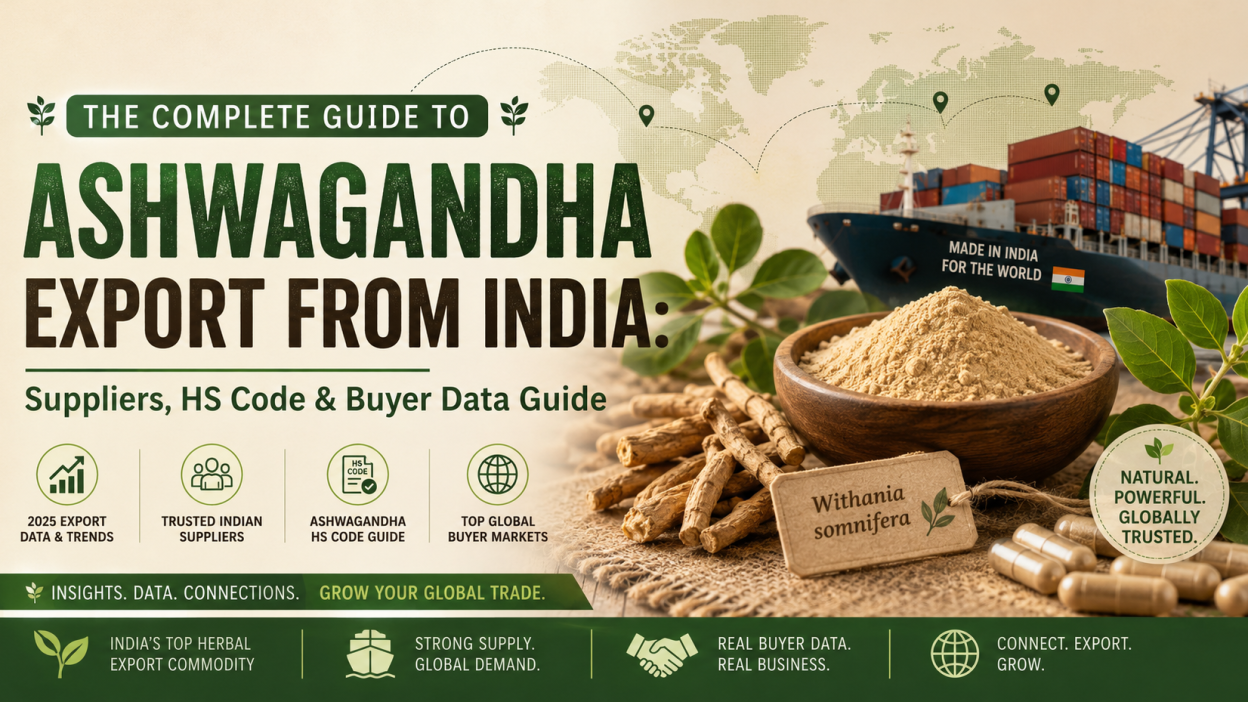
Ashwagandha has quietly become one of India’s most bankable herbal commodities. Ten years ago, it sat in the background of the Ayurvedic trade. Today, ashwagandha export from India feeds a global wellness economy that runs on adaptogens, stress-relief supplements, and clean-label nutraceuticals. The demand curve is steep. And Indian suppliers are the ones filling the orders.
Here’s the thing though. Getting into this trade — or growing your slice of it — takes more than good root powder. You need HS code clarity, buyer data, and a read on which markets actually pay. This guide covers all of it: the shipment numbers, the suppliers who dominate, the codes customs officers look for, and how to find real buyers instead of chasing dead leads.
Why Global Demand for Ashwagandha Keeps Climbing
The short version? The world got anxious, and it went looking for natural answers.
Ashwagandha (Withania somnifera) is an adaptogen — a plant that helps the body handle stress. Western consumers who once ignored Ayurveda now buy it in capsule form from supplement brands in Los Angeles, Berlin, and Sydney. The global ashwagandha market sat near USD 700 million in 2024, and projections point sharply upward through the decade.
That growth is why this trade matters so much right now. India grows the bulk of the world’s supply. When a nutraceutical firm in Germany needs standardised withanolide extract, or a supplement label in the USA wants organic root powder, the order almost always routes back to an Indian supplier.
Worth noting: this isn’t a passing trend. Stress, poor sleep, and burnout aren’t going anywhere. Neither is the appetite for plant-based remedies. That’s the tailwind carrying this trade forward.
Ashwagandha Export from India: The 2025 Trade Data
Let’s talk numbers, because the story lives in the shipment records.
Between June 2024 and May 2025, India exported roughly 2,597 cargoes of ashwagandha on a trailing-twelve-month basis. Around 180 Indian exporters moved those goods to 976 global buyers. That’s a 68% jump over the prior twelve months — a serious acceleration, not a rounding error.
May 2025 alone saw 241 shipments leave Indian ports. That figure was up 14% from April and a staggering 221% year-over-year against May 2024. When you see numbers move like that, you’re looking at a market that’s still in its growth phase, not one that’s maturing out.
| Ashwagandha Export from India | Trade Metric | Growth / Change |
| Total Cargoes (TTM) | 2,597 shipments | +68% over prior 12 months |
| Indian Exporters | 180 | — |
| Global Buyers | 976 | — |
| May 2025 Shipments | 241 | +14% from April 2025 |
| May 2025 (YoY) | — | +221% vs May 2024 |
| Lead Destinations | USA, Germany, Australia | — |
Globally, India dominates. With around 7,600 shipments, India stands as the world’s top ashwagandha exporter — miles ahead of China (roughly 298 shipments) and the United States (around 113 shipments). That gap tells you everything about who controls this supply chain.
So if you’re sourcing, you’re sourcing from India. And if you’re an Indian exporter, you’re competing in a fast-expanding pool where buyer data is the real edge. To track live shipment records, exporter profiles, and buyer contacts, verified trade intelligence platforms like VyaaparOne give you the granular data that raw customs figures can’t.
How Much Ashwagandha Does India Actually Produce?
India isn’t just the top exporter. It’s the top grower, full stop.
The crop thrives in arid, subtropical conditions — sandy soil, low rainfall, plenty of sun. That’s why cultivation clusters in states like Rajasthan, Madhya Pradesh, and Gujarat. Farmers in these regions increasingly swap conventional crops like wheat and rice for ashwagandha, simply because the returns are better when global demand outruns supply.
| State | Role in Ashwagandha Cultivation |
| Madhya Pradesh | Leading producer; cultivation spans over 5,000 hectares |
| Rajasthan | Major producer; arid climate and sandy soil suit the crop ideally |
| Uttar Pradesh | Significant grower contributing to national output |
| Gujarat | Backed by suitable climate and government support programs |
| Haryana | Established producer alongside other farm activity |
| Maharashtra | Strong contribution from its drier regions |
| Punjab | Cultivation prominent across subtropical belts |
Madhya Pradesh usually leads the pack. Its Neemuch and Mandsaur belts are practically synonymous with the crop. This production base is what makes the country’s herbal supply chain so reliable — domestic, scalable, and rooted in decades of agricultural know-how.
Ashwagandha HS Code: Getting the Classification Right
This is where a lot of first-time exporters trip up. Get the HS code wrong, and your consignment can stall at customs or attract the wrong duty. So pay attention here.
There is no single ashwagandha HS code. The classification depends entirely on the product’s form — raw root, concentrated extract, or finished supplement all fall under different headings.
| Ashwagandha HS Code | Product Form & Description |
| 1211.90.99 | Plants and parts of plants — used for raw/dried root, cut, crushed, or basic powder |
| 1302.19.19 | Vegetable saps and extracts — for concentrated withanolide extracts |
| 3004.90.11 | Medicaments (Ayurvedic system) — capsules, tablets, or churna for therapeutic use |
| 2106.90.99 | Food preparations / supplements — capsules or powders sold as dietary supplements |
| 0910.30 | Spices heading — occasionally used if blended or broadly classified |
The logic is simple once you see it. Raw or lightly processed forms — dried root, plain powder — sit under 1211.90.99 as medicinal plants. Concentrated extracts move to 1302.19.19. Finished goods get classified by intended use: 2106.90.99 for dietary supplements, and 3004.90.11 for products marketed as Ayurvedic medicine.
My advice? Confirm the code with your customs broker before the first shipment. A ten-minute conversation saves weeks of clearance headaches. And it protects your margins from surprise duty rates.
Top Countries Importing Ashwagandha from India
Western wellness markets drive the demand, and the destination map reflects that clearly.
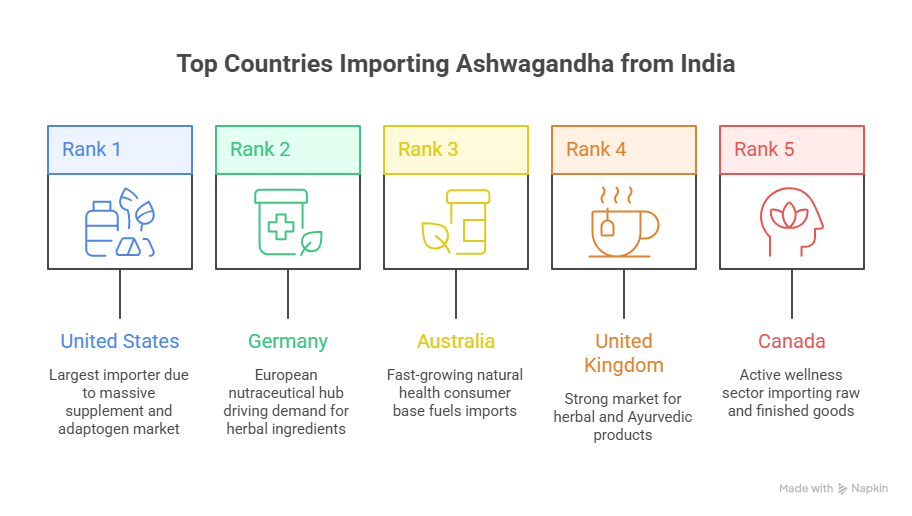
The United States sits at the top by a wide margin. American supplement brands can’t get enough adaptogen ingredients, and ashwagandha is the flagship of that category. Germany follows as Europe’s nutraceutical hub, with Australia not far behind thanks to a booming natural-health retail scene.
| Rank | Destination Country | Primary Demand Driver |
| 1 | United States (USA) | Massive dietary supplement and adaptogen wellness market |
| 2 | Germany | Central European hub for herbal medicine and nutraceuticals |
| 3 | Australia | Fast-growing natural health and supplement consumer base |
| 4 | United Kingdom | Strong market for herbal and Ayurvedic products |
| 5 | Canada | Active wellness sector importing both raw and finished goods |
| Others | China, UAE, Italy, France, New Zealand, Hungary | Rising interest in Ayurvedic ingredients for food and supplements |
Ashwagandha Export from India to USA
The USA is the crown jewel. Ashwagandha export from India to USA consistently leads shipment volume, fueled by a supplement industry that treats adaptogens as a core category rather than a niche. American buyers typically want standardised extracts with verified withanolide content and clean documentation. If you can supply GMP-certified, lab-tested material, the USA market rewards you well.
Ashwagandha Export from India to Europe
Europe is the disciplined market. Ashwagandha export from India to Europe runs through Germany, the UK, Italy, and France — regions where regulatory compliance is non-negotiable. European importers scrutinise heavy-metal testing, pesticide residues, and organic certification. It’s a tougher entry, but once you’re in, the relationships tend to be long and stable. Germany especially acts as a distribution gateway into the wider EU.
Curious about per-unit pricing or buyer contacts for any of these destinations? Platforms like VyaaparOne’s trade data let you drill into country-specific shipment records and connect with active importers directly.
Major Ashwagandha Suppliers in India
The supplier landscape splits into two camps: branded FMCG-style players and bulk ingredient exporters. Which one you work with depends on whether you want finished capsules or raw standardised material.
| Ashwagandha Suppliers in India | Primary Focus | Product Forms |
| Dabur India Ltd. | Branded FMCG & Ayurvedic products | Tablets, capsules, churna, herbal formulations |
| The Himalaya Wellness Company | Branded herbal healthcare | Tablets, single-herb capsules, personal care |
| Organic India | Certified organic products | Capsules, powders, herbal supplements |
| Baidyanath Group | Traditional Ayurvedic medicine | Tablets, capsules, churna, Ayurvedic paks |
| VCA Healthcare | Bulk extracts & ingredient export | Standardised extracts (5–10% withanolides), root extract, powder |
| Patanjali Ayurved Limited | Affordable Ayurvedic products | Churna, capsules, consumer goods |
The ashwagandha suppliers in India range from household names like Dabur and Himalaya to specialised bulk exporters like VCA Healthcare. For a supplement brand overseas, the choice usually comes down to this: do you need a private-label finished product, or bulk raw material to formulate yourself?
What to Check Before You Source
Sourcing in bulk isn’t just about price. A few things separate reliable suppliers from risky ones:
Part used. The root is the gold standard, backed by both tradition and research. Steer clear of suppliers padding batches with leaf material — regulators frown on it, and quality suffers.
Standardisation. Look for extracts with a stated withanolide percentage, usually 5% or 10%. Consistent potency is what serious buyers pay for.
Certification. ISO and GMP certificates aren’t optional if you’re exporting to the USA or Europe. Prioritise suppliers who already hold them.
Get these three right, and you’ve filtered out most of the headaches before they start.
Ashwagandha Buyers in India: The Domestic Side
Not every opportunity points overseas. The domestic market is substantial too, and knowing the ashwagandha buyers in India matters if you’re a farmer, processor, or bulk trader supplying inward.
Ashwagandha powder buyers in India are led by the big Ayurvedic and FMCG names — Patanjali Ayurved, Dabur Ltd., Himalaya Wellness Company, and Emami Ltd. These companies absorb huge volumes of raw and semi-processed material to feed their consumer product lines. They’re the anchor buyers that keep domestic cultivation profitable.
For a grower or aggregator, connecting with these buyers directly cuts out layers of middlemen. That’s where verified buyer directories earn their keep — they map who’s purchasing, at what volume, and how to reach them.
How to Find Ashwagandha Export Leads That Convert
Let’s be honest — most exporters waste months chasing leads that go nowhere. Cold emails to generic addresses. Directory listings that haven’t been updated since 2019. It’s exhausting, and it rarely works.
The smarter route is data. Real shipment records show you exactly who is importing ashwagandha, from which Indian supplier, in what quantity, and how often. That’s the difference between guessing and knowing.
Here’s how to build a genuine pipeline of ashwagandha export leads:
Start with shipment data. Pull records of actual export transactions from India. See which foreign buyers are active right now, not who bought once in 2021.
Filter by destination and volume. A buyer importing monthly into Germany is a very different prospect from a one-off importer. Prioritise the repeat purchasers.
Get the contact details. Ashwagandha export data leads are only useful if you can act on them. Verified buyer contact information turns a data point into a conversation.
Track competitor shipments. Seeing which exporters supply which buyers tells you where the gaps — and the poaching opportunities — sit.
This is precisely what trade intelligence platforms deliver. Instead of scattering effort, you focus on buyers already spending money in your category.
Comparing Product Forms for Export
Different buyers want different forms, and each carries its own margin and complexity. Here’s how the main options stack up.
| Product Form | Typical Buyer | HS Code | Value & Complexity |
| Raw root / basic powder | Formulators, bulk traders | 1211.90.99 | Lower value, simpler compliance |
| Standardised extract | Nutraceutical firms | 1302.19.19 | Higher value, needs lab documentation |
| Capsules / supplements | Retail supplement brands | 2106.90.99 | Premium value, packaging and labelling rules |
| Ayurvedic medicine | Pharma / Ayurvedic buyers | 3004.90.11 | Regulated, therapeutic claims apply |
The pattern is clear. The more processed the product, the higher the value — but also the heavier the compliance load. Many new exporters start with raw powder to learn the ropes, then move up to extracts and finished goods as relationships and certifications mature.
Pricing, Margins, and What Buyers Actually Pay
Price is where a lot of deals live or die. And ashwagandha pricing swings wildly depending on form, potency, and certification.
Raw dried root and basic powder sit at the low end. It’s a commodity — buyers compare you against dozens of other suppliers, and margins stay thin. The moment you move to standardised extracts, the picture changes. A 5% withanolide extract commands a meaningfully higher price than plain powder, and a 10% extract higher still. Buyers pay for verified potency because their own product claims depend on it.
Finished capsules and branded supplements sit at the top of the value ladder. But they also carry packaging costs, labelling compliance, and longer sales cycles. There’s no free lunch — higher margin means higher complexity.
What really moves the needle on price? Certification and consistency. A GMP-certified supplier with lab reports and a track record of on-time delivery can charge a premium that an unverified trader simply can’t. Buyers in the USA and Europe treat documentation as part of the product. Skip it, and you’re competing purely on price — a race nobody wins.
Currency also plays a quiet role. A favourable rupee-dollar rate can widen your margins on dollar-denominated orders, so watch the exchange rate when you quote. Small shifts add up across large consignments.
One more pricing reality worth internalising: the destination shapes the number. Ashwagandha export from India to premium markets like the USA and Germany fetches higher per-unit prices than shipments to price-sensitive regions, because those buyers demand — and pay for — certified, standardised material. Map your target markets to your product grade, and price accordingly rather than using one blanket rate for everyone.
Common Mistakes New Exporters Make
Plenty of promising exporters stumble in the first year. The mistakes are predictable, which is good news — you can dodge them.
The first is treating all buyers the same. A one-off importer and a monthly repeat buyer need completely different approaches. Chasing the wrong ones burns time.
The second is skimping on quality documentation. Sending samples without lab reports, or promising withanolide percentages you can’t consistently hit, kills trust fast. In this trade, reputation travels quickly.
The third is ignoring the data. Too many exporters rely on gut feel and referrals when verified shipment records would point them straight to active demand. Ashwagandha export data leads exist precisely so you don’t have to guess who’s buying.
And the fourth? Underpricing to win the first order, then getting stuck at a rate that doesn’t cover certification and compliance costs. Price for the long term, not just the opening deal.
Building a Sustainable Ashwagandha Export Business
Trade data gets you in the door. Consistency keeps you in the room.
The exporters who last aren’t the ones who land one big order. They’re the ones who deliver certified, consistent material shipment after shipment. In a market this hot, buyers have options — so reliability becomes your moat.
A few practical moves that separate the durable businesses from the flashes in the pan:
Invest in certification early. GMP and ISO aren’t just paperwork; they’re the price of entry to premium markets. Lock in your supply chain so you can meet reorder demand without scrambling. And keep watching the data — buyer preferences shift, new markets open, and the exporters who track those signals move first.
This trade is riding a genuine wave. The demand is real, the growth is documented, and India’s production dominance isn’t going anywhere. What separates winners from also-rans is simple: better data, tighter quality, and the discipline to treat this as a long game rather than a quick flip.
Final Word
Ashwagandha export from India isn’t a speculative bet anymore — it’s a documented growth story with real shipment volumes behind it. The herb has crossed from Ayurvedic tradition into the global wellness mainstream, and Indian suppliers hold the production advantage that keeps the world coming back.
Whether you’re sourcing bulk extract, hunting for ashwagandha buyers in India, or building an export pipeline into the USA and Europe, the winning ingredient is data. Know your HS codes, vet your suppliers, and chase leads backed by real shipment records rather than guesswork. To explore live trade data, buyer contacts, and shipment insights on ashwagandha export from India, visit VyaaparOne and turn market signals into signed orders.
Frequently Asked Questions
Which country is the largest producer of ashwagandha?
India is the world’s largest producer and exporter of ashwagandha. The main growing regions are Rajasthan, Madhya Pradesh, Gujarat, and Uttar Pradesh, where arid climate and sandy soil suit the crop.
What is the HS code for ashwagandha?
There’s no single code — it depends on form. Raw root and powder use 1211.90.99, extracts use 1302.19.19, dietary supplements use 2106.90.99, and Ayurvedic medicaments use 3004.90.11.
How much ashwagandha is exported from India?
On a trailing-twelve-month basis, India exported around 2,597 cargoes. Roughly 180 Indian exporters supplied 976 global buyers, marking a 68% increase over the previous year.
Who are the top ashwagandha suppliers in India?
Leading names include Dabur, Himalaya Wellness, Patanjali, Baidyanath, Organic India, and bulk extract specialists like VCA Healthcare.
Which countries import the most ashwagandha from India?
The United States leads by a wide margin, followed by Germany, Australia, the UK, and Canada. China, UAE, Italy, and France are growing secondary markets.
How do I find genuine ashwagandha buyers and export leads?
Use verified shipment data to identify active importers, filter by destination and volume, and access buyer contact details. This turns raw ashwagandha export data leads into a workable sales pipeline.
What certifications do I need to export ashwagandha?
GMP and ISO certifications are essential for USA and European markets. Buyers also expect standardised withanolide content and clean heavy-metal and pesticide testing.