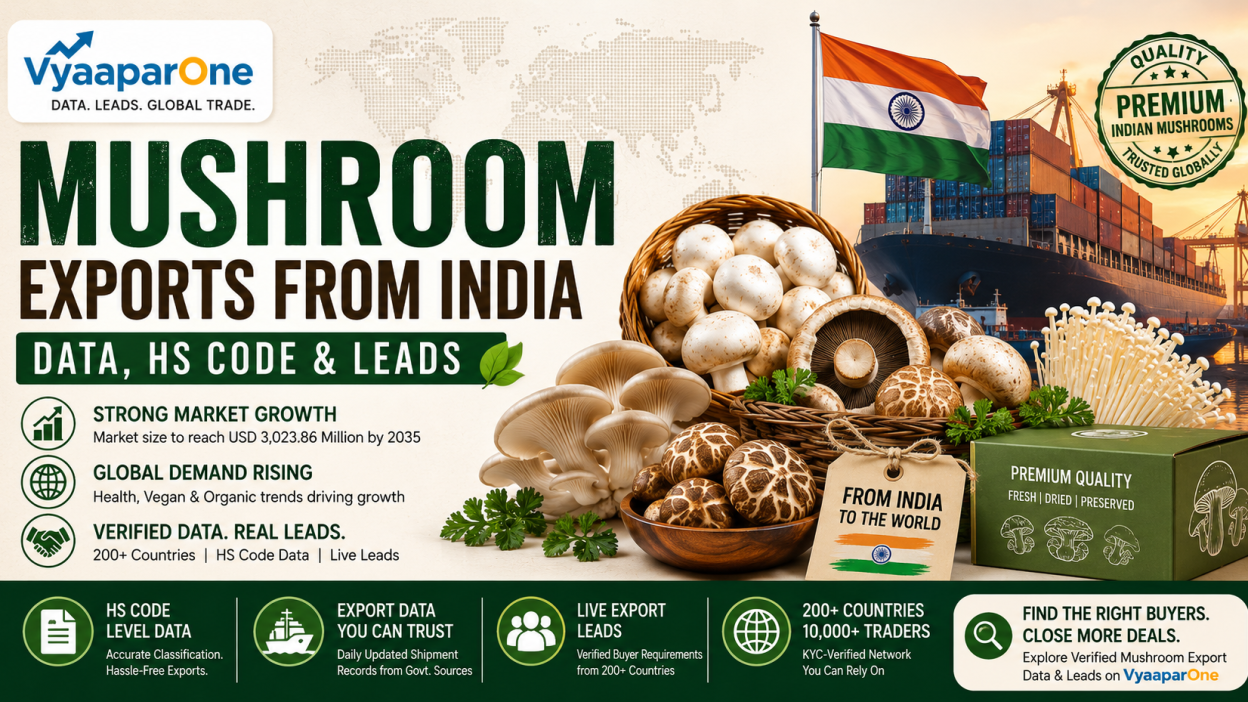
The global appetite for mushrooms has shifted from a niche gourmet interest into a mainstream trade category. And India, oddly enough, sits right in the middle of that shift. Mushroom exports from India have quietly climbed year after year, driven by health-conscious buyers, the vegan wave, and a food industry that keeps finding new uses for fungi. Simply put, mushroom exports from India are having a moment. Here’s the thing most traders miss: the numbers behind mushroom exports from India tell a much bigger story than the produce itself. This guide breaks down mushroom exports from India with real data, HS code details, exporter insights, and the trade leads that actually move deals forward on VyaaparOne.
Why Mushroom Exports from India Are Gaining Ground
Let’s be honest about what’s happening. Mushrooms aren’t a traditional Indian cash crop. They never were. Yet mushroom exports from India have grown into a genuine opportunity because the world changed its eating habits faster than most agricultural categories could keep up.
India ranks as the world’s second-largest mushroom producer, and that scale directly underpins mushroom exports from India. That production base gives exporters something valuable — a steady, controlled, year-round supply. Because mushrooms grow indoors in temperature-managed environments, seasonality stops being a barrier. Suppliers ship when buyers need stock, not when the weather allows. This reliability is a quiet advantage that props up mushroom exports from India season after season.
The demand side is just as compelling. Mushrooms are low in calories, rich in vitamins and minerals, and they slot perfectly into vegetarian and vegan diets. As meat alternatives keep gaining shelf space in supermarkets from Dubai to Toronto, mushroom exports from India benefit directly. Worth noting: the mushroom market in India was estimated at roughly USD 1,610.89 million in 2025, according to industry forecasts tracked by trade data providers.
Why does this matter to you as a trader? Because a growing domestic base plus rising global demand equals room to profit. That’s the simple math behind mushroom exports from India as a category, and it’s why mushroom exports from India keep drawing new traders each year.
Mushroom Market Size in India: The Numbers That Matter
Any serious conversation about mushroom exports from India has to start with market size. It sets the context for everything else.
The mushroom market size in India reached approximately USD 1.18 billion by 2023, and analysts pegged annual growth at over 12%. More recent projections put the 2025 figure at USD 1,610.89 million, with a forecast reaching USD 3,023.86 million by 2035. That’s a compound annual growth rate of around 6.8% across the 2026–2035 window.
Here’s a quick snapshot of the market size trajectory:
| Year | Market Value | Notes |
| 2023 | ~USD 1.18 Billion | Growing at 12%+ annually |
| 2025 | USD 1,610.89 Million | Strong organic-food demand |
| 2035 (Forecast) | USD 3,023.86 Million | 6.8% CAGR projection |
The mushroom market size in India matters for exporters because a large, expanding home market signals two things at once. First, production infrastructure keeps improving. Second, surplus supply naturally spills into export channels. A thin domestic market would starve the pipeline for mushroom exports from India. A fat one feeds it.
And yes, this is often overlooked, but domestic strength is the quiet engine behind mushroom exports from India. Exporters who understand mushroom market size in India can time their supply commitments far more accurately. The bigger the mushroom market size in India grows, the more headroom mushroom exports from India gain.
Mushroom Export Data: Reading the Real Trade Story
Numbers cut through the hype. So let’s look at actual mushroom export data rather than optimistic guesses.
India exported 7,768 metric tonnes of fresh and processed mushrooms in the 2022–2023 period, worth roughly Rs. 123.64 crore (about US$16.16 million). Between 2021 and 2022, mushroom export data showed a 173.8% jump in volume and a 151.8% rise in value. Those aren’t small increments — they signal a structural shift in mushroom exports from India. Fresh mushroom exports from India alone reportedly climbed by 250% over a single year.
Here’s the mushroom export data laid out clearly:
| Financial Year | Export Volume | Export Value |
| FY 2021–22 | ~2,830 MT | — |
| FY 2022–23 | 7,768 MT | Rs. 123.64 Cr (US$16.16M) |
| FY 2024–25 | Growing | ~US$2.94M (partial period) |
Reliable mushroom export data is the single most important asset a trader can hold. Why? Because it reveals which buyers are actually purchasing, at what volumes, and through which ports. Guesswork gets you burned. Verified mushroom export data from India, the kind aggregated on VyaaparOne, lets you approach the right partners with confidence.
The mushroom export data from India also exposes patterns competitors miss — seasonal buying spikes, emerging destination markets, and pricing shifts. Traders who study mushroom export data closely tend to negotiate better and waste less time chasing dead ends. In short, good mushroom export data is what separates guesswork from a real strategy behind mushroom exports from India.
Mushroom HS Code: Getting the Classification Right
You can’t export anything without the correct classification. The mushroom HS code determines your customs treatment, duty rates, and documentation. Get it wrong and shipments stall at the border, and your mushroom exports from India grind to a halt.
The Harmonized System code is an internationally standardized method for classifying goods. For mushrooms, several codes apply depending on the form and species. Here’s the mushroom HS code breakdown:
| HS Code | Product Description |
| 0602 9010 | Mushroom spawn |
| 0709 5100 | Fresh or chilled mushrooms of the genus Agaricus (button, portobello, cremini) |
| 0711 5100 | Provisionally preserved mushrooms of genus Agaricus (e.g., in brine) |
| 0712 3100 | Dried mushrooms of the genus Agaricus |
| 2003 1000 | Prepared or preserved mushrooms of genus Agaricus (canned, pickled) |
Choosing the correct mushroom HS code is not a formality — it’s a financial decision. Each code carries different tariff implications in the destination country. A dried-mushroom shipment classified under a fresh-mushroom mushroom HS code could trigger delays, penalties, or rejected paperwork.
Smart exporters cross-check the mushroom HS code against the buyer’s import requirements before booking freight. On VyaaparOne, you can look up HS code-level shipment records to see exactly how established players handling mushroom exports from India classify their consignments. That single step removes a lot of guesswork from your export planning and keeps your mushroom exports from India moving smoothly.
Mushroom Exporters in India: Who’s Actually Shipping
The category has real players. Mushroom exporters in India range from established trading houses to specialised agri-export firms that focus on premium and exotic varieties.
Among the more frequently cited mushroom exporters are firms such as S.D. Enterprise, Krutik International, Appleway International, Aries Overseas, Haul Enterprise LLP, Mangal Exporters, Starlink Global Impex, Harbour Exports, KNG Exports, and Guru Kripa Udyog. This list of mushroom exporters shifts as new entrants scale up and older names consolidate.
What separates successful mushroom exporters from the rest? A few things. Consistent quality control. Cold-chain logistics that keep fresh produce viable across long shipping routes. And — this is the big one — access to accurate buyer data. The best mushroom exporters in India don’t rely on cold outreach alone. They work from verified trade leads.
Here’s a comparison of exporter types you’ll encounter in the market:
| Exporter Type | Typical Focus | Best Suited For |
| Large Trading Houses | High-volume fresh & processed | Bulk contract buyers |
| Specialised Agri-Exporters | Exotic & organic varieties | Premium niche markets |
| Farmer-Producer Companies | Direct-from-source supply | Traceability-focused buyers |
| New MSME Exporters | Flexible MOQ, emerging markets | First-time importers |
If you’re aiming to join the ranks of mushroom exporters in India, the fastest route to traction is data-driven targeting. Mushroom exporters who plug into platforms like VyaaparOne skip months of manual research and get straight to verified buyers. That head start is often what makes new mushroom exports from India profitable in year one rather than year three.
Mushroom Export Leads: Turning Data Into Deals
Data without action is just trivia. Mushroom export leads are where the trade actually happens.
A mushroom export lead is a verified buyer requirement — someone actively looking to import mushrooms, with a stated volume, destination, and timeline. Instead of guessing which importer in Germany might want oyster mushrooms next quarter, quality mushroom export data leads hand you the buyer’s active demand on a plate.
This is exactly where VyaaparOne earns its keep. The platform aggregates live import and export opportunities, letting you filter mushroom export leads by country, volume, and product type. You see who’s buying, unlock verified contact details with a subscription, and reach out while the requirement is still warm.
Why does this matter so much? Because timing wins deals. A mushroom export lead acted on today beats a stale contact list every time. Traders working fresh mushroom export data leads consistently close faster than those relying on directories compiled months ago. Warm mushroom export leads turn mushroom exports from India from a hopeful gamble into a repeatable process.
Think about the alternative. Cold-calling random importers, hoping one of them needs mushrooms right now. That’s exhausting and inefficient. Verified mushroom export leads flip the script — you engage buyers who’ve already raised their hand. Combine those mushroom export leads with solid mushroom export data, and mushroom exports from India start to feel almost systematic.
Mushroom Export from India: Product Varieties in Demand
Not all fungi are equal in the export game. Mushroom export from India spans everyday commercial types and high-value specialty varieties.
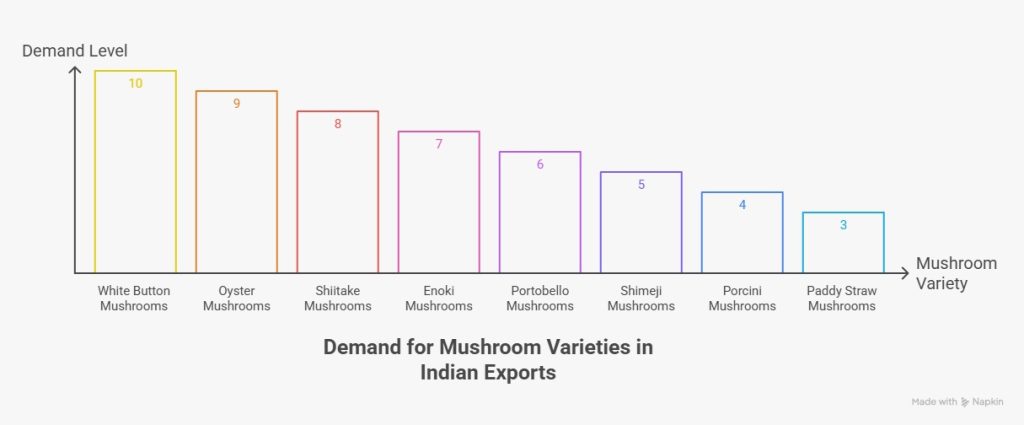
The commonly traded varieties include:
- White Button Mushrooms — the volume workhorse
- Oyster Mushrooms — strong demand, especially in Asia
- Shiitake Mushrooms — premium pricing, growing globally
- Enoki Mushrooms — popular in East Asian cuisine
- Portobello Mushrooms — favoured as a meat substitute
- Shimeji Mushrooms — specialty restaurant demand
- Porcini Mushrooms — high-end gourmet segment
- Paddy Straw Mushrooms — regional and tropical markets
Oyster mushrooms in particular sit at the top of the demand curve for mushroom exports from India, both domestically and abroad. A well-planned mushroom export from India often leads with button and oyster varieties for volume, then layers in specialty types for margin.
This variety is a genuine competitive edge. Because India produces such a broad spectrum, it functions almost as a one-stop source for international buyers chasing premium fungi. That diversity strengthens every round of mushroom exports from India, giving suppliers more ways to meet buyer specifications and defend their pricing.
Mushroom Exporting Countries: India’s Global Competition
To understand where mushroom exports from India fit, you have to see the wider board. The leading mushroom exporting countries dominate different segments of the trade.
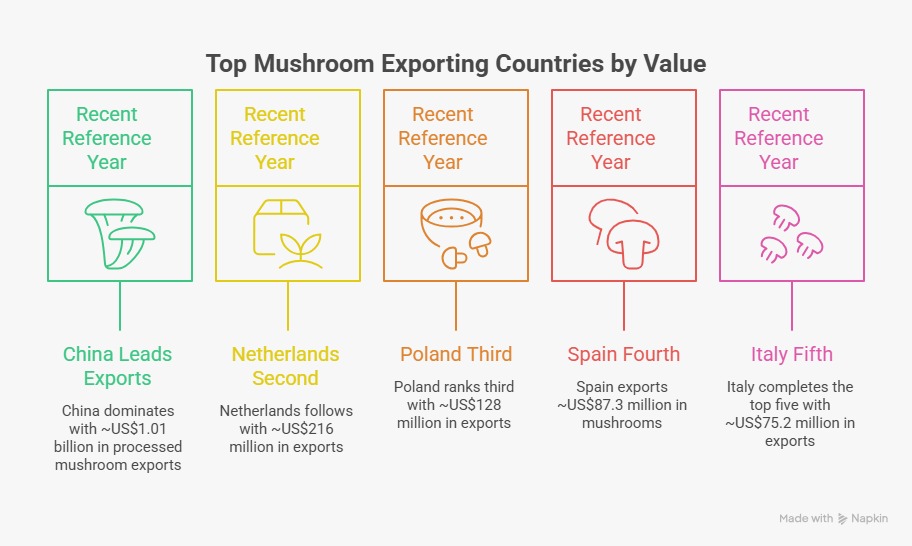
Here’s how the top mushroom exporting countries stacked up for processed mushrooms in a recent reference year:
| Rank | Mushroom Exporting Countries | Export Value |
| 1 | China | ~US$1.01 Billion |
| 2 | Netherlands | ~US$216 Million |
| 3 | Poland | ~US$128 Million |
| 4 | Spain | ~US$87.3 Million |
| 5 | Italy | ~US$75.2 Million |
China clearly leads the pack among mushroom exporting countries, operating at a scale India hasn’t yet reached. But — and this is the opportunity — India competes on freshness, variety, and cost for specific buyer segments the giants overlook.
Among the mushroom exporting countries, India’s edge lies in exotic and organic varieties plus flexible order sizes that suit mid-tier importers. As global mushroom exporting countries jostle for market share, India’s second-place production ranking positions mushroom exports from India to climb steadily rather than explosively.
The point stands: knowing the competitive landscape of mushroom exporting countries helps Indian suppliers position their pitch. You’re not selling against China on volume. You’re selling on the things buyers can’t get from the volume players — and that’s precisely where mushroom exports from India win.
India’s Top Mushroom Export Destinations
Where do these shipments actually go? Mushroom exports from India flow to a recognisable set of destination markets.
The leading import partners include the United States, Mexico, Israel, the United Arab Emirates, Canada, France, Germany, and Switzerland. The USA, Mexico, and Israel rank consistently among the strongest buyers, while the UAE and Canada have emerged as fast-growing destinations for mushroom exports from India.
Total mushroom exports from India reportedly touched around USD 5.4 million in one recent measured year, climbing steadily over prior periods. Each destination carries its own preferences — some markets favour fresh button mushrooms, others want dried or preserved product with a longer shelf life.
Matching the right variety to the right destination is where mushroom export data becomes indispensable. A buyer in France may want something entirely different from a buyer in the UAE. Knowing that in advance, through verified data, saves both time and shipping costs — and keeps your mushroom exports from India landing in the right hands.
How to Start Your Mushroom Export Business
So you want in. Where do you begin? Building a mushroom export operation isn’t complicated, but it rewards preparation.
Start with the fundamentals. Secure a reliable supply source — either your own cultivation or a network of producer partners. Nail down cold-chain logistics for fresh varieties, since mushrooms are perishable and unforgiving. Register for the necessary export documentation and confirm the correct mushroom HS code for your product form.
Then comes the part most beginners rush: buyer discovery. This is where mushroom export data and verified leads change the game entirely. Rather than scattering enquiries across random directories, tap into a platform that shows you active buyers with real requirements. That’s the foundation of profitable mushroom exports from India.
VyaaparOne consolidates all of this — shipment records, HS code lookups, country-wise analytics, and live mushroom export leads — into one dashboard. For a new exporter, that’s the difference between fumbling for months and landing your first order in weeks.
Here’s a light take from experience: most first-time exporters overestimate the difficulty of sourcing and underestimate the difficulty of finding buyers. Flip that assumption. Get your buyer intelligence sorted first, and the rest of your mushroom exports from India journey follows.
Common Obstacles in the Mushroom Export Market
No trade is friction-free. The market for mushroom exports from India carries real challenges worth naming upfront.
The recurring obstacles include limited market research, uneven farm-gate prices, thin profit margins, inconsistent supply, rising raw-material costs (rice straw, for instance), variable spawn quality, and disease risk in cultivation. On the trade side, the biggest hurdle is unreliable data. Many traders struggle simply to find accurate, current export-import figures.
That data gap is exactly what sinks otherwise promising ventures. Acting on outdated mushroom export data leads to mispriced offers, missed buyers, and wasted freight. The fix is straightforward: source your mushroom export data from a verified platform that updates continuously rather than annually.
VyaaparOne addresses this head-on with daily-updated shipment intelligence, so decisions about mushroom exports from India rest on fresh data instead of stale assumptions.
Why Use VyaaparOne for Mushroom Export Data and Leads
Let me be direct about why this platform fits the category. VyaaparOne is built for exactly the kind of buyer discovery that mushroom exports from India demand.
The platform delivers verified import-export data from 200+ countries, HS code-level shipment records, live trade leads, and country-wise analytics — all updated daily from government-authorised sources. For anyone handling mushroom exports from India, that means you can search by mushroom HS code, spot which destination markets are heating up, and pull verified mushroom export leads without chasing false contacts.
VyaaparOne connects you to a network of 10,000+ active traders with KYC-checked profiles. So when you find a buyer, you’re dealing with a verified business, not a question mark. That trust layer matters enormously in cross-border trade, where a single bad partner can cost you a shipment.
The bottom line? Mushroom exports from India succeed on the strength of accurate data and warm leads. VyaaparOne supplies both, which is why it’s a natural home base for traders serious about scaling their mushroom exports from India.
Final Words
Mushroom exports from India have moved from curiosity to genuine commercial opportunity, backed by a market projected to more than double by 2035. The fundamentals line up — second-largest global production, rising health-driven demand, and a broad variety mix that few competitors can match. Success in mushroom exports from India comes down to three things: understanding the mushroom market size in India, mastering the correct mushroom HS code, and acting on verified mushroom export data and leads before opportunities cool. VyaaparOne brings all of that together, giving exporters the shipment intelligence, HS code tools, and live mushroom export leads needed to compete globally. Ready to grow? Explore verified mushroom export data and leads on VyaaparOne and turn insight into closed deals for your mushroom exports from India.
Frequently Asked Questions
Q1. Which mushroom is exported most from India?
White button and oyster mushrooms lead the volume in mushroom exports from India, while shiitake, enoki, and porcini command premium pricing in gourmet markets. For updated variety-wise mushroom export data, VyaaparOne offers verified shipment records.
Q2. Where can I find verified mushroom export data from India? Verified mushroom export data from India is available on trade intelligence platforms like VyaaparOne, which aggregates daily-updated, HS code-level shipment records and buyer-supplier data across 200+ countries.
Q3. Who are the top mushroom exporters in India?
Frequently cited mushroom exporters in India include S.D. Enterprise, Krutik International, Appleway International, and Aries Overseas, among others. The list of active mushroom exporters shifts regularly, so check current data for accuracy.
Q4. Which are the top mushroom exporting countries globally?
The leading mushroom exporting countries are China, the Netherlands, Poland, Spain, and Italy. India ranks as the second-largest producer and competes strongly in exotic and organic segments among these mushroom exporting countries.
Q5. How do I get mushroom export leads for my business?
You can source verified mushroom export leads on VyaaparOne by filtering live buyer requirements by country, volume, and product. These mushroom export data leads connect you directly with active importers seeking Indian mushrooms.
Q6. What is the current mushroom market size in India?
The mushroom market size in India was estimated at around USD 1,610.89 million in 2025, with forecasts projecting USD 3,023.86 million by 2035 at a 6.8% CAGR — strong support for continued growth in mushroom exports from India.