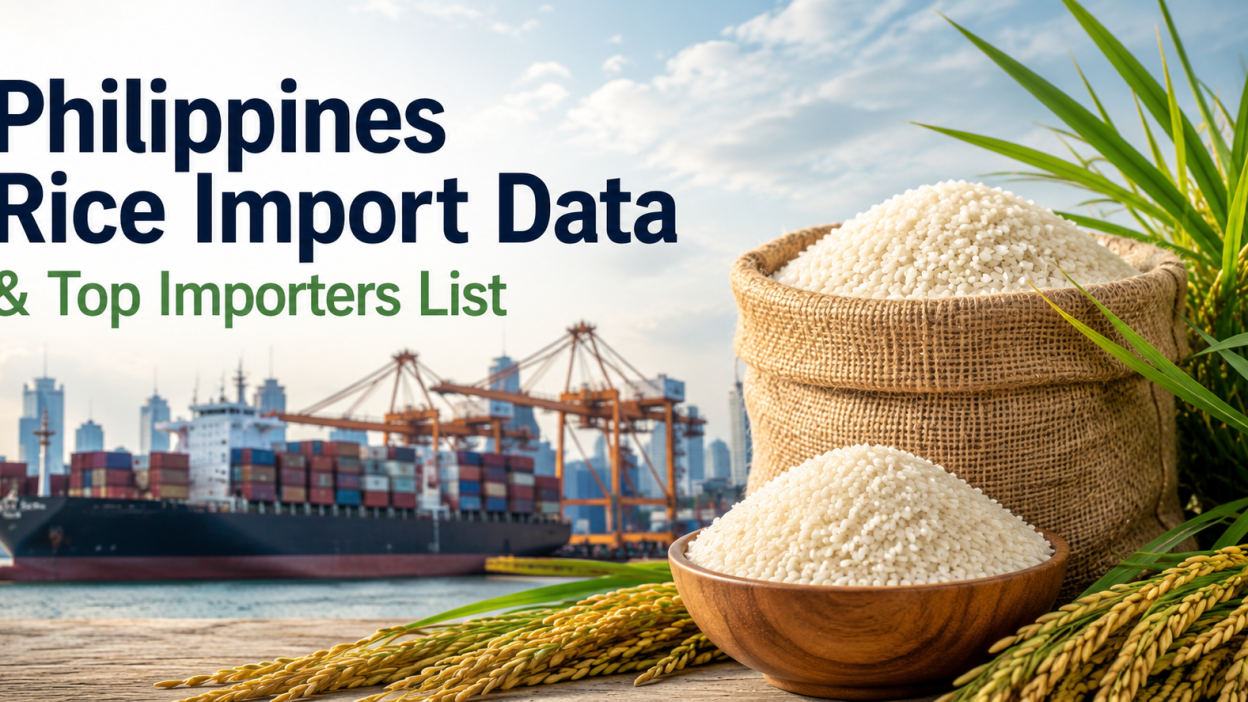
The Philippines has held the title of the world’s largest rice buyer for four straight years, and the numbers keep climbing. Anyone tracking Philippines rice import activity right now is looking at a market that pulled in roughly 4.7 million metric tons in 2024 — worth well over $2.5 billion. That’s a staggering volume for a single staple grain. This guide breaks down the real trade picture: verified importers, the exact HS codes you’ll need, supplier leads, and the market statistics that actually move deals. Whether you export rice or research the sector, here’s what the data says.
Why Philippines Rice Import Volumes Keep Breaking Records
Let’s be honest — few countries depend on imported grain the way the Philippines does. Local production simply can’t keep pace with demand. Typhoons, El Niño, and La Niña have battered domestic palay harvests season after season, leaving a gap that only foreign supply can fill.
The scale here is genuine. According to USDA’s Foreign Agricultural Service, the Philippines is projected to remain the world’s top rice importer through 2026, with volumes forecast as high as 5.5 million metric tons on continued population growth and steady consumption. In 2024, the country logged a record 4.7 million MT. This demand isn’t a blip — it’s structural.
Why does this matter for exporters? Because a market this hungry rewards suppliers who understand it. The buyer in Manila is comparing you against a dozen other origins at the same time. Knowing the trade flows gives you the edge.
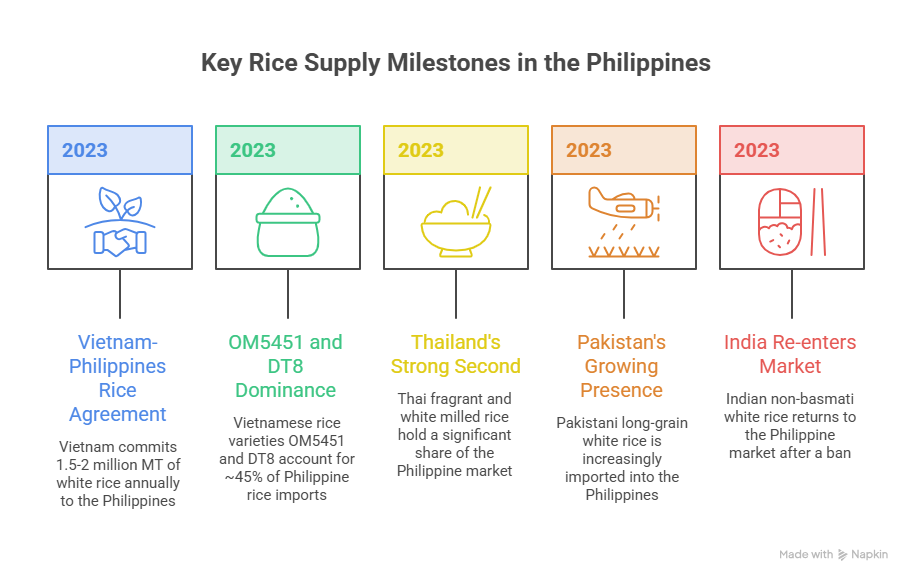
Vietnam dominates as the supply source. In one recent measurement period, Vietnamese shipments accounted for around 2.6 million MT — roughly 45% of Vietnam’s entire rice export book went to Philippine buyers. Thailand and Pakistan follow at a distance, and India re-entered the picture after lifting its non-basmati white rice export ban.
Philippines Rice Import Data: The 2024–2025 Numbers
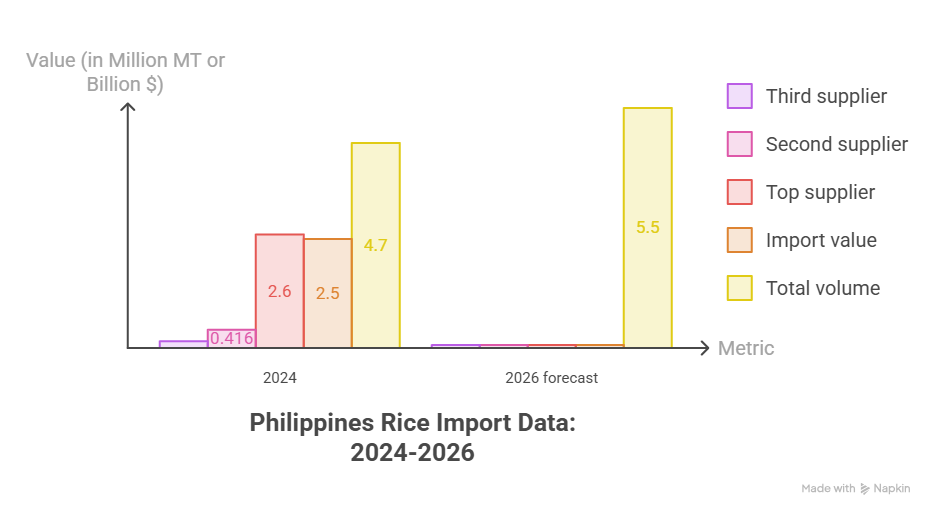
Here’s a quick snapshot of where the market stands. Reliable Philippines rice import data comes from customs shipment records, and the headline figures tell a clear story.
| Metric | Figure | Source Period |
| Total volume imported | ~4.7 million MT | 2024 |
| Import value | ~$2.5 billion | 2024 |
| Top supplier | Vietnam (~2.6M MT) | 2024 |
| Second supplier | Thailand (~416,000 MT) | 2024 |
| Third supplier | Pakistan (~157,000 MT) | 2024 |
| 2026 forecast | Up to 5.5 million MT | USDA projection |
The Philippine rice import statistic that surprises most people: import volumes in 2024 hit well over 90% of the previous year’s total purchases within the same window. Demand is relentless.
And 2025 added a twist. On August 6, 2025, President Ferdinand Marcos Jr. announced a 60-day suspension of rice imports starting September 1 — later extended through December 31 — to protect local farmers from falling paddy prices during harvest. That single policy move rippled through Vietnam’s export forecasts. It’s a reminder: anyone importing rice in the Philippines needs to watch regulation as closely as price.
Good trade data isn’t just a volume chart. It’s importer names, shipment dates, ports, quantities, and unit values — the granular detail that turns a lead into a contract.
Rice HS Code: Getting Classification Right
Get the HS code wrong and your shipment stalls at customs. Correctly identifying the rice HS code is essential for compliance, documentation, and taxation. There’s no shortcut here.
Most rice moving into the Philippines falls under a handful of subheadings. Here’s the breakdown traders actually use:
| Rice Type | Rice HS Code | Notes |
| Rice in the husk (paddy/rough) | 1006.10 | Unmilled |
| Husked (brown) rice | 1006.20 | Partially processed |
| Semi-milled or wholly milled rice | 1006.30 | The big one — white milled rice |
| Broken rice | 1006.40 | Lower grade, feed and processing |
The vast majority of commercial imports sit under Rice HS Code 1006.30 — particularly well-milled and regular-milled white rice. That’s the workhorse classification. Glutinous rice (locally called malagkit) and fragrant varieties like Jasmine and DT8 also generally classify here depending on milling degree.
Worth noting: HS codes are the universal language of trade. A buyer in Manila and a supplier in Vietnam both quote 1006.30, and customs on both ends read it the same way. Master the code, and half your paperwork headaches disappear.
Importing Rice in the Philippines: Rules, Tariffs, and the RTL
Here’s the thing about importing rice in the Philippines — it changed dramatically in 2019. The Rice Tariffication Law (RTL) replaced the old system of quantitative import restrictions with straightforward tariffs. Suddenly, private traders could import far more freely, as long as they paid the duty.
The tariff structure looks like this:
- 35% tariff on rice imports from ASEAN nations (this covers Vietnam, Thailand, and most of the region’s suppliers)
- 50% tariff on imports from non-ASEAN countries
- Duty-free imports handled by the National Food Authority (NFA) for buffer stock purposes
The NFA still licenses importers and regulates the trade, even after the RTL loosened the quota regime. And in December 2024, the amended RTL added a new power: when imported or local rice floods the market and crashes farmgate prices, the President can suspend importation for a limited period. That’s exactly the mechanism used in the 2025 ban.
So importing rice in the Philippines today means balancing three things at once: tariff cost, NFA licensing, and the ever-present possibility of a policy pause. Traders who ignore any one of them get burned.
List of Rice Importers in the Philippines
This is what most exporters really want — a real list of rice importers in the Philippines they can approach. Based on shipment records, several companies consistently appear among the country’s leading buyers.
The top importer of rice in the Philippines includes established grain traders and milling corporations:
- GrainPro Philippines, Inc.
- Vitarich Corporation
- VIEVA Philippines, Inc.
- SL Agritech Corporation
- Republic Grains Milling Corp.
These firms are typically registered with the National Food Authority and comply with tariff and phytosanitary requirements. When you’re building a list of rice importers in the Philippines for outreach, registration status matters — an NFA-licensed buyer can actually clear your shipment.
Beyond the headline names, the importer base runs deep. Hundreds of registered private traders now participate under the RTL framework. That fragmentation is actually good news for exporters: more buyers, more entry points, more chances to land a first order. Verified shipment records let you sort the serious players from the occasional dabblers.
List of Rice Suppliers in the Philippines and Sourcing Origins
Flip the coin, and there’s the supply side. A working list of rice suppliers in the Philippines usually means the foreign exporters and local distributors feeding the market. Vietnamese exporters dominate — varieties like OM5451 and DT8 make up a huge share of arriving volume.
Among the named suppliers surfacing in trade records are firms like Ngosiok Marketing and P.O.P., alongside the major Vietnamese and Thai export houses that ship under long-term agreements. Vietnam signed a five-year memorandum with the Philippines committing 1.5 to 2 million MT of white rice annually to the private sector at competitive prices — a deal that locked in the sourcing relationship.
| Supplier Origin | Key Varieties | Market Position |
| Vietnam | OM5451, DT8, Jasmine | Dominant (~45% of its exports) |
| Thailand | Fragrant, white milled | Strong second |
| Pakistan | Long-grain white | Growing |
| India | Non-basmati white | Re-entering post-ban |
Building a reliable list of rice suppliers in the Philippines takes verified data. Anyone can Google a company name. Confirming they actually ship, at what volume, and to which buyers — that’s where customs records earn their keep.
The Most Imported Rice Types
Not all rice is equal in this market. The volume leaders are well-milled white rice and regular-milled white rice — the everyday staple on Filipino tables. Then come the specialty grains:
- Glutinous rice (malagkit) — for kakanin, desserts, and festive dishes
- Fragrant rice — Jasmine and DT8, prized for aroma
- Regular-milled white — the affordable bulk category
A significant share of the imported volume is Vietnamese rice, especially the OM5451 and DT8 types. Understanding which grades sell helps exporters position their product before they even quote a price.
Rice Export Leads and Rice Import Leads: Turning Data Into Deals
Data without action is just trivia. The real payoff of studying these trade flows is generating rice export leads and rice import leads that convert.
How does it work in practice? You pull shipment records, identify which buyers are actively importing your grade, note their volumes and frequency, then reach out with a targeted offer. Cold outreach with no context fails. Outreach backed by “I see you imported 5,000 MT of 1006.30 last quarter” gets replies.
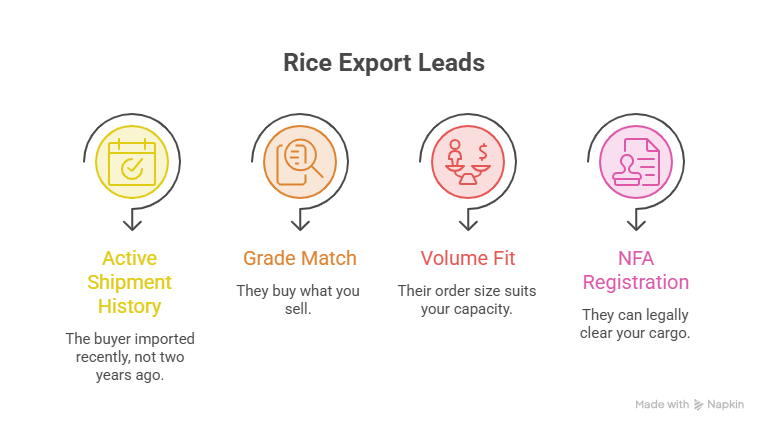
Quality rice export leads share a few traits:
- Active shipment history — the buyer imported recently, not two years ago
- Grade match — they buy what you sell
- Volume fit — their order size suits your capacity
- NFA registration — they can legally clear your cargo
The same logic drives rice import leads for local distributors hunting new supply sources. Both sides win when the data is verified and current. Stale leads waste everyone’s time — a buyer who stopped importing in 2022 is a dead end.
This is precisely where a platform like VyaaparOne earns its place. Instead of scraping fragmented sources, you get consolidated import data, importer contacts, and shipment intelligence in one workspace — turning research hours into qualified rice import leads. The difference shows up in how fast you move from a raw name to a real conversation with a buyer who actually purchases your grade.
Ports and Logistics: How Rice Actually Arrives
Volume figures mean little without understanding the physical trade. Rice reaches Filipino consumers through a handful of major gateways, and the port a shipment enters through often signals which buyer is behind it.
Manila’s port complex handles the largest share, feeding the dense Luzon consumer belt. Subic and Batangas take significant tonnage too, while Cebu and Davao serve the Visayas and Mindanao markets respectively. For an exporter, knowing the destination port narrows down the buyer pool fast — a cargo landing in Davao points to a very different distributor than one clearing in Manila.
Shipping economics also shape sourcing. Vietnam’s proximity is a quiet superpower here. A vessel from Ho Chi Minh City reaches Manila in days, not weeks, and that freight advantage compounds over millions of tons. It’s one more reason Vietnamese suppliers keep the lion’s share while more distant origins fight for the remainder.
Phytosanitary clearance is the other gatekeeper. Every arriving cargo needs proper certification, and buyers registered with the National Food Authority handle this routinely. Exporters who prep clean documentation upfront clear faster and build the reliability reputation that wins repeat orders.
Comparing Data Sources: What Actually Helps Traders
Not every source delivers usable intelligence. Here’s how the main options stack up for someone serious about the rice trade:
| Source Type | Data Depth | Best For |
| Free government summaries | Aggregate volumes only | Macro trends |
| USDA/FAS reports | Forecasts, policy | Market outlook |
| Customs shipment data | Importer names, ports, values | Direct leads |
| B2B trade platforms | Verified buyer/supplier profiles | Deal-making |
The gap is obvious. Government and USDA data tell you the market is big — useful context, but you can’t email a statistic. Customs-level and platform data give you the names, and names close deals. For a genuine list of rice importers in the Philippines with contact-ready detail, verified trade intelligence beats every free summary.
Market Outlook: Where Philippines Rice Import Trends Are Heading
So where’s this going? The trajectory points up, with volatility baked in. USDA forecasts the Philippines importing up to 5.5 million MT by 2026 — a record — driven by population growth, tourism recovery, and rice’s unshakeable place as the national staple.
But the 2025 import ban proved the government will intervene when local farmers hurt. Expect more of this push-pull: strong structural demand meeting periodic protectionist pauses. Smart traders plan around the calendar, front-loading shipments before harvest-season suspensions.
For anyone weighing Philippines rice import prospects, the statistic to remember is simple: this is the single largest rice import market on earth, and it isn’t shrinking. Vietnam locked in its position early. There’s still room for Thai, Pakistani, and Indian suppliers to grow share — especially as the market keeps expanding.
Currency movements add another layer. A weaker peso raises the landed cost of every imported sack, squeezing margins for local distributors and occasionally shifting demand toward the cheapest available origin. Global paddy prices swing too — Vietnam’s 5% broken rice dropped nearly 30% year-on-year at one point in 2025, a reminder that today’s bargain can evaporate by the next harvest. Exporters who track these signals, rather than reacting to them late, protect their pricing power.
There’s also a quiet structural shift underway. As the private sector takes on more of the importing role that the government once monopolized, the buyer landscape keeps fragmenting into hundreds of smaller, nimbler traders. For a foreign supplier, that means fewer gatekeepers and more direct relationships — provided you can find the right contacts and prove your reliability quickly.
The way I see it, whoever brings the best combination of price, reliability, and clean documentation wins the next contract. Data is how you find the buyer. Execution is how you keep them. And in a market that imports millions of tons every year, the exporters who treat information as a competitive weapon — not an afterthought — are the ones still standing after the next policy shift or price swing.
Final Word
The Philippines rice import market rewards those who understand it. Between record 4.7 million MT volumes, a Vietnam-anchored supply chain, HS Code 1006 driving classification, and a regulatory landscape that shifts with each harvest, this is a trade sector defined by detail. Get the numbers right, target the correct importers, and back your outreach with verified data — that’s how rice import leads become signed contracts.
The traders who consistently win here share one habit: they treat every shipment record as a lead, every tariff change as a planning signal, and every new buyer registration as an opening. The market is enormous, the demand is durable, and the competition is real. Preparation is what separates a one-time order from a standing supply relationship that lasts for years.
Ready to work with accurate Philippines rice import data, verified importer lists, and actionable trade leads? Explore VyaaparOne and turn market intelligence into your next deal.
Frequently Asked Questions
What is the rice HS code for importing into the Philippines?
Most commercial rice imports use Rice HS Code 1006.30 for semi-milled and wholly milled white rice. Paddy uses 1006.10, brown rice 1006.20, and broken rice 1006.40. Correct classification is essential for customs clearance and tariff calculation.
How much rice does the Philippines import each year?
The Philippines imported roughly 4.7 million metric tons in 2024, valued at about $2.5 billion. USDA projects volumes reaching up to 5.5 million MT by 2026, keeping the country the world’s largest rice importer.
Who are the top importers of rice in the Philippines?
Leading names include GrainPro Philippines, Vitarich Corporation, VIEVA Philippines, SL Agritech Corporation, and Republic Grains Milling Corp. Most are registered with the National Food Authority and comply with tariff and phytosanitary rules.
Where does the Philippines import most of its rice from?
Vietnam is the dominant supplier, accounting for roughly 2.6 million MT and about 45% of Vietnam’s total rice exports. Thailand, Pakistan, and India follow as secondary sources.
What is the tariff on rice imports in the Philippines?
Under the Rice Tariffication Law, ASEAN-sourced rice carries a 35% tariff and non-ASEAN rice a 50% tariff. NFA imports for buffer stock are duty-free. The law also lets the President suspend imports to protect local farmers.
How can I find rice import leads and suppliers in the Philippines?
Verified customs shipment data reveals active importers, their volumes, and shipment frequency. Platforms consolidating Philippines rice import data let exporters generate qualified rice export leads and build a reliable list of rice suppliers in the Philippines.