Finding genuine garlic powder buyers in India is where most exporters get stuck. You have the product, the packaging, and maybe even a competitive price. What you don’t have is a verified list of who’s actually purchasing, at what volume, and through which port. That gap costs deals — and it costs them quietly, month after month.
Here’s the thing about the garlic powder market. It moves fast, and the real buyer information sits inside customs shipment records, not open web directories. Anyone can list a company name. Almost nobody hands you the actual import volumes, destinations, and repeat-order patterns that tell you where the money is.
This guide fixes that. It breaks down the top garlic powder buyers, the correct garlic powder HS code, current garlic powder export data, global demand trends, and the exact process for turning verified trade leads into signed orders. No filler. Let’s get into it.
Why Garlic Powder Demand in India Keeps Climbing
Garlic isn’t just a kitchen staple in India. It runs through Ayurveda as Lahsun, prized for immunity, heart health, and its antibacterial and anti-inflammatory punch. That dual role — culinary and medicinal — is exactly why processed garlic keeps selling in volume.
India is the world’s second-largest garlic producer. Annual output crossed 3 million tonnes in 2023, roughly 16–18% of global production. Production reached about 3.24 million tonnes, with a gross production value near US$1.71 billion in 2022–23. Madhya Pradesh alone contributes around 40% of the national crop, followed by Rajasthan, Gujarat, and Uttar Pradesh. That raw supply feeds a growing dehydration and processing industry serving food, pharma, and nutraceutical clients.
And the demand keeps widening. Ready-to-eat brands, QSR chains, spice-blend makers, and seasoning houses all lean on it as a base ingredient. Worth noting: the flavor-and-fragrance majors buy it in serious quantity, which is why they dominate the buyer list you’ll see below. When a snack company reformulates a masala coating or a QSR chain rolls out a new sauce, procurement volumes spike — and those spikes show up in trade data long before they show up in any directory.
Who Are the Top Garlic Powder Buyers in India?
Let’s be honest — this is the section you came for. Based on shipment records, the leading garlic powder buyers cluster around three groups: global flavor houses, large FMCG processors, and dedicated regional spice companies.
| Rank | Company | Likely Sector |
| 1 | Givaudan India Pvt Ltd | Flavours & Fragrances |
| 2 | International Flavours & Fragrances India Pvt Ltd (IFF) | Flavours & Fragrances |
| 3 | Bell Flavours & Fragrances India Pvt Ltd | Flavours & Fragrances |
| 4 | Symrise Pvt. Ltd. | Flavours & Fragrances |
| 5 | Aromatix Flavours & Fragrances Pvt Ltd | Flavours & Fragrances |
| 6 | Sakthi Masala Private Limited | FMCG / Spice Blends |
| 7 | Maharaja Dehydration Pvt. Ltd. | Dehydrated Products / Trading |
| 8 | Gyan Sagar Seasoning And Spices Pvt. Ltd. | Seasoning & Spices |
| 9 | Orkla India Private Limited (MTR, Eastern) | FMCG / Processed Foods |
| 10 | Nestlé India / PepsiCo India / McCain Foods India | FMCG / Snacks |
Companies like Givaudan, IFF, and Symrise show up again and again as major importers. Why? They engineer flavor systems, spice blends, and seasonings for the snack, ready-to-eat, and quick-service restaurant industries—and it is a core building block across that entire product range.
The takeaway for exporters is this: you’re not chasing one buyer type. You’re serving flavor formulators who need pharmaceutical-grade consistency, mass-market food processors who buy on price and reliability, and regional masala brands who care about aroma and color. Each has a different volume threshold, a different specification sheet, and a different negotiation style. Understanding that mix upfront changes how you pitch.
There’s a second layer worth mentioning. Many of these names appear on the importer side because they bring in specific grades or forms not produced at scale locally. That’s an opportunity. If you can supply the exact particle size, mesh, or dehydration standard a formulator wants, you’re not competing on price alone—you’re solving a sourcing problem.
Garlic Powder HS Code: Get the Classification Right
A wrong HS code means delayed shipments, customs queries, duty disputes, and an unhappy buyer. So nail the garlic powder HS code down before anything leaves the warehouse.
| Garlic powder HS code | Description |
| 0712.90.20 | Dehydrated Garlic Powder |
| 0712.90.30 | Dehydrated Garlic Flakes |
| 0712.90.40 | Dried Garlic |
| 0712.90 | Dried vegetables — whole, cut, sliced, broken, or in powder |
The parent code 071290 covers dried or powdered garlic broadly, while the eight-digit subheadings separate powder, flakes, and dried whole garlic. Use the specific eight-digit code that matches your exact product form. It keeps your documentation clean and your buyer’s clearance smooth — and it stops your consignment from getting flagged for reclassification at the destination port.
A quick caution. Blended and value-added products can slip into different chapters entirely if they contain additives, anti-caking agents, or carriers. When in doubt, don’t improvise the classification at the border. Run it through a proper HS code lookup first, confirm the duty rate for your destination country, and file it right the first time.
Garlic Powder Export Data from India: What the Numbers Say
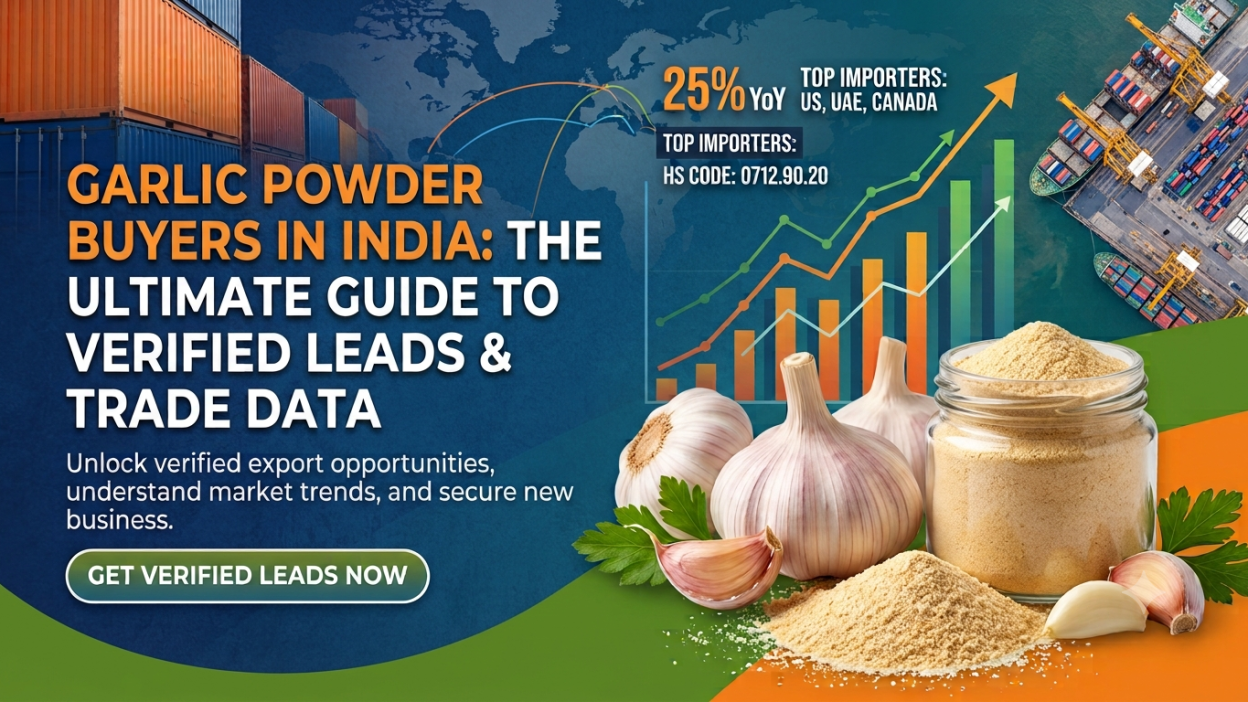
Now to the figures that drive real decisions. Between November 2023 and October 2024, India shipped 294 consignments on a trailing-twelve-month basis. Those shipments came from 112 Indian exporters and reached 146 overseas buyers — a 25% jump over the prior 12 months. That’s not a flat market. That’s a rising one.
| Metric | Garlic powder export data |
| Total shipments (TTM) | 294 shipments |
| Period covered | Nov 2023 – Oct 2024 |
| Shipments in Oct 2024 alone | 30 shipments |
| Indian exporters involved | 112 |
| Global buyers reached | 146 |
| Year-on-year growth | +25% |
| Key HS codes | 0712.90.20 / .30 / .40 |
October 2024 alone saw 30 shipments leave the country — a strong monthly clip that signals steady, not seasonal, demand. Most garlic powder exports from India head to the United States, the United Arab Emirates, and Canada. Those three markets deserve top priority in any outreach plan, simply because the shipment lanes are already proven.
Zoom out to the global picture and the ranking shifts. China, South Korea, and India sit as the top three exporters by shipment count. China leads with roughly 4,782 shipments, South Korea follows with about 1,502, and India takes third at around 1,081 shipments. India punches above its weight here, especially considering it’s also one of the planet’s largest domestic consumers. Every tonne exported is a tonne not sold at home, which tells you the export-grade product commands enough margin to justify shipping it abroad.
Reading garlic powder export data properly matters. A rising shipment count with a growing buyer base — 146 buyers, up 25% year on year — means the market is broadening, not consolidating around a few giant accounts. That’s good news for new entrants. There’s room.
Global Garlic Powder Exporters: The Competitive Field
If you’re exporting from India, you’re competing with these players. Here’s how the leading garlic powder exporters stack up by approximate annual export value.
| Rank | Country | Export Value (USD Millions) |
| 1 | China | 2,400 |
| 2 | Spain | 420 |
| 3 | Argentina | 113 |
| 5 | Mexico | 41 |
| 6 | France | 38 |
| 7 | Egypt | 37 |
| 8 | Italy | 29 |
| 9 | India | 28 |
| 10 | Malaysia | 23 |
China obviously dwarfs everyone — its export value is nearly six times Spain’s, the next in line. But here’s what that table hides. Buyers across North America and Europe increasingly want alternatives to Chinese supply, driven by cost swings, quality concerns, and geopolitical caution around single-source dependency.
That’s the opening for Indian suppliers. If you can prove batch consistency, provide clean phytosanitary documentation, and hold your delivery schedule, you’re a credible “China-plus-one” option—and that positioning wins contracts that pure price competition never would. The Netherlands is a useful example: it re-exports a lot, meaning much of its value is trade and repackaging rather than production. India, by contrast, has the actual agricultural base. That’s a structural advantage worth leaning on in your sales conversations.
Garlic Powder Importing Countries: Where the Demand Sits
Which countries import garlic powder in real volume? The top garlic-powder-importing countries include the United States, Vietnam, and Australia. The US stands out as both a heavyweight importer and the single largest destination for premium-grade material.
For an Indian exporter, that means your best garlic powder buyers in India research should sit alongside a global demand map. Sell domestically to the flavor majors and masala brands, absolutely—but also line up international garlic powder import leads from the US, UAE, Canada, and Southeast Asia, where repeat-order demand runs strong and long-term supply relationships form quickly.
A short comparison helps frame the two audiences you can serve at once:
| Market Type | Buyer Profile | What They Prioritise |
| Domestic (India) | Flavour houses, FMCG, masala brands | Consistency, food-safety certs, mesh grade |
| Export (US, UAE, Canada) | Importers, distributors, food processors | Documentation, on-time delivery, and an alternative to China |
Serving both isn’t a distraction—it’s a hedge. When domestic procurement slows, export demand often holds, and vice versa.
How to Find Verified Garlic Powder Buyers and Export Leads
This is where most exporters waste months. They scroll unverified directories, email dead contacts, and never see real shipment volumes. There’s a far better way, and it starts with flipping the process.
Shipment-based trade data changes everything. Instead of guessing who might buy, you see who already imported the product, when, in what quantity, and to which destination. That’s the difference between a cold list and a garlic powder buyers’ list; you can actually work with confidence.
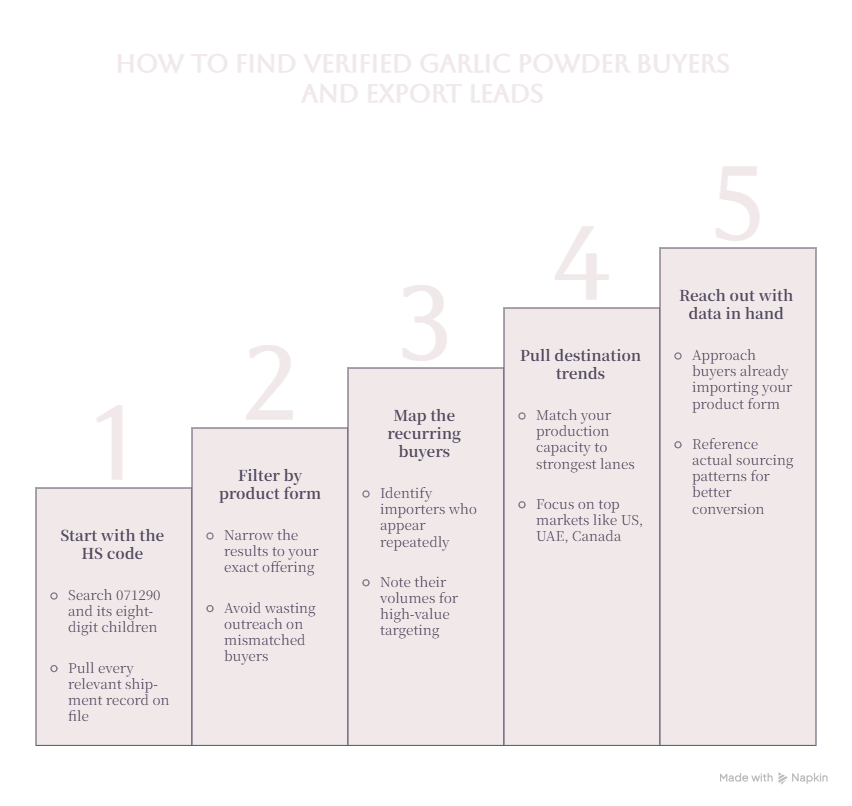
Here’s a practical, repeatable sequence:
- Start with the HS code. Search 071290 and its eight-digit children to pull every relevant shipment record on file.
- Filter by product form. Powder, flakes, or dried whole—narrow the results to your exact offering so you’re not wasting outreach on mismatched buyers.
- Map the recurring buyers. Identify importers who appear repeatedly and note their volumes. High-frequency, high-value accounts are your priority targets.
- Pull destination trends. Match your production capacity to the strongest lanes—the US, UAE, and Canada consistently top the list.
- Reach out with data in hand. Approach buyers already importing your exact product form. A message that references their actual sourcing pattern converts far better than a generic pitch.
One agri-exporter working from verified shipment intelligence found more than 45 buyers across India, identified the top five export destinations, and cut buyer-research time by over 60%. That’s not luck. It’s the natural result of working from real customs records instead of hope and cold emails.
Platforms like Vyaapar One pull verified customs and shipment data from 200+ countries, updated daily from government-authorized sources. You can filter garlic powder export leads and garlic powder import leads by HS code, product form, company, and destination — all in one dashboard. Fewer dead ends, faster deals, and a garlic powder buyers list built on evidence rather than optimism.
Is the Garlic Powder Export Business Worth It?
Short answer: yes — if you work with data. India has the raw agricultural supply, the processing base, and rising global demand outside China. The margins reward exporters who show up with clean documentation, the correct garlic powder HS code, and verified buyer relationships already mapped.
The exporters who struggle are the ones flying blind. No shipment visibility, no buyer verification, no destination strategy — just product and hope. The ones who win treat garlic powder export data as their starting point, not an afterthought. In a market growing 25% year on year, the cost of guessing is measured in missed contracts.
Comparison: Directory Sourcing vs Verified Trade Data
| Factor | Open Directories | Verified Trade Data |
| Buyer accuracy | Low, often outdated | High, shipment-verified |
| Volume visibility | None | Actual import quantities |
| Destination insight | Guesswork | Confirmed by customs records |
| Research time | Weeks | Hours |
| Lead quality | Cold, unverified | Warm, data-backed |
| Repeat-order signals | Invisible | Clearly traceable |
The gap is obvious. If you’re serious about garlic powder export from India, the verified route pays for itself on the very first genuine order—and every order after that gets easier, because you already know the market’s shape.
Final Word
The Indian garlic powder market rewards preparation over hustle. Know your buyers, classify your product correctly, and build outreach around verified garlic powder export data instead of cold directories. Whether you’re targeting domestic flavor majors or overseas import leads in the US and UAE, the exporters who win are consistently the ones working from real shipment intelligence.
Ready to find your next set of garlic powder buyers in India? Access verified trade leads, shipment records, and HS code-level data through VyaaparOne — and turn raw customs records into signed, repeatable orders.
Frequently Asked Questions
Is the garlic powder business profitable? Yes. Garlic powder exports from India can be highly profitable when you work from current export data, a verified importers list, correct HS codes, and real demand trends rather than from guesswork. The margin sits in matching the right grade to the right buyer.
Which countries import the most garlic powder? The leading garlic powder importing countries include the United States, Vietnam, and Australia, with the US ranking as the top destination for premium-grade material. The UAE and Canada are also strong, proven lanes for Indian suppliers.
Does India export garlic powder? Yes. Per recent garlic powder export data, India shipped 294 consignments over a trailing-twelve-month period to 146 global buyers, a 25% increase over the previous year.
What is the HS code for garlic powder? The main garlic powder HS codes are 0712.90.20 (dehydrated powder), 0712.90.30 (flakes), and 0712.90.40 (dried garlic), all falling under parent heading 071290. Always file the eight-digit code that matches your exact product form.
Who are the biggest garlic powder exporters worldwide? China leads by a wide margin, followed by Spain, Argentina, the Netherlands, Mexico, and France. India ranks in the global top ten by export value and third by shipment count.
How do I find a verified garlic powder buyers list? Use shipment-based trade data filtered by HS code and product form. This surfaces genuine importers with real, traceable volumes instead of unverified directory contacts that often lead nowhere.