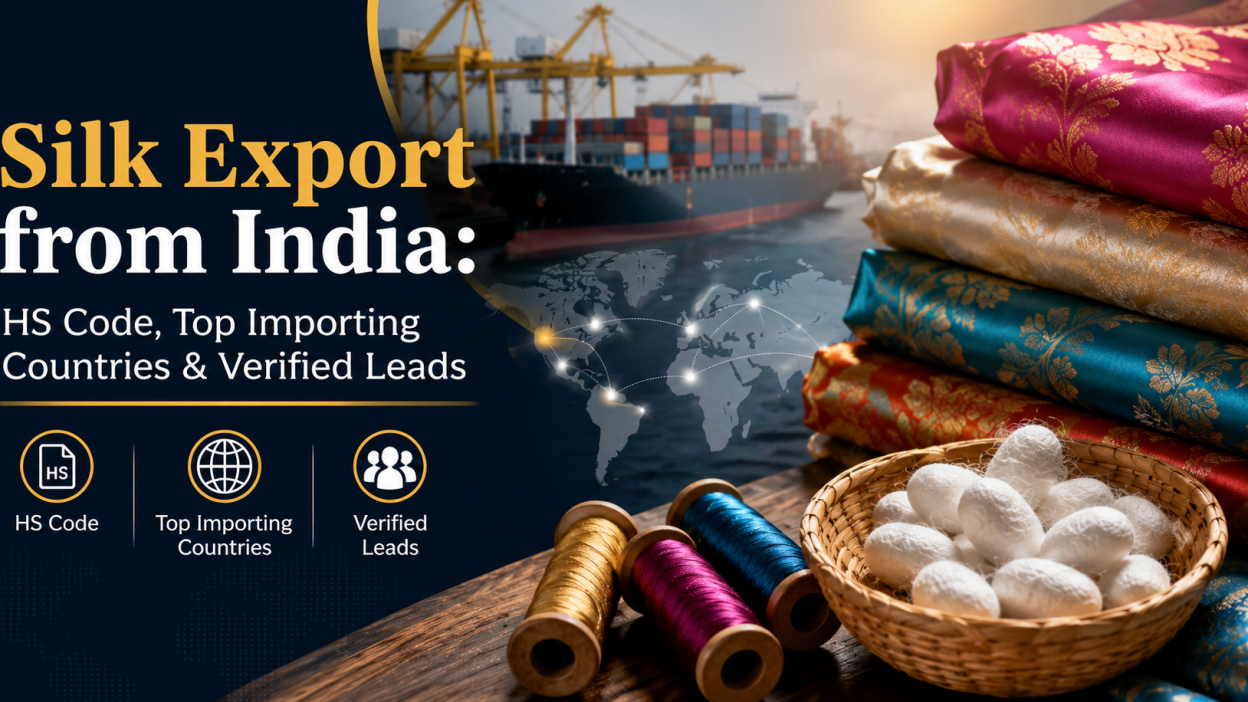
India has been trading this fibre for over two thousand years, and the business is still very much alive. If you handle sourcing, run an export house, or simply want to understand where the money moves, this guide breaks down silk export from India in plain terms — the tariff codes you’ll file under, the countries buying the most, and how to find real buyers instead of dead ends. The trade reached roughly US$244–246 million in FY24 and touches more than 30 countries. Here’s everything you need to act on it.
Let’s be honest: plenty of importers and suppliers dive into this market without a map. They know the product is in demand, they’ve heard the margins can be healthy, and then they get stuck at the first customs form or the first unqualified buyer contact. This guide is built to get you past both of those walls with data you can actually use.
Why India Still Matters in the Global Silk Trade
India is the second-largest silk producer on the planet, behind only China. Together, the two countries make up over 90% of the world’s silk. What makes India different? It’s the only country that produces all four commercial varieties — mulberry, tussar, eri, and muga. That variety is a genuine competitive edge no other supplier can match.
In FY25, India produced around 41,121 metric tons, up from 38,913 MT the year before. Karnataka does the heavy lifting here, contributing close to a third of national raw output and roughly 70% of the mulberry variety. The Ramanagara district near Bengaluru runs the largest cocoon market in Asia. So when buyers talk about silk exporters in Bangalore, they’re pointing at the real production heartland — not a marketing label.
Honestly, most new exporters underestimate how concentrated this industry is. A handful of states — Karnataka, Andhra Pradesh, Assam, West Bengal, Tamil Nadu — account for the bulk of it. Knowing where the supply sits changes how you negotiate.
HS Code for Silk Fabric and All of Chapter 50
Every silk shipment leaving the country files under Chapter 50 of the Harmonised System. Get the HS code for silk fabric right and customs clearance is smooth. Get it wrong and your consignment sits at the port. Here’s the full breakdown.
| HS Code | Product Description | Common Use |
| 5001 | Silk-worm cocoons suitable for reeling | Raw sericulture output |
| 5002 | Raw silk (not thrown) | Reeled natural silk |
| 5003 | Silk waste (cocoons unfit for reeling, yarn waste, garnetted stock) | Recycled silk stock |
| 5004 | Silk yarn (not spun from waste), not for retail | Industrial yarn supply |
| 5005 | Yarn spun from silk waste, not for retail | Spun-waste yarn |
| 5006 | Silk yarn and waste yarn, put up for retail; silk-worm gut | Retail-ready yarn |
| 5007 | Woven fabrics of silk or of silk waste | Finished silk fabric |
The silk HS code most fabric exporters care about is 5007 — that’s woven silk fabric, the finished product buyers in Europe and the Gulf want. Raw silk exporters file under 5002. If you deal in Indian silk carpets, note those often fall under Chapter 57, not 50, so double-check before you file. This is exactly the kind of detail that trips people up on their first shipment.
Top Importing Countries for Indian Silk
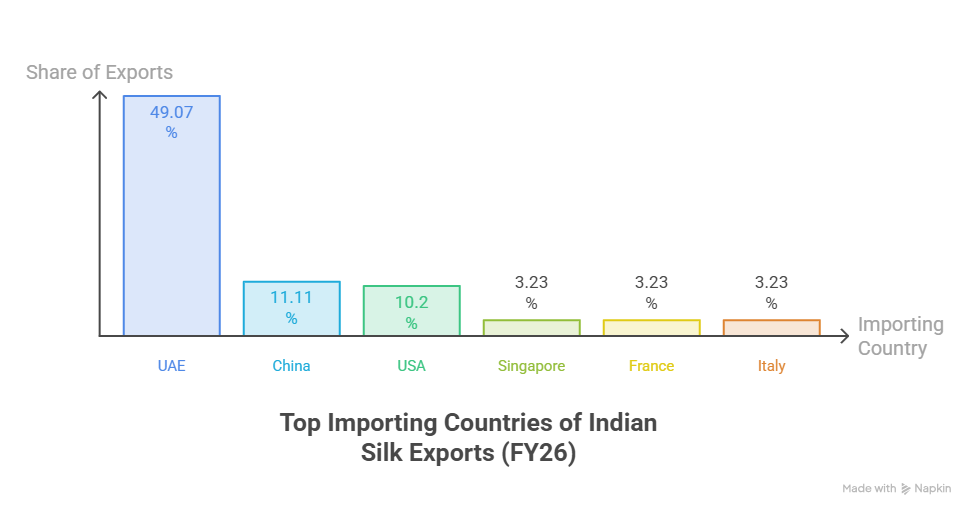
Where does it all go? The import and export of silk in India follows a fairly predictable set of destinations, though the ranking shifts year to year. Based on FY26 (April–July) figures, here’s how the top importing countries stacked up by share of India’s silk exports.
| Rank | Importing Country | Share of Indian Silk Exports |
| 1 | UAE | 49.07% |
| 2 | China | 11.11% |
| 3 | USA | 10.2% |
| 4 | Singapore | 3.23% |
| 5 | France | 3.23% |
| 6 | Italy | 3.23% |
| 7 | Australia | — |
| 8 | United Kingdom | — |
| 9 | Hong Kong | — |
| 10 | Canada | — |
The UAE dominating with nearly half the total surprises a lot of people. It works partly as a re-export hub — silk lands in Dubai and moves onward across the Middle East and Africa. China buying Indian silk might also seem odd given it’s the world’s biggest producer, but it sources specific Indian varieties and raw material it can’t make cheaply at home.
For anyone weighing silk exporting countries as competition, remember: Uzbekistan, Vietnam, and China together supply the majority of the world’s raw silk on the export side. India’s strength lies less in raw volume and more in value-added products — natural silk yarn, readymade garments, and handloom silk. In FY26 (April–July), natural silk yarn alone brought in US$68 million, with silk readymade garments at US$26 million and silk carpet at US$16 million.
What India Actually Exports (Product Split)
It helps to know the mix. Silk trade from India isn’t one product — it’s a basket. Natural yarn leads by value. Then come fabrics and made-ups, readymade garments, carpets, and waste. Raw material exports are surprisingly small — around US$2.89 million in the FY26 opening months — because India needs most of its reeled output for domestic weaving.
That product spread matters for buyers. A wholesaler in Milan sourcing woven fabric and a boutique in New York wanting finished garments are chasing completely different tariff headings and completely different silk exporters in India. Match the product to the supplier, not the other way around.
Silk Export from India to USA and Other Key Routes
The silk export from India to USA route deserves its own note. The United States consistently ranks among the top three buyers, drawn to premium handloom fabrics, silk sarees for the diaspora market, and finished garments. American buyers tend to prioritise certification, consistent quality, and reliable dispatch over rock-bottom pricing — so exporters who document well and ship on time win repeat orders.
Europe is a quality-first market too. Italy and France buy Indian silk for their fashion houses; they know silk, and they’ll test what you send. The Gulf, led by the UAE, moves higher volumes with faster turnaround. Each corridor rewards a slightly different approach, and reading that correctly is half the battle.
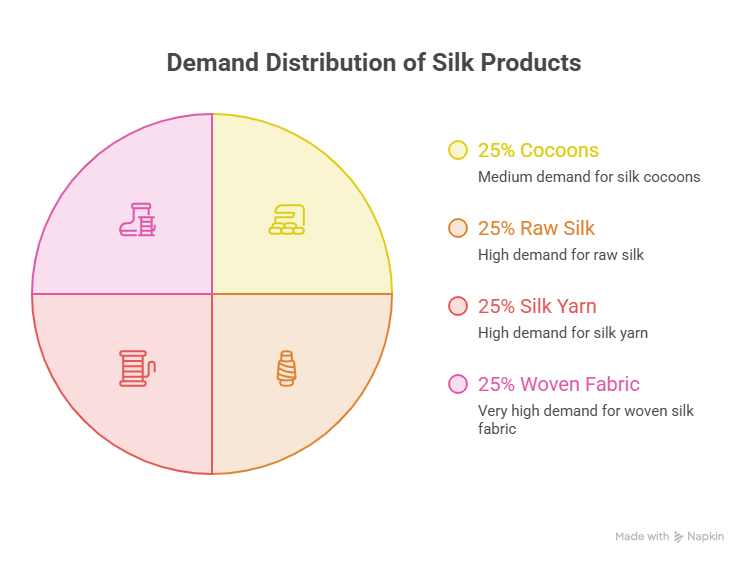
Silk Product Comparison
| Product | HS Code | Demand |
| Cocoons | 5001 | Medium |
| Raw Silk | 5002 | High |
| Silk Yarn | 5004 | High |
| Woven Fabric | 5007 | Very High |
Major Silk Exporters in India
The Indian export scene runs from large listed manufacturers to small handloom clusters. Established names include Himatsingka Seide, Mulberry Silks, and Niranjan Silk Palace, among many regional players. Bengaluru and the wider Karnataka belt host a dense concentration of silk exporters in Bangalore, thanks to the state’s cocoon markets and reeling infrastructure.
But here’s the thing — the biggest exporter isn’t always the right partner. Small and mid-size firms often deliver better flexibility on MOQ, faster sampling, and more attention to a first-time buyer. What you actually want is verified trade history: who has shipped your product, to your target country, recently and reliably.
Finding Verified Silk Import Leads and Silk Export Leads
This is where most trade stalls. You can know the HS code, the countries, the product split — and still struggle to reach an actual buyer. Cold outreach to random directories rarely converts. What works is trade data.
Verified silk import leads come from real customs and shipment records — who imported silk, in what quantity, through which port, at what price. Cross-reference that with silk export leads showing which Indian suppliers are already shipping, and you’ve got a shortlist grounded in fact rather than guesswork. This is exactly the kind of indian silk export data that turns a vague market into a named list of prospects.
Platforms like VyaaparOne pull silk export data from India together with buyer-supplier contacts, HS-code-level shipment records, and country-wise analytics across 200+ countries. Instead of chasing ten unqualified contacts, you work three that have a documented history of buying what you sell. That’s the difference between busy and productive.
Documentation and Compliance: The Paperwork That Ships Orders
Trade dies in the paperwork more often than in the pricing. Before a single consignment moves, an Indian exporter needs an Import Export Code (IEC) from the DGFT — this is non-negotiable and free to apply for online. Beyond that, most buyers in regulated markets want proof of origin, quality certification, and clean documentation of what’s inside the box.
The core paper trail usually runs: commercial invoice, packing list, bill of lading (or airway bill), certificate of origin, and any product-specific quality or phytosanitary certificate the destination requires. Buyers in the EU and USA lean hard on certification and traceability — send incomplete paperwork and you’ll watch a good order evaporate. Gulf buyers move faster but still expect the basics done right.
Here’s a practical tip most first-timers miss: align your invoice product description exactly with the tariff heading you’re declaring. When the description and the classification agree, clearance is quick. When they contradict each other, an officer flags the consignment and you’re stuck explaining yourself at the port. Small detail, big consequences.
How to Read Silk Export Data Before You Commit
Never build a strategy on a single number. Good silk export data from India layers several signals: shipment volume trends, average unit price by destination, the ports handling the most traffic, and the concentration of buyers. If one country shows rising shipments and firming prices, that’s a market opening. If prices are sliding while volume climbs, margins are getting squeezed — proceed carefully.
Smart exporters validate demand this way before spending a rupee on samples or travel. It’s the same logic a sourcing manager in Dubai applies before signing with a new supplier: check the trade record first, negotiate second.
Ready to Move on Silk Export from India?
The opportunity here is real, but it rewards preparation over enthusiasm. Get your tariff codes right, target the countries actually buying, and — most importantly — work from verified data rather than guesswork. Whether you’re sourcing silk exporters in India or hunting qualified silk import leads, the traders who win are the ones who check the trade record before they pitch. Explore verified silk export from India, buyer contacts, and live trade leads on VyaaparOne and turn market interest into signed orders.