
India sits at the centre of the global castor market, and it isn’t close. The country grows most of the world’s castor seed and ships the bulk of the processed oil abroad. If you trade in vegetable oils, industrial derivatives, or bio-based lubricants, understanding castor oil export from India is where your sourcing strategy starts. This guide walks through the trade data, the HS codes you’ll need at customs, the leading exporters, the buyers driving demand, and how to turn all of it into real leads.
Here’s the short version: in 2023-24, India exported roughly $1.01 billion worth of castor oil. That’s not a rounding error in the global market. That’s the market. Let’s break down what’s actually happening.
Why India Dominates the Global Castor Market
India accounts for around 85% of the world’s castor seed output. No other country comes close on volume, and that head start shapes everything downstream. When a buyer in Shanghai or Rotterdam needs castor oil at industrial scale, the supply chain almost always traces back to Gujarat.
The castor oil industry in India rests on a few structural advantages. The crop grows well in semi-arid conditions, which suits western and central India. Farmers in Gujarat, Rajasthan, Andhra Pradesh, Telangana, and Odisha have decades of accumulated know-how. And the processing infrastructure — crushing units, solvent extraction plants, derivative manufacturers — clusters near the growing regions, so the whole value chain stays tight and cost-efficient.
Why does this matter to you as a trader? Because concentration means predictability. You know where the supply is, you know the quality bands, and you know the seasonal rhythm. That’s rare in agricultural commodities.
Castor Oil Export from India: The 2023-24 Data
Let’s look at the numbers that matter. The export of castor oil from India in 2023-24 tells a clear growth story.
| Metric | 2023-24 Figure |
| Total export value | $1,009,267.91K (approx. $1.01 billion) |
| Total export volume | 629,846,000 kilograms |
| Total shipments (Mar 2023–Feb 2024) | 12,347 shipments |
| Number of Indian exporters | 1,153 exporters |
| Number of overseas buyers | 4,156 buyers |
| Year-on-year growth | 39% increase |
| Primary HS code | 151530 |
That 39% jump year-on-year is the headline. Demand didn’t creep up — it surged. Over 12,000 shipments moved through the year, handled by more than 1,150 Indian exporters and landing with over 4,000 buyers worldwide.
Worth noting: India ships more than 60% of its total castor oil production overseas. On average the country produces around 800,000 tonnes of castor oil annually, and the majority of that heads to export markets. So this isn’t a domestic industry with a side hustle in exports. Exports are the main event.
More recent figures show the market breathing in and out, as commodity markets do. In August 2025, exports came in at 40,592 MT, an 17.95% drop against August 2024, with value around ₹561.96 crore. But cumulative shipments for April–August 2025 still reached 301,065 MT. Production for 2025-26 is forecast to climb to roughly 1.76 million tonnes of castor seed, helped by stronger yields in Gujarat and Rajasthan.
Castor Oil HS Code: What You Need at Customs
Get the classification wrong and your shipment stalls. So let’s be precise about the castor oil HS code.
The primary HS code for castor oil is 151530. This heading covers fixed vegetable fats and oils — including castor oil and its fractions — whether or not refined, but not chemically modified.
Below that, a handful of sub-codes handle specific product forms. Here’s the breakdown traders use most:
| HS Code | Product Description |
| 151530 | Castor oil and its fractions (parent heading) |
| 15153010 | Castor oil, edible grade |
| 15153090 | Castor oil, other than edible grade |
| 29161990 | Certain castor oil-derived fatty acid compounds |
| 34021300 | Sulphonated / derivative castor oil products (surfactant use) |
The one you file under depends on grade and processing. Cold-pressed edible-grade oil doesn’t share a code with industrial derivatives, and mislabelling either invites customs scrutiny. When in doubt, confirm the HS code for castor oil against your product’s actual specification before you file. A quick check saves days.
Why the extra derivative codes matter: a lot of Indian castor value leaves the country not as raw oil but as hydrogenated castor oil, sebacic acid feedstock, or sulphated derivatives. Those move under chemical headings, and if you’re tracking the full trade picture you’ll want eyes on all of them.
One more practical note. Different importing countries sometimes classify castor products under slightly different national tariff extensions of the same base code. The first six digits (151530) stay consistent globally under the Harmonized System, but the digits after that vary by country. So when you’re reading foreign import records, match on the six-digit heading first, then reconcile the local suffix. Get comfortable with this and the trade data stops looking like noise and starts looking like a map.
Where Indian Castor Oil Goes: Top Buyer Countries
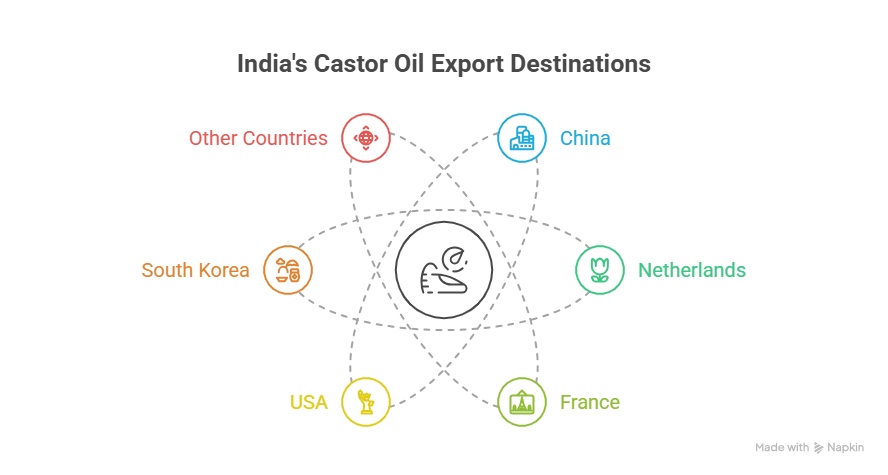
Follow the shipments and a clear map appears. A small cluster of countries absorbs most of India’s output — China, France, the Netherlands, South Korea, and the USA together account for over 78% of the total export of castor oil from India.
China is the giant here. In 2023-24, China imported roughly $279.14 million worth of Indian castor oil. The reason is industrial: castor oil is a raw material for plastics, resins, paints, and lubricants, and a large share goes into making sebacic acid, a core industrial chemical building block. When Chinese manufacturing runs hot, castor demand follows.
Here’s how the top destinations stacked up:
- China — approx. $279.14 million
- Netherlands — approx. $71.34 million
- France — approx. $57.6 million
- USA — approx. $55.87 million
- South Korea — approx. $23.37 million
The Netherlands functions partly as a European gateway, redistributing oil across the EU. France and the USA pull castor oil into cosmetics, pharmaceuticals, and speciality chemicals. Each destination has its own quality preferences and its own buying rhythm — something worth studying before you pitch a buyer in that market.
India exports castor oil to over 134 countries in total. The concentration at the top is real, but the long tail is where a nimble exporter can find an underserved niche.
India vs. the World: Castor Oil Exporting Countries
To appreciate India’s position, put it next to everyone else. It’s almost unfair.
| Rank | Exporting Country | Export Value (USD) |
| 1 | India | 1.01 billion |
| 2 | Netherlands | 47.43 million |
| 3 | France | 29.68 million |
| 4 | Germany | 26.24 million |
| 5 | United States | 16.91 million |
| 6 | Brazil | 9.42 million |
| 7 | European Union | 6.71 million |
| 8 | Kenya | 5.81 million |
| 9 | Belgium | 5.02 million |
| 10 | Canada | 4.51 million |
Look at the gap. India’s export value dwarfs the second-place Netherlands by more than twentyfold. India alone accounts for roughly 65% of worldwide castor oil production and over 87% of global exports. Most of what the Netherlands, France, and Germany “export” is really re-export or value-added processing of oil that originated — you guessed it — in India.
For a buyer, the takeaway is blunt: if you want castor oil at scale, at competitive prices, you’re buying from India one way or another. For an Indian exporter, it means your competition is largely other Indian suppliers, not foreign producers. That changes how you differentiate.
Castor Oil Exporters in India: The Established Players
The supply side is populated by a mix of large integrated firms and specialised castor houses. Knowing the major castor oil exporters helps you benchmark, partner, or scout suppliers.
Leading castor oil exporters in India include:
- Amee Castor & Derivatives Ltd
- Castor Products Company
- Castrochem Pvt Ltd
- Gokul Overseas
- Jaksh Castor Products Pvt Ltd
- Jayant Agro-Organics Ltd.
- N.R. Oils
- R.P.K. Agrotech Exports Pvt. Ltd.
- Royal Castor Products Ltd.
- Shree Uday Oil And Food Industries
- TGV SRAAC Limited
These firms span the range from commercial-grade oil shippers to derivative manufacturers producing hydrogenated castor oil, 12-hydroxystearic acid, and sebacic acid. Jayant Agro-Organics, for instance, is one of the world’s largest castor oil processors, not just an Indian one.
If you’re a new entrant, don’t try to out-scale these players on day one. Find a grade, a certification, or a destination market they underserve, and build there. The castor oil industry in India rewards specialists as much as giants.
Castor Oil Buyers in India and the Domestic Angle
It’s easy to fixate on exports and forget the home market. But castor oil buyers in India matter too — domestic derivative manufacturers, lubricant blenders, pharmaceutical formulators, and cosmetics makers all source locally before the oil ever ships out.
This domestic layer does two things. First, it competes with export demand for seed and crude oil, which affects pricing. Second, it creates a ready base of buyers for exporters who prefer to sell at home or who want a fallback when overseas demand softens. If you’re sourcing, mapping castor oil buyers in India gives you a fuller picture of where the oil actually flows.
The value-added chain inside India is deep. Raw seed becomes crude oil, crude becomes refined and grade-separated oil, and refined oil becomes derivatives worth far more per tonne. Every step is a potential buyer relationship.
Castor Seed Export from India: The Upstream Story
Oil gets the headlines, but castor seed export from India is part of the same equation. Seed and oil together made up that 1.01 billion export figure for 2023-24.
The primary destinations for castor seed export from India include the Netherlands, France, and South Korea — the same European and East Asian hubs that dominate oil buying. Some buyers prefer to import seed and crush it themselves for supply-chain or quality-control reasons, though the economics usually favour exporting processed oil, which is why India ships far more oil than raw seed.
Who are these castor seed buyers, then? They tend to be integrated processors and derivative manufacturers who want control over the crushing step. A European chemical firm running its own extraction line, for example, may source seed directly rather than buy finished oil. Tracking castor seed buyers separately from oil buyers is smart practice — the two groups behave differently, order on different cycles, and respond to different pitches. Seed buyers care about oil content and moisture; oil buyers care about grade, colour, and acid value.
For traders, watching both seed and oil flows gives an early read on demand. A shift toward seed exports can signal buyers building their own processing capacity — useful intelligence when you’re planning next season. And when seed flows tighten, it often means domestic crushers are absorbing more supply, which nudges oil prices upward. Reading these signals early is one of the quiet advantages that separates a reactive trader from a proactive one.
Castor Oil Industry in India: Market Size and Outlook
Zoom out to the whole sector. The castor oil industry in India generated around USD 81.0 million in the domestic castor oil and derivatives market in 2023, and it’s projected to reach roughly USD 108.7 million by 2030 — a CAGR of about 4.3% from 2024 onward. Hydrogenated castor oil led revenue among product segments.
The growth drivers are structural, not faddish. Sustainability is pushing manufacturers toward bio-based lubricants and plant-derived chemicals, and castor oil is one of the few vegetable oils with genuine industrial credentials. Its unique ricinoleic acid content makes it valuable in ways soybean or palm oil simply can’t match. Pharmaceuticals, cosmetics, coatings, and biopolymers all pull on the same supply.
Price context helps here too. Forecasts pegged castor seed around ₹5,700–6,000 per quintal heading into October 2025. Prices move with monsoon performance, acreage decisions, and Chinese industrial demand, so if you’re trading you’ll want to track all three.
There’s a strategic point buried in these numbers. The value of castor oil export from India isn’t just its size today — it’s how defensible that size is. Palm and soybean oil trade in crowded, commoditised markets where dozens of countries compete. Castor is different. The seed grows economically in only a handful of regions, and India owns most of that footprint. That scarcity, paired with rising industrial demand, is exactly the kind of structural advantage that holds up over decades rather than quarters.
How to Find Castor Oil Export Data Leads and Buyers
Data is only useful if it turns into contacts. This is where castor oil export data leads become the difference between guessing and knowing. Here’s a practical approach to generating castor oil export leads.
Start with the HS code. Search trade databases using 151530 (and the sub-codes above) to pull actual shipment records. Every record is a real transaction — a real exporter, a real buyer, a real volume.
Filter by destination. Narrow to the markets you can actually serve. If your certifications and logistics suit the EU, focus on Netherlands, France, and Germany buyers rather than chasing every lead globally.
Study buyer frequency and volume. A buyer importing steadily every month is worth more than a one-off large shipment. Frequency signals a stable relationship you might win a share of.
Analyse buyer profiles. Look at trade history, typical order size, and preferred grades. This tells you whether a prospect matches your capacity and product before you spend effort on outreach.
Cross-reference exporter competition. Seeing which Indian exporters already serve a buyer tells you the price and quality bar you’ll need to clear.
Platforms built on customs and shipment records turn this from a manual slog into a filtered list. VyaaparOne compiles trade intelligence so you can search by product, drill into castor oil export data, identify active buyers, and build a targeted outreach list instead of cold-emailing the void. Good castor oil export leads come from good data — there’s no shortcut around that.
Comparing Your Sourcing Options
Not every buyer or exporter fits every need. Here’s a quick frame for deciding how to engage the market.
| Approach | Best For | Trade-off |
| Buy from large integrated exporters | High volume, consistent grade, reliability | Less pricing flexibility |
| Source from specialised castor houses | Specific grades, derivatives, certifications | Smaller capacity ceilings |
| Import seed and process locally | Full quality control, margin capture | Higher capital and operational load |
| Use trade-data platforms for leads | Targeted buyer discovery, market entry | Requires filtering and follow-up |
The right choice depends on your volume, your margins, and how much of the value chain you want to own. Most successful traders mix approaches rather than betting on one. A first-time importer might lean on a large integrated supplier for reliability, then diversify toward specialised houses once relationships and quality benchmarks are established. There’s no single correct path — only the one that fits your risk appetite and your buyers’ expectations this season.
The Future of Castor Oil Export from India
The trajectory points up. Growing applications across pharmaceuticals, cosmetics, biofuels, and green chemistry keep pulling demand, and India’s production base keeps expanding to meet it. As the world leans harder into bio-based and sustainable inputs, castor oil’s industrial versatility becomes more valuable, not less.
India’s edge won’t vanish. The combination of 85% seed dominance, deep processing infrastructure, and established exporter relationships is not something a competitor replicates in a season. The real opportunity for Indian exporters lies in moving up the value chain — shipping more derivatives, more speciality grades, more certified product — rather than competing on raw commodity price alone.
For anyone entering or expanding in this space, the export of castor oil from India offers a rare mix of scale, growth, and defensibility. The demand is proven, the supply is concentrated at home, and the data to find buyers is available. What’s left is execution.
Final Word
Castor oil export from India is one of the most concentrated, data-rich trade stories in the agricultural commodity world. India produces most of the seed, exports most of the oil, and holds a position no competitor can easily challenge. From the $1.01 billion export value to the 151530 HS code, from China’s massive buying appetite to the specialised exporters in Gujarat, the market rewards traders who work from real numbers.
If you’re sourcing, selling, or scouting in this space, start with the data. Identify the buyers, verify the exporters, confirm the HS codes, and build outreach from actual shipment records rather than hunches. VyaaparOne gives you that trade intelligence in one place — turning castor oil export data into leads you can act on.
Frequently Asked Questions
Does India export castor oil?
Yes. India is the world’s largest exporter of castor oil, shipping it in large volumes worldwide. In 2023-24, India exported castor seed and oil worth about $1.01 billion.
What is the HS code for castor oil?
The primary castor oil HS code is 151530, covering fixed vegetable oils including castor oil and its fractions. Common sub-codes include 15153010 (edible grade), 15153090 (non-edible grade), and 34021300 for certain derivative products.
Who are the biggest buyers of Indian castor oil?
China is the largest buyer by far, followed by the Netherlands, France, the USA, and South Korea. Together these five markets take over 78% of India’s castor oil exports.
Which Indian states produce the most castor?
Gujarat leads by a wide margin, followed by Rajasthan, Andhra Pradesh, Telangana, and Odisha. Gujarat’s semi-arid conditions and established processing clusters make it the heart of the industry.
Who are the major castor oil exporters in India?
Leading names include Amee Castor & Derivatives Ltd, Gokul Overseas, Jaksh Castor Products Pvt Ltd, Jayant Agro-Organics Ltd., and Castrochem Pvt Ltd, among others.
How do I find castor oil buyers using trade data?
Search shipment databases by the 151530 HS code, filter by destination country and buyer frequency, analyse buyer profiles for volume and grade fit, then build a targeted outreach list. Platforms like VyaaparOne make this searchable and fast.
Why does China buy so much Indian castor oil?
Castor oil is a key industrial raw material in China for plastics, resins, paints, and lubricants, and a large share goes into producing sebacic acid, a fundamental chemical building block.