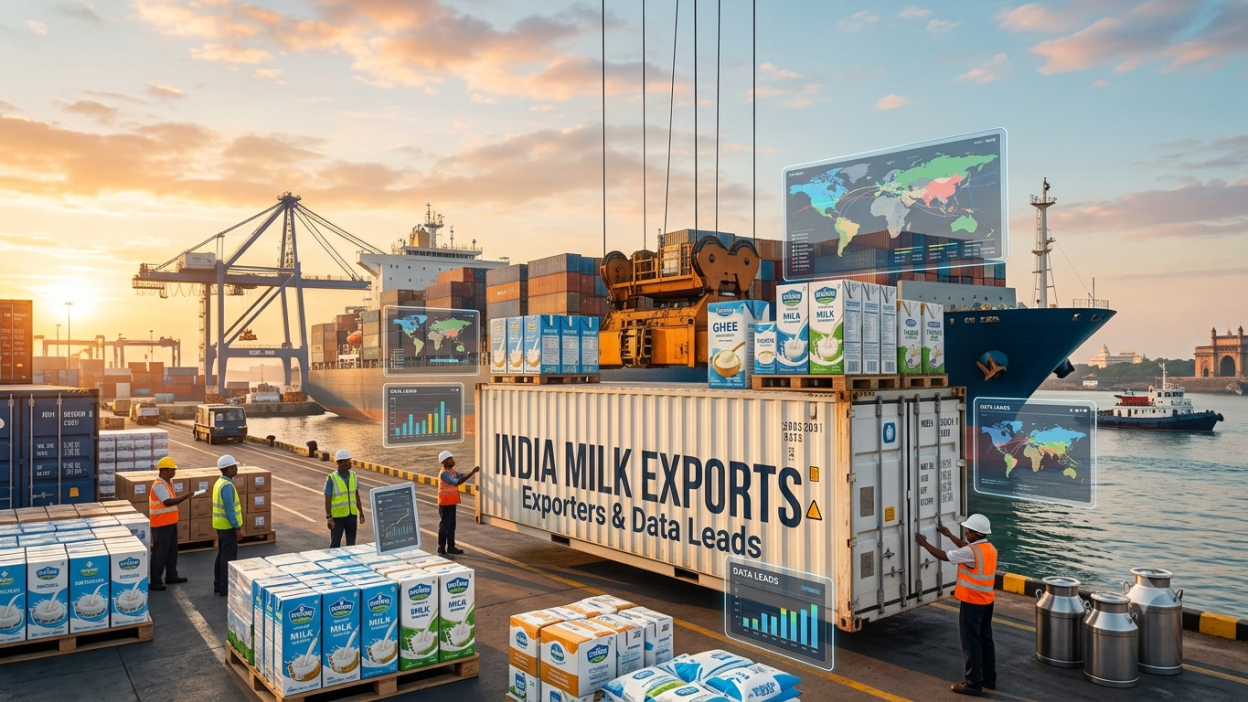
India produces more milk than any other country on earth. Roughly 239 million tonnes a year, about a quarter of global output. And yet, when you look at who actually ships dairy across borders, India barely registers.
That gap is the whole story behind milk exports from India. It is also where the opportunity sits for anyone willing to read the trade data properly instead of guessing.
This guide breaks down what the numbers actually say in 2025-26, which countries buy Indian milk and dairy, which milk HS codes matter, who the active milk exporters are, and how you find verified milk export data leads instead of chasing cold contacts. VyaaparOne tracks shipment-level records across these categories, so much of what follows comes from the same buyer-supplier trail that serious traders use before they quote a single container.
India’s Dairy Position: Big Producer, Small Exporter
Let’s be honest about the mismatch first. India accounts for around 25% of world milk production. As per FAO statistics for 2023, India’s milk production stood at 239.30 million tonnes, a 25.61 percent share of total world milk production. The country also holds the largest population of milch animals anywhere, which is why raw milk availability has never been the constraint.
Now the export side. In 2023-24, India exported 63,738 tonnes of dairy products worth US$272.6 million, accounting for just 0.25% of global exports. Read that again. A quarter of the world’s milk, a quarter of one percent of global dairy trade. Production and trade are not the same business.
Why? Domestic consumption eats almost everything. India drinks it, cooks with it, and processes it into curd, paneer, and ghee at a scale no other market matches. Only the surplus travels.
Here’s the thing, though: that surplus is growing, and it is growing fast.
Milk Export from India 2024-25: The Numbers That Changed
FY25 was a genuine turning point. Exports strengthened in FY 2024-25, reaching 113,350 tonnes valued at US $492.9 million—an increase of nearly 78% in volume and 81% in value. Growth was led by ghee and butter exports, which surged 142% to 67,565 tonnes, while milk powder exports declined.
Almost doubling in a single year is not normal for an agri-commodity. Something structural shifted in how India converts surplus milk into shippable product.
| Metric | 2023-24 | 2024-25 |
| Dairy export volume | 63,738 MT | 113,350 MT |
| Dairy export value | US$ 272.6 million | US$ 492.9 million |
| Volume growth | — | ~78% |
| Value growth | — | ~81% |
| Ghee & butter volume | — | 67,565 MT (+142%) |
| Share of global dairy trade | ~0.25% | Still under 0.5% |
The composition tells you where demand actually sits. India’s export basket is dominated by ghee and butter (59%), followed by milk powder (27%), cheese (11%), and products like buttermilk and casein.
Ghee is the engine. Milk powder export from India, once the headline category, slipped in the same period. If you are building a milk export plan around commodity powder alone, the data is quietly telling you to reconsider.
Who Buys? Top Destinations for Export Milk from India
Geography still rules dairy. Milk is heavy, perishable, and expensive to move, so short cold chains win.
Major export destinations for 2024-25 were the UAE, Saudi Arabia, Bahrain, the USA, and Egypt. Bangladesh, Singapore, and Bhutan continue to feature strongly across the broader dairy basket.
| Destination | Why It Buys | Dominant Category |
| UAE | Large Indian diaspora, re-export hub | Ghee, paneer, milk powder |
| Saudi Arabia | Diaspora demand, limited domestic dairy | Ghee, butter, cheese |
| Bahrain | GCC retail and HORECA channels | Ghee, value-added dairy |
| USA | Ethnic grocery retail networks | Ghee, paneer, specialty milk products |
| Egypt | Bulk industrial milk requirement | Milk powder, butter oil |
| Bangladesh | Land border, price-sensitive volume | Milk powder, liquid milk |
| Bhutan / Nepal | Adjacency and minimal cold chain cost | Liquid milk, milk powder |
Worth noting: export instability across destinations varies enormously — highest in Egypt and lowest in the UAE. Translation for exporters: the Gulf is your base load; Egypt is your upside bet. Do not confuse the two when you plan working capital.
Milk HS Codes Every Exporter Needs
Get the milk classification wrong and your shipment stalls at customs. These are the milk HS codes that carry actual volume.
| HS Code | Product Description |
| 0401 2000 | Milk and cream, fat content by weight above 1% but not above 6% |
| 0401 4000 | Milk and cream, fat content above 6% but not above 10% |
| 0401 5000 | Milk and cream, fat content exceeding 10% |
| 0402 1010 | Skimmed milk powder, fat not exceeding 1.5% |
| 0402 1020 | Milk food for babies, powder or granules, fat not exceeding 1.5% |
| 0402 2100 | Milk and cream in powder, unsweetened, fat above 1.5% |
| 0402 2910 | Whole milk powder, sweetened, fat above 1.5% |
| 0404 9000 | Products of natural milk constituents other than whey |
| 0405 1000 | Butter |
| 0405 9020 | Ghee |
| 0406 9000 | Other cheese |
The single most exported line is concentrated milk and cream powder under HS 040210, accounting for over $24.5 million in 2024, with milk powder above 1.5% fat at $6.4 million and full cream milk powder at $2.2 million.
Two notes. 0405 9020 (ghee) is where FY25 growth actually happened. And HS 0402 1020 covers infant milk food, which pulls far stricter scrutiny than standard milk powder.
How to Export Milk from India: The Compliance Path
Milk is one of the most tightly regulated export categories in India. There is no shortcut around it.
1. Business and IEC setup. Register the entity and obtain an import-export code from DGFT. Nothing moves without it.
2. FSSAI license. A central FSSAI license with dairy processing endorsement is mandatory. Your milk processing unit must be listed for the specific product category you intend to ship.
3. APEDA registration. Mandatory registration with APEDA applies to dairy exports. APEDA is also the body that publishes the official milk and dairy export dashboard, so registering puts you inside the same data ecosystem buyers check.
4. Export Inspection Council certification. A health certificate from the Export Inspection Council is required, along with product testing in EIC-approved laboratories against quality standards. For EU and Gulf shipments, the EIC certificate is effectively your passport.
5. Destination approvals. Halal for GCC markets, FDA prior notice for the USA. Milk plant listing requirements vary by country.
6. Cold chain and packaging. Liquid milk and fresh paneer need continuous temperature control from the milk chilling center onward. Powder and ghee are shelf-stable and far easier to ship, which is exactly why they dominate the export mix.
Most first-time milk exporters underestimate step four. The EIC lab timeline kills quarter-one targets, not logistics.
Top Milk Exporters in India
Milk exporters in India range from cooperative giants to lean private shippers, and the exporter base is a mix of cooperative giants and specialist private shippers.
- Amul (GCMMF)
- Mother Dairy
- Gujarat Cooperative Milk Marketing Federation
- Parag Milk Foods
- Hatsun Agro Product
- Creamline Dairy Products
- SBH Foods Private Limited
- Behal International
- Bhim Sain & Sons
- Thiva Exim
- Namaste India Milk
- Good Luck Agro
Cooperatives dominate volume. But a large share of shipment count belongs to mid-sized private milk exporters serving niche destinations, ethnic retail chains, and industrial buyers. That second group is where most new entrants realistically compete.
How do you verify who is genuinely active? Check shipment records, not brochures. An exporter with continuous monthly consignments under milk HS codes is operating. A polished website with no clearance history is not. The export of milk products from India runs on documented consignments.
Largest Exporter of Milk in the World: Where India Stands
Now zoom out. Being the largest milk producer and being the largest exporter of milk are entirely different achievements.
| Rank | Country | Approx. Dairy Export Value |
| 1 | New Zealand | US$ 6.8 billion |
| 2 | Germany | US$ 3.5 billion |
| 3 | United States | US$ 2.9 billion |
| 4 | Netherlands | US$ 2.6 billion |
| 5 | Belgium | US$ 2.31 billion |
| 6 | France | US$ 2.03 billion |
| 7 | Australia | US$ 1.14 billion |
| 8 | Poland | US$ 1.08 billion |
| 9 | Ireland | US$ 1.07 billion |
| 10 | United Kingdom | US$ 0.84 billion |
New Zealand is the largest milk exporter in the world, and it is not close. A country producing a fraction of India’s milk volume ships more than ten times the value.
The reason is structural. New Zealand built its milk sector around export from day one—standardized herds, consolidated processing, and Fonterra as one global marketing arm. India built its milk economy around feeding 1.4 billion people.
Which brings us to the actual question for Indian exporters: you are not competing with Fonterra on commodity milk powder. You compete on ghee, paneer, flavored milk, and diaspora-driven demand where taste preference beats price.
Milk Powder Export from India: A Category Under Pressure
Milk powder deserves its own section because the trend broke. For years, milk powder was the default answer for anyone asking how to export milk from India at scale.
While overall dairy exports nearly doubled in FY25, milk powder exports declined even as ghee and butter surged. Global powder prices, competition from EU and Oceania surplus, and domestic SMP demand all pulled in the same direction.
Does that mean abandon the category? No. It means pick your markets carefully. Bangladesh, Nepal, and Bhutan remain viable on freight advantage alone. Industrial buyers in West Asia buy on spec and price, and Indian SMP is competitive when global prices firm up.
But if you are new, ghee and value-added milk products give you better margin and less price exposure. The FY25 numbers say so plainly.
Dairy Exports from India: What Grows Next
Between 2009 and 2019, India’s dairy exports grew at a CAGR of 6.5% in quantity and 12.5% in value—value outpacing volume, which is exactly the signal you want.
Where does the next leg come from?
Value-added dairy. Cheese, paneer, probiotic yogurt, flavored milk, whey protein, and condensed milk. Margin-rich, less commoditized, harder for competitors to undercut on price alone.
Ethnic retail. Indian grocery chains in North America, the UK, and Australia keep expanding. Ghee and paneer ride that wave directly.
Infant milk nutrition. Slow to enter, extremely sticky once approved on a buyer’s vendor list.
Organic positioning. EU and North American buyers pay a real premium for certified organic ghee and milk powder. Certification is slow, but it moves you out of commodity pricing.
Cold chain investment. Expanded refrigerated transport, chilling centers, active packaging, and last-mile cold logistics are needed to maintain export quality. This is the constraint that decides how far liquid milk and fresh categories can travel.
Dairy exports from India also carry a policy tailwind. Strengthening bodies like APEDA and export promotion councils to assist dairy exporters with marketing, buyer linkages, and logistics, alongside credit, export insurance, and incentives for converting surplus milk into exportable forms, is the stated direction. Milk exporters who register early sit closer to those schemes.
Finding Verified Milk Export Data Leads
Here is where most exporters lose time. They collect email lists, blast inquiries, and hear nothing back.
Shipment data works differently. It shows you who imported what, from whom, at what volume, and on which date. A buyer who cleared eleven containers of ghee or milk powder into Dubai last quarter is a real prospect. A name scraped off a directory is not.
What to pull from milk export data before you approach anyone:
- Buyer name and consignee address — confirms the entity actually exists and imports
- Shipment frequency—monthly buyers are worth pursuing; one-off buyers usually are not
- Volume per shipment — tells you whether your capacity matches their requirement
- HS code specificity—a buyer importing 0405 9020 does not want your milk powder quote
- Current supplier — you learn who you are displacing and roughly on what terms
- Port of discharge — reveals their distribution footprint
VyaaparOne indexes these fields across milk and dairy HS codes, which lets you filter by country, product, and shipment size before you spend a rupee on outreach. Filter first, then contact. That order matters more than most people think.
One more filter: check seasonality. Ghee demand in the Gulf spikes before Ramadan and Diwali. Milk powder buying in Bangladesh follows monsoon-linked milk production dips. Approach a seasonal buyer off-cycle and you get silence.
Quick reality check: a buyer importing 20 MT a month will not respond to a supplier offering 2 MT. Match capacity before you write the email, and your reply rate changes overnight.
Comparing Your Export Route Options
| Approach | Speed to First Order | Cost | Margin | Best For |
| Direct buyer outreach via trade data | Medium | Low | Highest | Exporters with FSSAI + APEDA ready |
| Merchant exporter / trading house | Fast | Medium | Low | First-time shippers testing demand |
| Overseas distributor tie-up | Slow | High | Medium-high | Brands building long-term presence |
| B2B marketplace listings | Slow | Low | Variable | Passive lead generation |
| Trade fairs (Gulfood, Anuga, SIAL) | Medium | High | High | Value-added and branded dairy |
Most mid-sized milk exporters run two in parallel—trade data for outreach and one trade fair a year for credibility. Marketplace listings alone rarely produce volume.
Closing Thought
Milk export from India is no longer the sleepy footnote it was five years ago. The FY25 jump changed the conversation around milk export from India. A near-doubling in one year is not a statistical blip — it reflects real demand for Indian milk products, particularly for ghee and value-added dairy in Gulf and diaspora markets.
The exporters who capture the next phase will not be the ones with the cheapest powder. They will be the ones who read milk export data carefully, treat every shipment record as a lead rather than a statistic, target buyers whose volumes match their capacity, and clear compliance before the inquiry arrives rather than after it.
Start with the data. Explore verified milk export data leads, milk buyer records, and dairy product export shipment histories from India on VyaaparOne, and build your outreach list from what buyers actually imported—not from what a directory claims they might want.
FAQs
Who is the largest exporter of milk in the world? New Zealand, with dairy exports valued at roughly US$ 6.8 billion. Germany, the United States, the Netherlands, and Belgium follow. India, despite being the largest producer, sits well outside the top ten by export value.
How much dairy did India export in 2024-25? India exported 113,350 tonnes of dairy products valued at US$492.9 million in FY 2024-25, up nearly 78% in volume and 81% in value over the previous year.
Which products lead dairy product exports from India? Ghee and butter lead at about 59% of the export basket, followed by milk powder at 27%, cheese at 11%, and items such as buttermilk and casein.
What licenses do I need to export dairy from India? An IEC from DGFT, a central FSSAI license with dairy endorsement, APEDA registration, and a health certificate from the Export Inspection Council backed by testing in EIC-approved labs. Destination markets may add halal or FDA requirements.
Which milk HS code applies to milk powder? HS 0402 covers milk and cream in concentrated or sweetened form. Skimmed milk powder falls under 0402 1010, infant milk food under 0402 1020, and whole milk powder under 0402 2910. Ghee sits separately at 0405 9020, outside the milk powder headings.
Which countries import the most milk and dairy from India? The UAE, Saudi Arabia, Bahrain, the USA, and Egypt led in 2024-25, with Bangladesh, Singapore, Nepal, and Bhutan also taking consistent volume.
Is exporting dairy from India profitable? It can be, provided you pick the right category. Ghee and value-added products carry better margins than commodity powder, where global price competition from New Zealand and the EU is severe.