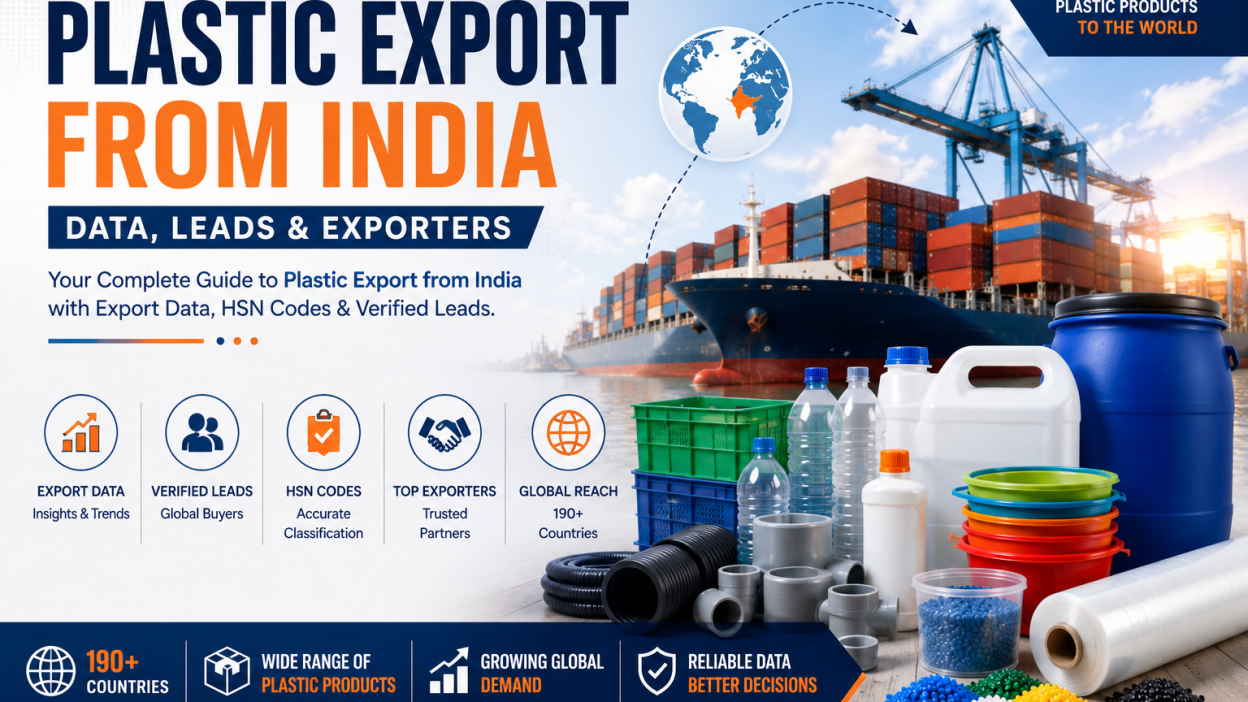
India has quietly become one of the biggest plastic suppliers on the planet. Not glamorous, but the numbers speak loudly. If you are tracking plastic export from India, you are looking at a sector that ships everything from raw polymer granules to finished household moulded goods across more than 190 countries.
Here’s the thing most people miss. The opportunity is not just in manufacturing. It sits in the data — who buys, under what HS code, through which port, and how often they reorder. This guide covers plastic export from India end to end: trade data, verified leads, HSN codes, and how to find genuine exporters and buyers without wasting six months on cold outreach.
Why Plastic Export from India Matters Right Now
The Indian plastics industry supports over 50,000 processing units. Per IBEF and industry estimates, sector exports have crossed USD 12 billion, with ambitions toward USD 25 billion.
Why the growth? A few reasons stack up together:
- Raw material access. Reliance, Haldia Petrochemicals, and IOCL supply domestic polymers competitively.
- Cost advantage. Moulding and extrusion costs run 15–25% below many Southeast Asian competitors.
- China+1 sourcing. Global buyers are actively diversifying away from single-country dependence.
- Government support. RoDTEP and the plastic parks initiative under the Department of Chemicals and Petrochemicals.
Anyone evaluating plastic export from India today is entering a market with genuine structural tailwinds. Honestly, most exporters underestimate how much the China+1 shift has moved the needle. Buyers in the US and EU are not just price-shopping anymore. They want a second reliable source. India fits that brief.
Worth noting: plastic export from India is not one trade. It is at least eight sub-sectors, and they behave very differently.
What Plastic Items Exported from India Actually Look Like
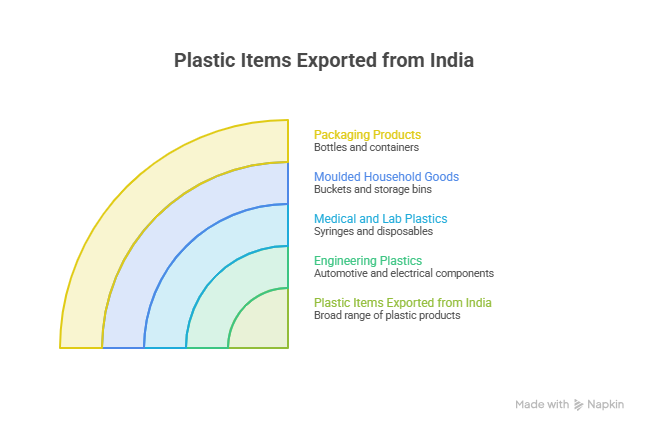
When people search for plastic items exported from India, they usually expect a short list. The reality is broader. The main categories:
Raw materials and polymers — PP, HDPE/LDPE, PVC resin, polystyrene, PET chips. Highest-volume segment by weight.
Films and sheets — BOPP, PET, shrink film, laminated packaging rolls. Gujarat and Maharashtra dominate.
Packaging products — Bottles, jars, closures, containers, FIBC bags, woven sacks. FIBC alone is a massive line.
Moulded household goods — Buckets, crates, storage bins, furniture. Big volume to Africa and the Middle East.
Medical and lab plastics — Syringes, IV sets, petri dishes, disposables.
Engineering plastics — Automotive components, electrical fittings, technical mouldings.
The breadth is the point. Plastic export from India is not a commodity trade; it is a portfolio of trades. Each of these has its own buyer profile, its own price sensitivity, and its own HS code. The full range of plastic items exported from India spans commodity resin at one end and precision medical mouldings at the other. Mixing them up in your outreach is the fastest way to get ignored.
Plastic HSN Code Export: The Codes You Need
Every shipment moves under a code. Get it wrong and your plastic export data search returns garbage. Chapter 39 covers plastics and articles thereof; Chapter 63 picks up some woven sacks.
| HS Code | Product Description | Typical Export Markets |
| 3901 | Polymers of ethylene (HDPE, LDPE, LLDPE) | China, Turkey, Vietnam, Bangladesh |
| 3902 | Polymers of propylene (PP granules) | Bangladesh, Nepal, UAE, Egypt |
| 3904 | Polymers of vinyl chloride (PVC) | Nepal, Sri Lanka, Kenya |
| 3907 | Polyacetals, polyesters, PET resin | USA, EU, Brazil |
| 3919 | Self-adhesive plastic plates, sheets, film | USA, UK, Germany |
| 3920 | Non-cellular plastic plates and sheets | USA, UAE, Saudi Arabia |
| 3923 | Plastic articles for packing goods (bottles, sacks) | USA, UK, Netherlands, Australia |
| 3924 | Tableware, kitchenware, household plastic articles | UAE, Nigeria, Kenya, Saudi Arabia |
| 3925 | Builders’ ware of plastics (pipes, fittings, tanks) | Nepal, Africa, Middle East |
| 3926 | Other articles of plastics | USA, UK, Germany, Australia |
| 9608 | Ball point pens and plastic writing instruments | Nigeria, UAE, Sudan, Brazil |
Use the plastic HSN code export mapping above before you pull any shipment records. Search “plastic buyers” without a code and you get noise. Search 3923.29 and you get actual importers of packaging sacks. That difference is worth real money.
Correct classification is the foundation of every successful plastic export from India transaction. Quick tip from experience: always pull data at the 8-digit level where possible. The 4-digit heading is too broad for meaningful plastic export leads.
Plastic Export Data from India: How to Read It Properly
Raw shipment records look intimidating at first. They are not. Each row of plastic export data from India carries:
- Date of shipment
- Indian exporter name and address
- Foreign buyer (consignee) name and country
- HS code and product description
- Quantity, unit, and unit price
- Port of loading and port of discharge
- Declared FOB value
What do you actually do with this? Three things.
One — find buyers. Filter by HS code and destination, then sort by frequency. A buyer importing 14 times in 12 months is a live account. One shipment two years ago is a wasted call.
Two — benchmark price. Compare your unit price against declared averages. If your quote sits 20% above market on 3923 goods, you know why nobody replies.
Three — track competitors. See which Indian suppliers ship to your target market, at what volume, and how pricing moves quarterly.
This is where plastic export data stops being a spreadsheet and becomes a sales strategy. Platforms like VyaaparOne aggregate these records so you can filter by product, buyer, country, and period without touching customs paperwork.
Anyone serious about plastic export from India should treat shipment records as a weekly habit, not a one-time purchase. Let’s be honest: most small exporters skip this step entirely and then wonder why their conversion rate is 1%.
Plastic Export Leads: Where They Come From and Which Ones Convert
Not all leads are equal. Here is a straight comparison of the main sources for plastic export leads.
| Lead Source | Data Quality | Cost | Buyer Intent | Best For |
| Customs shipment data | Very high — verified actual imports | Subscription | High | Established exporters targeting repeat buyers |
| B2B marketplaces (VyaaparOne, IndiaMART) | High — verified profiles | Low to medium | Medium-high | New exporters building pipeline |
| Trade fairs (Plastindia, K Fair, Arabplast) | High — face to face | High | High | Premium and technical products |
| Export promotion councils (PLEXCONCIL) | Medium-high | Membership fee | Medium | Policy support plus buyer delegations |
| LinkedIn / cold outreach | Low to medium | Low | Low | Volume top-of-funnel only |
| Embassy and EPC buyer-seller meets | High | Low | Medium-high | Market entry into new regions |
The plastic export data leads approach beats everything else on one metric: proof of purchase. A customs record is not a claim. It is documented evidence that this company imported this product at this volume on this date. That is why serious exporters build their pipeline on data first, marketplace second, cold outreach last. Every high-performing plastic export from India operation I have seen follows roughly that order.
Why does this matter? Your buyer is comparing you against ten suppliers at the same moment. Open the conversation knowing their import volume and price band and you sound like a partner, not a stranger.
Plastic Exporters in India: Who Ships What, and From Where
The map of plastic exporters in India follows the petrochemical clusters.
Gujarat — The leader. Vapi, Ankleshwar, Rajkot, Ahmedabad. Films, packaging, pipes, polymer trading. Roughly a third of national plastic export volume.
Maharashtra — Mumbai–Pune belt. Packaging, engineering plastics, technical mouldings. Biggest re-export hub via JNPT.
Tamil Nadu — Chennai and Coimbatore. Automotive plastics, medical disposables, household goods.
Delhi NCR — Writing instruments, toys, household articles, consumer packaging. Strong SME density.
West Bengal — Haldia polymer base feeding films and woven sacks, with strong lines into Bangladesh and Nepal.
Plastic exporters in India fall into three groups, and knowing which you are dealing with changes pricing and MOQ:
| Exporter Type | Typical MOQ | Price Level | Customisation | Suits |
| Large integrated manufacturers | 20 MT+ | Lowest | Limited | Bulk polymer and commodity buyers |
| Mid-size processors / converters | 3–20 MT | Competitive | Good | Packaging and moulded goods importers |
| Merchant exporters / trading houses | 1 MT+ | Higher margin | Very flexible | Small buyers and mixed-container orders |
Choosing the right partner type is half the battle in plastic export from India. A merchant exporter charges more — that is the trade-off for accepting a two-tonne order and mixing three products into one container. For a first-time importer, that flexibility is often worth the premium.
Plastic Exporting Countries: Where India Stands Globally
Context matters. India is significant but not dominant. Among the top plastic exporting countries, the ranking by value looks roughly like this:
| Rank | Country | Position in Global Plastics Trade | Strength |
| 1 | China | Largest exporter by value and volume | Finished goods, scale, full supply chain |
| 2 | Germany | Leading EU exporter | Engineering polymers, machinery-grade plastics |
| 3 | United States | Major resin exporter | Cheap shale-based feedstock, PE and PP resin |
| 4 | South Korea | Strong petrochemical base | High-grade resins and films |
| 5 | Belgium & Netherlands | EU logistics and re-export hubs | Distribution and trading |
| 6 | Japan | High-value niche | Engineering and specialty plastics |
| 7 | India | Fast-growing challenger | Cost-competitive processed goods, FIBC, pens, household |
Compared with the established plastic exporting countries above, India’s global share still sits in the low single digits by value, which is exactly the point. There is enormous headroom. Most leading plastic exporting countries are mature markets with rising costs. Indian suppliers are winning share in Africa, the Middle East, Latin America, and increasingly in the EU packaging segment.
The top destination markets for plastic export from India: United States, United Arab Emirates, China, United Kingdom, Germany, Nepal, Bangladesh, Saudi Arabia, Netherlands, and Turkey.
Against that backdrop, plastic export from India has room to grow for at least another decade. Nepal and Bangladesh deserve more attention than they get in any discussion of plastic export from India. Low freight cost, short transit, no language barrier, and consistent reorder behaviour. Not exciting, but very profitable.
How to Start Plastic Export from India: Step by Step
If you are setting up rather than scaling, here is the practical sequence.
Step 1 — Register. GST registration and a current account with an AD Category-I bank.
Step 2 — Get your IEC. Importer Exporter Code from DGFT. Online, quick, mandatory. Nothing moves without it.
Step 3 — Join PLEXCONCIL. It issues your RCMC, unlocking export incentives and buyer-seller meets.
Step 4 — Pick your product and code. Narrow to two or three products. Map the exact plastic HSN code export classification for each.
Step 5 — Study the data before you sell. Pull two years of shipment records for your HS code. Identify the 30 buyers importing most consistently.
Step 6 — Build compliance documents. BIS where applicable, MSDS for polymer grades, food-grade certification, REACH for EU shipments.
Step 7 — Quote correctly. FOB, CIF, or CFR. Know your Incoterm before your first email, not after.
Step 8 — Paperwork. Commercial invoice, packing list, shipping bill, bill of lading, certificate of origin. Claim RoDTEP and duty drawback.
Step 9 — Get paid safely. Advance payment or irrevocable LC for new accounts. ECGC cover for larger consignments. Never ship an open account to an unverified buyer.
Follow those nine steps in order and plastic export from India becomes a manageable process rather than a gamble. Skip Step 5 and you will spend twelve months emailing companies that never imported your product. I have watched exporters do exactly that.
Common Mistakes That Kill Plastic Export Deals
A few patterns repeat constantly:
- Wrong HS classification. Customs holds, penalty exposure, lost incentive claims.
- Ignoring destination regulations. Single-use plastic bans in the EU and parts of Africa have wiped out product lines overnight.
- Under-specifying grade. “PP granules” means nothing. MFI, density, and application grade decide whether the buyer can run your material.
- Poor packing. Moisture-damaged FIBC or crushed cartons destroy repeat business faster than price.
- No sample discipline. Send samples that exactly match production. Buyers test.
- Chasing every inquiry. Focus on verified importers with proven volume, not on inbox volume.
Avoiding these six mistakes will put your plastic export from India business ahead of most of the field.
Plastic Export from India: 2026 Outlook
Three shifts are worth planning around.
Recycled content is becoming mandatory. EU packaging rules and India’s EPR framework are pushing recycled PET and PCR requirements. Exporters with certified recycled input will command better access and margins.
Biodegradable and compostable lines are growing. Still small, still premium, but the buyer enquiries are real and rising. Expect this to reshape plastic export from India within the next five years.
Traceability is now a purchase condition. Large buyers want batch-level documentation. The exporters who can produce it will win the contracts.
Plastic export from India will keep expanding, but the winning exporter profile is changing. Compliance and data literacy now matter as much as machine capacity.
Plastic Export from India by Port: Where Shipments Actually Move
Port choice decides freight cost and transit time. Most plastic export from India clear through five gateways.
Mundra (Gujarat) — The volume king for plastic export from India. Closest to the polymer belt, strong US and Europe connectivity, faster turnaround than JNPT.
JNPT / Nhava Sheva — Deepest carrier network. If your buyer wants a specific line, JNPT usually has it.
Kandla / Deendayal — Strong for bulk polymers and FIBC. Competitive handling rates.
Chennai and Ennore — Southeast Asia, Africa east coast, and Australia routing.
Kolkata / Haldia — Gateway for Bangladesh, Nepal, and Myanmar trade, and a growing share of total plastic export from India.
Land routes matter too. Plastic export from India to Nepal and Bhutan moves by road via Raxaul and Jaigaon, cutting transit to days and removing container costs. Small exporters often overlook this completely, even though it is one of the cheapest entry points into plastic export from India.
Reading Plastic Export Data Like a Buyer Hunter
Let me be specific, because vague advice helps nobody. Say you make HDPE woven sacks — code 6305.33, with related plastic HSN code export entries under 3923.21. The sequence I would run:
- Pull 24 months of plastic export data from India for both codes.
- Filter to three target countries only.
- Group by consignee. Count shipments per buyer.
- Keep buyers with six or more shipments in 24 months.
- Sort by average unit price, descending.
- Contact the top of that list first.
That final list is usually 20 to 40 companies. Not thousands. Forty verified repeat importers beat a database of fifty thousand unverified emails, which is exactly why plastic export data is worth paying for.
That method works for any product line within plastic export from India. One more filter: check whether import volume is rising or falling year over year. A buyer scaling up converts far more easily than one winding down.
Pricing Intelligence Inside Plastic Export Data
Declared unit values in plastic export data from India give you a price band no broker will share honestly.
Watch three things:
Spread. If unit prices range from USD 950 to USD 1,600 per MT, that reveals grade differences and buyer segments. Position deliberately.
Seasonality. Packaging and agri-film demand spikes ahead of harvest and festival cycles. Quote accordingly.
Currency drift. The Rupee movement changes the competitiveness of plastic export from India within weeks. Exporters who reprice quarterly leave money on the table.
This is the part of plastic export from India separating professionals from hobbyists. Anyone can make the product. Pricing it against live market evidence is the skill.
Certifications and Compliance for Plastic Export from India
Compliance is where deals die late — the worst time.
| Requirement | Applies To | Issuing Body / Standard |
| IEC | All exporters | DGFT |
| RCMC | Incentive claims | PLEXCONCIL |
| Food-grade certification | Packaging touching food | FSSAI / FDA / EU 10/2011 |
| REACH declaration | EU shipments | ECHA |
| RoHS compliance | Electrical plastic parts | EU directive |
| MSDS | Polymers and resins | Manufacturer-issued |
| ISO 9001 / ISO 13485 | General / medical plastics | Certification body |
| EPR registration | Domestic and export packaging | CPCB |
| Certificate of Origin | Duty preference claims | Chamber of Commerce / DGFT |
Getting compliance right early removes the single biggest source of friction in plastic export from India. EU and US buyers increasingly ask for compliance documents before the first sample. Have them ready.
Building a Repeatable Plastic Export Leads Engine
A pipeline is a system, not a burst of activity. Steady growers run something close to this:
Weekly: Pull fresh records for your plastic export from India codes. Add new importers.
Weekly: Send 20–30 specific outreach messages referencing the buyer’s actual product and volume. Generic blasts get deleted.
Monthly: Review price movement in your plastic export data; adjust quotes.
Quarterly: Refresh your catalogue and test one new destination market.
Annually: Attend one major fair — Plastindia, Arabplast, or K Fair.
Consistency beats intensity, and it is the closest thing to a growth formula in plastic export from India. Thirty good messages weekly for a year is 1,500 qualified touches. That is how a plastic export leads engine compounds.
Working With B2B Platforms Effectively
Marketplaces amplify plastic export from India only if your listing is built properly. Weak profiles get ignored everywhere.
- Use exact product names plus grade specs, not category words.
- List the HS code openly. Serious buyers search by code.
- State MOQ, lead time, and packing format upfront.
- Upload real production photos, not stock images.
- Add certifications to the profile.
- Respond within a few hours. Speed is a ranking and trust signal everywhere.
Get those six things right and inbound plastic export from India enquiries start arriving without paid promotion.
Platforms combining directory listings with shipment intelligence give both sides — inbound visibility and outbound targeting from verified plastic export data. That combination is what makes the difference for most mid-size plastic exporters in India.
Final Word
Plastic export from India is a data business wearing a manufacturing costume. The manufacturing side is largely solved — capacity, competitive costs, raw material access. What separates exporters doing USD 5 lakh a year from those doing USD 5 crore is how well they use plastic export data.
Know the plastic HSN code export classification for your product. Pull the records. Identify buyers who already import what you make. Approach them with numbers instead of adjectives.
The exporters who win at plastic exports from India in the next cycle will be the ones treating trade data as core infrastructure. Ready to move? Explore verified plastic export leads, buyer records, and shipment intelligence on VyaaparOne and start building a pipeline from data rather than guesswork.
Frequently Asked Questions
What is the current value of plastic export from India?
India’s plastics exports have crossed roughly USD 12 billion annually across polymers, films, packaging, moulded goods, and pipes, with government targets aiming considerably higher over the coming years.
Which HS code applies to plastic export?
Chapter 39 covers plastics and plastic articles. The most-used headings are 3901–3907 for raw polymers, 3920 for sheets and films, 3923 for packaging products, 3924 for household plastic articles, and 3926 for other plastic goods.
How do I get genuine plastic export leads?
Start with customs shipment data filtered by your HS code and target country, then verify each buyer’s import frequency. Platforms such as VyaaparOne combine shipment records with verified buyer profiles so you contact companies that genuinely import your product.
Which countries import the most plastic from India?
The United States, UAE, China, United Kingdom, Germany, Nepal, Bangladesh, Saudi Arabia, Netherlands, and Turkey are consistently the largest destinations.
Do I need an IEC to start plastic export from India?
Yes. An importer-exporter code from DGFT is mandatory. A PLEXCONCIL RCMC is also strongly recommended to access export incentives.
Where can I find reliable plastic export data from India?
Customs-based trade intelligence platforms, DGFT publications, and commerce ministry statistics all publish export figures. Shipment-level plastic export data from India is available through trade data platforms including VyaaparOne.
Which Indian states have the most plastic exporters in India?
Gujarat leads by a wide margin, followed by Maharashtra, Tamil Nadu, Delhi NCR, and West Bengal.
Is plastic export from India profitable for small businesses?
Yes, particularly through merchant exporters or niches like medical disposables, specialty films, and writing instruments, where MOQs are lower and margins healthier than commodity polymer trading.