
India sits among the largest suppliers of coconut-based products in the world, and coconut oil export from India has become one of the most reliable trade lanes for edible-oil businesses. Whether you sell crude copra oil in bulk or premium virgin coconut oil in retail packs, the global appetite for natural, plant-based oils keeps growing. This guide breaks down the coconut oil export data, the right coconut oil HS code, verified coconut oil buyers, and how to source coconut oil export leads through a B2B platform like VyaaparOne.
Southern states — Kerala, Tamil Nadu, and Karnataka — produce the bulk of the country’s supply. From there, shipments move to the Middle East, North America, Europe, and East Asia. The story behind every shipment is data: who shipped what, to whom, at what price, and under which HS code. Get that data right and you stop guessing. You start selling.
If you’ve been treating your coconut oil export operation as a gut-feel business, this is your wake-up call. The most successful suppliers run it like analysts — they read shipment records, study buyer behaviour, and only then pick up the phone. By the end of this guide, you’ll know exactly how to do the same.
Why Indian Coconut Oil Exports Are Booming
Demand is the simple answer. Consumers worldwide want natural products, and coconut oil ticks every box — cooking, skincare, haircare, and even industrial use. That pull has lifted the entire Indian coconut oil trade to new highs over the last two years.
Here’s the thing. India isn’t just shipping commodity-grade oil anymore. Buyers in the USA and Europe now ask specifically for cold-pressed and virgin grades, where margins are far healthier than bulk crude. The premium segment is where small and mid-size exporters can actually compete with giant Southeast Asian producers.
A few forces driving this growth:
- Health trend: Coconut oil is marketed as a wellness product, not just a cooking medium.
- Clean-label cosmetics: Global beauty brands source virgin coconut oil for hair and skin formulations.
- Diaspora demand: Indian-origin communities in the Gulf, UK, and North America buy familiar brands.
- Organic certification: Certified organic lots fetch a premium that ordinary refined oil never will.
The takeaway? If you can document quality and supply consistently, the coconut oil export business rewards you. Buyers pay for trust, and trust is built on paperwork plus performance.
There’s a deeper shift too. A decade ago, most of India’s outbound coconut oil moved as undifferentiated bulk. Today, value-added and branded products make up a larger slice of the pie. That matters because branded and certified oil isn’t just more profitable — it’s stickier. Once a US private-label brand qualifies your facility, they don’t switch suppliers on a whim. They re-order. That recurring revenue is what turns a side hustle into a real export business.
Consider the cosmetics angle as well. Virgin coconut oil has quietly become a hero ingredient in natural shampoos, body butters, and lip balms sold across Europe and North America. Beauty formulators care less about price per litre and more about purity, aroma, and a clean certificate of analysis. If your lab reports are spotless, you can command a premium that bulk edible-oil buyers would never pay. That’s an entire revenue lane many exporters overlook simply because they only think in cooking-oil terms.
Coconut Oil Export Data: What the Numbers Say
Let’s be honest — opinions are cheap, but coconut oil export data tells the real story. Recent trade records show India shipping thousands of consignments across a twelve-month window, with a double-digit jump over the prior year. Hundreds of active Indian exporters served well over a thousand overseas buyers in that period.
What does that mean for you? A crowded but liquid market. There’s room, but you need to be visible to the right importers. That’s exactly where structured coconut oil export data lead generation comes in — instead of cold-emailing random companies, you target firms that already import your exact HS code.
Here is a snapshot of recent performance:
| Metric | Recent Trade Window |
| Total coconut oil shipments | ~7,700+ consignments |
| Year-on-year growth | ~11% increase |
| Active Indian exporters | ~800 firms |
| Overseas buyers reached | ~1,600 buyers |
| Primary coconut oil HS code | 1513 / 1513.11.00 / 1513.19.00 |
| Top destinations | UAE, USA, Qatar, Singapore |
These figures move every month, so treat them as a directional benchmark rather than a fixed truth. The point is clear though: the market is large, growing, and data-rich. Smart exporters mine that data before they ship a single drum.
When you analyse coconut oil export data properly, you’re looking for three signals — which countries buy most, which Indian ports dominate outbound flow, and what unit prices look like by grade. Nail those three and your pricing and outreach both get sharper. This is the analytical backbone of coconut oil export from India, and skipping it is the single most common mistake new exporters make.
Why obsess over a coconut oil export data lead before you spend on marketing? Because it removes guesswork. A verified shipment record tells you a company in Dubai imported refined coconut oil twelve times last year. That’s not a maybe — that’s a buyer with a proven, repeat need. Reaching ten such firms beats blasting a thousand generic emails. Quality of intent always beats quantity of contacts.
Coconut Oil HS Code: Getting Classification Right
Before anything ships, you need the correct coconut oil HS code. Wrong classification means customs delays, penalties, and a buyer who loses confidence in you. Worth knowing cold.
The core code sits under heading 1513, which covers coconut (copra), palm kernel, and babassu oil and their fractions, whether or not refined but not chemically modified. Within that:
| Coconut Oil HS Code | Description |
| 1513 | Coconut (copra), palm kernel or babassu oil and fractions thereof |
| 1513.11.00 | Crude coconut (copra) oil and its fractions |
| 1513.19.00 | Other — refined coconut oil and fractions, not chemically modified |
So which one do you use? If you’re shipping unrefined crude oil, it’s 1513.11.00. Refined or virgin grades typically fall under 1513.19.00. Always confirm with your customs broker, because the eight-digit subheading drives your duty, your paperwork, and how buyers find you in trade databases. Many overseas importers search trade records by HS code first — so listing the right one makes your product discoverable.
One practical tip: keep your coconut oil HS code consistent across your invoice, packing list, and platform listing. Mismatches between documents are a classic reason shipments get flagged. Consistency signals professionalism, and professionalism is what separates a serious exporter from a tyre-kicker in the eyes of a cautious importer.
Top Coconut Oil Exporting Countries
India doesn’t operate in a vacuum. To compete, you need to know the other coconut oil exporting countries and where you stand against them.
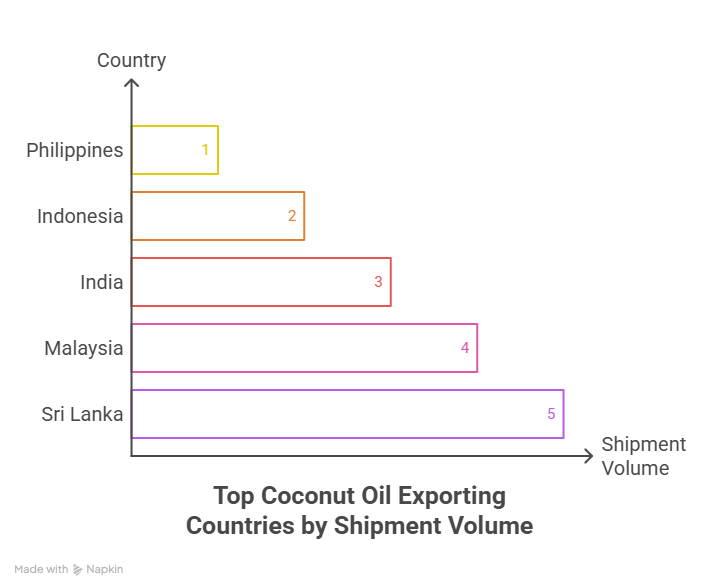
The global bulk market is led by Southeast Asia. The Philippines, Indonesia, and India are the heavyweight coconut oil exporting countries by shipment volume, with India ranking near the very top on consignment count. Malaysia and Sri Lanka follow, with Sri Lanka especially strong in premium virgin coconut oil.
| Rank | Country | Position in Global Trade |
| 1 | Philippines | Largest bulk volume exporter |
| 2 | Indonesia | High-value refined and crude supply |
| 3 | India | Top shipment count, growing premium segment |
| 4 | Malaysia | Significant refined oil exporter |
| 5 | Sri Lanka | Niche leader in virgin coconut oil |
Papua New Guinea is an emerging name worth watching too. But here’s where India has an edge: brand trust, English-language documentation, and a deep base of organic-certified producers. For buyers who want reliability over rock-bottom price, India is an easy choice.
How do you turn that national advantage into a personal one? Lean into the things Southeast Asian bulk suppliers can’t easily match — traceable sourcing, responsive communication, and flexible pack sizes for private-label clients. Among the major coconut oil exporting countries, India’s biggest selling point is partnership reliability, not just price. Sell that.
Coconut Oil Importing Countries: Where Your Buyers Are
Knowing the coconut oil importing countries is half the battle. You can have the best oil in Kerala, but if you’re pitching the wrong market, you’ll struggle.
The biggest buyers pulling supply from India include the United Arab Emirates, the United States, Qatar, Singapore, Saudi Arabia, and increasingly Vietnam and Russia. Globally, the USA, China, Germany, and the Netherlands rank among the largest overall importers.
A quick read on the major markets:
- United States: Huge demand for virgin and organic oil. The US lane is one of the most profitable, especially for retail-ready, certified product. Virgin coconut oil export from India to American wellness brands is among the fastest-growing premium segments.
- UAE & Gulf: Volume buyers, strong re-export hub, familiar with Indian brands.
- Europe (Germany, Netherlands): Quality-focused, certification-driven, premium pricing.
- Southeast Asia: Price-sensitive but high volume.
Why does this matter? Because your product grade should match your destination. Send commodity crude to price-driven markets and premium virgin coconut oil to the USA and Europe. Match the oil to the buyer, and your conversion rate climbs.
Don’t ignore the second-tier coconut oil importing countries either. Markets like Bangladesh, Poland, and South Korea quietly import meaningful volumes and often face less competition than the obvious giants. A mid-size exporter sometimes finds an easier first win in a smaller market than in the crowded US aisle. Read the data, spot the gap, move early.
Coconut Oil Export from India to the USA
The USA deserves its own section. Of all the coconut oil importing countries, it’s where premium Indian oil performs best. American consumers buy coconut oil for keto cooking, natural beauty, and wellness — categories that reward quality and storytelling.
For coconut oil export from India to the USA, three things matter most: organic and food-grade certification, clean labelling, and consistent supply. US importers and private-label brands don’t want a one-time lot. They want a partner who ships the same spec every quarter.
If you’re targeting this lane, get your FSSAI, organic, and any USDA-relevant documentation in order before you pitch. Buyers checking shipment records will look for exporters with a track record into North America. Build that record, and the route becomes a repeatable revenue stream rather than a lucky sale.
There’s also the freight and shelf-life angle. Coconut oil solidifies below roughly 24°C, so packaging and container conditions matter on long transits. American buyers will ask. Have a confident answer ready about how you protect product integrity from Cochin port to a Los Angeles warehouse, and you’ll stand out from exporters who haven’t thought it through.
List of Major Coconut Oil Exporters in India
Buyers often start by scanning a list of established suppliers to understand the landscape. Some well-known names in the trade include:
| Exporter | Known For | Base State |
| Marico Ltd. | Branded coconut oil (Parachute), high global volume | Maharashtra |
| KLF Nirmal Industries | Pure coconut oil under KLF Nirmal brand | Kerala |
| CavinKare Pvt. Ltd. | Branded pure coconut oil (Meera) | Tamil Nadu |
| Bajaj Consumer Care | Branded hair and edible coconut oil | Maharashtra |
| Keratech Coconut Oil | Virgin coconut oil specialist | Kerala |
| Green Valley Oils | Pure and virgin coconut oil supplier | Kerala |
This list isn’t exhaustive — hundreds of MSME coconut oil exporters operate across the southern belt, many supplying private-label and organic lots. The big brands grab headlines, but small and mid-size firms win plenty of overseas contracts when they show up with verified data and clean documentation.
That’s the real lesson here. You don’t need to be Marico to export. You need to be findable, credible, and consistent. Plenty of the most reliable coconut oil exporters you’ve never heard of are quietly shipping containers every month to loyal buyers they met through a single well-targeted lead.
How to Find Coconut Oil Buyers and Export Leads
Now the part everyone actually came for — finding coconut oil buyers and generating real coconut oil export leads. Most exporters get this wrong. They wait for buyers to find them. The exporters who grow do the opposite: they go where the buyers already are.
There are three practical routes to verified coconut oil buyers:
1. Trade data platforms. Analyse shipment records to identify which overseas firms import your HS code, how often, and in what volume. This is the single sharpest way to build a targeted prospect list instead of cold outreach.
2. B2B marketplaces. Platforms like VyaaparOne connect Indian exporters directly with international importers actively searching for products. Listing your oil with the right HS code and specs puts you in front of buyer intent, not just traffic.
3. Exhibitions and export promotion bodies. APEDA, coconut development boards, and trade fairs still generate quality leads, especially for organic and virgin grades.
Here’s a quick comparison of how these channels stack up for lead generation:
| Channel | Lead Quality | Speed | Best For |
| Trade export data | High (verified buyers) | Fast | Targeted outreach |
| B2B marketplace (VyaaparOne) | High (active intent) | Fast | Ongoing inbound leads |
| Exhibitions | Medium-High | Slow | Relationship building |
| Cold email | Low | Slow | Volume, low conversion |
The smartest approach? Combine them. Use a coconut oil export data lead intelligence layer to know who to target, then capture inbound interest through a marketplace listing. One feeds the other. The data tells you who’s buying; the marketplace brings some of them straight to your inbox.
Why Use VyaaparOne for Your Coconut Oil Export
A quick, honest word on platform choice. VyaaparOne is a B2B trade marketplace built to connect Indian exporters with genuine global buyers. For your coconut oil export specifically, that means you can list your product, specify your HS code, showcase certifications, and surface in front of importers who are actively sourcing.
What you get:
- Direct visibility to verified coconut oil buyers across multiple countries.
- A clean profile to display certifications, grades, and capacity.
- Inbound coconut oil export leads rather than constant cold outreach.
- A trade-data-backed view of demand so you pitch the right markets.
The goal is simple — fewer wasted hours, more qualified conversations. When buyers and sellers meet on a structured platform, deals close faster. And because every serious enquiry already knows what they want, you spend less time educating and more time quoting. For anyone scaling coconut oil export from India, that efficiency compounds month after month.
Tips to Grow Your Coconut Oil Export Business
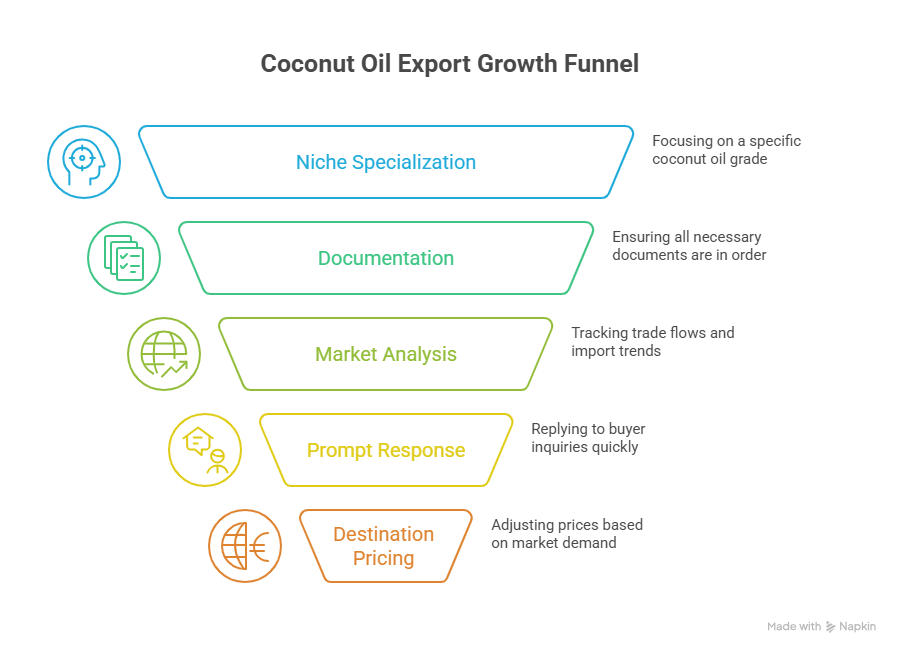
A few things separate exporters who scale from those who stall:
- Pick a grade and own it. Don’t try to be everything. Become the reliable virgin coconut oil supplier, or the bulk crude specialist.
- Document everything. Certifications, lab reports, and shipment history build the trust buyers pay for.
- Read the data monthly. Trade flows shift. Track which coconut oil importing countries are rising and adjust.
- Respond fast. Buyers contacting you about coconut oil export leads expect a same-day reply. Speed wins deals.
- Price by destination. Premium markets like the USA tolerate higher pricing; volume markets don’t.
None of this is complicated. It’s discipline. The exporters who treat the business as data-driven — not a hopeful guess — are the ones still standing in five years.
One more underrated move: build a simple one-page capability profile you can send within minutes of a buyer enquiry. Specs, certifications, capacity, pack sizes, lead times, and a clean photo. When a coconut oil export data lead turns into a live conversation, the exporter who replies first with a polished profile usually wins the order. Preparation beats hustle.
Final Thoughts
The numbers are clear and the demand is real. Coconut oil export from India keeps growing because the world wants natural, high-quality oil — and India delivers it. The exporters who win aren’t always the biggest; they’re the ones who use trade data, classify under the correct coconut oil HS code, target the right coconut oil importing countries, and convert verified coconut oil export leads into long-term buyers.
Whether you’re chasing the lucrative US lane or building steady Gulf relationships, the playbook is the same: get found, stay credible, ship consistently. List your product on VyaaparOne, connect with genuine coconut oil buyers, and turn India’s coconut oil advantage into your growth story.
Frequently Asked Questions
Is coconut oil exported from India?
Yes. Coconut oil export from India is substantial, with thousands of shipments leaving the country annually to destinations across the Middle East, North America, Europe, and Asia. India ranks among the top coconut oil exporting countries by shipment volume.
What is the coconut oil HS code?
The main coconut oil HS code is 1513, with 1513.11.00 covering crude coconut oil and 1513.19.00 covering refined coconut oil and fractions not chemically modified. Always confirm the eight-digit subheading with your customs broker.
Which countries import coconut oil from India?
Major coconut oil importing countries sourcing from India include the United Arab Emirates, the United States, Qatar, Singapore, Saudi Arabia, Vietnam, and Russia. Globally, the USA, China, and Germany are among the largest importers.
How do I find verified coconut oil buyers?
The fastest way is to combine coconut oil export data analysis with a B2B marketplace like VyaaparOne. Trade data shows you who imports your HS code, while the marketplace generates inbound coconut oil export leads from active buyers.
Is the coconut oil export business profitable in India?
Generally yes. Strong global demand, premium pricing for virgin and organic grades, and growing markets like the USA make it a profitable venture for exporters who maintain quality and consistency.
Which is the biggest coconut oil exporting country?
The Philippines, Indonesia, and India lead the global market. India ranks near the top by shipment count and is rapidly expanding its premium virgin coconut oil segment.
Can small exporters succeed in coconut oil export?
Absolutely. Many MSME coconut oil exporters win steady contracts by specialising in a grade, holding the right certifications, and using verified coconut oil export leads to reach buyers directly rather than competing on bulk price alone.