
India sits at the centre of the global jeera trade, and if you’re planning a cumin seed export business this year, the numbers are hard to ignore. India controls roughly 70% of the world’s cumin supply. That’s not a niche position — that’s dominance. Whether you’re a first-time trader in Unjha or an established exporter shipping to the Gulf, understanding how cumin seed export from India actually works is the difference between a profitable season and a stalled container at the port.
Here’s the thing. The cumin market moved a lot between 2023 and 2026. Prices swung. New buyers came online in East Asia. And the paperwork? Still catches people off guard. This guide walks through everything — verified exporters, live cumin seed export data, the top import destinations, HS codes, pricing, and how platforms like VyaaparOne help you find genuine buyers instead of chasing dead leads.
The best part about cumin seed export as a business is the repeatability. Once you’ve cracked one market, the same playbook works across the next. And with India’s supply base so deep, you’re never short of product to move. What you do need is a clear map of the trade — and that’s exactly what this guide gives you.
Let’s get into it.
Why Cumin Seed Export from India Matters in 2026
Cumin belongs to the parsley family, and while it originally came from western Asia, India turned it into a cornerstone of both its kitchens and its export economy. India and Iran are the two prime producers globally. But India pulls ahead on volume, quality consistency, and — crucially for buyers — traceable supply data.
Production in India now sits between 500,000 and 550,000 metric tons annually, up sharply from the 325,000–350,000 tons recorded a few years back. Rajasthan and Gujarat together grow about 90% of the country’s cumin. India consumes most of what it produces, but the exported share keeps climbing in dollar terms. Cumin exports from India were worth around $497 million in 2022 and crossed $784 million by 2024.
That growth is why cumin seed export from India has become one of the most searched-for agri-trade topics on B2B platforms. Demand is real, margins are workable, and the buyer pool is expanding beyond the traditional US and Bangladesh routes into China, the UAE, and Saudi Arabia.
Worth noting: this isn’t a “get rich quick” commodity. It rewards traders who do their homework on quality grades, moisture content, and buyer verification. Skip those, and you’ll learn expensive lessons fast.
There’s also a structural reason cumin seed export from India keeps growing. As global cuisine diversifies, cumin appears in more processed foods, spice blends, and ready-to-cook products worldwide. That downstream demand feeds straight back to Indian suppliers. In my experience watching this trade, the exporters who treat cumin seed export as a long-term relationship business — not a spot-market gamble — are the ones who compound their gains year after year.
Cumin Production in India: The Foundation
Before you can build a cumin seed export operation, you need to understand where the supply comes from and how reliable it is.
Global cumin production runs around 1 to 1.2 million metric tons per year. India accounts for the lion’s share of that. A few grounding facts:
- Rajasthan and Gujarat contribute close to 90% of India’s total domestic cumin output.
- Organic cumin — grown without chemical fertilisers or pesticides — is in strong demand across Western markets and commands premium pricing.
- Beyond cumin, India is also the largest producer, consumer, and exporter of chilli, coriander, and turmeric, which means spice-focused buyers often source multiple products from the same suppliers.
- Unjha in Gujarat is the largest cumin market in Asia and functions as the price-discovery hub for the entire trade.
If you’re sourcing for cumin seed export from India, Unjha is where most serious deals begin. The mandi sets the tone. Track its rates, and you’ll understand where your landed cost will sit before you even quote a buyer.
Quality grading also starts at the source. Buyers overseas classify Indian cumin by machine-cleaned purity — commonly 99% and 99.5% grades — plus singapore quality and Europe quality specifications. Knowing these grades cold is non-negotiable for cumin seed export, because a US buyer and a Bangladeshi buyer often want completely different specifications at completely different price points. Match the grade to the market, and your cumin seed export margins hold. Mismatch it, and you’ll face rejections at the destination port.
Cumin Seed Export Data from India: 2024–25 Snapshot
Numbers tell the real story. Here’s the most recent cumin seed export data picture for the 2024–25 period.
| Metric | Data (2024–25) |
| Export Volume | ~2.12 – 2.29 lakh metric tons |
| Export Value | ~$700 – $732 million |
| YoY Growth (Volume) | ~39% increase |
| Major Export Destinations | China, Bangladesh, UAE, USA, Saudi Arabia |
| India’s Global Share | ~70% of global cumin exports |
A near-40% jump in volume year over year is enormous for an agricultural commodity. It reflects a record crop in Gujarat and Rajasthan combined with aggressive buying from China. This is exactly the kind of shift live cumin seed export data helps you catch early — before your competitors do.
For the prior 2023–24 cycle, India exported roughly 1.84 lakh metric tons of cumin. Exports have grown at a compound annual growth rate of about 14% over the last seven years. China, the USA, Vietnam, the UAE, and Bangladesh together account for more than 60% of total shipments. The top three destinations by shipment count were the United States (808 shipments), Bangladesh (1,175 shipments), and Nepal (494 shipments).
The HSN codes you’ll be working with for cumin seed export from India are 09093129, 09093190, and 09093200. Get these right on your documentation. A wrong HS code triggers customs delays and, sometimes, penalties.
Reading cumin seed export data properly is a skill in itself. Don’t just look at total volume — look at the direction of travel. Is a particular destination’s shipment count rising month over month? Is the average unit value climbing or falling? These micro-signals inside the cumin seed export data tell you where to push and where to pull back. A trader who reads the data well can front-run a demand surge by weeks. That lead time is worth real money in a commodity this volatile.
Top Cumin Seed Exporters in India
Buyers constantly ask the same question: who are the reliable cumin seed exporters in India? Reputation matters here because cumin quality varies wildly between suppliers.
Here’s a working list of established cumin seed exporters in India to know:
- Royal Spices
- Yuvaraju Agro Impex
- Viral Spices
- Badani Corporation
- Dhaval Agri Exports LLP
- ECO Exports
- Surendraray & Co
- Dharsini Exports
- Wings Food and Chemicals Private Limited
- Shri Shyam Index
These names ship consistently and hold the certifications international buyers expect. That said, this list is far from exhaustive. Hundreds of registered cumin seed exporters in India operate out of Gujarat and Rajasthan alone. The challenge isn’t finding exporters — it’s verifying which ones actually deliver on quality and timelines.
That’s where trade intelligence platforms earn their keep. Instead of cold-emailing names off a directory, you can pull shipment history, buyer relationships, and volume data to see who’s genuinely active. A supplier with 200 verified shipments in the last year is a very different bet from one with a slick website and no trail.
Cumin Export from India by Country: Where the Demand Is
Not every market wants the same grade, and not every route offers the same margin. Mapping cumin export from India by country is essential before you commit inventory.
The current demand map for cumin seed export from India looks roughly like this:
- China — Now a dominant buyer, driving much of the recent volume surge. Price-sensitive but massive volume.
- Bangladesh — A steady, high-frequency market. Close proximity keeps logistics cheap.
- United States — Premium buyers who prioritise cleanliness, low moisture, and consistent grading. Better margins, stricter compliance.
- UAE — A re-export hub as much as a consumer market. Dubai buyers often redistribute across the Middle East and Africa.
- Saudi Arabia — Strong cultural demand for cumin in regional cuisine; reliable repeat orders.
- Vietnam and Nepal — Growing secondary markets with rising shipment counts.
For anyone building a cumin seed export pipeline, the smart move is to diversify across two or three of these markets rather than depending on one. When Chinese demand cools, Gulf and US orders keep your cash flow steady. That balance is what separates traders who survive a price crash from those who don’t.
Cumin Export Price from India: What Drives It
Pricing is the part of cumin seed export from India that keeps traders up at night. And for good reason — cumin is one of the more volatile agri-commodities out there.
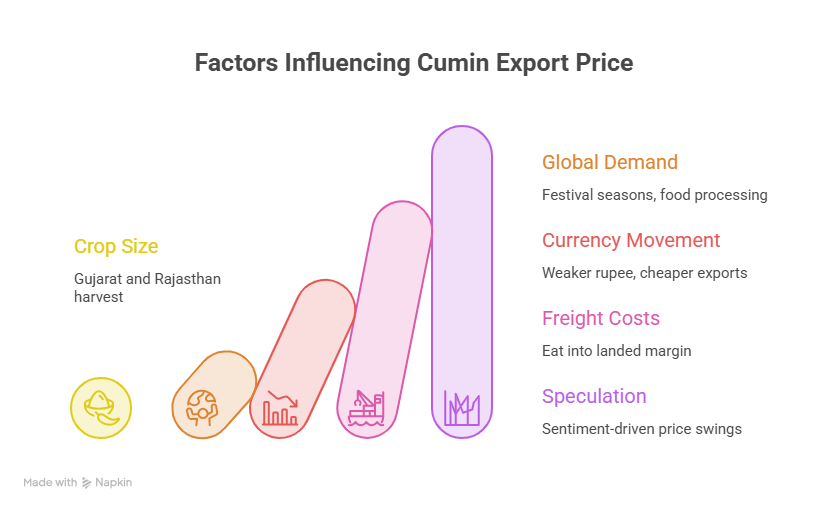
The cumin export price from India is shaped by a handful of forces:
- Crop size in Gujarat and Rajasthan — a bumper harvest floods the market and drops prices; a weak monsoon does the opposite.
- Global demand cycles — festival seasons and food-processing demand in importing countries lift prices predictably.
- Currency movement — a weaker rupee makes Indian cumin cheaper for foreign buyers, boosting export competitiveness.
- Freight and fuel costs — these quietly eat into your landed margin, especially on longer routes.
- Speculation in cumin futures — sentiment-driven swings can move the spot price by hundreds of rupees per quintal in days.
Here’s the honest truth most guides won’t tell you: you cannot reliably predict the cumin price, but you can position yourself to react faster than the next trader. That’s the entire argument for tracking live cumin seed export data rather than relying on last month’s mandi gossip. Speed of information is your edge in cumin seed export — full stop.
Jeera Export from India: Trends Shaping 2026
Let’s talk trends, because jeera export from India doesn’t move in a straight line. It reacts to weather, sowing decisions, and global sentiment — sometimes violently.
Recent cycles saw favourable weather and expanded sowing areas produce record crops in Gujarat and Rajasthan. Gujarat alone hit an estimated 4.08 lakh metric tons in a peak season. Rajasthan saw jeera production climb by as much as 53% year over year at one point. That oversupply pushed prices down and reshaped the export landscape.
But here’s the twist. Despite record production, there was a period where jeera export from India actually declined — by around 23.75% during one April–February stretch versus the prior year. Why? Buyers held back expecting lower prices, and open interest in cumin futures dropped. The market is jittery like that.
What does this mean for you in 2026? Watch three signals:
- Sowing acreage reports from Gujarat and Rajasthan — they predict next season’s supply.
- Futures price movement — sharp swings in open interest signal buyer sentiment shifts.
- Live shipment data — the earliest indicator of where real demand is landing.
Traders who monitor jeera export from India through live data rather than gut feel consistently time their shipments better. This is the single biggest edge available to a modern exporter, and most people still ignore it.
One more trend reshaping jeera export from India in 2026: organic and residue-free cumin. European and North American buyers increasingly demand certified organic product, and they pay a meaningful premium for it. If you can source certified organic cumin from Rajasthan or Gujarat, you unlock a higher-margin lane that most volume-focused exporters can’t touch. It’s a smaller market, sure — but the buyers are stickier and the competition thinner. That’s often a better place to build a durable cumin seed export business than fighting on price in the bulk commodity lane.
Top Spices Exported from India (Cumin in Context)
Cumin doesn’t trade in a vacuum. Buyers sourcing jeera often want other spices too, so it helps to see where cumin seed export from India sits among the broader basket.
| Sr. No. | Top Spices Exported from India | Export Value (2024–25) |
| 1 | Dry Ginger | ~$1.30 – $1.45 billion |
| 2 | Red Chilli | ~$1.20 – $1.30 billion |
| 3 | Black Pepper | ~$1.10 – $1.20 billion |
| 4 | Cumin (Jeera) | ~$700 – $780 million |
| 5 | Fennel | ~$500 – $550 million |
| 6 | Turmeric | ~$500 – $550 million |
| 7 | Cardamom | ~$230 – $260 million |
| 8 | Fenugreek | ~$170 – $190 million |
| 9 | Coriander | ~$85 – $95 million |
| 10 | Mustard | ~$60 – $70 million |
Cumin ranks in the top four by value — a serious position. And because it pairs naturally with coriander, turmeric, and fenugreek in most cuisines, cross-selling is easy. A buyer who trusts your cumin will often ask what else you can supply. Build that relationship, and one product becomes a full basket.
How to Start a Cumin Seed Export Business: Step by Step
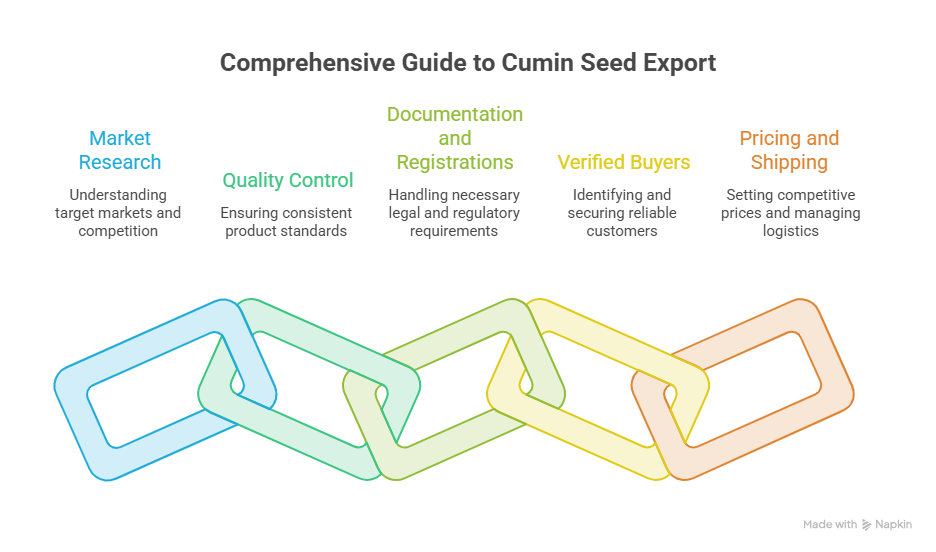
Alright, the practical part. If you’re serious about cumin seed export from India, here’s the sequence that actually works — no fluff.
1. Do Real Market Research
Study your target market before anything else. Which grade do buyers in that country want? What’s the going price? Who are you competing against? Skipping this step is the number one reason new exporters fail. Solid market research also helps you fix a realistic cumin export price from India instead of guessing.
2. Nail Quality Control
International buyers don’t tolerate inconsistency. Moisture content, admixture, colour, and aroma all get tested on arrival. Indian cumin already enjoys a strong reputation for quality — don’t be the supplier who ruins it. Invest in cleaning, grading, and lab testing before your first shipment goes out.
3. Get Your Documentation and Registrations Right
You’ll need an IEC (Import Export Code), FSSAI registration, a phytosanitary certificate, and often a certificate of origin. Match your HS codes precisely — 09093129, 09093190, or 09093200 depending on the product form. Understand the tariffs and food-safety rules of your destination country too. Regulatory surprises kill deals. Many first-timers underestimate this stage, and it’s exactly where a cumin seed export shipment can get stuck for weeks. Build a compliance checklist and stick to it religiously.
4. Find Verified Buyers (Not Just Any Buyers)
This is where most of the risk lives. A single unpaid invoice from an unverified buyer can wipe out a season’s profit. Use trade data to confirm a buyer actually imports cumin, at what volume, and how frequently. Platforms built for cumin seed Import leads let you filter genuine, active buyers instead of gambling on cold outreach.
5. Price Smart and Ship Clean
Factor in mandi cost, cleaning, packaging, freight, insurance, and your margin. Quote clearly. Ship with full documentation and clean, well-graded product. Your first clean shipment is what turns a one-off buyer into a repeat client.
That’s the whole loop. Research, quality, compliance, verified buyers, clean execution. Do it well and cumin seed export from India becomes a repeatable, scalable business.
Packaging, Logistics, and Getting Product to Port
The unglamorous side of the trade is where a lot of profit quietly leaks away. Packaging and logistics decide whether your margin survives the journey.
Cumin is typically shipped in new PP or jute bags of 25 kg or 50 kg, or in bulk for large industrial buyers. For premium and organic consignments, food-grade lined bags protect against moisture and contamination during long ocean transit. Get this wrong and you’ll face quality claims on arrival — the fastest way to lose a repeat buyer.
Route planning matters just as much. Shipments to Bangladesh often move by road or short-sea routes and clear quickly. Consignments to China, the US, or Europe travel by container ship, which means longer lead times and stricter fumigation and phytosanitary requirements. Factor these timelines into every quote. A buyer who’s promised delivery in four weeks won’t be forgiving if your container is sitting at a transhipment hub.
Insurance is the final piece. Marine cargo insurance protects you against loss or damage in transit, and for a high-value spice consignment, it’s not optional — it’s basic risk management. Skimp here and one damaged container can erase a season’s profit.
Finding Cumin Seed Import Leads That Actually Convert
Let’s be honest — finding real buyers is the hardest part of any cumin seed export venture. Directories are full of stale contacts. Trade shows are expensive. Cold email conversion is brutal.
Verified cumin seed Import leads change the equation. Instead of hoping a random enquiry is legitimate, you work from data: who imported cumin last month, from which country, in what quantity, and how often. That context tells you whether a lead is worth pursuing before you spend a rupee chasing it.
Good cumin seed Import leads share a few traits:
- A verifiable shipment history for cumin or related spices.
- A consistent buying pattern rather than a one-time enquiry.
- Contact details tied to a real, registered company.
- A volume requirement that matches what you can reliably supply.
This is precisely the gap VyaaparOne fills. As a B2B trade intelligence platform covering 200+ countries and 50M+ shipment records, it surfaces verified buyers, live cumin seed export data, and genuine cumin seed Import leads — so you spend your time closing deals, not qualifying strangers.
How VyaaparOne Powers Your Cumin Seed Export Journey
Here’s where it comes together. Running a successful cumin seed export from India operation depends on three things: accurate data, verified buyers, and speed. VyaaparOne delivers all three.
With VyaaparOne you can:
- Access real-time cumin seed export data sourced from government-authorised customs records.
- Filter verified cumin seed exporters in India and cross-check their shipment history before partnering.
- Pull live cumin seed Import leads from buyers actively sourcing cumin across 200+ countries.
- Search by HS code (09093129, 09093190, 09093200) to drill straight into cumin-specific trade flows.
- Track cumin export from India by country to spot demand shifts before your competitors react.
The platform indexes 50M+ shipment records with 99% data accuracy and is trusted by over 10,000 active traders. For a commodity as data-sensitive as cumin — where a single price swing can reshape the market — that intelligence is a genuine competitive edge.
Think of it this way. Every successful cumin seed export deal rests on three questions: Is the buyer real? Is the price right? Is the timing good? VyaaparOne answers all three from a single dashboard. That’s why data-first traders keep pulling ahead in the cumin seed export race while directory-dependent competitors fall behind.
Comparison: Traditional Sourcing vs Data-Driven Cumin Seed Export
To make the value concrete, here’s how the old way of running a cumin seed export business stacks up against a data-driven approach.
| Factor | Traditional Sourcing | Data-Driven (VyaaparOne) |
| Finding buyers | Directories, cold email, trade fairs | Live verified import leads by product |
| Buyer verification | Manual, often skipped | Shipment history cross-checked |
| Market timing | Gut feel and rumour | Real-time cumin seed export data |
| Price benchmarking | Word of mouth at the mandi | Country-wise trade value analytics |
| Risk of bad debt | High — unverified buyers | Low — KYC-verified companies |
| Time to first deal | Weeks to months | Days |
| Scaling across markets | Slow and manual | Filter by country in minutes |
The contrast is stark. Traders still relying on directories and gut instinct are competing with one hand tied behind their back. In 2026, cumin seed export from India is won on data.
Final Word
The opportunity in cumin seed export from India is bigger in 2026 than it has ever been — India’s 70% global share, rising export values, and expanding buyer markets make that clear. But opportunity alone doesn’t build a business. What separates the traders who scale from the ones who stall is intelligence: knowing the data, verifying the buyers, and timing the market.
Get the fundamentals right — quality, compliance, and verified relationships — and lean on live trade data to guide every decision. That’s the modern playbook for cumin seed export success. The traders who internalise this now will own the next decade of the cumin seed export trade.
Ready to find verified buyers and real-time cumin seed export data? Explore premium jeera export solutions at VyaaparOne and turn trade intelligence into your competitive advantage.
Frequently Asked Questions
Which country is the largest exporter of cumin?
India is the largest exporter of cumin, covering roughly 70% of the world’s total cumin seed exports. Its scale, quality reputation, and traceable trade data make it the default source for global buyers.
Which is the largest cumin market in India?
Unjha in Gujarat is the largest cumin market in Asia. It acts as the primary price-discovery hub, so most serious cumin seed export from India deals begin by tracking Unjha mandi rates.
Who are the top cumin seed exporters in India?
Leading cumin seed exporters in India include Royal Spices, Yuvaraju Agro Impex, Viral Spices, Badani Corporation, and Dhaval Agri Exports LLP, among hundreds of registered suppliers across Gujarat and Rajasthan.
Which countries import cumin seeds from India?
The main importers are China, Bangladesh, the USA, the UAE, and Saudi Arabia, with Vietnam and Nepal emerging as growing secondary markets. Tracking cumin export from India by country helps you target the right demand.
What HS codes apply to cumin seed export from India?
The primary HSN codes are 09093129, 09093190, and 09093200. Using the correct code on your documentation is essential to avoid customs delays and penalties.
Where can I find verified cumin seed Import leads?
Platforms like VyaaparOne provide live, verified cumin seed Import leads backed by real shipment history, so you can connect with genuine buyers instead of chasing unverified enquiries and scale your cumin seed export operation with confidence.