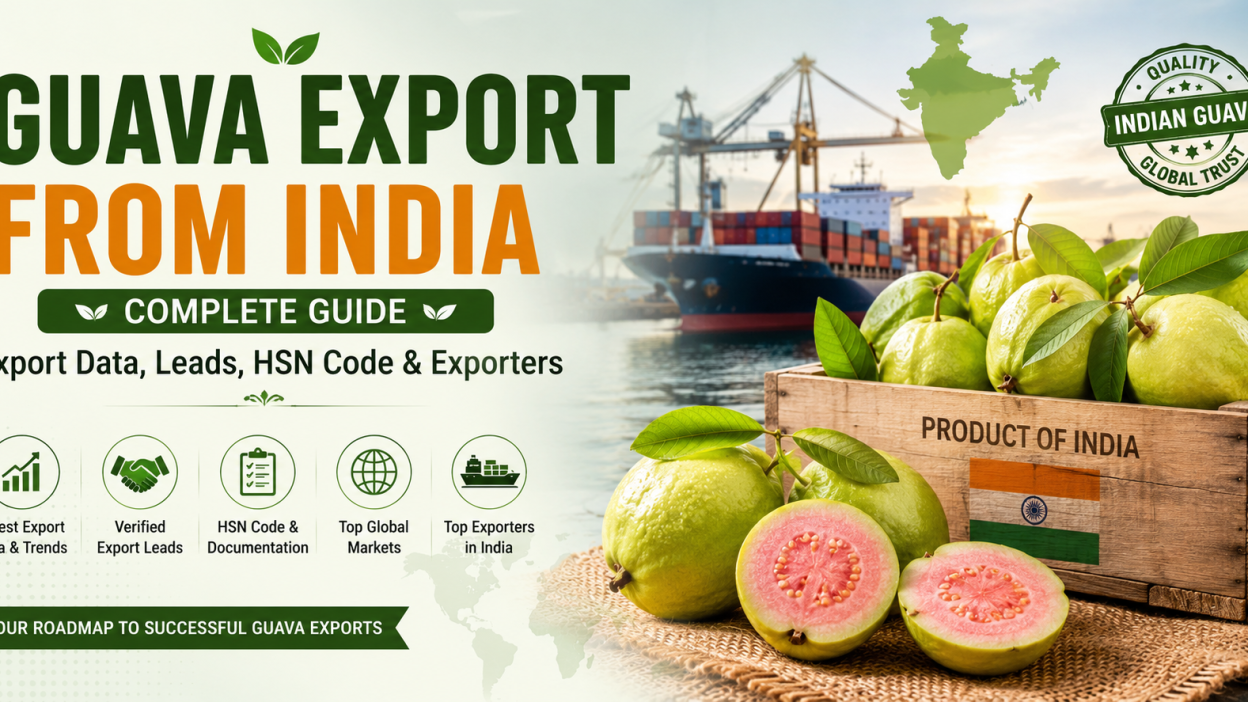
India grows more guava than any other country on earth — and that single fact quietly powers a growing export trade that most people never notice. If you are planning a guava export from India, the opportunity is real, but so is the competition. This guide walks you through the numbers, the paperwork, the buyers, and the market intelligence you need before your first container ever leaves the port.
Here’s the short version: India produced roughly 5.59 million metric tonnes of guava in 2023, holds over 45% of global output, and shipped 5,736.38 tonnes worth about INR 48.64 crore (around US$ 6 million) in FY 2024-25. The demand is sitting in the Gulf, the US, the UK, and Europe. Your job is to reach it. Let’s break down exactly how a smart guava export from India actually works, step by step.
Why Guava Export from India Is Worth Your Attention
Guava is not a niche curiosity. It’s a mainstream tropical fruit with a loyal following across the Middle East, North America, and Europe, eaten fresh, juiced, and processed into pulp, jam, and syrup. That versatility is precisely why the export line keeps expanding.
The global guava market was valued at around USD 15.65 billion in 2022 and is projected to grow at a 4.5% CAGR through 2027. The guava puree segment alone is set to climb from $443.4 million in 2024 to roughly $652 million by 2031, a 5.7% CAGR, driven by the worldwide appetite for natural, healthy foods. Processed guava products carry longer shelf life and travel better than fresh fruit — a detail that matters a lot when you’re shipping across oceans.
India sits at the centre of this. With more than 45% of global production, the country is the natural first stop for any buyer sourcing guava at scale. That’s leverage — if you know how to use it.
And here’s the thing most guides skip: the buyer doesn’t care that India is the biggest producer. They care whether you can deliver consistent quality on time at a workable price. Production dominance opens the door; execution keeps it open. Treat the market-size numbers as context, not a sales pitch.
Where India’s Guava Actually Comes From
Before you source a single crate, know your supply map. India’s guava production is concentrated in a handful of states, and understanding this geography helps you buy smart and ship faster.
Uttar Pradesh is the powerhouse, producing around 4.5 million tonnes of guava each year. West Bengal follows with over 3.8 million tonnes annually, and Andhra Pradesh contributes more than 2.5 million tonnes. Between them, these three states anchor the bulk of India’s exportable surplus.
Why does location matter for an exporter? Two reasons. First, sourcing close to a major port cuts inland transit time — critical for fresh fruit. Second, established growing clusters usually come with better packing infrastructure and more experienced farmer networks, which means fewer quality surprises. If you’re aggregating fruit for export, proximity to both the orchard and the port is worth paying for — a small logistics edge that quietly improves the economics of guava export from India.
Variety selection is the other early decision. Indian guava isn’t one product — it’s a family. L-49 (Lucknow-49) is prized for its size and yield. Allahabad Safeda is a classic white-fleshed favourite. Banarasi, Chittidar, Harijha, Red Fleshed, and Arka Mridula each bring different traits in sweetness, colour, and firmness. Buyers in different markets have different preferences, so matching variety to destination is a quiet but real competitive edge.
Guava Export Data from India: The Latest Numbers
Numbers close deals. Before you pitch a single buyer, you should know what recent guava export data actually says.
In FY 2024-25, India exported guava worth INR 48.64 crore, approximately US$ 5.8–6 million, on a volume of 5,736.38 tonnes. That figure came in lower than 2023-24, largely because of price shifts and reporting differences rather than a collapse in demand. Between June 2024 and May 2025 (trailing twelve months), India recorded around 345 guava shipments spread across roughly 65 buyers and 38 exporters — a +17% shipment growth on a TTM basis.
Compare that with the prior cycle. In 2023, India exported an estimated $154 million worth of fresh and dried guavas, and between March 2023 and February 2024, the country logged 1,122 shipments made to 190 buyers by 80 Indian exporters — a 52% jump over the previous twelve months. In February 2024 alone, 37 guava shipments went out, up 49% year-on-year.
| Key Component | Guava Export Data (FY 2024-25) |
| Export value | INR 48.64 crore (US$ 5.8–6 million) |
| Export volume | 5,736.38 tonnes |
| Total shipments (Jun 2024 – May 2025, TTM) | 345 |
| Number of buyers | 65 |
| Number of exporters | 38 |
| YoY shipment trend | +17% growth (TTM) |
| Top destinations | UAE, USA, UK, Saudi Arabia, Netherlands, Qatar |
Why does the swing between years matter? Because it tells you the market is demand-steady but price-sensitive. Buyers keep ordering; margins move. That’s the environment you’re stepping into, and reliable guava export data from India is what keeps you from guessing.
Guava HSN Code: Classify Correctly or Pay for It
Get your classification wrong and you’ll face delays, wrong duty calculations, and rejected paperwork. The guava HSN code you’ll actually use depends on the form of the product.
| Guava HSN Code | Description |
| 0804 | Fresh or dried dates, figs, guavas, mangoes, and mangosteens |
| 080410 | Mangoes, mangosteens, guavas, figs, and fresh dates (excluding damp dates) |
| 080450 | Guavas, mangoes, and mangosteens, fresh or dried |
| 20079920 | Guava products (jams, purees, preparations) |
For fresh whole fruit, 080450 is the code you’ll lean on most. For processed guava — pulp, jam, puree — 20079920 applies. Confirm the exact heading against your buyer’s import requirements, because the destination country’s customs may want a specific sub-classification. When in doubt, run the code through a proper HS code lookup tool before you file anything.
One practical tip from the field: buyers in the Gulf and the US often ask for the HS code up front in their RFQs. Having it ready signals you know your product and speeds up the whole negotiation.
Guava Exporting Countries: Where India Stands Globally
You’re not the only origin competing for these buyers. The leading guava exporting countries worldwide are Mexico, Thailand, the Netherlands, Peru, and India. Mexico dominates supply into North America thanks to proximity; the Netherlands plays a re-export and distribution role into wider Europe.
So where does India win? Volume, variety, and price. India’s production dwarfs most rivals, and its climate supports year-round cultivation across multiple regions. Popular Indian varieties — L-49 (Lucknow-49), Allahabad Safeda, Banarasi, Chittidar, Harijha, Red Fleshed, and Arka Mridula — give exporters options to match different buyer preferences on sweetness, colour, and firmness.
The catch? Logistics. Mexico ships to the US in days; India has to move fruit farther, which puts a premium on cold-chain quality. This is exactly why processed guava (with its longer shelf life) is often the smarter entry point for first-time exporters targeting distant markets.
| Guava Exporting Countries | Competitive Edge |
| Mexico | Proximity to the US, high fresh-fruit volume |
| Thailand | Strong Asian and regional supply |
| Netherlands | European re-export and distribution hub |
| Peru | Growing counter-seasonal supply |
| India | Largest global production, variety range, price advantage |
India’s Guava Export Destinations
According to recent guava export data from India, the country’s top guava export destinations are the United Arab Emirates, the United States, the United Kingdom, Saudi Arabia, and the Netherlands. The Gulf and the US together absorb the lion’s share.
| Top Guava Export Destination | Approx. Export Value (2024–25) |
| United Arab Emirates | ~US$ 29,500K |
| United States | ~US$ 27,110K |
| United Kingdom | ~US$ 19,000K (est. trend) |
| Saudi Arabia | ~US$ 16,500K (est. trend) |
| Netherlands | ~US$ 8,500K (est. trend) |
Notice a pattern? The UAE and Saudi Arabia keep showing up. Large expatriate Indian populations across the Gulf sustain steady, repeat demand for familiar tropical fruit — which makes these markets an ideal starting point. The US and UK, meanwhile, reward exporters who can meet strict phytosanitary and quality standards with premium pricing.
For a fuller picture of buyer activity in any of these markets, country-wise trade data lets you see which importers are actively sourcing and how volumes are trending month to month.
What’s Driving Guava Export from India
The trajectory of India’s guava exports — from roughly $0.58 million to $2.09 million across earlier reporting windows and onward — didn’t happen by accident. A few forces are behind it:
- Production dominance. India’s tropical and subtropical climate makes it the world’s primary guava grower, so raw supply is never the bottleneck.
- Better cold chains. Modern packing facilities and improved cold-chain logistics now preserve fruit quality through longer transit, opening up distant markets that were once impractical.
- Quality that meets standards. Advanced farming, pest management, and quality control help Indian guava clear international phytosanitary requirements.
- Trade agreements. Bilateral and multilateral deals reduce tariffs and ease restrictions, widening the door for Indian exporters.
Honestly, most new exporters underestimate the cold-chain point. A gorgeous batch of fruit that arrives soft or spotted is a batch you can’t sell twice. Infrastructure isn’t glamorous, but it’s where deals are won or lost.
Major Fresh Guava Exporters in India
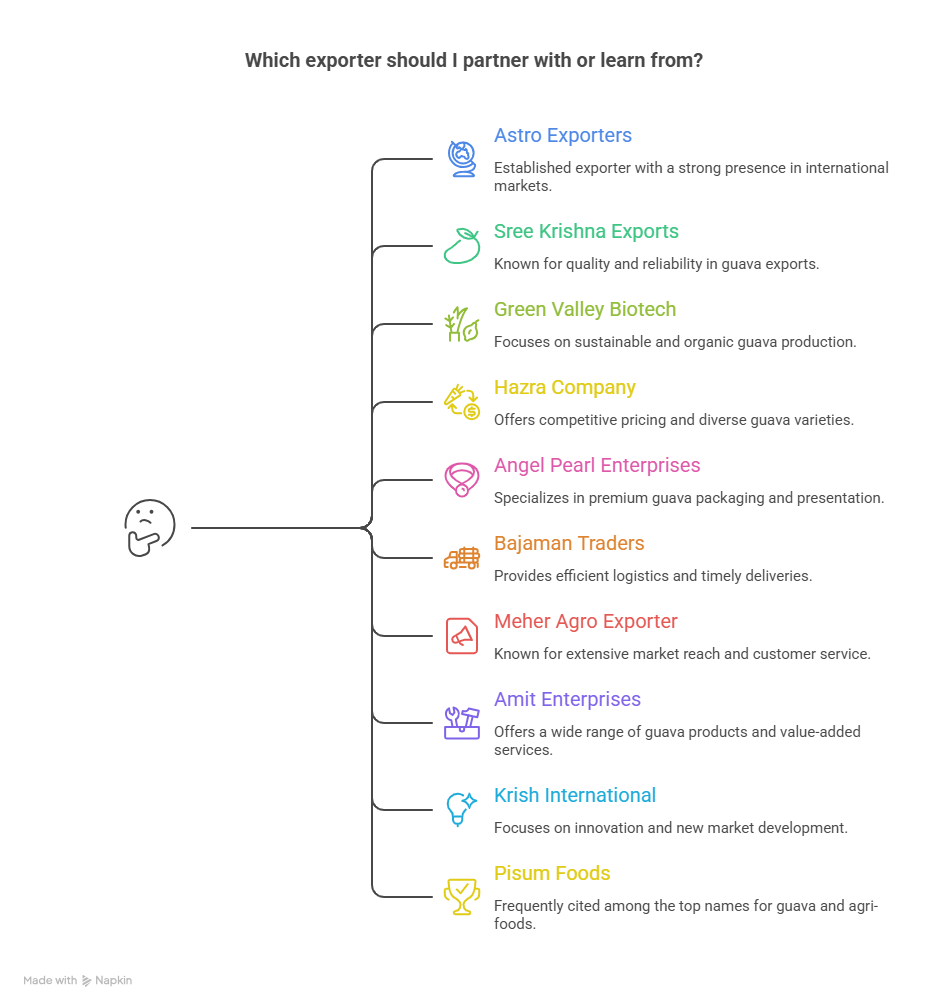
If you’re mapping the competitive landscape — or looking for partners — here are notable fresh guava exporters and established guava exporters in India:
- Astro Exporters
- Sree Krishna Exports
- Green Valley Biotech
- Hazra Company
- Angel Pearl Enterprises
- Bajaman Traders
- Meher Agro Exporter
- Amit Enterprises
- Krish International
- Pisum Foods
These guava exporters in India move meaningful volume into international markets, with Pisum Foods frequently cited among the top names for guava and other agri-foods. Studying how established fresh guava exporters structure their shipments — destinations, packaging, pricing — is one of the fastest ways to shortcut your own learning curve. That intelligence lives inside detailed guava export data, which shows you exactly who ships what, where, and at what value.
Step-by-Step: How to Start Guava Export from India
Ready to move from research to action? Here’s the practical sequence for guava export from India.
1. Set Up Your Export Business
Before anything ships, you need a legal export entity.
- Choose a structure: sole proprietorship, partnership, or private limited company, depending on your scale and risk appetite.
- Register with the ROC: formally register your firm with the Registrar of Companies.
- Get your IEC: obtain an Import Export Code from the Directorate General of Foreign Trade (DGFT). No IEC, no export. Full stop.
2. Decide What Form of Guava to Export
Fresh whole fruit, or processed pulp and puree? This choice shapes everything downstream — packaging, HSN code, shelf life, and which markets are realistic. Base the decision on real guava export data: values, volumes, and which product forms are actually moving to your target destinations.
3. Handle Compliance and Documentation
Register with APEDA (the Agricultural and Processed Food Products Export Development Authority) and secure any licences your destination requires. The core documents for guava export from India typically include:
- Commercial invoice
- Certificate of origin
- Phytosanitary certificate
- Packing list and bill of lading
Each destination has its own rulebook. The US and EU are stricter than most Gulf markets on residue limits and phytosanitary checks, so confirm requirements before you ship, not after.
A word on timing, because it trips people up. APEDA registration and IEC issuance aren’t instant — build in a few weeks of lead time before you promise a buyer any dispatch date. Phytosanitary certificates are issued close to shipment, so coordinate inspection scheduling with your logistics partner early. And keep digital copies of every document; buyers and customs officials will ask for them again, often at the least convenient moment. Getting the paperwork rhythm right the first time saves you from the scramble that sinks so many debut shipments.
4. Find Reliable Buyers and Verify Them
This is where most first-timers stall. Cold emails to random importers rarely convert. What works is targeting buyers who are already importing guava — and you find them through guava export leads built on real shipment records. Verified leads tell you who’s buying, how often, and in what volume, so you spend your energy on live prospects instead of hoping.
Turning Guava Export Data into Guava Export Leads
Here’s the part that separates browsers from exporters who actually close: data is only useful when it becomes a lead.
Raw guava export data shows you the shape of the market — values, volumes, destinations. But guava export leads put a name and a shipment history next to that data, so you know who to call. When you can see that a UAE importer has been buying Indian guava every quarter for two years, that’s not a cold prospect. That’s a warm conversation waiting to happen.
Good guava export data leads typically give you:
- Verified buyer and importer contact details
- Shipment frequency and volume history
- HS code-level product breakdowns
- Country-wise demand patterns
Why does this matter so much? Because your buyer is comparing you against several other suppliers at the same time. The exporter who shows up already understanding the buyer’s volume needs and pricing history looks credible from the first message. The one guessing looks like everyone else.
Platforms like VyaaparOne turn 50M+ verified shipment records into exactly this kind of actionable intelligence — letting you filter guava export data leads by product, HS code, and destination country, then connect with verified buyers across 200+ markets. That’s the difference between exporting on hope and exporting on evidence.
Picture a simple example. Say you pull recent guava export data and spot a Dubai importer that has taken three shipments of Indian guava in the last six months, each around the same volume, each under HS code 080450. That’s a buyer with a proven pattern — a repeat purchaser, not a maybe. Now compare that to blasting an introductory email to fifty unverified addresses scraped off a directory. Which approach do you think lands a reply?
This is why serious exporters treat data and outreach as one workflow, not two. You read the shipment record, you identify the pattern, you reach out with a message that already reflects the buyer’s real needs. The best guava export data from India doesn’t just describe the market — it hands you a shortlist. Used well, verified guava export leads compress months of guesswork into a focused list of live prospects, which is exactly what a small or first-time exporter needs to compete against bigger names.
Pricing, Packaging, and Getting Paid
Data finds the buyer. Execution wins the order. A few operational realities decide whether your first deal becomes a lasting relationship.
Pricing is the obvious battleground. Because the market is price-sensitive, you can’t simply match Mexico or Thailand on the fresh-fruit shelf in every geography. Where India competes best is on total value — variety range, volume reliability, and processed-product options that rivals can’t match at the same scale. Don’t lead with “cheapest.” Lead with “consistent supply you can plan around.”
Packaging is where quality reputations are made or broken. Fresh guava bruises easily, so ventilated corrugated cartons, proper cushioning, and controlled ripening make the difference between fruit that arrives sellable and fruit that arrives as compost. For processed guava, food-grade aseptic packaging and clear labelling that meets the destination’s food-safety rules are non-negotiable.
Payment terms deserve early attention too. New exporters often accept unfavourable terms just to land the deal, then regret it. Letters of credit and advance-payment arrangements protect you until trust is built. Verify the buyer first — and this loops back to why verified guava export leads matter. A buyer with a documented shipment history is far less likely to vanish after delivery than a name you found in a random listing.
Comparing Your Entry Options: Fresh vs Processed Guava
Not sure whether to start with fresh fruit or processed products? This comparison should help.
| Factor | Fresh Guava | Processed Guava (Pulp/Puree) |
| Shelf life | Short — days to weeks | Long — months |
| Cold-chain demand | High and unforgiving | Lower, more forgiving |
| Best-fit markets | Nearby Gulf markets | Distant US, EU, global |
| HSN code | 080450 | 20079920 |
| Entry difficulty | Higher for beginners | More beginner-friendly |
| Margin profile | Price-sensitive, volume play | Value-added, steadier |
For a first-time exporter shipping to distant markets, processed guava often lowers the risk. For established players with strong cold-chain partners, fresh fruit into the Gulf can move serious volume fast. Neither is “better” — it depends on your infrastructure and target buyers.
Final Word
The guava export industry in India rewards exporters who pair strong product with sharp market intelligence. The production base is unmatched, global demand is steady, and the Gulf and Western markets keep buying. What decides who succeeds isn’t just fruit quality — it’s whether you’re acting on real guava export data from India or shipping blind.
Get your IEC and APEDA registration sorted, nail your HSN classification, choose fresh or processed based on your infrastructure, and then let verified guava export leads point you toward buyers who are already in the market. That’s how a first shipment becomes a repeat customer.
Ready to find real buyers? Explore verified guava export data and trade leads on VyaaparOne and turn shipment records into your next export deal.
Frequently Asked Questions
Who is the largest producer of guava in India?
Uttar Pradesh leads Indian guava production at around 4.5 million tonnes per year, followed by West Bengal (over 3.8 million tonnes) and Andhra Pradesh (over 2.5 million tonnes).
Which country is famous for guava?
India. It holds more than 45% of global guava output and produced an estimated 5.59 million metric tonnes in 2023 across roughly 359,000 hectares of cultivation.
Which countries import guava the most?
The leading guava importing countries are the United States, the United Arab Emirates, Saudi Arabia, Kuwait, the Netherlands, and Jordan.
Which country exports the most guava?
Mexico, Thailand, the Netherlands, Peru, and India rank among the top guava exporting countries worldwide, with Mexico strong in fresh supply to North America and India leading on total production.
Which countries import guava from India?
India’s top guava export destinations are the United Arab Emirates, the United States, the United Kingdom, Saudi Arabia, and the Netherlands.
What is the guava HSN code for export?
Fresh guava commonly falls under 080450 (with 0804 and 080410 also relevant), while processed guava products use 20079920. Confirm the exact sub-heading against your buyer’s import rules.
How do I find guava export leads?
The most reliable route is verified guava export leads built from actual shipment records — showing which importers are actively buying, how often, and in what volume, so you can approach genuine buyers instead of cold prospects. Pairing these leads with current guava export from India data gives you both the who and the how much before you reach out.