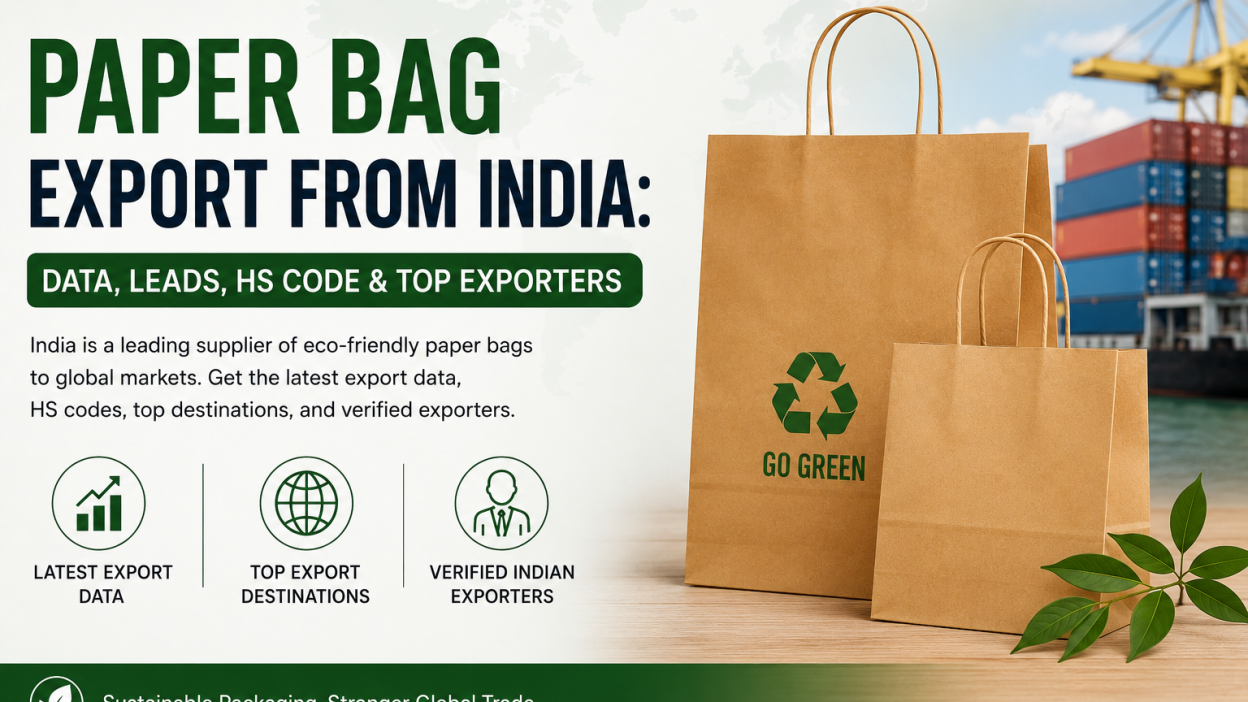
India has quietly built one of the most active packaging supply chains in the world, and paper bags sit right at the centre of it. As plastic bans tighten across Europe, the Gulf, and North America, buyers are hunting for reliable Indian suppliers who can ship in volume. That shift is exactly why paper bag export from India has become such a fast-moving trade lane over the last two years.
This guide breaks down the numbers that matter. You’ll get current trade data, a clear read on paper bag HS code classifications, the export destinations pulling the most volume, and a working list of the top paper bag exporters in India. Whether you’re sourcing suppliers or trying to sell overseas, the goal here is simple: give you the trade intelligence to act, not just read.
Why Paper Bag Demand Is Climbing Fast
Here’s the thing — this isn’t a passing trend. The global paper bag market is projected to grow at roughly 4.22% between 2024 and 2032, pushing toward $8.4 billion. India is a real contributor to that curve. The Indian paper bag market was valued at around $727.4 million in 2023 and is forecast to cross $1,087.7 million by 2032, growing at a CAGR of about 4.4%.
What’s driving it? A few forces stacking on top of each other:
- Plastic bans and regulation. Governments across India, the EU, and the Gulf are cracking down on single-use plastics. Retailers need compliant alternatives, fast.
- Consumer pressure. Shoppers increasingly want sustainable packaging, and brands respond to that at the shelf.
- Retail and e-commerce growth. Every new grocery chain, quick-commerce brand, and D2C label needs branded carry bags at scale.
- Better manufacturing. Automated bag-making lines have cut costs, so Indian suppliers can now compete on price internationally.
Put those together and you get a market where the export of paper bags from India keeps finding new buyers each quarter.
Paper Bag Production in India: The Supply Base
You can’t export what you can’t make, and India’s production base is deeper than most traders realise. Roughly 3.5 billion paper bags were produced across the country in 2023.
India ranks around 15th globally for paper production, with a capacity near 12.7 million metric tons — about 2.6% of world paper output. More than 750 paper mills feed this ecosystem, concentrated heavily in Gujarat, Andhra Pradesh, and West Bengal. Maharashtra and Uttar Pradesh add meaningful volume too.
Why does the geography matter to a buyer? Because sourcing near a port cluster — say a Gujarat mill feeding through Mundra or Nhava Sheva — often means shorter lead times and cleaner logistics. Smart importers look at production location before they even discuss price.
There’s a quality dimension too. Not every mill runs the same grades. Kraft paper for grocery sacks, coated white paper for premium retail bags, recycled fibre for budget lines — each comes from a different production cluster with different price points. A buyer sourcing luxury boutique carry bags shouldn’t be shopping the same mills as a wholesaler chasing the cheapest bulk grocery sack. Knowing the supply map saves you from mismatched quotes and wasted negotiation cycles.
Labour and input costs also work in India’s favour. Pulp is largely domestically sourced, energy costs sit below several competing exporters, and the workforce is skilled in high-volume converting. That combination is why so many overseas brands have started splitting orders — keeping some capacity in China but shifting a growing slice to Indian units as a hedge.
Paper Bag Export from India: Latest Trade Data
Let’s get to the numbers traders actually care about. According to recent global trade data under HS Code 481940 (sacks and bags of paper), India exported paper bags worth roughly $112.58 million in 2024, at a quantity of about 75.35 million kg.
Looking at the trailing twelve months from March 2023 to February 2024, India shipped 37,289 shipments of paper bags. Those movements came from around 3,011 Indian exporters reaching 6,237 overseas buyers — a striking 50% growth versus the prior year. In February 2024 alone, 3,036 export shipments were recorded.
So where does it all go? Most of these shipments land in three markets: the United States, the United Kingdom, and the United Arab Emirates. These are mature, plastic-conscious economies with steady repeat demand — which is what makes them so valuable as long-term accounts rather than one-off orders.
This is the kind of shipment-level detail that separates a guess from a strategy. Verified paper bag export data — buyer names, shipment frequency, port of loading, unit values — is what lets a supplier decide which markets to chase and which to skip.
Paper Bag HS Code: Get the Classification Right
Nothing derails a shipment faster than a wrong HS code. Customs delays, incorrect duty, blocked clearances — most of it traces back to misclassification. Here are the HS code entries that matter.
| Paper Bag HS Code | Product Description |
| 4819 | Cartons, boxes, cases, bags and other packing containers of paper, paperboard, cellulose wadding or webs of cellulose |
| 48193000 | Sacks and bags having a base of a width of 40 cm or more |
| 48194000 | Other sacks and bags, including cones |
| 48195090 | Other packing containers (residual category) |
| 4707 | Recovered (waste and scrap) paper or paperboard |
| 47079000 | Other unsorted waste and scrap paper |
Worth noting: 481940 is the code most exporters use for standard paper carry bags, while 48193000 covers the wider-base grocery and industrial sacks. Match your product spec to the exact sub-heading before you file. If you’re unsure, cross-check against the full HS code classification before booking freight.
Export Documentation and Compliance Basics
Before a single carton moves, the paperwork has to be right. New exporters often underestimate this, and it costs them their first order. Here’s the short checklist every Indian supplier should have ready.
You’ll need a valid IEC (Import Export Code) from the DGFT — it’s the non-negotiable starting point. Beyond that, standard export documents apply: the commercial invoice, packing list, bill of lading or airway bill, and certificate of origin. For eco-certified or recycled paper products, buyers in the EU and Gulf frequently ask for FSC certification or a recycled-content declaration, so having those lined up widens your buyer pool considerably.
Duty and incentives matter too. Many paper products qualify for export benefits under schemes like RoDTEP, which can improve your landed price competitiveness. And because destination-country regulations differ — the EU’s packaging rules are stricter than most — confirming compliance before you quote saves painful surprises at the buyer’s customs. Getting this foundation right is what turns a one-time shipment into a repeat account.
Paper Bag Exporting Countries: Where India Ranks
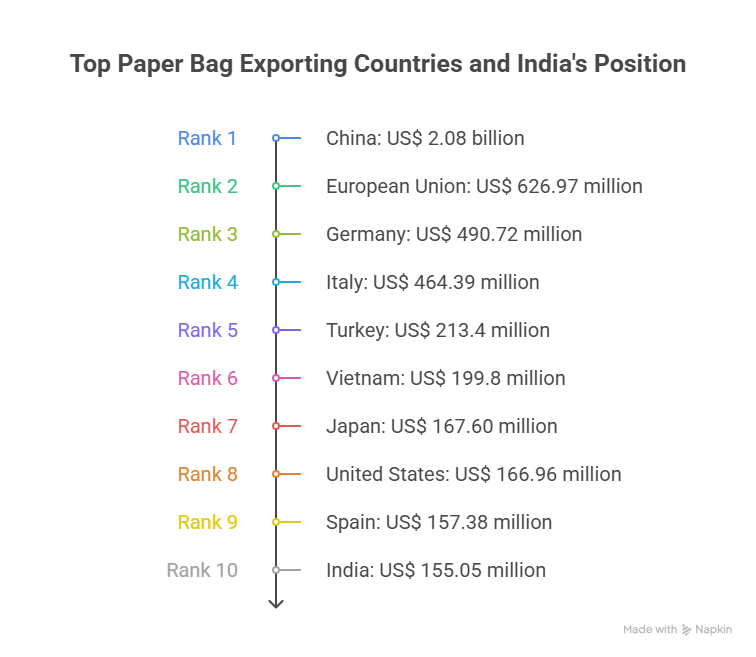
India is a strong player, but let’s be honest — it’s not yet the leader. Here’s how the top paper bag exporting countries stack up by export value.
| Rank | Country | Export Value |
| 1 | China | US$ 2.08 billion |
| 2 | European Union | US$ 626.97 million |
| 3 | Germany | US$ 490.72 million |
| 4 | Italy | US$ 464.39 million |
| 5 | Turkey | US$ 213.4 million |
| 6 | Vietnam | US$ 199.8 million |
| 7 | Japan | US$ 167.60 million |
| 8 | United States | US$ 166.96 million |
| 9 | Spain | US$ 157.38 million |
| 10 | India | US$ 155.05 million |
India sits at number 10 — respectable, but with clear headroom. China alone exports more than thirteen times India’s value. That gap is actually the opportunity: as buyers diversify away from China for supply-chain resilience, India is the obvious alternative on cost and capacity. Suppliers who build verified buyer relationships now are positioning for the shift.
Paper Bag Importing Countries: Who’s Buying
Knowing who buys is half the game. The leading paper bag importing countries include China, the United States, Germany, France, the United Kingdom, Italy, Sri Lanka, Kenya, Indonesia, and Argentina.
Beyond those, secondary demand markets worth watching are Bolivia, Colombia, Ecuador, Kazakhstan, Peru, Ukraine, Venezuela, Mexico, and Pakistan. Several of these are underserved by Indian suppliers right now — which, for an exporter willing to do the outreach, is white space. India needs to tap these demand-driven markets to grow the export of paper bags from India beyond its current base.
Top Paper Bag Exporters in India
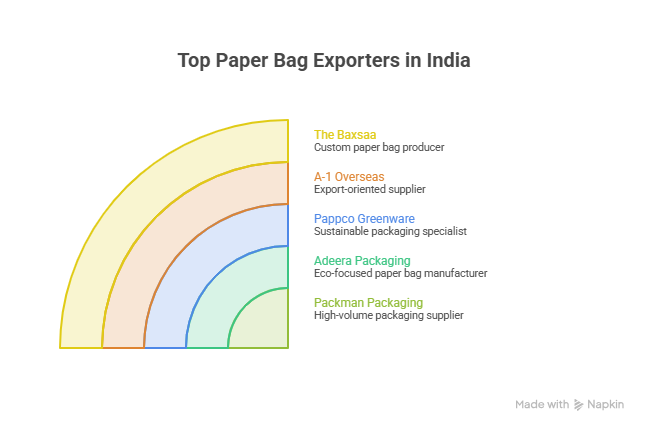
Ready to source? Here’s a working list of established paper bag exporters and manufacturers operating in the Indian market:
- Packman Packaging — high-volume packaging supplier
- Adeera Packaging — eco-focused paper bag manufacturer
- Pappco Greenware — sustainable packaging specialist
- A-1 Overseas — export-oriented supplier
- The Baxsaa — custom paper bag producer
- Vistaprint.in — branded and printed bags
- Lathikasri Packaging — bulk manufacturer
- Eco Bags India — green packaging brand
- Max Packaging — retail and industrial bags
- Adept Industries — established exporter
These are among the more visible paper bag export companies in India, but the market runs far deeper — thousands of small and mid-sized units export under HS Code 4819 every month. To find the ones actually shipping to your target country, you need shipment-level records, not a static directory. That’s where verified import export leads change the equation.
How to Find Verified Paper Bag Export Leads
This is where most traders stall. A name and a website aren’t a lead — a lead is a buyer who is actively importing your product, right now, in the volumes you can serve.
Real export leads come from customs and shipment data: who imported paper bags last month, from which supplier, at what unit price, into which port. When you can see that a UK retailer bought 40,000 kg of paper bags from an Indian supplier in the last quarter, you’re no longer cold-calling — you’re approaching a proven buyer.
Here’s how sharp exporters work the data:
- Filter by HS code and destination. Start with 481940 into your target market.
- Rank buyers by frequency and volume. Repeat importers are worth ten one-time buyers.
- Check unit values. They tell you where you can compete on price and where you can’t.
- Pull the buyer contact and shipment history. Then reach out with a specific, relevant pitch.
That’s the difference between paper bag export data leads and a spreadsheet of random company names. One converts; the other wastes your week.
Timing matters as much as targeting. Import demand for carry bags spikes ahead of retail seasons — festive quarters in India, back-to-school in the US, holiday retail across Europe. If you can see a buyer’s historical ordering rhythm in the shipment records, you know exactly when to land your pitch. Reaching out three weeks before a buyer typically places their annual order beats a cold email in the dead season every time.
And don’t ignore the competitive angle. Trade data doesn’t just show you buyers — it shows you which Indian suppliers are already serving them, at what volume, and roughly at what price. That intelligence tells you whether a buyer is locked in or up for grabs, and how aggressive your offer needs to be. Walking into a negotiation already knowing the incumbent’s shipment pattern is a serious edge.
Comparison: Data Directory vs Verified Trade Data
| Factor | Free Web Directory | Verified Trade Data Platform |
| Buyer intent | Unknown | Proven — based on actual imports |
| Shipment history | None | Full — dates, volumes, ports |
| Contact accuracy | Often outdated | Verified and current |
| Competitor visibility | None | See who supplies whom |
| Pricing insight | None | Unit values per shipment |
| Conversion rate | Low | High — you pitch active buyers |
The takeaway is blunt: directories tell you a company exists. Trade data tells you a company is buying. For anyone serious about exporting these products overseas, that distinction decides whether outreach pays off.
One more practical point: your first message to a buyer decides everything. Skip the generic “we manufacture quality products” opener — it gets deleted. Instead, reference something specific from the shipment record: the product grade they import, their typical order volume, the market they serve. A line like “We supply the same 481940-grade recycled kraft sacks you’ve been sourcing, at a landed price I think you’ll want to compare” lands because it proves you did the homework. Buyers respond to relevance, and relevance comes straight from the data.
Future Outlook for Paper Bag Export from India
Where’s this heading? Up — and the tailwinds are structural, not seasonal. The global move toward sustainable packaging isn’t reversing, and India’s cost advantage plus its expanding mill capacity make it a natural supplier as buyers de-risk away from single-source China dependence.
The exporters who win the next few years won’t just be the biggest factories. They’ll be the ones who read the market accurately — tracking which countries are ramping imports, which buyers are switching suppliers, and where unit prices leave room to compete. In my experience watching these trade lanes, information moves faster than freight, and the supplier who sees the demand first usually closes the deal.
This trade lane is a genuine growth story. The demand is real, the supply base is ready, and the data to connect the two has never been more accessible.
Find Verified Paper Bag Buyers on VyaaparOne
The market is moving, and the exporters capturing it are the ones acting on real data. VyaaparOne gives you verified shipment records, buyer contacts, and live paper bag export leads across 200+ countries — so you can stop guessing and start pitching active importers. Explore paper bag export data and connect with trusted paper bag export companies in India on VyaaparOne today. Book a free demo and see the leads for your product line.
Frequently Asked Questions
How big is the paper bag industry in India?
The Indian paper bag market was valued at roughly $727.4 million in 2023 and is projected to surpass $1,087.7 million by 2032, growing at a CAGR of about 4.4%.
Which countries export the most paper bags?
The top paper bag exporting countries by value are China, the European Union, Germany, Italy, Turkey, and Vietnam. India ranks 10th globally.
Who is the largest manufacturer of paper bags in India?
Gujarat leads Indian production with the highest concentration of paper mills. Andhra Pradesh, West Bengal, Maharashtra, and Uttar Pradesh also produce large volumes.
What is the paper bag HS code?
The primary code is 4819, with key sub-headings including 48193000 (sacks and bags with a base width of 40 cm or more) and 48194000 (other sacks and bags including cones). Standard carry bags are commonly classified under 481940.
Where does most paper bag export from India go?
The largest export destinations are the United States, the United Kingdom, and the United Arab Emirates, driven by strong sustainable-packaging demand.
How do I find genuine paper bag export leads?
Use verified customs and shipment data to identify buyers who are actively importing paper bags, then filter by HS code, destination, and volume. Platforms like VyaaparOne provide this shipment-level trade intelligence.