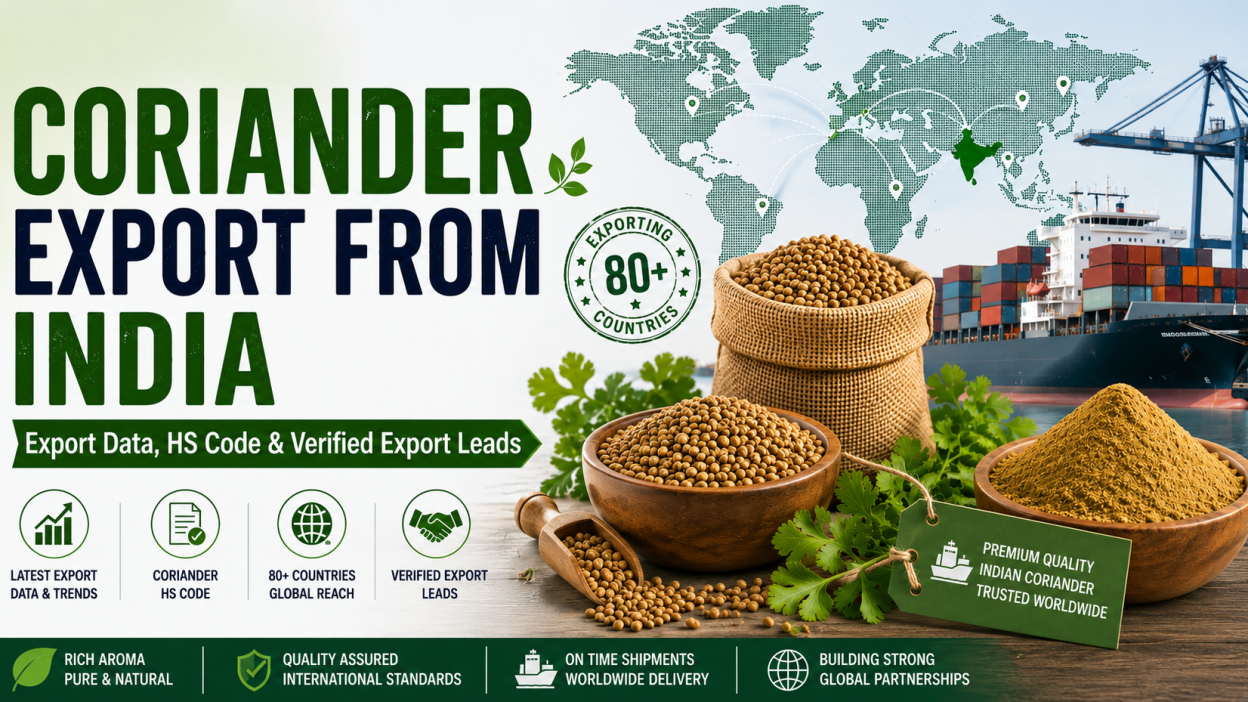
India ships coriander to more than 80 countries, and the numbers behind that trade tell a story most spice exporters never bother to read. Coriander export from India crossed 97.7 million kg in 2023-24, worth roughly US$95.9 million, and the momentum has only sharpened since. If you sell seeds, powder, splits, or oil, this guide walks you through the coriander export data, the coriander HS code you need on every shipping bill, and where to find verified coriander export data leads that actually convert. Let’s be honest — most suppliers chase buyers blind. You don’t have to. This is the complete playbook for anyone serious about the export of coriander from India in 2025-26.
Why Coriander Export from India Dominates Global Spice Trade
Here’s the thing about coriander. India isn’t just a participant in this market — it sets the pace. The country produces around 1.89 billion metric tonnes annually, which works out to roughly 68.58% of global output. That scale is why coriander export from India stays competitive on price even when Mediterranean growers push hard on quality.
Rajasthan carries a big share of the acreage, thanks to its semi-arid climate and well-drained soils that produce clean, aromatic seeds. Madhya Pradesh runs close behind — Kumbhraj town alone supplies large multinational buyers like Tata. So when a buyer in Dubai or Kuala Lumpur asks for consistent lots at scale, Indian suppliers can say yes. Few origins can.
What does this mean for you as an exporter? Supply depth. You’re never short on raw material, and that reliability is exactly what repeat buyers pay a premium for. The strength of coriander export from India rests on this foundation — a producer base so deep that no single crop failure can knock the country off its perch. And yes, that matters when a buyer is comparing you against a Moroccan or Bulgarian supplier who simply can’t guarantee the same volume.
Worth noting: production has climbed steadily. India produced over 847,000 metric tonnes of coriander in 2023, up from roughly 462,000 metric tonnes in 2015. The main growing belt runs through Rajasthan, Madhya Pradesh, Andhra Pradesh, Tamil Nadu, Odisha, Uttar Pradesh, and Uttarakhand. Rajasthan alone accounts for a large slice of national production, and its seed quality is the reason premium buyers keep coming back.
Coriander Export Data from India: The Numbers That Matter
Numbers first, opinions later. In 2023-24, coriander export data from India recorded 97.7 million kg shipped, valued at about US$95.9 million. Between March 2023 and February 2024, roughly 3,180 cargoes moved out of Indian ports. Around 622 active exporters served 1,223 registered buyers worldwide — a 38% jump in buyer count over the prior year. That growth in buyer numbers is the real headline, because it signals widening demand for coriander export from India, not just a one-off spike.
Then FY 2024-25 flipped the script on realisation. Volume softened but value climbed. As per coriander export data, India exported about 38,314 tonnes in the first seven months (April to October), generating USD 48.25 million. Compare that with 81,045 tonnes and USD 82.27 million in the same window a year earlier. Lower tonnage, but the average realisation per tonne jumped dramatically — from around USD 883 to USD 2,171. That’s the kind of price signal smart exporters watch.
Why the swing? Global demand held firm while supply tightened, pushing unit prices up. For anyone reading coriander export data leads correctly, that gap between volume and value is where margin lives. The exporter who ships less but earns more per tonne is quietly winning, and the raw coriander import export data behind coriander export from India proves it quarter after quarter.
Let me put it plainly. If you only track volume, you miss half the picture. Realisation per tonne tells you where pricing power sits, and right now it sits with disciplined suppliers who hold quality and don’t dump stock. That’s a lesson buried inside every honest reading of coriander export data from India.
Coriander Export Value and Volume Snapshot
| Metric | FY 2024-25 | FY 2023-24 |
| Total export volume | ~63,435 tonnes | ~1,08,624 tonnes |
| Total export value | USD 137.74 million | USD 95.90 million |
| H1 volume (Apr-Oct) | 38,315 tonnes | 81,045 tonnes |
| H1 value (Apr-Oct) | USD 48.25 million | USD 82.27 million |
| Avg. realisation | USD 2,171/tonne | USD 883/tonne |
| Export destinations | 80+ countries | 80+ countries |
| Active Indian exporters | 622 | 622 |
| Registered global buyers | 1,223 | 1,223 |
Worth noting: these figures shift every quarter. Real-time coriander import export data beats any static blog table, which is why serious traders subscribe to a live platform instead of relying on last year’s summary. A number that was accurate in January can mislead you by June.
Coriander HS Code: Get the Classification Right
Get the HS code wrong and your shipment stalls at customs. Simple as that. The coriander HS code family sits under Chapter 09, and each variant covers a specific form of the spice. Filing the correct code isn’t bureaucratic box-ticking — it decides your duty rate, your clearance speed, and whether your buyer receives goods on schedule.
- 0909 — Seeds of fennel, coriander, cumin, anise, badian, or caraway (the parent heading)
- 09092110 — Coriander seeds of high quality, neither crushed nor ground
- 09092190 — Coriander seeds, neither crushed nor ground, other
- 09092200 — This is the coriander powder HS code, covering crushed or ground coriander seeds
- 33012922 — Coriander seed oil
The coriander powder HS code (09092200) trips people up most often. If you’re exporting ground coriander and you file under the whole-seed code, you invite a query — and queries cost days. GST on these lines sits at 5%. When in doubt, verify the classification against live shipment records before the goods leave the warehouse.
Here’s a tip from experience: keep a small internal reference sheet mapping your product forms to their exact coriander HS code. Whole seed, split, powder, and oil each carry a different classification, and mixing them up on a single invoice is one of the most common reasons a coriander consignment gets flagged. The coriander powder HS code in particular — 09092200 — should never be confused with the whole-seed lines. That single discipline saves more shipments in coriander export from India than any other habit.
Coriander Exporters in India: Who’s Leading the Market
The top coriander exporters in India have built their reputations on consistency, not luck. Here are the names that show up repeatedly in shipment records:
- Mahesh Agro Food Industries
- Yuvaraju Food Impex
- Dhaval Agri Exports LLP
- Badani Corporation
- Diya Exports
- Seasons International Pvt. Ltd.
- Pisum Food Services
- Shiva Ruthra Exports
- Anu Foods
- Apex International
These coriander seeds exporters aren’t just moving volume — they’ve cracked the harder part, which is retaining buyers across seasons. In my experience, the exporters who win long-term contracts are the ones who back their pitch with documented shipment history. A buyer trusts a track record far more than a brochure — and in coriander export from India, the track record lives in the shipment data.
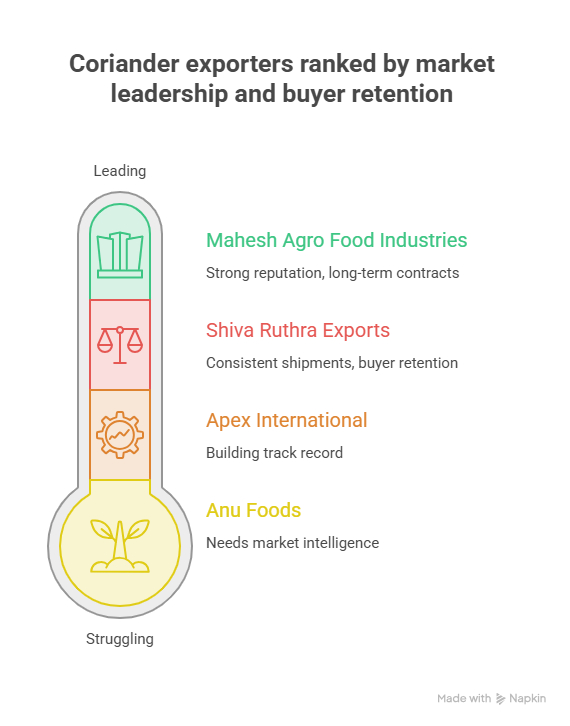
If you’re a newer supplier trying to break into this circle, the fastest path is intelligence: know who’s buying what, from whom, at what price. That’s not guesswork you can afford. That’s data. The established coriander exporters in India already work this way — they read the market before they pitch, and that’s precisely why they keep their spots. You can do the same the moment you get access to the right coriander export data.
There’s no secret handshake here. The gap between a top-ranked exporter and a struggling one usually comes down to information asymmetry. The leaders know which buyer in Malaysia reorders every quarter. The strugglers are still sending cold emails. Close that gap and you compete on equal footing in the coriander export from India market.
Top Destinations for Coriander Export from India
Where does Indian coriander actually go? The demand map is broader than most people assume, but a handful of markets do the heavy lifting.
| Importing Country | Approx. Export Value |
| China | $35.29 million |
| Malaysia | $14.65 million |
| United Arab Emirates | $8.76 million |
| Saudi Arabia | $4.59 million |
| Nepal | $4.35 million |
| Egypt | $3.33 million |
| United States | $3.28 million |
| Bangladesh | $2.53 million |
| Algeria | $2.44 million |
| United Kingdom | $2.13 million |
China leads by a wide margin for coriander export from India, pulling in ground and whole seed for its food-processing sector. Malaysia and the UAE are the steady, reliable buyers — the ones that reorder without much fuss. And the long tail of markets like Egypt, the US, and the UK keeps growing as global cuisines lean harder on Indian spices.
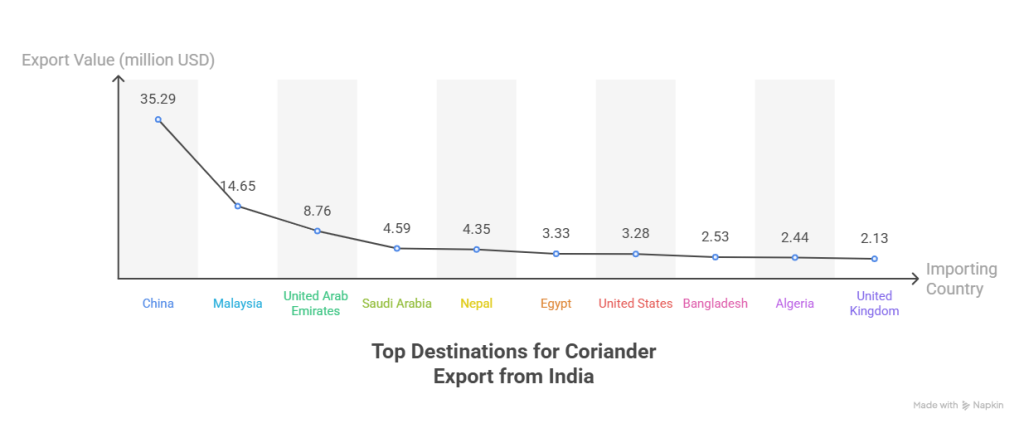
The takeaway? Don’t fixate on one destination. Coriander export from India works best as a diversified play, spreading risk across the Gulf, East Asia, and the West. If China slows for a season, Malaysia and the UAE hold your revenue steady. That’s not luck — that’s portfolio thinking applied to spice trade. And it’s exactly how the strongest names in coriander export from India protect themselves against a single-market shock.
How Global Coriander Trade Stacks Up
India doesn’t operate in a vacuum. Several countries export coriander, though none matches India’s raw scale. Here’s how the global field lines up by export value.
India tops the list at roughly $117.07 million, followed by the European Union bloc at $48.69 million, with Italy, Spain, Bulgaria, and Morocco filling out the next tier. Canada, Poland, and the Netherlands round off the leaders. What’s striking is the gap — India exports more than double the value of its nearest single-country rival. That dominance is your leverage as an Indian exporter. Buyers already expect to source from India; your job in coriander export from India is simply to be the supplier they find first.
This global picture also explains pricing. When European producers face a weak harvest, buyers pivot hard toward Indian origin, and coriander export from India absorbs the extra demand almost overnight. That elasticity is a structural advantage no marketing budget can buy. It’s baked into the trade itself.
Documents Required for the Export of Coriander from India
Paperwork isn’t glamorous, but it’s non-negotiable. Every successful export of coriander from India runs on a stack of compliance documents. Miss one and the whole consignment waits.
- Import Export Code (IEC)
- APEDA Registration
- FSSAI License
- Spice Board Registration
- Commercial Invoice
- Packing List
- Bill of Lading or Airway Bill
- Certificate of Origin
- Phytosanitary Certificate
- Health Certificate
- Quality Inspection Certificate
The Spice Board registration and phytosanitary certificate matter most for coriander export from India, since importing nations screen hard for pest and residue compliance. Get these ready before you confirm an order — scrambling for documents after a buyer commits is how deals fall apart.
One more thing. Different destinations layer on their own requirements. The EU wants tight residue documentation; Gulf markets often ask for halal certification on processed spice. Build a country-specific checklist early, because the export of coriander from India runs smoothest when your paperwork is destination-ready before the buyer even asks.
Why the Coriander Export Business Keeps Growing
A few forces keep pushing coriander export from India upward, and they’re not slowing down.
Worldwide demand. Coriander export from India rides on a spice that flavours everything from curries to Scandinavian pastries to liqueurs. That breadth insulates the market from any single region’s slowdown.
Better margins abroad. Export prices routinely beat domestic rates, which is the whole reason the smart money looks outward. Indian coriander typically fetches between $950 and $970 a tonne on the international market — and premium, cleaned lots command more.
Government backing. Export incentives, Spice Board support, and trade facilitation schemes lower the barrier to coriander export from India for new exporters.
Open markets. The USA, Europe, and the Middle East all keep buying, and each new buyer relationship opens a referral network of its own.
Honestly, the biggest limiter isn’t demand — it’s discovery. Plenty of capable suppliers never scale simply because they can’t find the buyers who are actively sourcing. That’s a fixable problem, and it’s the one place where good coriander export data leads change everything.
Coriander Powder vs Coriander Seeds: Which Export Is Right for You?
Not every exporter should chase the same product form. Whole seed and powder behave very differently in the market, and picking the wrong lane costs you margin. Here’s a clean comparison to help you decide.
| Factor | Coriander Seeds (Whole) | Coriander Powder (Ground) |
| Primary HS code | 09092110 / 09092190 | 09092200 (coriander powder HS code) |
| Shelf life | Longer, more stable | Shorter, aroma fades faster |
| Value addition | Lower | Higher per kg |
| Buyer type | Processors, re-packers | Retail brands, food service |
| Quality scrutiny | Moisture, purity | Residue, adulteration checks |
| Typical margin | Thinner | Wider if quality holds |
Within coriander export from India, powder carries more value per kilogram but demands tighter quality control and faster turnover, since ground spice loses aroma quickly. Whole seed is more forgiving and stores longer, which suits exporters shipping to distant markets on longer transit times. Neither is universally better — the right choice depends on your buyer, your storage, and your appetite for quality risk. Read your coriander export data before committing to a form; the shipment records tell you exactly which buyers want which product.
Finding Verified Coriander Export Leads That Convert
This is where most exporters stall. You can have the best product in Rajasthan and still sit idle if you can’t reach buyers. Reliable coriander export leads are the difference between a warehouse that turns over and one that doesn’t, and they sit at the heart of profitable coriander export from India.
Real leads come from shipment data — actual records of who imported coriander, in what quantity, at what price, and through which port. That’s the raw material for coriander export data leads you can act on. Generic directories won’t cut it; you need contact-level intelligence tied to verified trade history. Anyone can hand you a list of company names. Far fewer can tell you which of those companies actually imported coriander last month.
VyaaparOne pulls exactly this kind of coriander import export data from government-authorised sources across 200+ countries, refreshed daily. Instead of cold-emailing into the void, you see which buyers are live in the market right now, filter by HS code, and connect with verified importers before a competitor does. For coriander seeds exporters scaling coriander export from India, that shortcut is worth more than any amount of guesswork.
Think about the math. If verified coriander export leads convert even a few percentage points better than cold outreach, that difference compounds across every shipment for the rest of the year. Data isn’t a nice-to-have in coriander export from India. It’s the whole game.
Coriander Price Trends and Market Outlook
Price is the pulse of any commodity trade, and coriander is no exception. Indian coriander has historically traded between $950 and $970 a tonne on the global market, but cleaned, premium-grade coriander seeds and finely milled coriander powder routinely command more. The realisation jump seen in FY 2024-25 — from roughly USD 883 to USD 2,171 per tonne — shows how quickly coriander pricing can move when supply tightens.
What should you take from this? Watch the spread between whole coriander seed and coriander powder. When powder margins widen, value-added coriander export from India becomes far more attractive than shipping raw seed. When seed prices spike on a weak harvest, the opposite holds. The exporters who read coriander price trends monthly — not annually — are the ones who time their shipments right.
Demand-side, the outlook stays firm. Coriander consumption keeps rising across the Gulf, East Asia, and Western retail, and India’s coriander production base is deep enough to meet it. For a well-prepared supplier, that combination of steady demand and reliable coriander supply is about as favourable a backdrop as this trade offers.
Turn Coriander Export Data into Real Buyers
Coriander export from India is a genuine opportunity — but only if you act on current intelligence instead of last year’s figures. The market rewards suppliers who know their HS codes, keep their documents ready, and reach buyers first. That last part is where VyaaparOne earns its keep. Explore live coriander import export data, unlock verified coriander export leads, and connect with real importers across 200+ countries. The export of coriander from India rewards those who move on data, not on hope. Book a free demo and start turning trade data into signed orders.
Coriander Export from India: Frequently Asked Questions
Which countries import the most coriander from India?
China leads by value, followed by Malaysia, the United Arab Emirates, Saudi Arabia, Nepal, and Egypt. These markets account for the bulk of coriander export from India each year, and together they define where the demand really sits.
Who are the leading coriander exporters in India?
Mahesh Agro Food Industries, Yuvaraju Food Impex, Dhaval Agri Exports LLP, Badani Corporation, Diya Exports, and Seasons International Pvt. Ltd. rank among the top coriander exporters in India.
Which Indian state produces the most coriander?
Rajasthan and Madhya Pradesh lead production. Rajasthan’s semi-arid climate yields high-quality seeds, while Kumbhraj in Madhya Pradesh supplies major buyers including multinationals.
What documents do I need for the export of coriander from India?
You’ll need an IEC, APEDA registration, FSSAI license, Spice Board registration, commercial invoice, packing list, phytosanitary certificate, and certificate of origin, among others.
How do I find verified coriander export data leads?
Use a live trade intelligence platform like VyaaparOne to access shipment records and verified buyer contacts filtered by HS code and destination country. This is the quickest way to turn raw coriander import export data into real orders.
Is coriander export from India profitable for small exporters?
Yes. With average realisation rising and government incentives in place, even small suppliers can profit from coriander export from India — provided they classify correctly, keep documents ready, and reach buyers using accurate coriander export data.