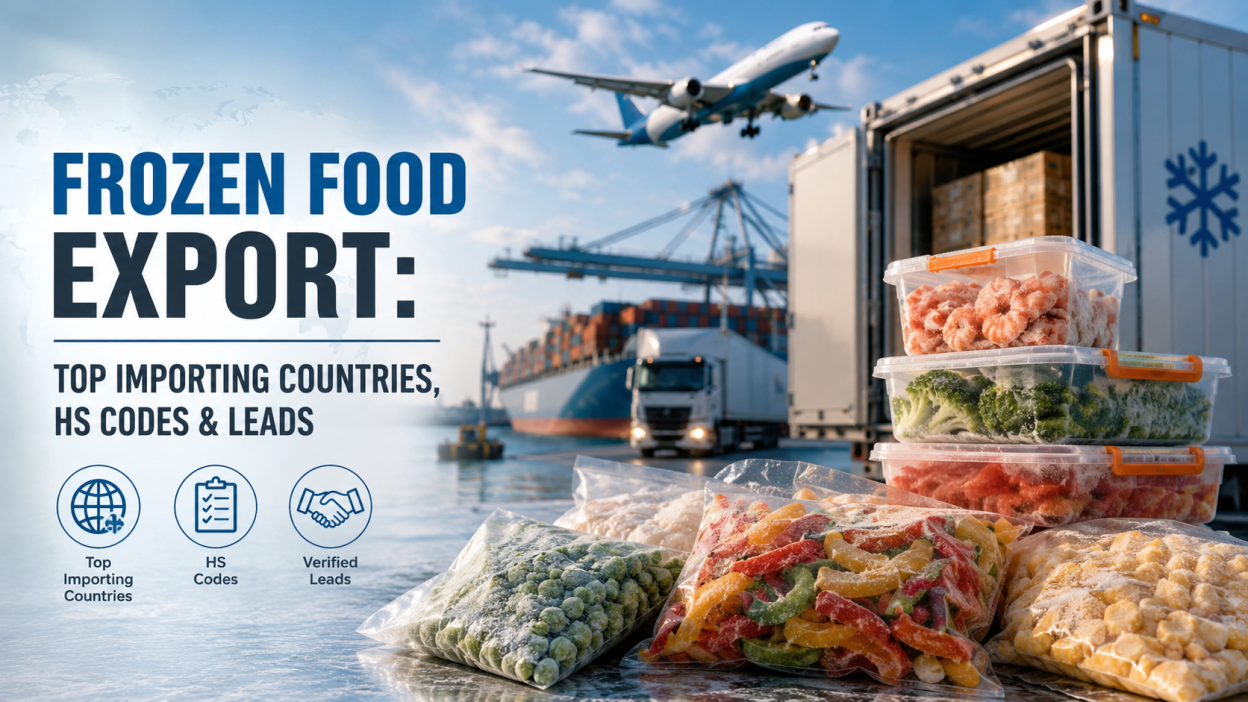
India sits at the top of the global cold-chain trade map, and the numbers back it up. As per Volza’s India export data, India led the world in frozen food export with 264,894 shipments in a single 12-month window — ahead of the United States and Russia. That single stat tells you everything about why frozen food export from India has become one of the most searched trade opportunities for MSMEs, processors, and first-time shippers. This guide breaks down the top importing countries, the exact frozen food HS code categories that matter, and where to find verified frozen food export leads that actually convert.
Let’s be honest — most people enter this business blind. They know there’s demand. They don’t know which country buys what, which HS code to file, or where the real buyers are. So let’s fix that and map the frozen food export opportunity end to end.
Why Frozen Food Export from India Is Booming
Here’s the thing. Frozen food export from India runs on three engines: seafood, buffalo meat, and processed vegetarian products. Marine products alone — mostly frozen shrimp — hit US$7.45 billion in FY25, making them India’s single largest agri-export category by value. Buffalo meat added roughly ₹42,500 crore in 2024-25. That’s not a niche. That’s an industrial machine.
And it keeps growing. Over one recent 12-month stretch, the frozen food export growth rate from India stood at 75%. Why? Rising global appetite for ready-to-eat meals, a bigger Indian diaspora, and cold-chain infrastructure that finally works. The AL-Kabeer plant in Rudraram processes 600 buffaloes a day and gets meat to Dubai in 60 hours. That’s the level of frozen food export capability India now runs.
Worth noting: the sector isn’t just big players. As per frozen food export data, 741 exporters shipped 244.8K consignments to 2,275 buyers. Room exists for newcomers who understand the frozen food export game.
Top Importing Countries for Frozen Food Export from India
Demand is concentrated. According to Volza’s export data, the top three importers — the United States, Australia, and Vietnam — together took 69% of India’s total frozen food export volume. The US alone received 40% (14,790 shipments). If you’re planning your first frozen food export shipment, these are your priority markets.
Here’s the deeper cut. The frozen food export destination mix shifts by product. Buffalo meat flows to Vietnam, Egypt, Malaysia, Iraq, and Saudi Arabia. Frozen shrimp goes overwhelmingly to the US and EU. Spain imports a huge share of India’s frozen fish; Italy’s “Calamari Fritti” is now largely Indian squid. So your frozen food export strategy should match product to market — not spray and pray.
Top Importing Countries for Frozen Food Export from India
| Rank | Importing Country | Share of India’s Frozen Food Export | Primary Products Bought |
| 1 | United States | ~40% (14,790 shipments) | Frozen shrimp, processed snacks |
| 2 | Australia | ~16% (5,915 shipments) | Ready meals, frozen vegetables |
| 3 | Vietnam | ~13% (4,970 shipments) | Buffalo meat, seafood |
| 4 | United Kingdom | ~8% | Frozen curries, snacks |
| 5 | Egypt | Growing | Buffalo meat |
| 6 | Malaysia | Growing | Buffalo meat, poultry |
| 7 | Saudi Arabia | Growing | Halal meat, ready meals |
These seven markets should anchor any serious frozen food export plan. Get one right before you chase ten.
Frozen Food HS Code: The Classification You Must Get Right
Get the frozen food HS code wrong and your consignment stalls at customs. Simple as that. The correct HS code determines duty rate, export benefits, and whether your paperwork clears. There isn’t one single frozen food HS code — it depends entirely on the product.
The most-used frozen food export categories are HSN 2106 (food preparations), 21069099, 20049000 (frozen vegetables), and 19059090 (bakery/snacks). For frozen seafood, you’re looking at Chapter 03 codes — 0306.17 for frozen shrimp, 03073200 for frozen molluscs. Frozen buffalo meat sits in Chapter 02. This is the backbone of frozen food export documentation.
Frozen Food HS Code Reference for Export
| Product Category | Frozen Food HS Code | Common Use in Frozen Food Export |
| Food preparations (prepared meals) | 2106 / 21069099 | Curries, ready-to-eat, sauces |
| Frozen vegetables | 20049000 / 070810 | Peas, okra, spinach, mixed veg |
| Frozen snacks & bakery | 19059090 / 1905 | Samosas, patties, veggie fingers |
| Frozen shrimp / prawns | 0306.17 | Vannamei, black tiger shrimp |
| Frozen molluscs | 03073200 | Squid, cuttlefish |
| Frozen buffalo meat | 0202 | Boneless halal buffalo meat |
| Frozen fruit | 0811 | Mango pulp, strawberries |
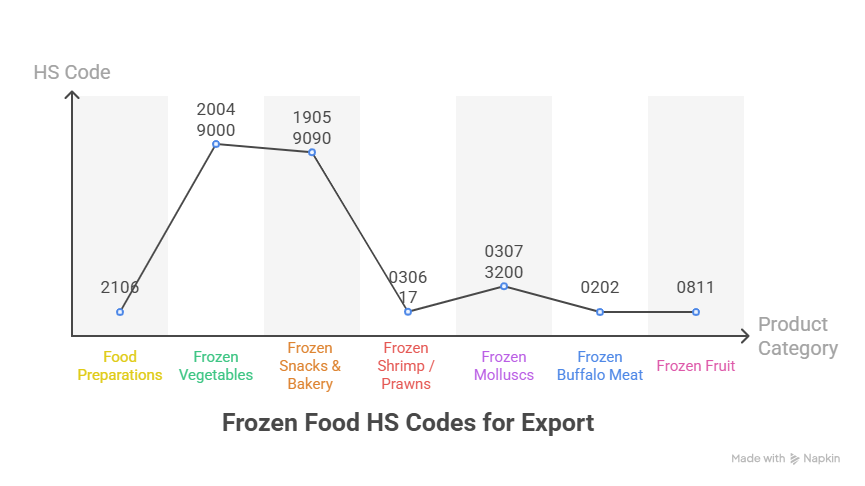
Honestly, most first-time exporters get this wrong. They pick a 4-digit code and assume it’s enough. It isn’t. Customs wants the full 8-digit frozen food HS code, and the duty math changes with it. Use a verified HS code lookup — VyaaparOne’s HS Code tool covers the full 2022 tariff classification — before you commit to any frozen food export contract.
Frozen Food Exporters in India: Who’s Leading
The frozen food export space in India runs from global giants to nimble upstarts. The leading frozen food exporters in India include McCain Foods India Pvt. Ltd., Nestlé India (frozen division), M.K.R. Frozen Food Exports Private Limited, ITC Ltd., and Godrej Tyson Foods. As per frozen food export data, M.K.R. Frozen Food Exports ranks among the largest dedicated players.
But here’s what matters for you: these names prove the model works. They don’t own the market. Thousands of mid-size frozen food exporters in India ship successfully every month through the right buyer connections and clean documentation. That’s the opening for a new frozen food export business.
What separates a scaling frozen food export operation from a stalled one? Consistency and cold-chain discipline. A frozen food export shipment lives or dies on temperature integrity — one broken link and the whole container is rejected at port. The exporters who win at frozen food export invest early in IQF freezing, BRC certification, and refrigerated logistics. In my experience watching this sector, buyers forgive a slightly higher price far more readily than they forgive a thawed consignment. So if you’re building a frozen food export brand, reliability is your real product.
There’s another angle most people miss. Frozen food export success often comes from picking a narrow lane. Instead of “frozen food,” a smart new entrant might own “frozen okra to the Gulf” or “IQF mango pulp to the EU.” Niche frozen food export positioning gets you found faster and lets you compete on expertise, not just price.
Frozen Food Export Data: What the Numbers Actually Tell You
Good frozen food export data isn’t just vanity stats. It’s your market map. Real frozen food export data includes bill of entry dates, HS codes, product descriptions, port names, quantities, and — critically — verified importer details. That’s how you find frozen food buyers before your competitor does.
According to trade records, India exports frozen food to 68+ countries. The product spread is wide: frozen mangoes, green peas, okra, strawberries, black tiger shrimp, vannamei shrimp, Indian mackerel, ribbonfish, buffalo meat, saag paneer, butter chicken, and pappadums. Each one has its own frozen food export data signature — different buyers, different seasons, different price bands.
Why does this matter? Because your buyer is comparing you with ten other suppliers at the same time. Frozen food export data lets you walk into that negotiation knowing the going price, the buyer’s shipment history, and their real volume. That’s leverage.
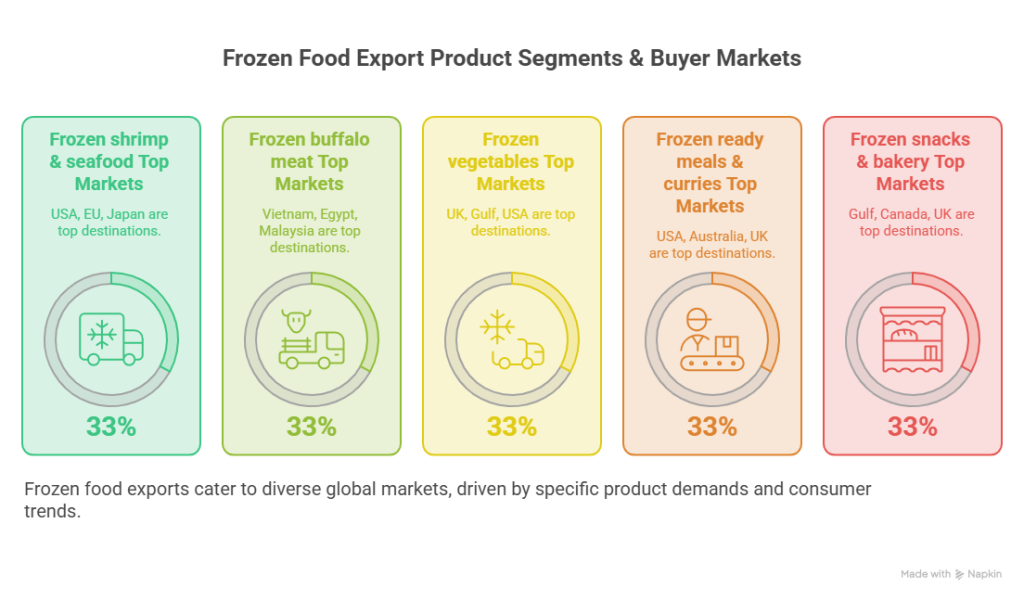
Frozen Food Export Product Segments & Buyer Markets
| Product Segment | Top Destination Markets | Peak Demand Signal |
| Frozen shrimp & seafood | USA, EU, Japan | Year-round; festive spikes |
| Frozen buffalo meat | Vietnam, Egypt, Malaysia | Steady; halal-driven |
| Frozen vegetables | UK, Gulf, USA | Off-season in buyer country |
| Frozen ready meals & curries | USA, Australia, UK | Diaspora + mainstream |
| Frozen snacks & bakery | Gulf, Canada, UK | Convenience-food growth |
Where to Find Frozen Food Export Leads and Buyers
This is where most guides go quiet. So let’s be direct. Frozen food export leads come from three places: government trade data, B2B marketplaces, and verified lead platforms.
Raw customs data gives you frozen food import leads — companies actively buying. B2B platforms like VyaaparOne surface live frozen food leads with HS-code-level detail, buyer contacts, and country filters. The difference between a cold list and real frozen food leads is verification. A verified frozen food buyers list with direct contacts beats 500 unqualified emails every time. This is exactly how experienced shippers scale frozen food exports from India — buyer data first, outreach second.
Want frozen food import leads from the US? Filter by HS code 0306.17 and destination country. Chasing buffalo meat frozen food buyers in Vietnam? Filter Chapter 02 by that market. That’s how modern frozen food export lead generation works — targeted, data-first, not scattershot.
VyaaparOne’s platform pulls verified frozen food export leads and frozen food import leads across 200+ countries, updated daily from government-authorised sources. For anyone serious about frozen food export leads, that’s the shortcut past months of manual research. Treat quality frozen food export leads as the single highest-leverage input in the entire frozen food export workflow.
How to Start a Frozen Food Export Business in India
Quick roadmap. First, register your firm and get an Import Export Code (IEC) from DGFT — non-negotiable for any frozen food export. Second, secure APEDA registration (processed/agri food) or MPEDA (marine products) plus FSSAI compliance. Third, nail your frozen food HS code and destination-country certifications — halal for GCC, FDA for the US, veterinary health certificates where required.
Then find buyers. Use frozen food export data to identify demand, pull verified frozen food export leads, benchmark your price, and lock cold-chain logistics before you quote. Get those five steps right and your first frozen food export shipment won’t be your last.
One more tip. Don’t skip sample orders. Serious frozen food export buyers almost always test with a trial container before committing to volume. Treat that first small frozen food export order as your interview — nail the documentation, the temperature log, and the delivery window, and repeat business follows.
Final Word
Frozen food export from India isn’t a gamble anymore — it’s a data problem you can solve. The demand is proven, the top importing countries are known, and the frozen food HS code map is clear. What separates winners from the rest is access to verified frozen food export leads and clean frozen food export data. Start with the right market, file the right HS code, and connect with real buyers. Explore verified frozen food export leads and buyer data on VyaaparOne and turn global demand into your next shipment.
Frequently Asked Questions
Which country imports the most frozen food from India?
The United States is the largest importer, taking roughly 40% of India’s frozen food export volume, followed by Australia and Vietnam.
What is the frozen food HS code for export from India?
It depends on the product. Common frozen food HS code categories include 2106/21069099 (food preparations), 20049000 (frozen vegetables), 0306.17 (frozen shrimp), and 0202 (frozen buffalo meat). Always confirm the 8-digit code for your SKU.
Who are the top frozen food exporters in India?
Leading frozen food exporters in India include McCain Foods India, Nestlé India, M.K.R. Frozen Food Exports, ITC Ltd., and Godrej Tyson Foods.
How do I find verified frozen food buyers?
Use frozen food export data and verified lead platforms like VyaaparOne to access frozen food import leads with HS-code-level detail and direct buyer contacts across 200+ countries.
What licenses do I need for frozen food export from India?
An IEC from DGFT, plus APEDA or MPEDA registration, FSSAI compliance, and destination-specific certifications (halal, FDA, veterinary health certificates).