Introduction
Building a product-based business has never been more accessible — and private label manufacturers are a big reason why. Whether you’re launching a skincare brand, a supplement line, or a household goods store, private label manufacturing gives you a clear path to selling products under your own brand without running a factory.
In this guide, you’ll learn exactly how private label manufacturing works, how to find reliable private label suppliers, what to look for in product label manufacturers, and how to source private label products wholesale at competitive prices. By the end, you’ll have a roadmap to launch or scale your private label business with confidence.
What Is Private Label Manufacturing?
Private label manufacturing is a business model where a third-party manufacturer produces goods that a retailer or brand then sells under its own name and label. The manufacturer handles production; the brand owner handles marketing, packaging, and sales.
Think of it this way: a skincare company sells a moisturizer with its custom logo and branding, but a private label manufacturer in South Korea or Germany actually made the formula. The brand owner never touches a mixing bowl or production line.
This model is widely used across industries — from food and beverages to electronics, cosmetics, and apparel.
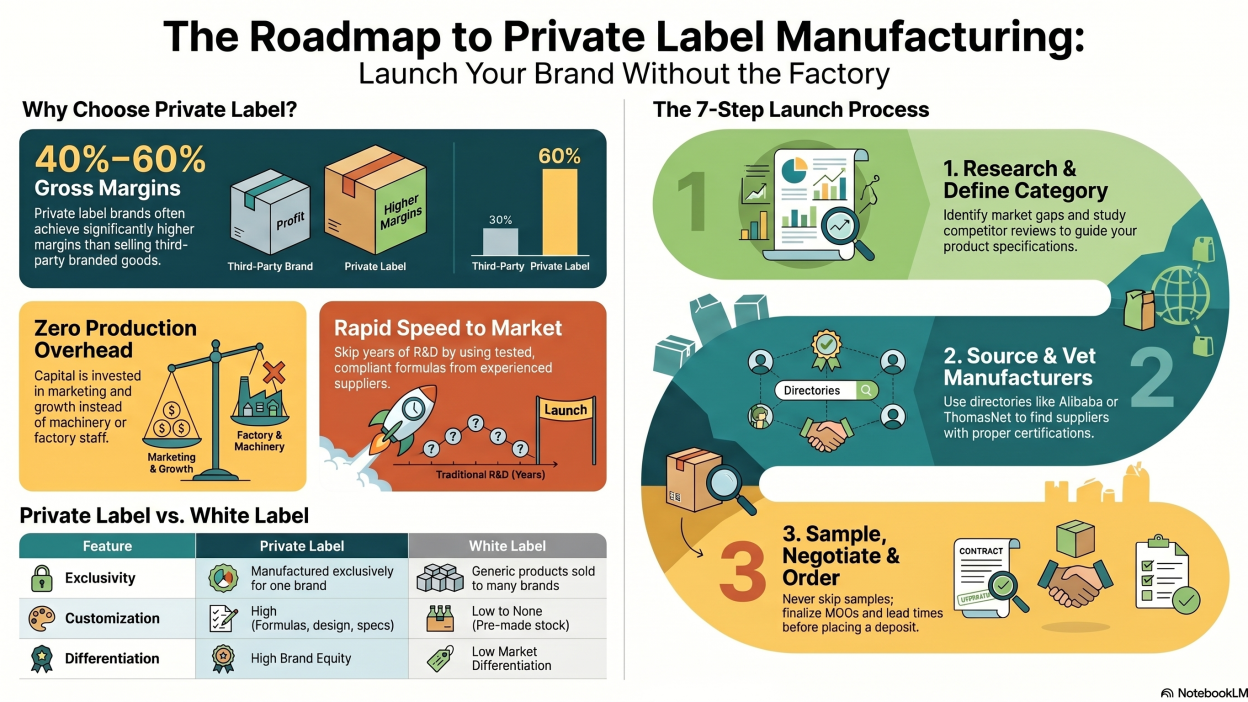
How Is Private Label Different from White Label?
These terms are often confused, but they are not identical:
- Private label products are manufactured exclusively for one brand. The formula, packaging, and specifications can often be customized.
- White label products are generic, pre-made products that multiple brands can put their name on without customization.
If exclusivity and brand differentiation matter to your business strategy, private label is the stronger option.
Why Businesses Choose Private Label Manufacturing
Thousands of entrepreneurs and established companies turn to private label manufacturing every year. The reasons are straightforward and compelling.
Brand Ownership Without Production Overhead
You build brand equity and customer loyalty without investing in manufacturing facilities, equipment, or production staff. Your capital goes into marketing and growth instead of machinery.
Higher Profit Margins
Private label products wholesale typically cost less than branded alternatives. You buy at manufacturer prices and sell at retail, capturing the margin in between. Many private label brands achieve 40–60% gross margins depending on the product category.
Product Customization
Unlike buying pre-made stock, working with private label suppliers lets you shape the product — ingredients, formulation, packaging size, label design, and fragrance or flavor profiles. You create something that reflects your brand values and meets your customers’ specific needs.
Speed to Market
Partnering with experienced private label manufacturers means you skip years of R&D. Most suppliers already have tested, compliant formulas ready to go. You get to focus on branding and launch.
Scalable Growth
Starting small is fine. Most private label wholesale suppliers offer low minimum order quantities (MOQs) for new brands. As your sales grow, you scale your orders without changing your supplier or production process.
How Private Label Manufacturing Works — Step by Step
Understanding the process helps you navigate it with fewer surprises.
Step 1: Define Your Product and Category
Start with research. What product do you want to sell? Who is your target customer? Study competitor products, read customer reviews, and identify gaps in the market. Your findings will guide conversations with private label suppliers.
Step 2: Find Private Label Manufacturers
This is the most critical step. Your manufacturer determines your product quality, compliance, delivery timelines, and ultimately your brand reputation. We cover how to find reliable private label manufacturers in detail below.
Step 3: Request Samples
Never commit to a supplier without ordering samples first. Evaluate product quality, packaging finish, consistency, and how closely the sample matches your specifications.
Step 4: Negotiate Terms
Discuss MOQs, pricing per unit at different order volumes, lead times, payment terms, and customization options. Get everything in writing before placing an order.
Step 5: Finalize Branding and Packaging
Work with your supplier or a third-party designer to finalize your label, packaging design, and any legal requirements (ingredient lists, warning labels, barcodes, etc.). Product label manufacturers can often assist with print-ready files and compliance requirements.
Step 6: Place Your First Order
Once samples are approved and terms are agreed, place your initial production order. Most suppliers require a deposit (typically 30–50%) upfront.
Step 7: Quality Control and Fulfillment
Inspect your goods before they ship — or hire a third-party inspection service for larger orders. Once approved, ship to your warehouse, 3PL, or direct to customers.
How to Find Reliable Private Label Suppliers
Sourcing the right private label suppliers separates successful brands from those that struggle. Here’s how to search smartly.
Online Directories and Marketplaces
Several platforms specialize in connecting brands with private label manufacturers:
- Alibaba — The largest global supplier directory with thousands of private label manufacturers across product categories. Use the “Verified Supplier” and “Trade Assurance” filters.
- ThomasNet — Focused on North American manufacturers, ideal for US-based private label products.
- Global Sources — Strong for electronics and consumer goods, especially Asia-based suppliers.
- Maker’s Row — Connects US brands with domestic manufacturers for apparel, accessories, and home goods.
- Private Label Select — A niche platform focused specifically on private label wholesale and contract manufacturing.
Trade Shows and Industry Events
Meeting suppliers in person builds trust faster than any email thread. Key trade shows for private label sourcing include:
- PLMA (Private Label Manufacturers Association) Trade Shows in Chicago and Amsterdam — the world’s largest private label events
- Natural Products Expo West for food, supplement, and wellness products
- Cosmoprof for beauty and personal care
- Canton Fair in Guangzhou, China for consumer goods across all categories
Industry Associations
The Private Label Manufacturers Association (PLMA) offers resources, supplier directories, and networking events specifically for private label businesses. Membership opens doors to vetted private label suppliers across every major category.
Referrals and Communities
Online communities — Reddit (r/Entrepreneur, r/FBA), Facebook groups, and LinkedIn — are valuable for peer referrals. When someone has already vetted a supplier, their recommendation shortens your research time significantly.
What to Look for in Private Label Manufacturers
Not all private label manufacturers deliver the same quality and reliability. Use this checklist when evaluating potential partners.
Manufacturing Certifications
Certifications signal that a manufacturer meets recognized quality and safety standards. Look for:
- ISO 9001 — Quality management systems
- GMP (Good Manufacturing Practices) — Critical for food, supplements, and cosmetics
- FDA Registration — Required for products sold in the US market
- CE Marking — Essential for electronics and certain goods in European markets
- USDA Organic / NSF Certified — Important for food and supplement brands
Minimum Order Quantities (MOQs)
MOQs vary widely. Some private label suppliers start at 100 units; others require 5,000+. Match the supplier’s MOQ to your launch budget and projected sales volume.
Customization Capabilities
Ask specifically:
- Can you modify the formula or product composition?
- Can you use custom packaging materials or sizes?
- What label printing options do you offer?
- Can you produce exclusive formulas not available to other clients?
Communication and Responsiveness
Poor communication is a red flag. A supplier who takes five days to respond to an email will likely cause delays during production. Test responsiveness before committing.
Production Lead Times
Understand clearly how long it takes from order placement to shipping. Typical lead times for private label manufacturing range from 2 to 12 weeks depending on product complexity, customization level, and order size.
References and Reviews
Ask for client references and check third-party review platforms like Trustpilot, Google Reviews, or supplier-specific feedback on Alibaba. A few conversations with existing clients can reveal a great deal about reliability and quality consistency.
Product Label Manufacturers: What You Need to Know
Your product’s label is your first point of physical branding. Working with the right product label manufacturers ensures your packaging looks professional and meets all regulatory requirements.
Label Requirements by Product Category
Different categories carry different labeling obligations:
- Food and Beverage: Nutritional facts panel, ingredient list, allergen statements, net weight, country of origin
- Dietary Supplements: Supplement facts, serving size, daily values, disclaimer language
- Cosmetics and Personal Care: Ingredient list (INCI names), usage warnings, net contents
- Electronics: Certification marks (CE, FCC, UL), model numbers, safety warnings
Your private label manufacturer may provide label templates that already comply with regulations in your target market. Always verify compliance with a regulatory consultant before printing at volume.
Label Materials and Finishes
Modern product label manufacturers offer a wide range of options:
- Matte or gloss laminate — Affects the premium feel of the product
- Foil accents — Popular in beauty and luxury goods
- Waterproof labels — Essential for personal care, bath, and beverage products
- Biodegradable and recycled materials — Increasingly demanded by eco-conscious consumers
Printing Methods
Common printing technologies include digital printing (better for small runs), flexographic printing (cost-effective for large volumes), and screen printing (ideal for specialized finishes). Work with your product label manufacturer to choose the method that balances quality and budget for your order size.
Private Label Products Wholesale: Building a Profitable Catalog
Buying private label products wholesale is one of the most effective ways to build a catalog quickly and keep your cost of goods low.
Best-Selling Private Label Product Categories
Some categories are particularly well-suited to private label because of high consumer demand and low brand loyalty:
- Health and Wellness: Vitamins, supplements, protein powders, and herbal products are among the highest-demand private label products worldwide.
- Beauty and Personal Care: Skincare, haircare, and cosmetics offer strong margins and allow deep brand differentiation.
- Food and Beverages: Coffee, tea, sauces, snack foods, and specialty items are all strong private label categories.
- Household Products: Cleaning supplies, air fresheners, and organization products sell well under private labels.
- Pet Products: Pet food, grooming products, and supplements are a rapidly growing private label wholesale segment.
- Fitness and Sports: Resistance bands, workout accessories, and gym apparel have seen surging demand for private label products.
Pricing Strategy for Private Label Wholesale
When calculating your pricing, factor in:
- Cost of Goods (COGS): Your per-unit manufacturing cost at your target order volume
- Shipping and Freight: Domestic delivery or international freight, duties, and customs
- Labeling and Packaging: Custom label printing and packaging materials
- Amazon/Platform Fees: If selling on Amazon FBA, include referral fees and fulfillment costs
- Target Margin: Most successful private label brands target a 3–5x markup on COGS
For example, if your product costs $4 per unit to manufacture and ship, a $16–$20 retail price is a reasonable starting point depending on competitive pricing in your category.
Selling Private Label Products: Key Channels
Once your private label products are ready, choosing the right sales channels determines how fast you grow.
VyaaparOne
VyaaparOne is rapidly emerging as a powerful B2B marketplace platform for manufacturers, suppliers, exporters, and private label businesses looking to scale in the digital economy. Unlike traditional marketplaces, VyaaparOne helps businesses build direct B2B connections, generate verified trade inquiries, and expand their reach across domestic and international markets. The platform enables sellers to showcase products, connect with genuine buyers, manage inquiries efficiently, and grow their brand visibility through a seamless and transparent ecosystem designed for modern wholesale trade.
Amazon FBA
Amazon remains the dominant channel for new private label brands. The FBA (Fulfilled by Amazon) model lets you ship inventory to Amazon warehouses and let them handle storage, shipping, and customer service. Amazon’s search traffic gives new brands immediate access to millions of buyers.
Shopify / Direct-to-Consumer (DTC)
A branded Shopify store gives you full control over customer data, messaging, and margin. DTC is slower to build initially but creates stronger brand equity and higher customer lifetime value over time.
Wholesale to Retailers
Selling your private label products wholesale to brick-and-mortar retailers, boutiques, or regional chains builds brand credibility and adds a revenue channel outside of Amazon. Platforms like Faire and Abound connect private label brands with independent retailers.
Subscription Models
Subscription boxes and auto-ship programs work exceptionally well for consumable private label products like supplements, coffee, or beauty products. Predictable recurring revenue improves your cash flow and supplier negotiations.
Common Mistakes to Avoid in Private Label Manufacturing
Even experienced business owners make these missteps. Knowing them in advance saves you time and money.
Skipping the Sample Stage
Ordering inventory without first approving samples is one of the costliest mistakes in private label. Always test multiple samples, check consistency across batches, and have end users evaluate the product before committing to a production run.
Ignoring Compliance Requirements
Regulatory requirements for your target market are non-negotiable. Products that don’t meet labeling, ingredient, or safety standards can be seized at customs or pulled from shelves. Invest in compliance review upfront.
Choosing Suppliers Solely on Price
The cheapest supplier is rarely the best choice. Prioritize quality, reliability, and communication over rock-bottom unit costs. A supplier who misses deadlines or delivers inconsistent quality will cost you far more than the savings justify.
Underestimating Lead Times
Build buffer time into your supply chain. Unexpected production delays, shipping congestion, or customs holds are common. Plan for 20–30% longer lead times than your supplier quotes, especially for first orders.
Neglecting Brand Differentiation
Selling the same product as dozens of other private label brands will push you into a race to the bottom on price. Invest in unique packaging, a clear brand story, and product differentiation to command better margins.
Conclusion
Private label manufacturing opens the door to building a real product brand without the enormous overhead of running your own factory. By partnering with the right private label manufacturers and sourcing private label products wholesale, you gain access to tested formulations, professional packaging, and scalable production — all under your brand name.
The key is doing your homework. Vet your private label suppliers carefully, insist on samples, understand your compliance obligations, and build a brand story that goes beyond the product itself. Businesses that treat private label as a brand-building opportunity — not just a sourcing tactic — are the ones that grow into recognized names in their categories.
Start small, stay focused, and scale what works. Your private label business starts with one great supplier relationship and one product worth putting your name on.
Frequently Asked Questions About Private Label Manufacturing
What is the typical MOQ for private label products?
MOQs vary significantly by supplier and product category. Many cosmetic and supplement private label suppliers start at 100–500 units. Food and beverage manufacturers often require 500–2,000 units minimum. Electronics and apparel suppliers may require larger volumes. Always negotiate MOQs — many suppliers have flexibility, especially for new client relationships.
How long does private label manufacturing take?
From initial supplier contact to receiving your first order, expect 6–16 weeks depending on customization complexity, production schedules, and shipping method. Rush options are sometimes available at higher cost.
Can I create fully custom formulas with private label manufacturers?
Yes. Many private label manufacturers offer custom formulation services where they develop an exclusive formula to your specifications. This often requires a higher MOQ and additional development fees, but it results in a truly proprietary product that competitors cannot replicate.
Is private label manufacturing legal?
Absolutely. Private label manufacturing is a standard, legal practice used by major retailers and independent brands worldwide. The key is ensuring your products comply with all applicable regulations in your target market, including labeling, ingredient safety, and import/export requirements.
How do I protect my product from being copied?
Register your brand as a trademark, file patents on genuinely novel formulations or designs, and include exclusivity clauses in your manufacturing agreements where possible. Building strong brand loyalty is ultimately the best protection against imitation.