Supply chains have never been more complex — or more critical. Across every sector, from automotive to electronics to pharmaceuticals, Global Manufacturing Trends are fundamentally reshaping how goods are produced, sourced, and delivered to market. Businesses that once relied on stable, predictable networks are now navigating a landscape defined by disruption, digital transformation, and the relentless pursuit of efficiency.
The COVID-19 pandemic, geopolitical tensions, and climate pressures exposed deep vulnerabilities in traditional supply chain models. In response, companies worldwide are rethinking their partnerships with global suppliers, investing in smarter technologies, and demanding more transparency across every tier of production.
Whether you are a procurement leader searching for the right global manufacturer, a logistics strategist tracking evolving sourcing dynamics, or a business owner looking to find global suppliers online, understanding these shifts is no longer optional. It is essential. This comprehensive guide explores the most significant Global Manufacturing Trends transforming supply chains today — and what they mean for your business tomorrow.
Understanding Today’s Global Manufacturing Trends
The term “global manufacturing” has changed dramatically over the past decade. What was once synonymous with offshoring to the cheapest available labor market has evolved into a sophisticated, multi-dimensional strategy balancing cost, quality, speed, and risk.
Today’s Global Manufacturing Trends are shaped by several converging forces:
- Geopolitical realignment — Trade wars, tariff policies, and shifting alliances are prompting companies to diversify their sourcing geographies rather than concentrating production in a single region.
- Technological advancement — Automation, artificial intelligence, and the Industrial Internet of Things (IIoT) are changing what it means to manufacture at scale.
- Consumer expectations — Modern buyers demand faster delivery, greater product variety, and provable sustainability credentials.
- Regulatory pressures — Governments worldwide are tightening rules around supply chain transparency, labor standards, and carbon emissions.
- Raw material volatility — From semiconductors to rare earth minerals, input shortages have pushed global manufacturers to rethink procurement strategies entirely.
Understanding these forces is the first step toward building a supply chain that thrives — not just survives — in the current environment.
What Has Changed in Global Supply Chains?
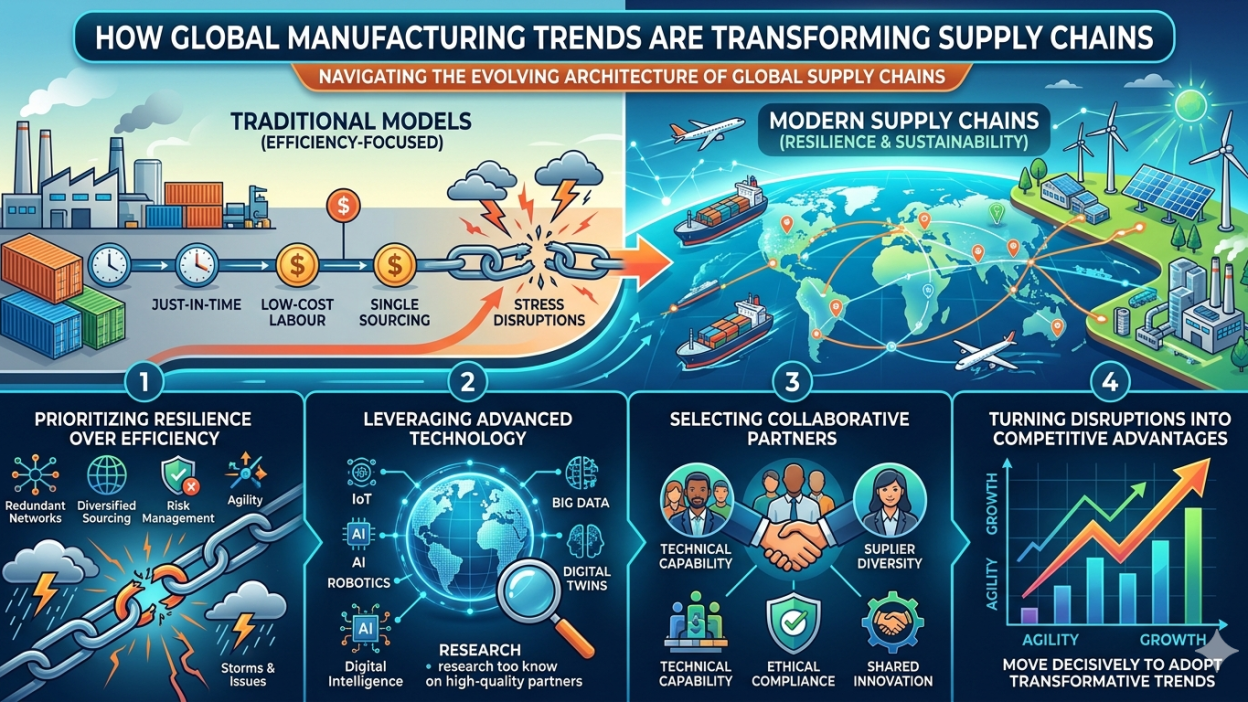
Historically, global supply chains operated on a “just-in-time” philosophy. Companies minimized inventory to reduce costs, relying on predictable deliveries from a small number of trusted global suppliers. That model delivered impressive efficiency gains for decades.
Then, in 2020, it collapsed spectacularly.
Port shutdowns, factory closures, and shipping bottlenecks created cascading shortages across industries. The semiconductor shortage alone cost the automotive industry an estimated $210 billion in lost revenues in 2021. These disruptions made clear that efficiency without resilience is a liability.
Today, leading companies are rebuilding their supply chains with a “just-in-case” mindset, diversifying their networks of global suppliers, building buffer inventories for critical inputs, and reducing over-dependence on any single country or region.
How Global Manufacturing Companies Are Reinventing Operations
The world’s top global manufacturing companies are not sitting still. They are making bold strategic moves to position themselves for a more uncertain, more digital, and more sustainability-conscious future.
Nearshoring and Reshoring
One of the most prominent Global Manufacturing Trends of recent years is the movement of production closer to end markets. Nearshoring — relocating manufacturing to a nearby country rather than a distant one — reduces shipping times, cuts logistics costs, and offers greater supply chain control.
Mexico, for example, has become one of the fastest-growing manufacturing hubs in the Americas, attracting investment from global manufacturing companies in automotive, aerospace, and electronics. In Europe, countries like Poland, Romania, and Morocco are absorbing production previously centered in Asia.
Reshoring — bringing production back to the home country — is gaining traction in North America. The U.S. Chips and Science Act, the Inflation Reduction Act, and similar legislation are incentivizing global manufacturers to build domestic capacity in strategic sectors such as semiconductors, electric vehicles, and clean energy equipment.
Regionalization of Supply Chains
Rather than building single global supply chains, forward-thinking global manufacturing companies are creating multiple regional networks — each capable of serving its local market semi-independently. This “China plus one” strategy (or “plus many”) reduces the risk of a single point of failure while preserving some of the cost advantages associated with global sourcing.
Vertical Integration
Some global manufacturers are moving to vertically integrate key supply chain steps, acquiring suppliers or building in-house capabilities in critical materials and components. This reduces dependency on third-party global suppliers for inputs that carry the highest strategic risk.
How to Find Global Suppliers Online
Sourcing the right partners is at the heart of any successful manufacturing strategy. With the rise of digital platforms and data-driven procurement tools, it has never been easier to find global suppliers online — but it has also never been more important to vet them carefully.
Leading Platforms to Find Global Suppliers Online
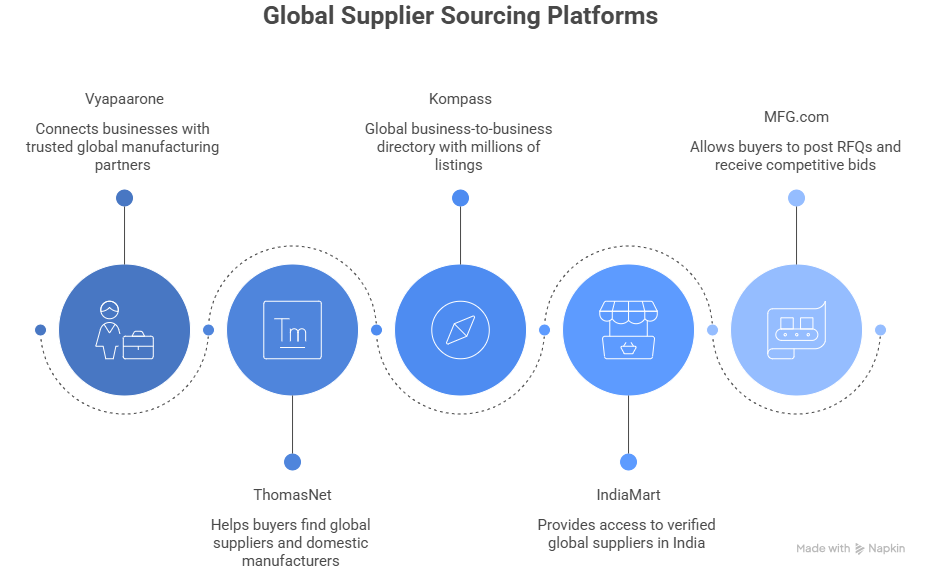
Several digital marketplaces and sourcing platforms have transformed how businesses connect with global suppliers:
1. Vyaaparone Vyapaarone connects businesses with trusted global manufacturing partners and verified suppliers across multiple industries. The platform offers streamlined sourcing solutions, supplier verification, product discovery, and direct business communication tools. Ideal for companies looking for reliable B2B manufacturing, wholesale sourcing, and scalable supply chain partnerships.
2. ThomasNet A leading industrial sourcing platform in North America, ThomasNet helps buyers find global suppliers and domestic manufacturers across thousands of product categories. Its detailed supplier profiles include certifications, capabilities, and quality standards.
3. Kompass Kompass is a global business-to-business directory with listings for millions of global manufacturing companies across 70+ countries. It is particularly strong for European and emerging-market sourcing.
4. IndiaMart For businesses looking to source from India — now one of the world’s fastest-growing manufacturing hubs — IndiaMart provides access to a vast network of verified global suppliers across textiles, engineering, chemicals, and more.
5. MFG.com Designed specifically for custom manufacturing, MFG.com allows buyers to post RFQs (requests for quotation) and receive competitive bids from global manufacturers worldwide.
Best Practices When You Find Global Suppliers Online
Simply finding a global manufacturer on a platform is not enough. Due diligence is essential:
- Request certifications — ISO 9001, ISO 14001, and industry-specific quality standards indicate a professional global manufacturer with documented processes.
- Conduct factory audits — Whether in person or through a third-party audit firm, visiting a global supplier’s production facility reveals realities that paperwork cannot.
- Check trade references — Speak with other buyers who have worked with the global manufacturer to understand their performance on delivery, quality, and communication.
- Start small — Before placing a large order with a new global supplier, run a pilot order to test quality, lead times, and responsiveness.
- Use escrow and trade assurance — When finding global suppliers online through platforms, leverage built-in payment protection tools to reduce financial risk.
The rise of AI-powered procurement tools is also changing how companies identify and evaluate global suppliers. Platforms are increasingly using machine learning to match buyers with the most suitable global manufacturing companies based on product specifications, capacity, compliance records, and pricing benchmarks.
Key Technologies Driving Change in Global Manufacturing
Technology is at the core of every major shift in Global Manufacturing Trends today. The factories of the future are already being built — and they look nothing like the factories of the past.
Artificial Intelligence and Machine Learning
AI is transforming production planning, quality control, and demand forecasting across global manufacturing operations. Machine learning algorithms analyze historical data and real-time signals to predict equipment failures before they occur (predictive maintenance), optimize production schedules, and flag quality defects with greater accuracy than human inspectors.
Global manufacturing companies investing in AI-driven quality control report defect rate reductions of up to 50%, alongside significant cuts in waste and rework costs. For global suppliers handling high-volume, precision-critical components, this is a game-changer.
The Industrial Internet of Things (IIoT)
IIoT connects machines, sensors, and systems across a global manufacturer’s factory floor — and beyond, into the wider supply chain. Real-time data from connected devices enables:
- Remote monitoring of equipment performance across multiple global manufacturing facilities
- Supply chain visibility that tracks materials from the global supplier’s warehouse to the customer’s door
- Energy management optimization that reduces consumption and supports sustainability goals
- Dynamic production adjustments based on live demand signals
IIoT adoption among global manufacturing companies has accelerated sharply, with the global industrial IoT market projected to surpass $500 billion by 2030.
Robotics and Advanced Automation
Collaborative robots (cobots) are now affordable enough for small and medium-sized global manufacturers to deploy. Unlike traditional industrial robots, cobots work alongside human workers safely, handling repetitive or ergonomically challenging tasks while freeing people for higher-value work.
In industries where labor costs are rising — including China, historically the world’s largest global manufacturing hub — robotics adoption is accelerating. Global manufacturing companies are automating not to eliminate workers, but to remain cost-competitive and maintain production quality at scale.
Additive Manufacturing (3D Printing)
Additive manufacturing is reshaping how global manufacturers think about prototyping, tooling, and even end-part production. 3D printing enables:
- Faster product development cycles
- On-demand spare parts production, reducing the need to hold large inventories across global supply chains
- Customized components without the cost penalties of traditional machining
- Localized production of parts previously sourced from distant global suppliers
As materials science advances, additive manufacturing is expanding from plastics into metals, ceramics, and composites — opening new possibilities for global manufacturers in aerospace, medical devices, and industrial equipment.
Blockchain for Supply Chain Transparency
Blockchain technology is gaining traction as a tool for verifying the authenticity and provenance of materials across complex global supply chains. By creating an immutable, shared record of transactions, blockchain enables global manufacturers and global suppliers to prove:
- Where raw materials were sourced
- That labor practices met ethical standards
- That products have not been counterfeited or tampered with in transit
This traceability is increasingly demanded by regulators and consumers alike — making blockchain a key enabler for global manufacturing companies building trust in their supply chains.
Sustainability: The New Non-Negotiable in Global Manufacturing
Sustainability has moved from a nice-to-have to a business-critical imperative for global manufacturing companies. Regulatory requirements, investor pressure, and shifting consumer preferences are all pushing global manufacturers toward greener operations.
Decarbonizing Global Manufacturing
Manufacturing accounts for approximately 20% of global CO₂ emissions. Reducing that footprint is central to the climate commitments many global manufacturing companies have made under the Paris Agreement and related frameworks.
Key decarbonization strategies include:
- Transitioning to renewable energy at manufacturing facilities
- Electrifying industrial processes currently reliant on fossil fuels
- Optimizing logistics to reduce transportation emissions across global supply chains
- Working with global suppliers to measure and reduce Scope 3 emissions
Global Manufacturing Trends are increasingly being shaped by carbon accounting. Companies that cannot demonstrate a credible decarbonization pathway are finding it harder to win contracts, attract investors, and retain top talent.
Circular Economy Models
Forward-looking global manufacturers are embracing circular economy principles — designing products for disassembly, recovering end-of-life materials, and building reverse logistics networks. This approach reduces reliance on virgin raw materials (and the global suppliers who provide them), cuts waste costs, and creates new revenue streams from recovered materials.
Companies like Renault, Caterpillar, and Michelin have pioneered circular manufacturing models that are now influencing industry standards worldwide.
Responsible Sourcing
Businesses are under growing scrutiny for the labor and environmental practices of their global suppliers. Legislation like the EU Corporate Sustainability Due Diligence Directive and the U.S. Uyghur Forced Labor Prevention Act requires companies to verify that their global supply chains are free from human rights abuses.
This is driving greater investment in supplier auditing, ethical sourcing certifications, and supply chain mapping tools that give companies visibility deep into their global supplier networks.
Resilience Strategies for Modern Global Suppliers
Building a resilient supply chain is the defining challenge of this era of global manufacturing. Here are the strategies global manufacturers are deploying:
Dual Sourcing and Multi-Sourcing
Rather than relying on a single global supplier for critical components, companies are qualifying two or more sources. This adds some procurement complexity but dramatically reduces the risk of a single supplier disruption cascading into a production shutdown.
Safety Stock and Strategic Inventory
Just-in-case inventory management is back in favor. Global manufacturing companies are rebuilding buffer stocks of key components, particularly those with long lead times or limited global supplier alternatives. The added carrying cost is viewed as affordable insurance against supply chain shocks.
Supply Chain Mapping and Risk Monitoring
Many global manufacturers previously had little visibility beyond their first-tier global suppliers. Modern supply chain mapping tools now enable companies to identify their sub-tier suppliers — and the risks those deeper relationships carry. AI-powered risk monitoring platforms continuously scan news, financial data, and geopolitical signals to flag emerging threats before they become crises.
Flexible Manufacturing Capabilities
Global manufacturers are investing in flexible production systems that can quickly shift between product types, volumes, and specifications. This agility allows them to respond rapidly to demand changes, supply disruptions, or new market opportunities.
What Makes a Trusted Global Manufacturer?
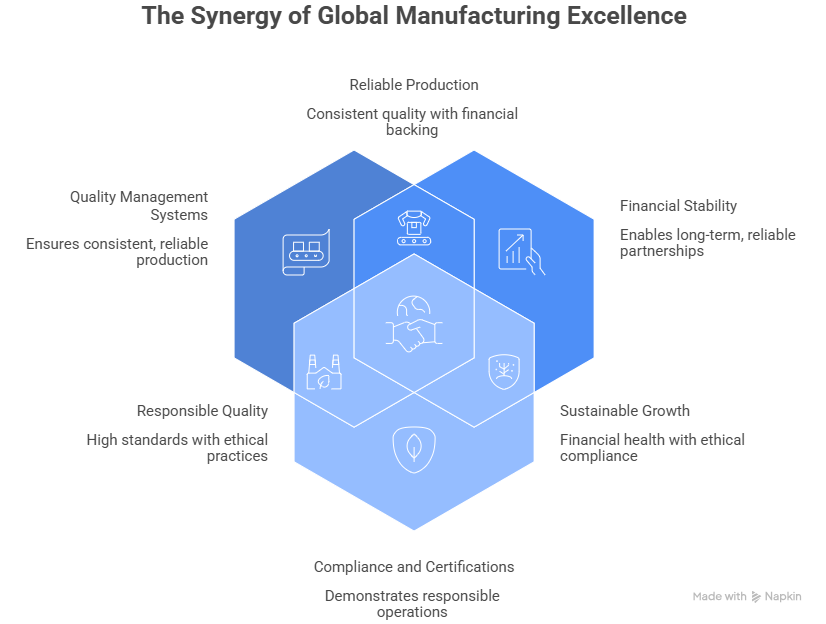
Not every global manufacturer is created equal. As supply chain risk management becomes more sophisticated, the criteria for selecting and retaining global manufacturing partners are evolving.
Quality Management Systems
A trustworthy global manufacturer operates under a certified quality management system — most commonly ISO 9001. This standard ensures that production processes are documented, monitored, and continuously improved. Industry-specific standards, such as IATF 16949 for automotive or AS9100 for aerospace, signal even higher levels of quality discipline.
Financial Stability
A global supplier that is financially fragile is a supply chain risk. Before committing to a global manufacturer as a key partner, assess their financial health through credit checks, financial statements, and industry references. A stable global manufacturer is one that can invest in capacity, technology, and people — and weather economic downturns.
Compliance and Certifications
Top global manufacturing companies maintain current certifications across environmental management (ISO 14001), workplace safety (ISO 45001), and sector-specific regulatory requirements. These certifications signal that the global manufacturer takes compliance seriously and has the systems to maintain it.
Communication and Transparency
Perhaps the most underrated quality in a global supplier relationship is straightforward, proactive communication. Global manufacturing operations are complex — problems will arise. The global manufacturers who distinguish themselves are those who surface issues early, communicate clearly, and work collaboratively to find solutions.
Innovation Capability
As Global Manufacturing Trends evolve rapidly, working with a global manufacturer that invests in research, technology, and process innovation becomes a competitive advantage. The best global manufacturing companies act as genuine partners in product development — bringing ideas, insights, and engineering expertise to the relationship.
The Future of Supply Chains According to Global Manufacturing Trends
Looking ahead, Global Manufacturing Trends point toward several major transformations in how global supply chains will operate over the next decade.
Hyper-Localization and Mass Customization
Advances in digital manufacturing — 3D printing, CNC machining, modular automation — are making it economically viable to produce small batches of highly customized products at distributed locations close to end consumers. This will reduce the role of centralized global manufacturing hubs and create new opportunities for regional and local global suppliers.
AI-Orchestrated Supply Chains
Artificial intelligence will increasingly move from a decision-support tool to an active orchestration layer in global supply chains. AI systems will autonomously adjust procurement, production scheduling, and logistics in response to real-time signals — reducing the lag time between disruptions and responses from weeks to hours.
Digital Twins
Digital twin technology — creating virtual replicas of physical manufacturing assets and supply chain networks — is enabling global manufacturing companies to simulate disruptions, test operational changes, and optimize performance without risking real-world production. As digital twin platforms mature, they will become standard infrastructure for any serious global manufacturer.
Green Supply Chains as Competitive Advantage
Sustainability will become an increasing differentiator between global manufacturing companies. Those who can demonstrate verifiable, science-based emissions reductions across their supply chains will earn preferred supplier status with leading brands — and command premium prices. Those who cannot will face exclusion from high-value customer relationships.
The Rise of Manufacturing as a Service (MaaS)
The “as a service” model is spreading from software to manufacturing. Manufacturing as a Service platforms connect product companies with a distributed network of global manufacturers who can produce on demand, without the buyer needing to own or manage factory assets. This model reduces capital intensity, accelerates time to market, and democratizes access to sophisticated global manufacturing capabilities.
Conclusion
The forces reshaping Global Manufacturing Trends are not temporary disruptions — they are structural shifts redefining the rules of global competition. Supply chains that served businesses well for decades are being fundamentally reimagined. The global manufacturers and global suppliers who will thrive are those who embrace technology, prioritize resilience, and build sustainability into the core of their operations.
For businesses seeking to navigate this landscape, the path forward begins with knowledge. Understanding which Global Manufacturing Trends are relevant to your industry, knowing how to find global suppliers online who meet the highest standards of quality and compliance, and selecting global manufacturing companies with the capabilities and values to be true partners — these are the foundations of supply chain success in the modern era.
The transformation of global manufacturing is not a challenge to endure. It is an opportunity to build something stronger. The companies that move decisively — investing in the right global manufacturers, embracing new technologies, and committing to resilient and responsible supply chains — will emerge as the leaders of the next era of global commerce.
Frequently Asked Questions
What are the most important Global Manufacturing Trends shaping supply chains today?
The most significant Global Manufacturing Trends currently transforming supply chains include nearshoring and reshoring of production, AI-driven automation, IIoT adoption, supply chain digitization, sustainability mandates, and the shift from just-in-time to resilience-focused inventory strategies. Each of these trends is pushing global manufacturers to build supply chains that are smarter, greener, and more flexible.
How can I find global suppliers online for my business?
The best way to find global suppliers online is through B2B sourcing platforms such as Vyaaparone, ThomasNet, Kompass, IndiaMart, and MFG.com. When evaluating global suppliers, prioritize verified certifications, trade references, and factory audit reports. Starting with a small trial order before scaling up is strongly recommended.