Introduction
The global sugar trade is one of the most active commodity markets in the world. Whether you’re a buyer, trader, or distributor, understanding the top sugar exporters gives you a competitive edge in securing the best deals. With billions of dollars flowing through sugar supply chains every year, knowing where the sugar comes from — and how to connect with reliable suppliers — is critical for success.
This guide covers everything you need: from the world’s largest exporter of sugar, to actionable sugar export leads, sugar export data, HS codes, and how to use import export trade leads to grow your sugar business. If you’re ready to tap into global sugar trade opportunities, keep reading.
What Is the Sugar HS Code and Why Does It Matter?
Before diving into the list of sugar exporters, understanding the sugar HS code is essential for any trade professional. The Harmonized System (HS) code is an internationally standardized classification used in customs declarations and trade documentation.
The most commonly used HS codes for sugar are:
| Sugar Type | HS Code |
| Raw cane or beet sugar | 1701.12 / 1701.13 |
| Refined white sugar | 1701.99 |
| Cane molasses | 1703.10 |
| Beet sugar | 1701.14 |
| Other sugars (glucose, fructose) | 1702 |
Using the correct HS code ensures smooth customs clearance, accurate tariff calculation, and valid import export leads data. When sourcing sugar export data from trade intelligence platforms, always filter by the correct HS code to get precise shipment records.
World Largest Exporter of Sugar: An Overview
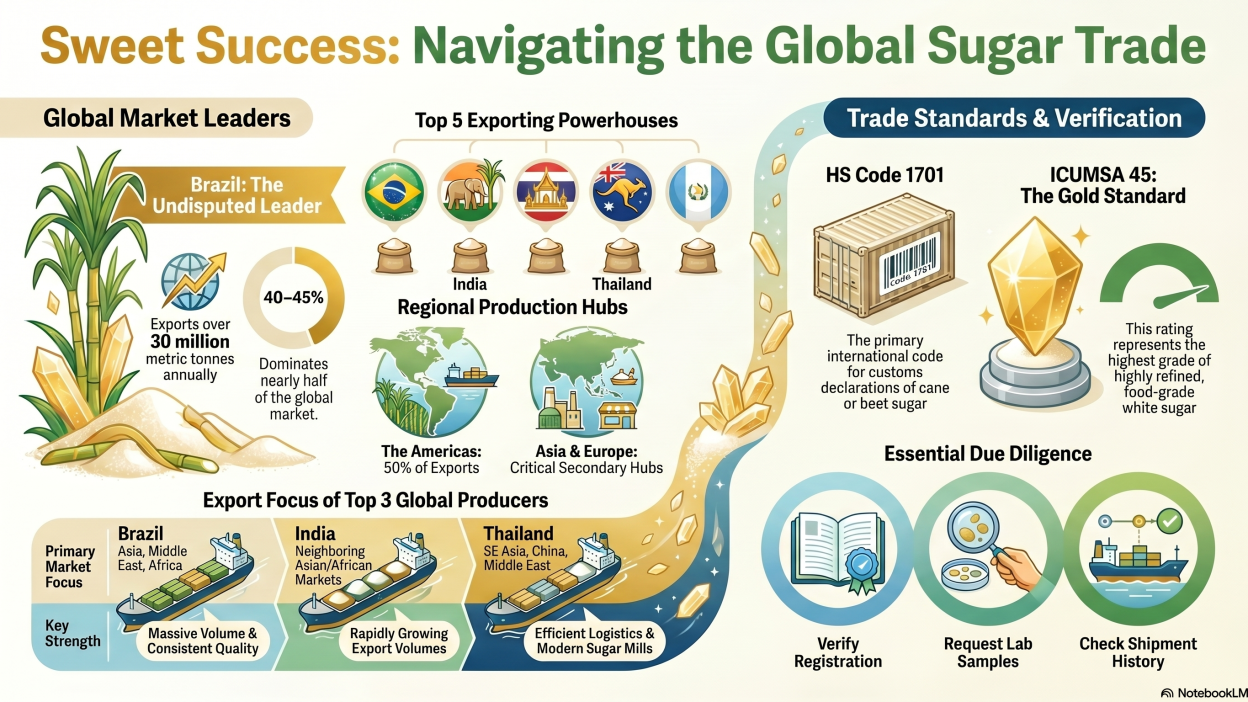
Brazil holds the title of the world’s largest exporter of sugar — and has maintained this position for decades. The country’s tropical climate, massive sugarcane plantations, and advanced processing infrastructure make it a dominant force in global sugar supply.
Brazil exports over 30 million metric tonnes of sugar annually, primarily to markets in Asia, the Middle East, and Africa. Its sugar industry is deeply integrated with the ethanol sector, giving producers the flexibility to pivot between fuel and food-grade sugar depending on global market conditions.
However, Brazil is not alone. Several other nations have emerged as significant players, making the top sugar exporting countries a diverse group spread across multiple continents.
Top 10 Sugar Exporters in the World
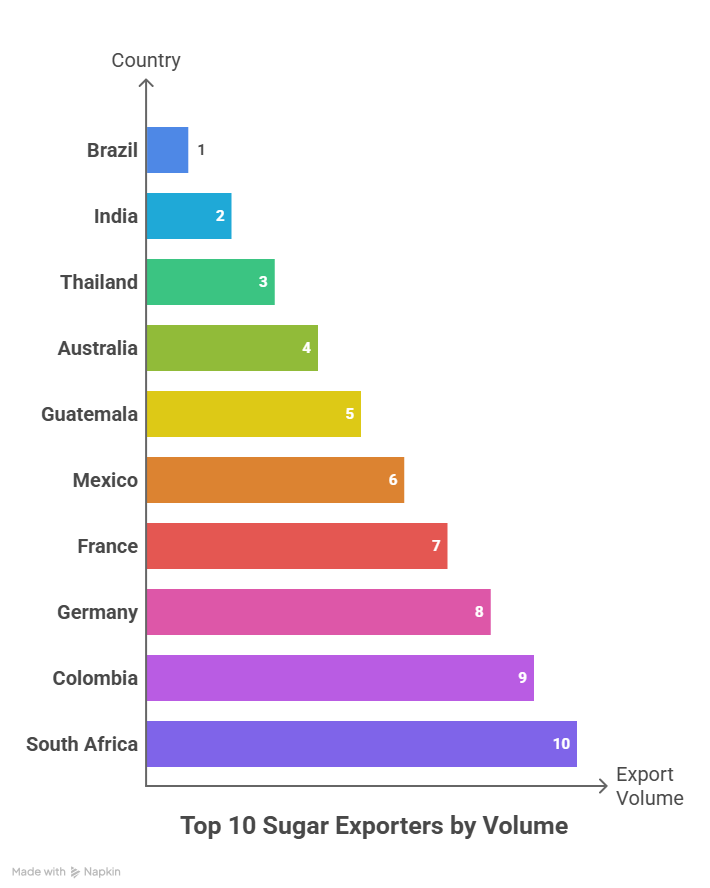
Here is a detailed look at the top 10 sugar exporters that dominate global trade today:
1. Brazil
Brazil is the undisputed largest sugar exporter in the world. Its state of São Paulo alone produces more sugar than most countries combined. Brazilian sugar is well known for its consistent quality, competitive pricing, and massive export volumes. ICUMSA 45 white refined sugar from Brazil is among the most traded grades globally.
2. India
India has rapidly grown to become the second-largest sugar exporter in recent years. With government subsidies supporting its sugarcane sector, India exports large volumes — particularly to neighboring Asian and African markets. Its sugar export volumes have fluctuated based on domestic policy but remain substantial.
3. Thailand
Thailand is a consistent top-three sugar exporting country, known for high-quality raw and refined sugar. Thai sugar is a favorite across Southeast Asia, China, and the Middle East. The country’s modern sugar mills and efficient logistics contribute to strong export performance.
4. Australia
Australia ranks among the top sugar exporters globally, with Queensland being the heart of its sugarcane industry. Australian raw sugar is widely respected for its quality and is exported primarily to Japan, South Korea, and other Asia-Pacific markets.
5. Guatemala
Guatemala is one of the most efficient sugar producers in Central America and a notable exporter to the United States and Europe. Its sugarcane yields are among the highest in the world, and it consistently features on any list of sugar exporters ranking by efficiency.
6. Mexico
Mexico exports significant quantities of sugar to the United States under NAFTA/USMCA trade agreements. It is both a large consumer and a notable exporter, particularly of high-fructose corn syrup alternatives and refined cane sugar.
7. France
France represents Europe’s strongest sugar export presence. As a major beet sugar producer, it exports refined white sugar across the EU and to international markets, particularly in West Africa.
8. Germany
Germany is another key European beet sugar producer and exporter. Its refined sugar is highly valued in global markets, and German sugar companies maintain strong B2B sugar export business leads networks across multiple regions.
9. Colombia
Colombia has a thriving sugarcane sector concentrated in the Cauca Valley region. It exports refined and raw sugar to a variety of markets, including the US, Chile, and parts of Africa.
10. South Africa
South Africa is sub-Saharan Africa’s largest sugar producer and exporter. KwaZulu-Natal is the primary production hub, and the country exports to African and Asian markets with growing volume year over year.
Sugar Export Data: How to Use It for Business Growth
Accessing reliable sugar export data is one of the most powerful tools for traders, importers, and sourcing agents. This data contains:
- Exporter names and contact details
- Shipment dates and frequencies
- Port of origin and destination
- Quantity exported (in metric tonnes or containers)
- FOB/CIF values and unit prices
- Buyer and consignee information
Platforms that provide verified import export trade leads and customs shipment data allow you to identify active sugar suppliers, benchmark pricing, and discover new buyer-seller relationships.
Key Data Points to Analyze
When reviewing sugar export data, focus on:
Volume Trends — Monitor how export volumes from top sugar exporting countries fluctuate seasonally. Brazil’s harvest season (April–November) typically drives peak supply.
Price Benchmarks — FOB pricing from sugar export records helps you negotiate better deals and understand fair market value.
Trade Routes — Knowing which ports and shipping lanes are most active helps you plan logistics and reduce transit risk.
Buyer-Seller Matching — Shipment data reveals who is buying from whom, giving you intelligence to approach potential partners directly.
How to Find Sugar Export Leads for Your Business
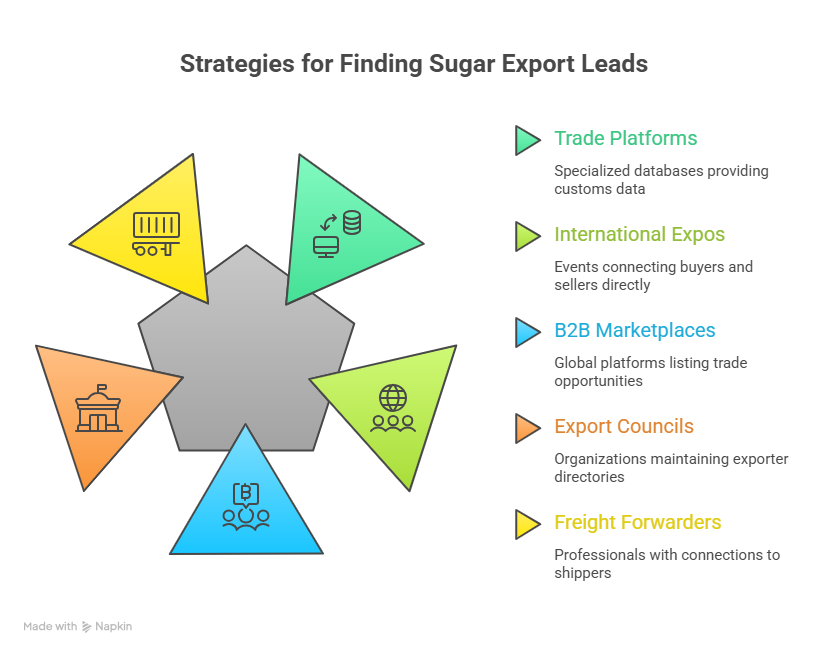
Generating quality sugar export leads is the core challenge for anyone in the sugar trading business. Whether you are a buyer looking for suppliers or a supplier looking for buyers, the right lead generation strategy makes all the difference.
1. Use Import Export Trade Leads Platforms
Specialized import export leads databases aggregate customs data from dozens of countries. These platforms let you search by HS code, country, company name, or date range to find active sugar traders. This is the fastest way to build a targeted list of sugar exporters.
2. Attend International Trade Expos
Events like the Sugar Industry Show, Dubai International Food Safety Conference, and Anuga FoodTec connect buyers and sellers directly. These events are excellent for generating sugar export business leads and forming long-term partnerships.
3. Register on B2B Marketplaces
Global B2B platforms are key sources of sugar leads. Listing your requirements or capabilities on platforms like TradeIndia, IndiaMART, or ExportHub connects you with verified counterparties actively searching for sugar trade opportunities.
4. Connect with Export Promotion Councils
Export bodies in major producing countries — such as Brazil’s UNICA, India’s ISMA, or Thailand’s OCSB — often maintain directories of registered exporters and can connect you with vetted sugar export leads.
5. Leverage Freight Forwarder Networks
Freight forwarders who specialize in commodity trades often have direct connections to active sugar shippers. Building relationships with these professionals opens doors to import export leads that aren’t publicly listed.
Understanding the Sugar Export Business: Key Considerations
Getting into the sugar export business requires more than just finding leads. Here are the critical factors every trader must understand:
Quality Grades and ICUMSA Ratings
Sugar is graded by color using the ICUMSA (International Commission for Uniform Methods of Sugar Analysis) rating:
- ICUMSA 45 – Highly refined white sugar, bright white color, food-grade
- ICUMSA 100 – Slightly less refined, used in food processing
- ICUMSA 600–1200 – Raw brown sugar, common in bulk commodity trade
- VHP (Very High Polarization) Sugar – Semi-refined, preferred for re-processing
Always confirm the ICUMSA grade when reviewing sugar export business leads to ensure the product matches your end-use or buyer requirements.
Payment Terms
Sugar export deals commonly use:
- L/C (Letter of Credit) – Most secure for high-value transactions
- CAD (Cash Against Documents) – Used for trusted relationships
- TT (Telegraphic Transfer) – For smaller or pre-verified transactions
Packaging and Shipping
Sugar is shipped in bulk (for industrial buyers) or in 50kg/1MT bags. Incoterms such as FOB, CIF, and CFR are standard in sugar export data records and define who bears cost and risk at each point in the journey.
Top Sugar Exporting Countries: Regional Breakdown
Understanding regional dynamics helps you target the right source markets for your sugar needs.
Americas
Brazil and Colombia dominate South America, while Guatemala and Mexico lead Central America. The Americas account for over 50% of global sugar exports, making this region the heartbeat of the sugar export market.
Asia
India and Thailand are Asia’s powerhouses. Both nations have modernized their processing infrastructure and compete strongly on price. Sugar export leads from this region are often for ICUMSA 100 and raw grades.
Europe
France, Germany, and Poland are Europe’s leading beet sugar exporters. EU-origin sugar commands a premium for quality assurance and meets strict food safety standards demanded by buyers in MENA and Africa.
Africa
South Africa leads sub-Saharan Africa, while Egypt and Swaziland (Eswatini) are notable regional exporters. African-origin sugar is increasingly competitive as production technology improves.
Oceania
Australia remains Oceania’s dominant exporter. Its proximity to Asia-Pacific markets gives it a logistics advantage that supports consistent export volumes.
How to Verify a Sugar Exporter Before Closing a Deal
With high-value commodity trades, due diligence is non-negotiable. Before closing a sugar deal found through import export trade leads, always:
- Verify company registration – Check that the exporter is legally registered in their home country.
- Request product samples – Lab-test the sugar for ICUMSA rating, moisture content, and purity before signing a large contract.
- Check shipment history – Use sugar export data to confirm the company has a genuine track record of exports.
- Review SGS/Inspection reports – Ask for third-party inspection certificates from SGS, Bureau Veritas, or Intertek.
- Confirm banking details independently – Fraud in commodity trades is real. Always verify bank details through official channels.
Sugar Export Leads: Frequently Asked Questions
What is the largest exporter of sugar in the world?
Brazil is the largest exporter of sugar globally, accounting for approximately 40–45% of world sugar exports. Its massive sugarcane production in the Center-South region drives this dominance.
Which countries are the top sugar exporting countries?
The top sugar exporting countries include Brazil, India, Thailand, Australia, Guatemala, Mexico, France, Germany, Colombia, and South Africa. These nations collectively supply most of the world’s traded sugar.
What is the HS code for sugar exports?
The primary sugar HS code is 1701, which covers cane or beet sugar and chemically pure sucrose. Sub-categories include 1701.12 (raw cane sugar), 1701.13 (cane sugar from sugarcane), and 1701.99 (refined white sugar).
How can I find verified sugar export leads?
You can find verified sugar export leads through import export trade data platforms, B2B marketplaces, trade associations, industry expos, and freight forwarder networks. Using customs shipment data filtered by sugar HS codes gives you the most accurate and actionable leads.
What is ICUMSA 45 sugar?
ICUMSA 45 is the highest grade of refined white sugar, characterized by a sparkling white color and fine crystalline texture. It is the most traded grade in the global sugar export market and is used in food, beverage, and confectionery industries.
How do I use sugar export data for sourcing?
Sugar export data helps you identify active exporters, track shipment volumes, compare pricing, and discover trading patterns. Platforms that aggregate customs records allow you to search by HS code (1701), origin country, date range, and buyer/seller name to build a precise supplier list.
Final Thought
The global sugar market presents massive opportunities for importers, traders, and distributors who know where to look. By understanding the top sugar exporters, leveraging verified sugar export leads, and using accurate sugar export data, you can build profitable relationships across the supply chain.
Whether you’re sourcing ICUMSA 45 refined sugar from Brazil, raw VHP from India, or high-quality beet sugar from Europe, the key is connecting with the right suppliers through reliable import export trade leads platforms.
Start by identifying the right sugar HS code for your product category, search verified shipment data, and reach out to active exporters in the top sugar exporting countries. With the right information and strategy, your sugar trade business can scale faster than you think.
Sugar Export Leads: Frequently Asked Questions
What is the largest exporter of sugar in the world?
Brazil is the largest exporter of sugar globally, accounting for approximately 40–45% of world sugar exports. Its massive sugarcane production in the Center-South region drives this dominance.
Which countries are the top sugar exporting countries?
The top sugar exporting countries include Brazil, India, Thailand, Australia, Guatemala, Mexico, France, Germany, Colombia, and South Africa. These nations collectively supply most of the world’s traded sugar.
What is the HS code for sugar exports?
The primary sugar HS code is 1701, which covers cane or beet sugar and chemically pure sucrose. Sub-categories include 1701.12 (raw cane sugar), 1701.13 (cane sugar from sugarcane), and 1701.99 (refined white sugar).
How can I find verified sugar export leads?
You can find verified sugar export leads through import export trade data platforms, B2B marketplaces, trade associations, industry expos, and freight forwarder networks. Using customs shipment data filtered by sugar HS codes gives you the most accurate and actionable leads.
What is ICUMSA 45 sugar?
ICUMSA 45 is the highest grade of refined white sugar, characterized by a sparkling white color and fine crystalline texture. It is the most traded grade in the global sugar export market and is used in food, beverage, and confectionery industries.
How do I use sugar export data for sourcing?
Sugar export data helps you identify active exporters, track shipment volumes, compare pricing, and discover trading patterns. Platforms that aggregate customs records allow you to search by HS code (1701), origin country, date range, and buyer/seller name to build a precise supplier list.