
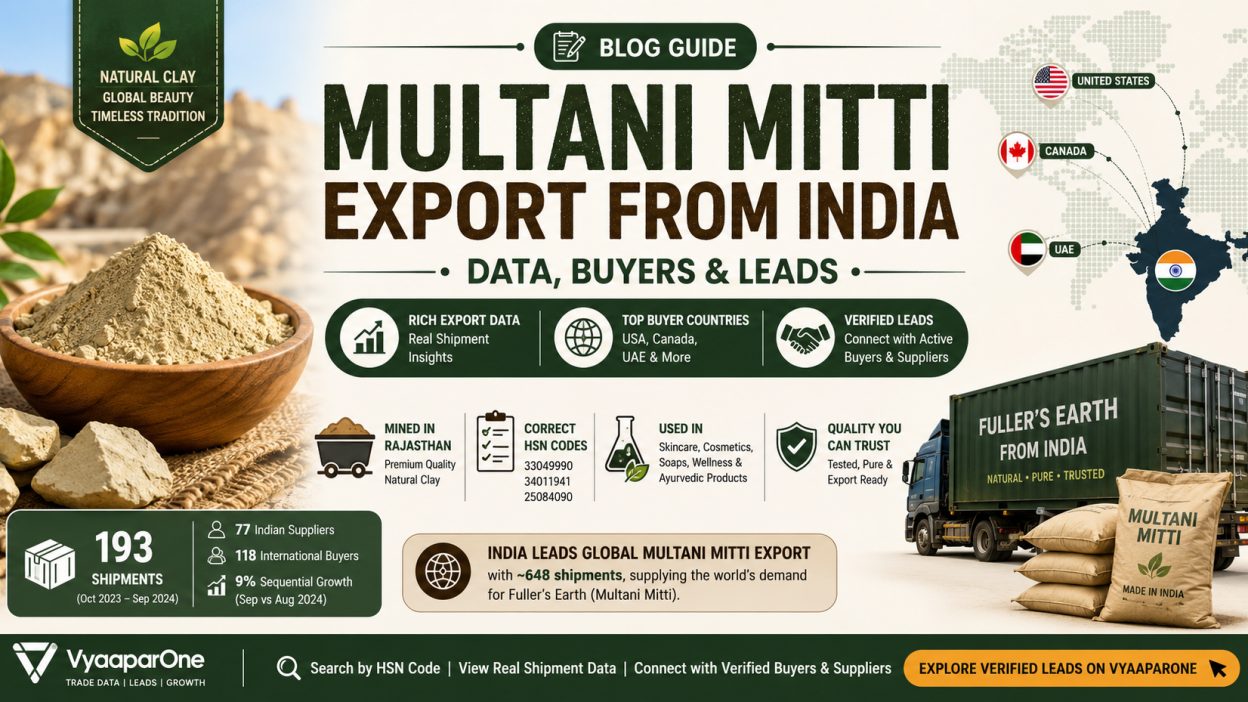
Multani mitti export from India has quietly become one of the more interesting stories in the country’s natural mineral trade. What was once a village-level clay dug out of the arid stretches of Rajasthan is now packed into drums and containers headed for skincare labs in Texas, wellness brands in Toronto, and cosmetic manufacturers across the Gulf. If you are an exporter, importer, or sourcing manager trying to understand where multani mitti export from India stands today, this guide breaks down the real numbers — shipment volumes, HSN codes, buyer countries, supplier names, and how to find verified trade leads.
Fuller’s earth, as multani mitti is known internationally, isn’t a niche curiosity anymore. It sits inside a global skincare and cosmetics supply chain worth billions, and India happens to control a large share of the raw material that feeds it. This piece walks through every angle of multani mitti export from India — the data behind it, the HSN classification, the countries buying it, the suppliers shipping it, and the practical steps to get started.
Quick answer: India leads global multani mitti export from India volumes with roughly 648 shipments recorded, supplying primarily the United States, Canada, and the UAE, using HSN codes 33049990, 34011941, and 25084090.
What Is Multani Mitti and Why the World Wants It
Multani mitti is a naturally occurring sedimentary clay — silica, iron oxide, lime, and magnesia bound together with trace moisture. It has been used across the Indian subcontinent for centuries as a skin cleanser, oil absorber, and hair treatment. What changed is the audience. Clean-beauty brands in North America and Europe started marketing it as a “natural detox clay,” and demand for multani mitti export from India followed close behind.
Here’s the thing — this isn’t a fad that will fade in a season. The global fuller’s earth market was valued at roughly USD 25.2 million in 2020, and analysts project a compound annual growth rate (CAGR) of around 6.2% between 2021 and 2028. That steady climb is exactly why multani mitti export from India keeps attracting new exporters every quarter, from small Rajasthan-based mining units to established chemical trading houses.
Rural and urban buyers overlap in this market too. Ayurvedic product makers, spa suppliers, cosmetic formulators, and even soap manufacturers all draw from the same raw material pool, which keeps demand diversified rather than dependent on a single buyer category. Honestly, that diversification is part of what makes multani mitti export from India a more stable trade lane than many other single-buyer-dependent commodities.
Where Multani Mitti Is Mined in India
Almost all of the raw material behind multani mitti export from India comes from one belt: Barmer, Rajasthan. The region’s soil composition and dry climate create ideal conditions for this particular clay to form and get extracted at scale. Gujarat contributes a smaller share, but Rajasthan remains the anchor of production.
The process is fairly straightforward on paper — extraction, sun-drying, grinding, sieving, and packaging — but quality control at each stage is what separates a supplier who wins repeat export orders from one who doesn’t. Buyers in the US and EU, in particular, are picky about particle size consistency and mineral purity, so processing quality matters as much as raw availability when it comes to sustaining multani mitti export from India relationships long-term.
Local mining cooperatives and mid-sized processing units both play a role here. Some suppliers handle everything from extraction to export documentation in-house; others buy raw clay from smaller miners and focus purely on refining and packaging for international standards. Either model can work for multani mitti export from India, but buyers tend to prefer suppliers who control more of the supply chain directly, simply because it reduces the number of hand-offs where quality can slip.
Multani Mitti Export Data: The Numbers That Matter
Let’s get into the multani mitti export data itself, because this is where sourcing decisions and buyer confidence actually get built for anyone serious about multani mitti export from India.
Based on recent shipment-level trade data, India exported 193 shipments of multani mitti during the trailing twelve months from October 2023 to September 2024. These shipments moved from 77 Indian suppliers to 118 international buyers — a healthy buyer-to-supplier ratio that signals real, distributed demand rather than one or two dominant relationships.
September 2024 alone saw 12 shipments leave Indian ports, a 9% sequential jump from August. Year-over-year, growth was flat compared to September 2023, which suggests multani mitti export from India has entered a stabilization phase after earlier expansion — still active, just not accelerating as sharply month to month.
| Multani Mitti Export Data (Trailing 12 Months) | Figure |
| Total shipments (Oct 2023 – Sep 2024) | 193 |
| Number of Indian suppliers | 77 |
| Number of international buyers | 118 |
| Shipments in September 2024 | 12 |
| Sequential growth (Sep vs Aug 2024) | 9% |
| Year-over-year growth (Sep 2024 vs Sep 2023) | 0% |
| Leading destinations | Canada, United States, UAE |
Globally, India dominates this trade by a wide margin. With roughly 648 shipments recorded, India leads every other player when it comes to multani mitti export from India-style volumes worldwide, followed by Pakistan at around 13 shipments and Oman in a distant third with about 2. In practical terms, if a buyer anywhere in the world wants fuller’s earth at scale, India is almost always the first stop — which is precisely why multani mitti export data leads sourced from Indian shipment records carry so much weight in this category.
Multani Mitti HSN Code — Getting the Classification Right
Correct HSN classification is non-negotiable for smooth customs clearance. Misclassify the shipment and you risk delays, penalties, or a rejected consignment at the port. The multani mitti HSN code depends on how the product is processed and packaged for export.
| HS Code | Description |
| 33049990 | Cosmetic/skincare preparations (processed, packaged multani mitti for beauty use) |
| 34011941 | Soap and organic surface-active products category |
| 25084090 | Other clays (raw/bulk mineral clay classification) |
Most exporters shipping processed, retail-ready multani mitti for cosmetic use file under 33049990, while bulk raw clay shipments typically fall under 25084090. If you’re unsure which multani mitti HSN code applies to your specific product form, it’s worth confirming with a customs broker or checking verified shipment records before filing — a wrong HSN entry is one of the most common (and avoidable) reasons for held-up export consignments.
Getting the multani mitti HSN code right also affects duty calculations on the importer’s end. Buyers in the US and Canada often ask suppliers to confirm the exact code in advance, since it determines their own customs clearance costs and timelines. A supplier who gets this wrong even once tends to lose that buyer’s trust for future multani mitti export from India orders.
Top Multani Mitti Importing Countries
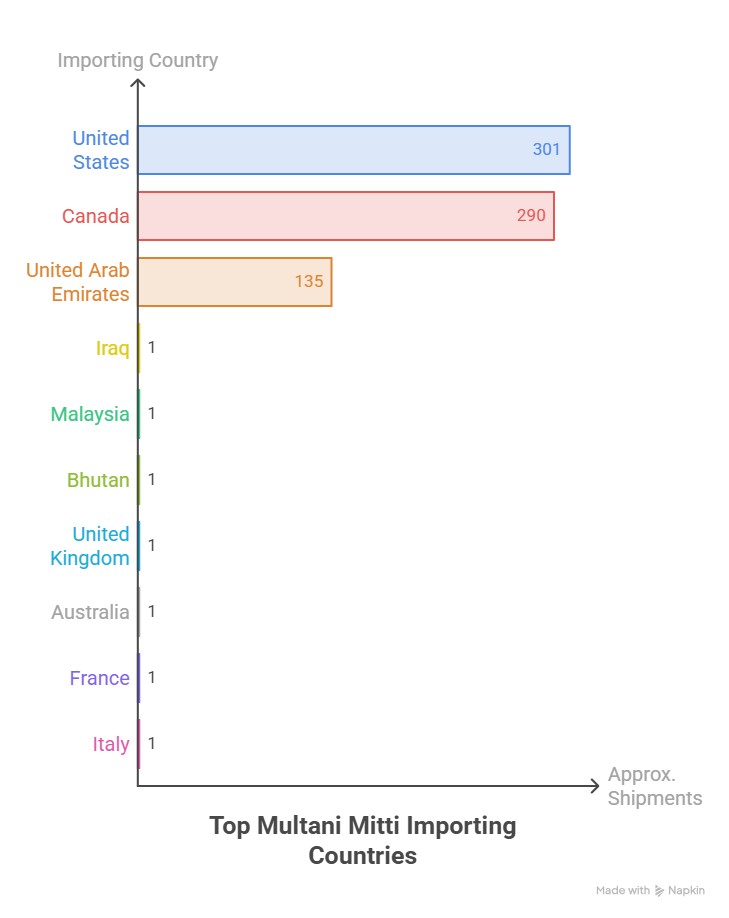
So who’s actually buying? The importer list behind multani mitti export from India is fairly concentrated at the top, with three countries accounting for the bulk of volume.
| Rank | Importing Country | Approx. Shipments |
| 1 | United States | 301 |
| 2 | Canada | 290 |
| 3 | United Arab Emirates | 135 |
| 4 | Iraq | 1 |
| 5 | Malaysia | 1 |
| 6 | Bhutan | 1 |
| 7 | United Kingdom | Active buyer, low volume |
| 8 | Australia | Active buyer, low volume |
| 9 | France | Active buyer, low volume |
| 10 | Italy | Active buyer, low volume |
Notice how top-heavy this list is. The US and Canada alone account for the overwhelming majority of recorded shipments, which tells you two things: North American clean-beauty demand is the real engine behind multani mitti export from India, and there’s meaningful white space in markets like the UK, Australia, and continental Europe where volumes are still small relative to the underlying interest in natural skincare ingredients.
Multani Mitti Export from India to the USA
Multani mitti export from India to USA leads every other destination by shipment count. US-based cosmetic manufacturers and wellness brands are drawn to the clay’s clean-label appeal — no synthetic additives, no complicated ingredient list, just a mineral that’s been used for generations. Buyers here tend to be repeat importers once a supplier passes their initial quality check, which makes multani mitti export from India to USA one of the more stable long-term lanes for Indian exporters to build around.
What makes this destination particularly attractive is repeat-order behavior. Once a US buyer verifies a supplier’s quality and documentation, they tend to place recurring orders rather than shopping around every cycle — which means the effort of landing that first multani mitti export from India to USA order tends to pay off well beyond a single transaction.
Multani Mitti Export from India to China
Multani mitti export from India to China doesn’t show up prominently in current shipment data, and that’s worth flagging honestly rather than glossing over. China has its own domestic clay and mineral cosmetics supply chains, which limits import demand compared to North America. That said, China’s fast-growing natural and Ayurvedic-inspired beauty segment means this could shift — exporters willing to invest in market entry now may find themselves ahead of the curve if Chinese demand for multani mitti export from India to China picks up over the next few years.
Building a presence in China typically requires more patience than the US or Canadian markets. Distribution channels, regulatory approval for cosmetic ingredients, and local competition from domestic clay producers all add friction. Exporters exploring multani mitti export from India to China are better served treating it as a medium-term market development play rather than an immediate volume opportunity.
Largest Exporters of Multani Mitti — Global and Domestic
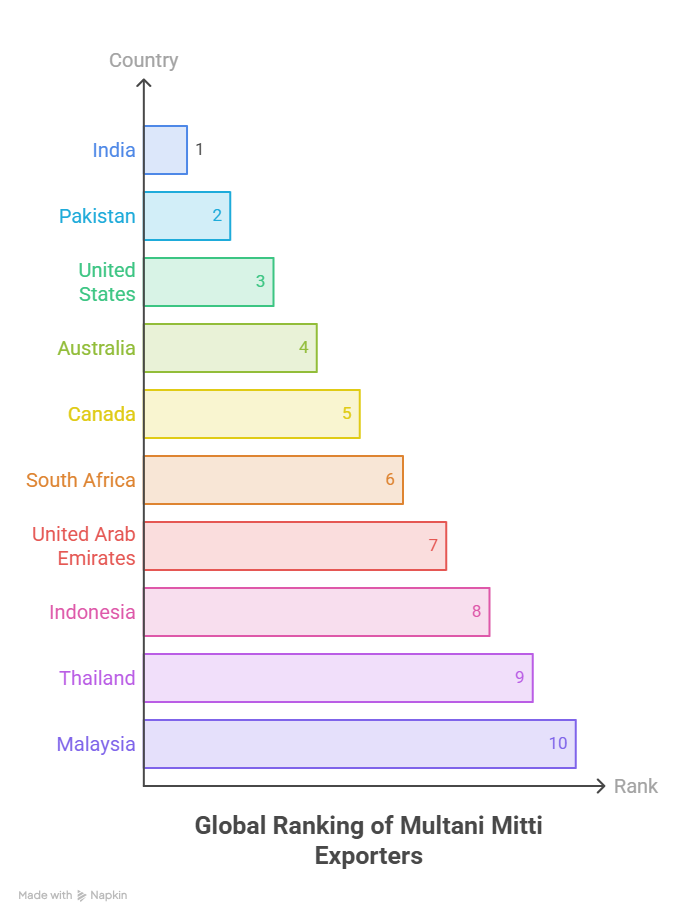
At the country level, India’s position at the top isn’t close. Here’s how the global ranking of largest exporters of multani mitti breaks down.
| Rank | Country |
| 1 | India |
| 2 | Pakistan |
| 3 | United States |
| 4 | Australia |
| 5 | Canada |
| 6 | South Africa |
| 7 | United Arab Emirates |
| 8 | Indonesia |
| 9 | Thailand |
| 10 | Malaysia |
It’s worth noting that several countries appearing on this largest exporters of multani mitti list — like the US, Canada, and the UAE — also show up as major importers. That’s not unusual in mineral trade; re-export and value-added repackaging often happen in secondary hubs even when the raw material originates almost entirely from one source, in this case India.
Within India, a handful of companies handle the bulk of recorded shipments behind multani mitti export from India. Multani mitti suppliers currently active in export trade include:
- Aaminah Enterprises
- Pisces Impex
- SLE Minerals
- Shri Ram Chemical & Minerals Industries
- Swarnabhumi Clay Chem Industries
- Multani Trading Company
- Go Organics
- Dev International
- Grasim Creations
- Sudhersen Exports
None of these names dominate the entire market — the buyer base behind multani mitti export from India is spread across 77 active suppliers, which means there’s real room for new entrants who can source clean, consistently graded clay and meet international documentation standards.
Multani Mitti Suppliers vs. Multani Mitti Exporting Countries — A Quick Comparison
It helps to separate two things buyers often confuse: who mines and processes the clay domestically (suppliers) versus which countries function as major players in the multani mitti exporting countries list globally.
| Category | Who They Are | Primary Role |
| Domestic suppliers (India) | Aaminah Enterprises, Pisces Impex, SLE Minerals, and similar firms based mainly in Rajasthan/Gujarat | Extract, process, and package raw multani mitti for both domestic and export sale |
| Global exporting countries | India, Pakistan, USA, Australia, Canada | Ship finished or semi-processed fuller’s earth product to importing markets |
| Global importing countries | United States, Canada, UAE | Receive and distribute product to cosmetic, spa, and wellness manufacturers |
This distinction matters when you’re building a sourcing strategy around multani mitti export from India. A buyer in Germany looking for multani mitti suppliers should be talking directly to Indian exporters, not to secondary trading hubs — cutting out the middle layer usually means better pricing and more reliable batch quality.
Market Growth Drivers Behind This Trade
A few forces are pushing this trade higher year over year, and understanding them helps exporters plan capacity and buyers plan sourcing timelines.
Clean-label cosmetics demand. Consumers in the US, Canada, and much of Europe are actively reading ingredient labels and favoring products with recognizable, natural components. Multani mitti fits that trend perfectly — it’s a single-ingredient mineral with centuries of traditional use behind it.
Ayurvedic and wellness brand expansion. International wellness brands positioning themselves around Ayurveda specifically seek Indian-origin raw materials for authenticity, which directly benefits Indian suppliers over substitute clays sourced elsewhere.
DIY skincare culture. Social media has turned multani mitti into a recognizable ingredient among home skincare enthusiasts, not just professional formulators, widening the buyer base beyond B2B cosmetic manufacturers alone.
Lower production costs relative to synthetic alternatives. For manufacturers, natural clay is often cheaper to source and process than lab-formulated absorbent compounds, adding a cost incentive on top of the marketing appeal.
How to Find Multani Mitti Export Data Leads
This is usually where exporters and buyers get stuck. Knowing that a market exists is one thing; finding the actual companies to call is another. Multani mitti export data leads — meaning verified shipment records tied to real company names, contact details, and order history — are what separate cold outreach from a warm introduction.
A few practical ways to source multani mitti export leads:
- Shipment-based trade data platforms. Services like VyaaparOne pull directly from customs records, so you can see exactly which Indian suppliers have shipped to which countries, at what volume, and how recently. This is far more reliable than a generic supplier directory when you’re chasing genuine multani mitti export data leads.
- HS code filtering. Searching by the specific multani mitti HSN code (33049990, 34011941, or 25084090) narrows results to genuinely relevant shipments instead of unrelated mineral or cosmetic products.
- Buyer-side verification. Before committing to a supplier, check their shipment history — how many export cycles they’ve completed, to which countries, and whether volumes have grown or stayed flat. Consistency is a stronger signal than a polished sales pitch.
- B2B marketplace listings. Platforms with verified seller badges reduce the risk of dealing with unregistered or inconsistent exporters chasing this business without a real track record.
On VyaaparOne specifically, you can search by product name or HS code, cross-reference supplier shipment history, and connect directly with verified multani mitti suppliers and buyers — cutting weeks off the manual research most new exporters end up doing on their own when trying to break into this trade.
How to Export Multani Mitti from India: Documentation and Process
Exporting multani mitti from India follows the same regulatory path as most mineral and cosmetic-adjacent products, with a few sector-specific steps layered in. Anyone new to multani mitti export from India should treat these registrations as the starting point, not an afterthought.
Registrations required before your first shipment:
- GST registration
- Import Export Code (IEC) from DGFT
- RCMC (Registration Cum Membership Certificate) from CHEMEXCIL, since fuller’s earth falls under chemical-adjacent export categories
- TIN for trade licensing purposes
Shipment-specific documentation:
- Phytosanitary certificate, where the importing country requires it
- Bank Realisation Certificate (BRC)
- Commercial invoice and packing list matched to the correct multani mitti HSN code
- Certificate of origin, particularly for buyers claiming preferential duty treatment
Quality and compliance checks:
Buyers in the US and EU increasingly ask for lab-tested purity reports before confirming a purchase order — heavy metal content, particle size distribution, and microbial contamination limits are the usual checkpoints. Building this testing into your process upfront, rather than scrambling after a buyer request, tends to shorten deal cycles considerably.
Once your paperwork is in order, finding the buyer becomes the real bottleneck for most first-time exporters. This is exactly where verified trade data and lead platforms earn their keep — instead of cold-emailing generic import directories, you’re working from shipment-confirmed buyer records.
Final Thoughts
Multani mitti export from India isn’t a speculative opportunity anymore — it’s a functioning, data-backed trade lane with 77 active suppliers, 118 international buyers, and steady shipment volume moving primarily toward the US, Canada, and the UAE. The market’s CAGR of roughly 6.2% through 2028 gives exporters a reasonable runway, and the relatively low concentration among domestic suppliers means new entrants with clean, well-documented products still have room to compete.
Whether you’re a first-time exporter trying to identify multani mitti suppliers worth partnering with, or an international buyer hunting for verified multani mitti export data leads, the fastest path forward is working from real shipment records rather than guesswork. Search by HSN code, verify supplier shipment history, and connect directly with parties who have a demonstrated track record in multani mitti export from India — that’s how serious trade relationships in this category actually get built. Explore verified multani mitti export from India trade leads and shipment data on VyaaparOne to get started.
FAQs on Multani Mitti Export from India
1. Where is multani mitti mined in India?
Multani mitti is primarily mined in Barmer, Rajasthan, with smaller deposits also found in parts of Gujarat — the same belt that supplies most multani mitti export from India volume today.
2. What is the multani mitti HSN code?
The three most commonly used codes are 33049990 (cosmetic preparations), 34011941 (soap/surfactant category), and 25084090 (other clays, raw form).
3. Which countries import the most multani mitti from India?
The United States, Canada, and the United Arab Emirates are the top three importers by shipment volume, with the US and Canada together accounting for the large majority of recorded exports.
4. Who are the largest exporters of multani mitti?
At the country level, India leads by a wide margin, followed by Pakistan and Oman. At the company level, active Indian exporters include Aaminah Enterprises, Pisces Impex, SLE Minerals, Shri Ram Chemical & Minerals Industries, and Swarnabhumi Clay Chem Industries.
5. How can I get verified multani mitti export data leads?
Trade data platforms like VyaaparOne provide shipment-level records — supplier names, buyer countries, HS codes, and volumes — which is far more reliable than sourcing from unverified directories.
6. Is multani mitti export from India to China a viable market?
Current shipment data shows limited volume compared to North America, mainly because China has its own domestic clay supply chains. It remains a market worth watching as demand for natural skincare ingredients grows there.
7. What documents are required to export multani mitti from India?
At minimum: GST registration, IEC code, RCMC from CHEMEXCIL, phytosanitary certificate (where applicable), BRC, and correctly matched HSN classification on the commercial invoice.
8. How big is the multani mitti export from India market expected to grow?
The broader fuller’s earth market is projected to grow at a CAGR of roughly 6.2% between 2021 and 2028, which gives multani mitti export from India a reasonably steady long-term growth runway.