
Introduction
India’s booming fruit trade makes up a big part of its rapid economic development, and apples are right in the middle of that growth. India is the 5th largest apple producer in the world, but is still unable to fulfill its own apple demand. It is no wonder that buyers of apples from across the globe target the Indian apple market.
Apple importers in India sourced over US$ 399.6 million worth of fresh apples in FY 2023–2024 alone. With projections showing a 26% surge in import volumes for the 2024–2025 marketing year, the opportunity for traders, wholesalers, and business decision-makers has never been more significant.
This guide will give you all the import export data you need to make a business decision if you are looking for verified apple import data, qualified apple import leads, or understanding the apple export market and the countries that export the most apples.
Why Apple Importing Is So Popular in India
Apples are grown in the Indian apple belt, which is made up of the state of Himachal Pradesh, Jammu & Kashmir, and Uttarakhand. Although these states produce millions of metric tons of apples, local production has a narrow seasonal window that leaves a sizable supply gap.
Per USDA FAS New Delhi (December 2025 data), Indian apple consumption for the 2023–2024 marketing year was pegged at 2.63 million metric tons (MMT), with 2.41 MMT produced domestically. There was a deficit of over 200,000 metric tons. The combination of this deficit and increasing urban premium apple demand makes apple importers a critical supply chain component.
The following key market dynamics are driving apple import growth in India:
Seasonal supply gaps: The domestic apple harvest occurs between August and October. The remaining months are covered by imports.
Premium variety demand: There is a growing demand for imported apple varieties (Gala, Fuji, Washington Red Delicious, Royal Gala, and Granny Smith) that are available in exporting countries.
Cold chain development: New refrigerated logistics technology in Tier 1 and Tier 2 cities are extending the reach of previously underserved markets.
Retail chain development: Organised retail (supermarkets, hypermarkets, D2C fruit brands) has developed a year-round demand for imported apples.
Rising disposable incomes: A growing middle class with the means to purchase premium fresh produce has supported volumetric growth.
All signs point to a continued increase in importation. Apple imports for India are forecast at 0.600 MMT in MY 2024–2025 (10% greater than in MY 2023–2024) and a significant growth from 0.211 MMT in 2015–16.
Apple Import Data: India’s Shipment Overview
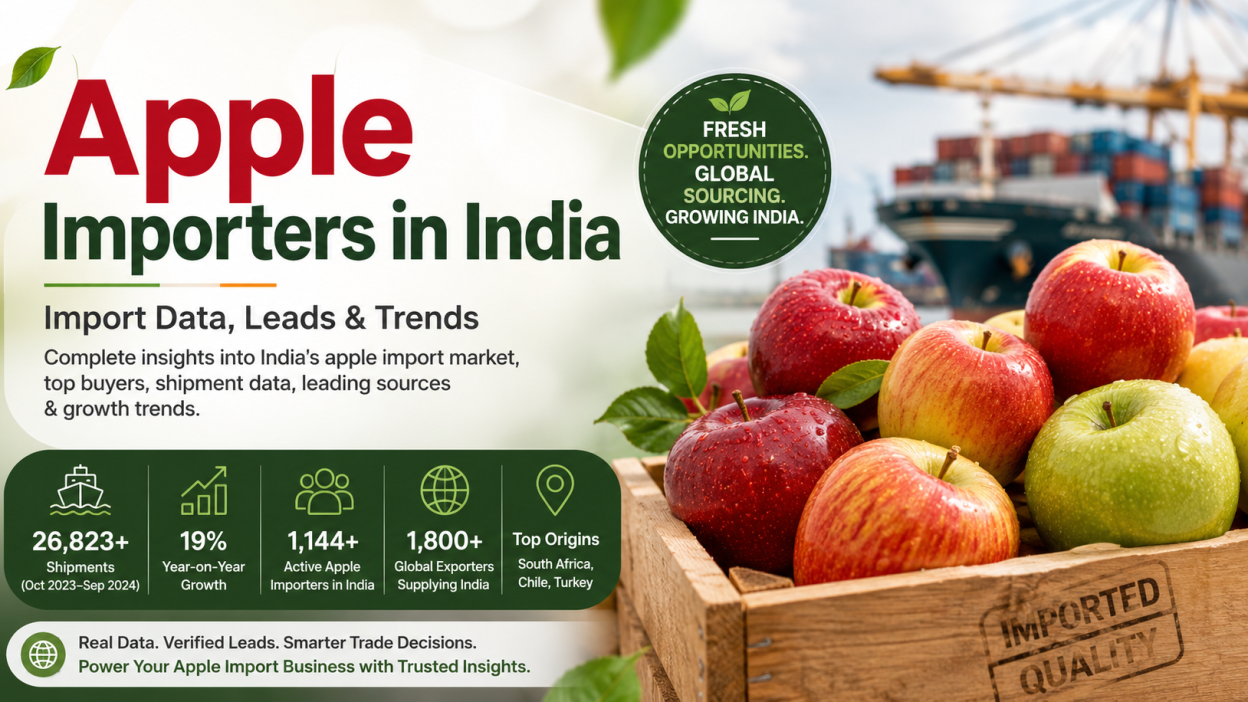
Understanding the scale of apple import data helps traders assess market depth, source verification opportunities, and competitive dynamics. Here is a detailed breakdown of India’s apple import shipment activity:
| Detail | Value / Figure |
| Total Shipments Imported (Oct 2023–Sep 2024 TTM) | 26,823 shipments |
| Year-on-Year Growth | 19% increase |
| Number of Apple Importers in India (Active Buyers) | 1,144 buyers |
| Number of Foreign Exporters Supplying India | 1,800 exporters |
| Shipments in September 2024 Alone | 351 shipments |
| Top Apple Import Origins for India | South Africa, Chile, Turkey |
These figures from real-time apple import data reveal a highly active trade corridor. With 1,144 verified Indian buyers transacting with 1,800 international exporters, the market is diverse and competitive.
The 19% year-on-year growth is particularly significant. It signals that India is not just maintaining its position as a large importer — it is actively expanding its apple procurement at pace.
India’s Apple Import Volume Over Time
To contextualise how dramatically the market has grown, here is a snapshot of import volumes across key periods:
| Period | Imports (MMT) | Notes |
| 2015–16 | 0.211 MMT | Baseline period |
| MY 2021–22 | 0.448 MMT | Record high at the time |
| MY 2022–23 (Estimated) | 0.430 MMT | Slight normalisation |
| MY 2024–25 (Forecast) | 0.600 MMT | New projected record |
| 2025–26 (Projected) | 0.60+ MMT | Continued upward trend |
The compound growth across this decade-long window underscores why apple import data leads from India are among the most valuable in the fresh produce trade intelligence space globally.
Key Buyer Segments of Apple Import Leads in India
Understanding buyer segments is essential to suppliers and exporters planning to enter the Indian market. The following segments provide the bulk of apple import leads in India.
1. Wholesale Fruit Traders
Indian wholesale fruit markets (especially Azadpur Mandi in Delhi, Vashi Mandi in Mumbai, and Koyambedu Market in Chennai) handle large volumes of apple imports. Traders that source from Turkey, Iran, and South Africa supply these markets with fast-moving stocks at competitive prices.
2. Organised Retail Importers
Fresh produce importers servicing modern trade channels (supermarkets, hypermarkets, and organized grocery chains) import on their own and prefer to give value to consistent quality, as well as adherence to phytosanitary and cold-chain requirements.
3. Gourmet and Premium Retailers
This segment of importers supplies luxurious hotels and fine-dining establishments premium apple varieties (e.g. Pink Lady, Honeycrisp, and KIKU) from upscale grocery retail outlets. These buyers are willing to pay a premium for imports with branding, packaging, and traceability.
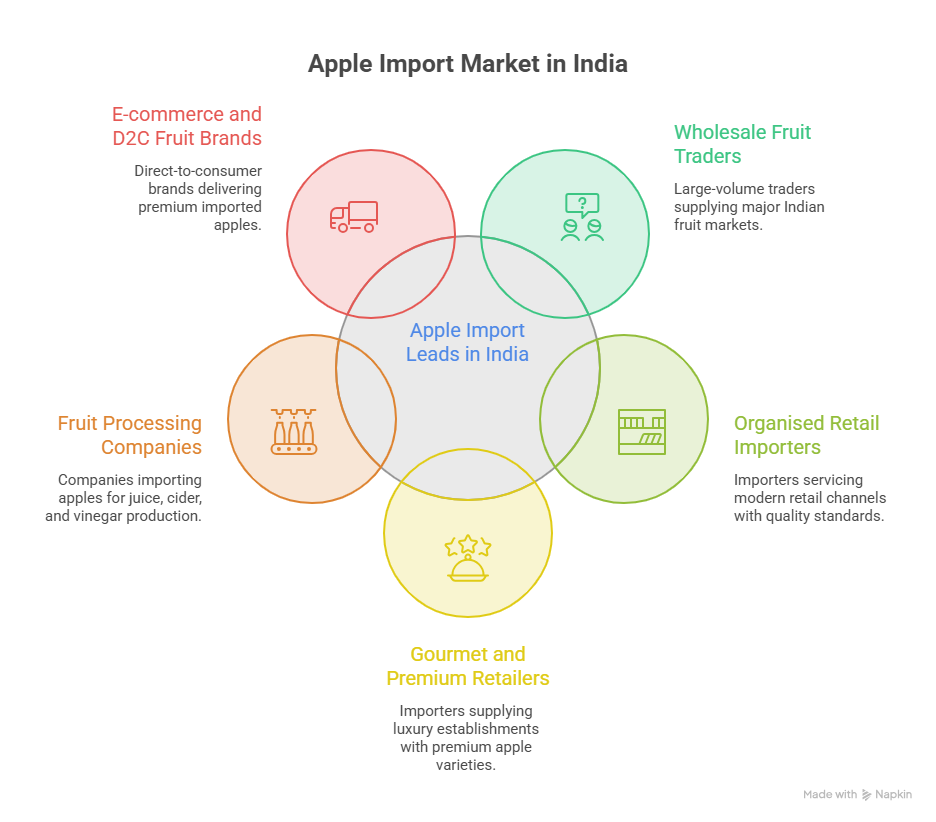
4. Fruit Processing Companies
The import of apples by some of the processing companies and industries that manufacture juice, cider, and vinegar is a good source of business for importers. These companies focus on specific requirements such as high acid or high brix apples and are driven by volumes.
5. E-commerce and D2C Fruit Brands
This fast emerging segment is composed of companies focusing on direct-to-consumer e-commerce and fresh produce delivery, and is a good source of a premium imported apples. These companies are especially concerned with quality packaging and branding.
Company Profiles of Apple Importers in India
This section covers the primary apple importers in India:
1. Apple India Pvt. Ltd.
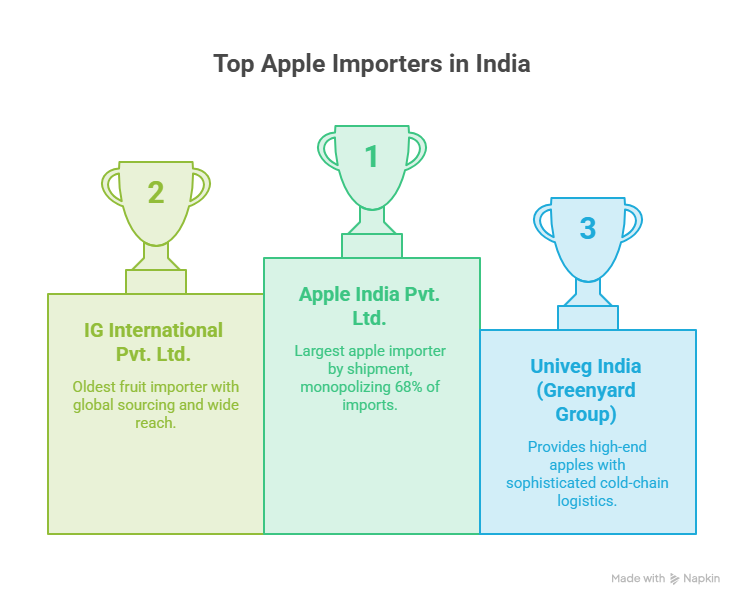
Since Apple India Pvt. Ltd. is the largest apple importer by shipment, it is the main apple importer along with Foxconn Hon Hai Technology India Mega Development and D J Exports Pvt. Ltd. The three of them monopolize approx. 68% of all apple imports to India.
2. IG International Pvt. Ltd.
Being one of the oldest importers of fruits in India, IG International has many associations for sourcing including Dole and T & G Global. With its reach in all major cities, and many of the growing cities too, IG International sources apples from USA, New Zealand and other major growing regions in Europe.
3. Univeg India (Greenyard Group)
Univeg India provides some of the best imported apples to many of the high-end retailers and hospitality groups across India. They are part of the Greenyard Group in Belgium and have one of the most developed and sophisticated, cold-chain logistics systems.
4. FruitBox & Co.
With its focus on the highest and most gourmet fruits, FruitBox & Co. has developed a good market catering to luxury hotels and high-end grocers with their Washington state apples and Granny Smith apples. Their market focus has been on quality buyers rather than volumes.
5. Kiku India Pvt. Ltd.
Kiku India is concerned with the marketing of KIKU apple variety. The KIKU apple variety (imported from NZ and Italy) is grown in New Zealand and Italy. It is a naturally sweet variety of apple. KIKU brand is recognized in northern and western India, thanks to several retail partnerships and KIKU brands in-store promotions.
6. Fresh Express
Fresh Express is a cold chain, logistics, and fresh produce expert. Fresh Express has set up distribution networks amongst supermarket chains, hotel groups, and restaurant aggregators. Fresh Express has an advantage over its competitors due to its effective post-harvest and last-mile delivery, thus helping Fresh Express with its apple import and distribution.
7. Devik Traders
Devik Traders is a wholesale trader in Delhi, supplying fresh apples imported from Iran and Turkey to the large wholesale fruit markets of northern India like the Azadpur Mandi. They focus on the importing of apples to the wholesale markets and supply the bulk markets with low cost, imported apples, thus providing an adequate supply to the market.
Top Apple Exporting Countries: Who Supplies India and the World?
Understanding the top apple exporting countries helps importers diversify their sourcing, manage risk, and capitalize on seasonal price dynamics. In 2023, global apple exports were valued at US$ 7.11 billion — marking a 5% year-on-year rise, according to trade data analysis.
Here is the full ranking of apple exporting countries by export value:
| Rank | Country | Export Value (US$ Billion) | Share of Global Apple Exports (%) |
| 1 | Italy | 1.12 | 14.5% |
| 2 | United States | 1.09 | 14.1% |
| 3 | Mainland China | 1.05 | 13.6% |
| 4 | New Zealand | 0.597 | 7.8% |
| 5 | Chile | 0.582 | 7.6% |
| 6 | South Africa | 0.577 | 7.5% |
| 7 | Poland | 0.510 | 6.6% |
| 8 | France | 0.470 | 6.1% |
| 9 | Türkiye | 0.192 | 2.5% |
| 10 | Netherlands | 0.177 | 2.3% |
Key Sourcing Insights for Indian Importers
Italy leads global apple exports at US$ 1.12 billion. Italian varieties — notably Gala, Golden Delicious, and Fuji — find strong acceptance in Indian premium retail. Italy is also the home of the KIKU variety gaining traction in India.
The United States is the second-largest global exporter and a major supplier of Washington State apples — including Red Delicious, Fuji, and Gala — to Indian markets. US apples carry strong brand recognition among urban Indian consumers.
Chile and South Africa are critically important counter-seasonal suppliers. Given that these Southern Hemisphere countries harvest in India’s off-season (March–June), they help bridge the supply gap when domestic production is low. Both countries rank among the top origins in India’s apple import data.
Turkey is India’s single largest apple supplier by value. In FY 2023–2024, Turkey supplied apples worth US$ 90.09 million to India — nearly a quarter of the total import value. Turkish apples are particularly competitive on price in the mid-market and wholesale segments.
Poland is a key European supplier, particularly for processing-grade apples, and features prominently in India’s import documentation.
Apple HS Code: Classification for Customs and Trade Data
Accurate apple HS code classification is essential for customs compliance, duty calculation, and trade data analysis. Whether you’re tracking apple import data or searching for apple import leads, HS codes are the backbone of any shipment-level trade intelligence.
Here is the complete list of apple fruit HS codes used in international trade:
| Apple HS Code | Description |
| 0808 | Apples, Pears and Quinces, Fresh (4-digit heading) |
| 080810 | Fresh Apples (6-digit subheading — most commonly used) |
| 8081000 | Apples (country-specific 7-digit classification in some systems) |
| 0810 | Other Fruit, Fresh (used occasionally for uncommon varieties) |
| 08109090 | Others — covers less common apple varieties or mixed consignments |
| 08133000 | Dried Apples (for processed/dehydrated apple trade) |
Why Apple HS Codes Matter for Trade Research
When you search apple import data databases using HS code 080810 (or the country-level variant 8081000), you access:
- Shipment-level records: Importer name, exporter name, port of loading, port of discharge, quantity, and value per consignment.
- Price benchmarking: Real-world FOB and CIF prices by origin country, helping you negotiate competitive rates.
- Lead generation: Verified apple import leads — the names and contact details of active Indian buyers placing repeat orders.
- Market trend analysis: Monthly and annual volume trends to time your market entry or sourcing strategy.
For importers and exporters alike, filtering trade databases by apple HS code 0808 or 080810 is the fastest route to actionable intelligence on the Indian apple market.
Apple Exports Market: Global Trade Trends and India’s Position
Globally, the apple exports market is increasing in value due to premiumisation, the advancement of cold chain logistics in developing markets, and increased apple consumption among the emerging middle classes in Asia and the Middle East.
In 2023, international trade in apples was valued at US$ 7.11 billion — an increase of 5% — and trade was dominated by Northern (Italy, USA, China, Poland, France) and Southern (Chile, South Africa, New Zealand) Hemisphere countries.
Apple Exports Market: Major Trends for 2024–2025
1. Premiumisation has taken hold. In Asia, especially India, China, and Southeast Asia, consumers are more willing to purchase apple varieties that are premium and branded. This provides a market opportunity to Italian, American and New Zealand exporters, among others.
2. Counter-seasonal sourcing is on the rise. Indian importers are signing yearly sourcing contracts which split procurement among Northern Hemisphere (August–February) and Southern Hemisphere (March–July) countries. This stabilises supply and diminishes the impact of seasonal price variances.
3. Climate risk is altering sourcing. Unpredictable weather (late frosts in European orchards and droughts in growing regions of Chile) leads to supply uncertainty. Apple importers that monitor real-time import data are the most responsive to shifting supply and sourcing.
4. There is a rise in phytosanitary requirements. FSSAI has imposed stricter phytosanitary controls with lower allowable MRL for imported fruits. Those exporters who do not meet India’s phytosanitary standards are being replaced with compliant exporters.
5. A direct-to-retail approach is advancing. Major Indian retailers are starting to bypass intermediary importers by sourcing directly from exporters or producer cooperatives in the exporting countries. For mid-tier importers, this presents a threat to their business, whereas exporters capable of retail logistics have the opportunity to operate in this space.
India’s Global Position on Apple Imports
India became the fifth-largest importer of apples and pears in the world in 2023, with import value reaching US$ 376 million (apples and pears combined). Ahead of India in the global rankings:
- Philippines — 243,580 shipments (largest globally by shipment volume)
- United States — 213,423 shipments
- Mexico — 189,649 shipments
- Russia
- India — rapidly closing the gap
The Philippines leads by shipment volume because of a high-frequency, lower-average-value import pattern, primarily supplied by China. India’s imports skew toward higher per-unit values, reflecting premium variety sourcing from Italy, the US, New Zealand, and Chile.
How to Source Apple Import Data Leads for India
If you are an exporter wanting to target India, or a trader within India wanting to evaluate your competition, this is a guide to sourcing high-quality apple import data leads.
Step 1: Use a Trade Intelligence Platform
The best and most detailed source of apple import data from India is a platform with Indian customs and trade shipment data. Use HS code 080810 or 0808 to view apple shipments.
Step 2: Filter by Buyer Profile
Narrow results by:
- Import frequency (monthly active buyers vs. one-time importers)
- Port of discharge (Delhi ICD, Mumbai JNPT, Chennai, Kolkata)
- Origin country (Turkey, South Africa, Chile, Italy, USA, New Zealand)
- Shipment size (identify volume buyers vs. small-lot premium importers)
Step 3: Build a Targeted Outreach List
Once you’ve identified active apple importers in India through shipment records, you can build outreach lists segmented by:
- Buying frequency
- Preferred origin country
- Variety types (inferred from origin and value per unit)
- Port preferences (relevant for logistics planning)
Step 4: Monitor Market Trends
Use monthly shipment data to track:
- Volume trends by origin country
- Price per MT fluctuations
- Emergence of new importers entering the market
- Changes in buyer-exporter relationships
Step 5: Validate Through Business Intelligence
Before you start trade talks, confirm the legitimacy of the importers by comparing the shipment data with the business registration data, GST, and company profiles.
Customs Duty and Regulatory Challenges for Indian Apple Importers
International exporters and Indian importers need to understand the regulations before sourcing apples to India.
Apples Import Duty
For the imports of fresh apples under HS code 080810, India applies a 50% basic customs duty (BCD). This makes India one of the markets with the highest tariffs on apples, and the import prices in India are much higher than the FOB prices at the country of origin.
- Apart from BCD, importers must consider:
- IGST on imported fresh fruits
- Social Welfare Surcharge (SWS)
- Port and CFS (Container Freight Station) charges
Phytosanitary and Food Safety Requirements
All apple shipments entering India must comply with:
- FSSAI (Food Safety and Standards Authority of India) standards for pesticide residue levels and food safety
- Plant Quarantine Order requirements — including phytosanitary certificates from the exporting country
- Cold storage requirements during transit and at Indian ports
Importer of Record (IOR) Requirements
The apple importers need to be in possession of the Import Export Code (IEC) granted by the DGFT (Director General of Foreign Trade). In addition, the importers also need to be registered with the FSSAI as Food Business Operators (FBO) to be eligible for importing food products.
Final Words
The Indian apple import market is one of the most dynamic and data-rich segments of global fresh produce trade. With apple importers in India sourcing from over 1,800 international exporters, a verified buyer base of 1,144 active companies, and import volumes growing at 19% year-on-year, the opportunity for well-informed market participants is substantial.
Whether you are an international apple exporter looking to enter or expand in India, a domestic trader seeking competitive intelligence, or a business analyst tracking the apple exports market, access to accurate apple import data is the single most powerful advantage you can have.
The top apple exporting countries — Italy, the United States, mainland China, New Zealand, and Chile — continue to dominate global supply, but counter-seasonal origins like South Africa and Turkey are carving out increasingly important roles in India’s sourcing mix.
Understanding apple HS code classifications, India’s customs duty structure, phytosanitary requirements, and the buyer landscape will position any stakeholder to navigate this market with confidence.
Use verified apple import data leads, monitor shipment trends in real time, and build relationships with India’s most active importers to unlock the full potential of this growing market.
Frequently Asked Questions
1. Who are India’s leading apple importers?
India’s apple importers by volume are Apple India Pvt. Ltd, IG International Pvt. Ltd, Univeg India (Greenyard Group), FruitBox & Co, Kiku India Pvt. Ltd, Fresh Express and Devik Traders. Apple India Pvt. Ltd. along with Foxconn Hon Hai and D J Exports import around 70% of apples imported to India.
2. What is the apple HS Code in India?
The apple HS Code in India is 0808 (4 digit) and 080810 (6 digit). In some customs systems, 8081000 may be the 7 digit entry. Dried apples would fall under 08133000.
3. Which countries are the largest exporters of apples?
Countries that export the most apples include Italy ($1.12B), the United States ($1.09B), mainland China ($1.05B), New Zealand ($0.597B), and Chile ($0.582B). These five nations export over 57% of apples globally.
4. How much did India import in apples in FY 2023–24?
India imported apples valued at $399.6 million in FY 2023–2024. The country processed 26,823 shipments of apples in the fiscal year, which is a 19% increase compared to the previous fiscal year (from October 2023 to September 2024).
5. What are apple import leads, and how do I obtain them?
Apple import leads are records of apple buyers in India, including shipment records and contact information, and are verified and detailed. They can be obtained from trade intelligence platforms as customs import data. A good starting point in building a buyer list is to filter by apple HS code 080810.
6. What are the most imported apples into India?
The apples that are most frequently imported into India include Washington Red Delicious, Gala, Fuji, Royal Gala, and Granny Smith. Other apples that are entering India are more premium apples that are KIKU, Honeycrisp, and Pink Lady.
7. What is India’s expected apple import volume for 2024–25?
Apple imports to India are expected to be at 0.600 MMT for the 2024–2025 marketing year with a 26% increase from the previous year as per USDA FAS New Delhi. This is projected due to the increased demand from consumers paired with the increased cold-chain and infrastructure, and seasonal supply gaps in India’s apple production.
8. What are the best practices to assess credibility of apple suppliers in India?
Exporters should follow FSSAI MRL requirements and secure a phytosanitary certificate from the national plant.