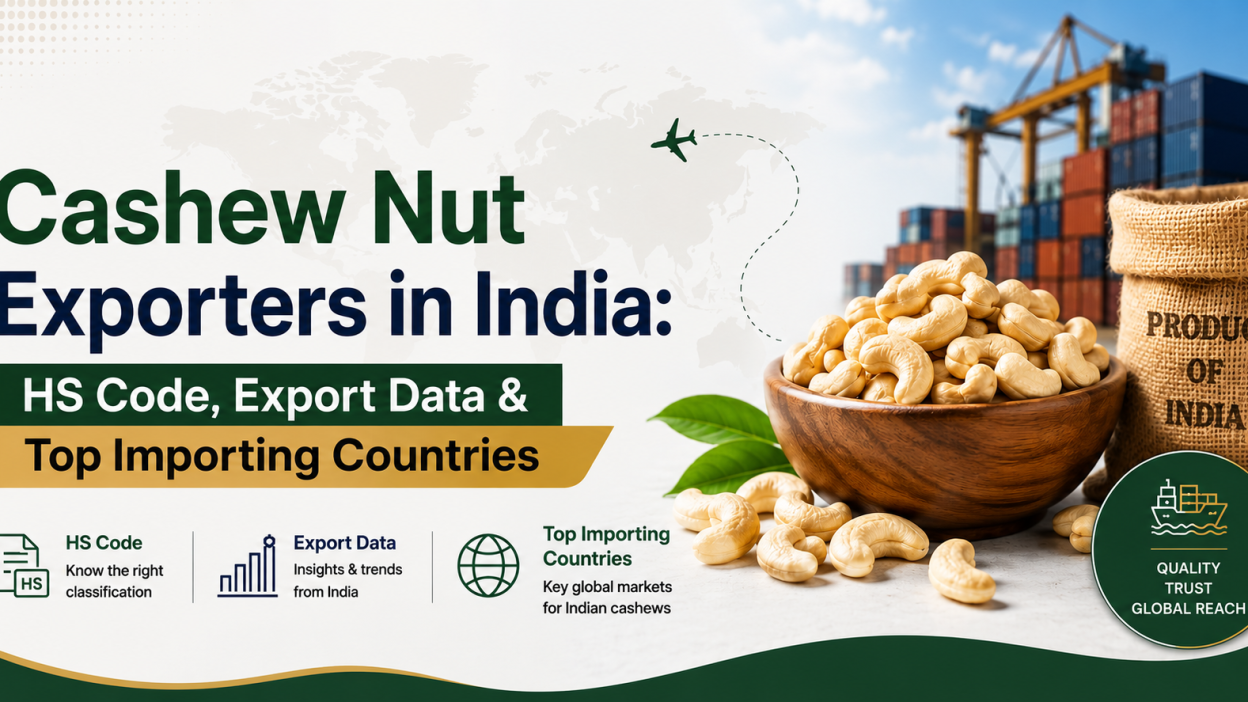
The global cashew trade is bigger than most people realise. Worldwide cashew exports were valued at roughly $6.64 billion in 2023, and the market is climbing again after a flat patch. So if you sell, source, or ship kernels, understanding how Cashew Nut Exporters operate has never mattered more. India sits right at the centre of this story. It is the world’s fourth-largest exporter of shelled cashews, holding around a 6.6% global share—and one of the most respected names in processing quality anywhere.
Here’s the thing. The cashew business runs on data. HS codes, shipment records, buyer-seller connections, country rankings — that’s the language every serious trader speaks. This guide breaks all of it down: the HS codes you’ll actually use, real cashew export numbers, the top cashew exporting countries, India’s biggest cashew buyers, and how to find genuine import export leads without burning weeks on dead ends.
Whether you’re a buyer hunting reliable suppliers or a processor in Kollam looking to scale your cashew export business, the same fundamentals apply. The Cashew Nut Exporters who win are the ones who treat trade data as a tool, not an afterthought. Let’s get into it.
Who Are the Top Cashew Nut Exporters in the World?
Three names dominate global cashew trade: Vietnam, Ivory Coast (Côte d’Ivoire), and India. Together with the Netherlands and Germany, these top five Cashew Nut Exporters accounted for more than 72% of all cashew exports in 2024. That concentration tells you something — cashew is a specialist’s game, and a handful of origins control most of the flow.
Vietnam is the undisputed leader. With cashew shipments worth roughly $2.9 billion in 2023, it processes raw nuts at a scale no one else matches. Much of West Africa’s raw crop flows into Vietnamese factories, gets shelled and graded, then heads back out to buyers in the US, EU, and China. Ivory Coast comes next — it’s the world’s largest producer of raw cashew nuts (RCN) and is now pushing harder into shelled cashew exports too.
And India? India is the value-addition specialist. We export premium grades, organic kernels, and specialised products to over 60 countries. The reputation for clean, hand-sorted, consistently graded kernels is what keeps Indian Cashew Nut Exporters in demand even when cheaper supply exists elsewhere. When a Japanese buyer wants flawless W320 kernels, India is the name on the shortlist.
Why does this ranking matter to you as a buyer? Because each origin offers something different — Vietnam for industrial volume, Africa for raw nuts, India for quality and value-added grades. Smart sourcing means matching the origin to what you actually need. The best Cashew Nut Exporters know exactly which buyer profile they serve, and they don’t try to be everything to everyone.
Top 10 Cashew Nut Exporting Countries (2024)
Here’s the snapshot every importer asks for. The list below ranks the top cashew exporting countries by export value, drawn from global trade data.
| Rank | Country | Approx. Export Value | Global Share | Notes |
| 1 | Vietnam | $2.9 billion | ~40%+ | World’s top processor & exporter |
| 2 | Ivory Coast | $1.25 billion | ~17% | Largest raw cashew producer |
| 3 | Netherlands | $301 million | 6.6% | Major EU re-export hub |
| 4 | India | $300–356 million | 6.6% | Quality & value-added leader |
| 5 | Germany | $166 million | 3.7% | Strong EU demand market |
| 6 | Nigeria | $351 million* | ~7% | Rising African exporter |
| 7 | Ghana | $282 million | ~6% | Growing raw nut supplier |
| 8 | UAE | Re-export hub | ~2% | Dubai-based redistribution |
| 9 | Burkina Faso | Growing | ~2% | West African RCN source |
| 10 | Turkey | $44 million | ~1% | Fast-growing, +80% YoY |
*Nigeria’s figure reflects large-volume raw nut exports. Values shift year to year, so always cross-check against live shipment data before committing to a supplier.
Worth noting: the fastest-growing Cashew Nut Exporters since 2023 include Guinea-Bissau (up a staggering 187.8%), Myanmar (up 132.4%), Indonesia (up 130.8%), and Turkey (up 80.3%). New origins are entering the game fast. For established cashew suppliers, that’s both a threat and a signal — the market is expanding, and there’s room for more players who get the basics right.
One more layer worth understanding: continental share. In 2024, Asian nations supplied roughly 54.8% of the world’s cashew exports, African exporters around 35.7%, and Europe about 8.5%. Asia’s dominance comes almost entirely from Vietnam and India. Africa’s share keeps climbing as more countries move from exporting raw nuts to shelling them domestically — a shift that’s slowly reshaping who the major Cashew Nut Exporters will be a decade from now.
Cashew Nut HS Codes Every Exporter Must Know
You can’t ship a single kilogram of cashew without the right HS code. Get it wrong and your cashew consignment sits at customs. Get it right and clearance is smooth, duties are accurate, and your cashew paperwork matches your buyer’s import documents.
For cashews, the classification sits under Chapter 08 (edible fruit and nuts), heading 0801. Every cashew HS code below ladders up from this heading:
| HS Code | Product Description | Common Use |
| 0801 | Cashew nuts (parent heading) | General classification |
| 080131 | Cashew nuts, fresh or dried, in shell (raw) | Raw cashew nut (RCN) trade |
| 080132 | Cashew nuts, fresh or dried, shelled (kernels) | Processed kernel exports |
| 08013100 | Raw cashew nuts in shell (8-digit India) | Indian customs filing |
| 08013210 | Cashew kernels, broken | Value grades, splits |
| 08013220 | Cashew kernels, whole | Premium whole grades |
Most Indian Cashew Nut Exporters work primarily with 080132 — that’s the shelled kernel code that covers W240, W320, W450, and the other commercial grades buyers recognise. The raw side (080131) matters mainly because India is also one of the world’s largest importers of raw cashew nuts, which feed the processing units in Kerala, Karnataka, and Tamil Nadu.
A quick tip from experience: always confirm the exact 8-digit code with your customs broker for the destination country. The parent heading is the same globally, but national tariff lines (the last two digits) vary. A mismatch here is one of the most common reasons shipments get flagged.
For Cashew Nut Exporters shipping multiple grades, it’s worth building a simple internal reference sheet that maps each product grade to its HS code and the destination tariff line. It sounds basic. But the exporters who keep this tidy clear customs faster and field fewer buyer complaints about documentation errors. Small discipline, big payoff.
India Cashew Export Data: The Real Numbers
Let’s talk specifics, because vague claims help no one. Good cashew export data is what separates serious traders from hopefuls.
In 2024, India ranked 4th globally in the export of shelled cashew nuts (HS 080132), holding a 6.60% market share, according to APEDA. India’s cashew production grew from 782,000 tonnes in 2022-23 to 795,000 tonnes in 2023-24 — modest growth of about 1.66%, but steady.
On the raw side, India is the world’s 12th-largest importer of in-shell cashews (080131). That dual role — big importer of raw cashew nuts, big exporter of finished cashew kernels — is the backbone of the Indian model. We buy raw, process with skill, and sell graded cashew kernels at a premium.
Export value figures vary by source and reporting window, but recent data puts India’s cashew kernel exports in the range of $206–356 million depending on the period measured. During April–January of the recent fiscal year, exports were valued at roughly $289 million. The Indian cashew market itself is projected to reach around USD 2.9 billion by 2029, growing at a CAGR near 3.8%.
The cashew industry employs over 10 lakh people across farms and processing factories, mostly in rural coastal areas. That’s not a small sector — it’s a livelihood engine for entire cashew-growing districts.
Where Are India’s Cashews Grown?
Cashew cultivation in India hugs the coastline. The leading cashew-producing states are:
- Maharashtra — the top producer, around 199,700 MT
- Andhra Pradesh — major east-coast output
- Karnataka, Kerala, Goa — west-coast processing heartland
- Tamil Nadu, Odisha, West Bengal — significant east-coast volume
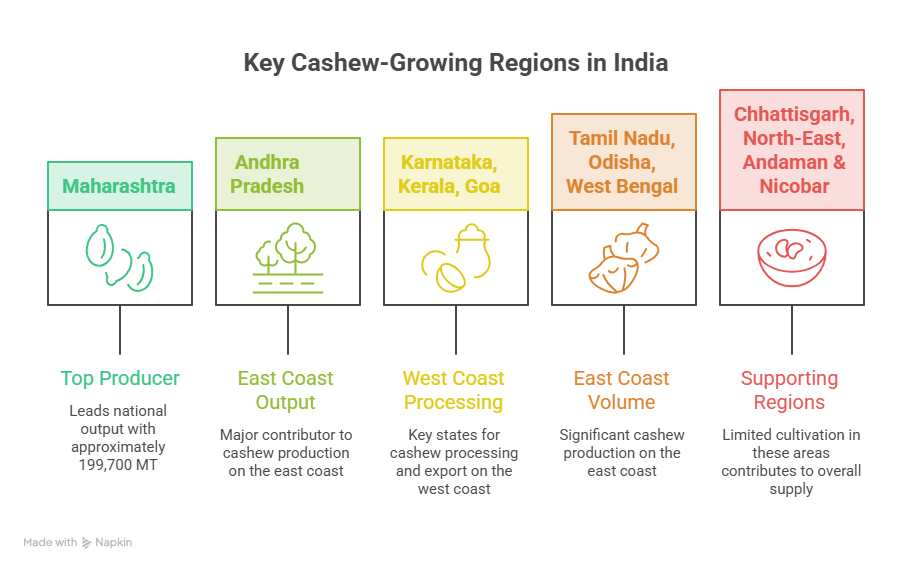
Maharashtra alone leads national output, and the broader peninsular belt — supported by limited cultivation in Chhattisgarh, the North-East, and the Andaman & Nicobar Islands — keeps India’s supply chain running. This geographic spread is an advantage: when one region has a weak harvest, others can cover the gap, giving Indian Cashew Nut Exporters more supply stability than single-origin competitors.
Understanding Cashew Grades (What Buyers Actually Order)
Here’s something new exporters underestimate — grade language is everything in cashew trade. Buyers don’t order “cashews.” They order specific grades, and knowing them marks you as a serious supplier.
The “W” grades refer to whole white kernels, and the number is the count per pound. Lower number means bigger nut, which means higher price:
- W180 — the “king” grade, largest and most premium, prized in the Gulf
- W210 — large, gift-pack and premium retail favourite
- W240 — popular all-rounder, strong demand in Japan and the EU
- W320 — the most traded grade globally, the workhorse of cashew exports
- W450 — smaller whole kernels, value-conscious markets
Then come the broken grades — splits (S), butts (B), pieces (LWP, SWP) — which feed the food-manufacturing sector for confectionery, bakery, and cashew butter. Smart Cashew Nut Exporters sell across the grade spectrum, because the broken grades that one buyer rejects are exactly what another buyer needs. Nothing goes to waste when you know your market.
Top Importing Countries for Indian Cashews
If you’re an Indian exporter, this is your market map. India ships cashews to more than 60 countries, but a handful dominate the cashew order book.
According to APEDA’s 2024-25 data, India’s major cashew kernel export destinations are:
- UAE — consistently India’s largest buyer (historically ~29–35% of total shipments)
- Vietnam — large-volume buyer, partly for re-processing
- Japan — premium market, around 13% of exports
- Netherlands — EU gateway, around 9% of exports
- Saudi Arabia — strong Gulf demand
Beyond these, the USA, UK, Canada, France, Israel, and Italy round out the regular buyer list. The UAE relationship alone has been worth upwards of US$ 127–131 million in peak years — a single market accounting for roughly a third of India’s cashew exports.
For Cashew Nut Exporters planning expansion, the pattern is clear: the Gulf and East Asia pay for quality, while Europe values reliability and certification. Match your grade and your story to the market. A W180 destined for a Dubai gift-pack brand needs a different pitch than a W320 bulk order for a Dutch food manufacturer.
And don’t sleep on the by-products. Cashew nut shell liquid (CNSL) and its purified form, cardanol, are quietly profitable export lines. India’s CNSL and cardanol shipments go to the UK, Italy, Japan, Korea, and Belgium, feeding industrial applications from resins to coatings. The Cashew Nut Exporters who diversify beyond kernels into these derivatives often find healthier margins and less price competition.
A Quick Comparison: Sourcing Origins for Buyers
If you’re an importer deciding where to source, this side-by-side helps. Different Cashew Nut Exporters bring different strengths, and the “best” origin depends entirely on your priority — price, volume, quality, or certification.
| Factor | Vietnam | India | Ivory Coast / Africa |
| Best for | Bulk industrial volume | Premium & value-added grades | Raw cashew nuts (RCN) |
| Pricing | Competitive, scale-driven | Mid-to-premium | Lowest (raw) |
| Processing quality | High, automated | Very high, hand-sorted | Developing |
| Grade consistency | Strong | Excellent | Variable |
| Lead time | Fast (large capacity) | Moderate | Longer |
| Certifications | Wide availability | Strong (organic, FSSAI) | Improving |
| Ideal buyer | Large food manufacturers | Retail, gourmet, organic | Processors needing RCN |
There’s no single winner here. A snack-food manufacturer in Germany wants Vietnamese volume at the right price. A premium organic retailer in Japan wants India’s hand-sorted W320. A processor in Vietnam wants Ivory Coast’s raw nuts. Each buyer, each need.
Exporting Cashew from India: Step-by-Step
Thinking about starting a cashew export business? Here’s the realistic path for aspiring Cashew Nut Exporters. It’s not complicated, but it does demand the right paperwork and the right partners. Skip a step and your first cashew shipment can stall before it leaves port.
1. Register your business. Get your IEC (Import Export Code) from DGFT. This is non-negotiable — no IEC, no legal export.
2. Register with APEDA and CEPCI. The Agricultural and Processed Food Products Export Development Authority and the Cashew Export Promotion Council of India give you access to schemes, cashew buyer-seller meets, and trade intelligence. CEPCI has supported cashew exporters since 1955.
3. Source and grade your cashew. Whether you process in-house or buy from established cashew units in Kollam, Mangalore, or Panruti, your grade (W180, W240, W320, etc.) defines your buyer.
4. Get your certifications sorted. FSSAI, phytosanitary certificate, certificate of origin, and any buyer-specific standards (organic, kosher, halal). The more certs, the wider your market.
5. Classify under the right HS code. As covered above — 080132 for kernels. Match it to the destination’s tariff line.
6. Find verified buyers. This is where most new exporters struggle. You need genuine cashew export leads, not recycled contact lists. More on that next.
7. Ship and follow up. Handle logistics, documentation, and payment terms (LC, advance, or DA/DP). Build the relationship for repeat orders.
One thing I’ll be honest about — step 6 trips up more first-time exporters than anything else. You can have the best W320 in Kollam and still sit on unsold stock if you can’t reach real buyers.
Finding Genuine Import Export Leads
Let’s be real about this. The difference between a struggling exporter and a thriving one usually comes down to lead quality. Anyone can list a product. Few can connect it to a verified buyer who actually places orders.
So how do you find real cashew import leads and cashew export leads? The cashew market has more verified-buyer sources than most exporters realise — you just need to know where to look.
Trade data platforms are the starting point. Cashew shipment records reveal who’s actually buying — company names, ports, volumes, frequency. This isn’t guesswork; it’s the paper trail of real cashew transactions.
B2B marketplaces like VyaaparOne connect verified Cashew Nut Exporters directly with importers actively sourcing. The advantage of a focused B2B platform is intent — buyers there are looking to transact, not browse. Instead of cold-emailing strangers, you’re listed where active cashew buyers are already searching.
Trade fairs and buyer-seller meets, often organised through CEPCI and APEDA under the Market Access Initiative (MAI) scheme, put you face-to-face with serious importers.
Industry directories and HS-code-based search let you filter by the exact product line — so you’re chasing cashew buyers specifically, not generic food importers.
Here’s my take after watching this market closely: import export leads are only as good as their verification. A list of 5,000 “buyers” with no confirmation of actual purchasing behaviour is worth less than 50 verified, active importers. Quality crushes quantity every time in B2B trade.
What Makes a Good Cashew Export Lead?
Not all leads are equal. A genuinely useful cashew export lead has:
- Verified company identity — real entity, real address, real cashew trade history
- Demonstrated buying intent — they’ve imported cashews before, or are actively sourcing now
- Volume match — their cashew order size fits your capacity
- Destination clarity — you know the market, the duties, the standards
- Direct contact — a decision-maker, not a gatekeeper
When you’re evaluating any source of cashew import leads, run it against this checklist. It’ll save you months of chasing dead-end cashew enquiries.
Lead Sources Compared
Here’s the third comparison — a straight look at where import export leads actually come from and what each channel delivers.
| Lead Source | Lead Quality | Cost | Speed | Best For |
| B2B marketplaces (VyaaparOne) | High (intent-verified) | Low–Mid | Fast | Direct buyer connections |
| Trade data / shipment records | Very high (proven buyers) | Mid–High | Moderate | Targeting active importers |
| Trade fairs & BSMs | High (face-to-face trust) | High | Slow | Long-term relationships |
| Cold outreach / directories | Low–Mid (unverified) | Low | Slow | Volume prospecting |
| Government schemes (CEPCI/MAI) | High (curated) | Low | Moderate | New market entry |
The smart play? Combine channels. Use trade data to identify who’s buying, a B2B platform like VyaaparOne to make the connection, and trade fairs to lock in the relationship. No single source does everything.
Why Cashew Nut Exporters Are Betting on Growth
The numbers tell an optimistic story. The global cashew market, valued at roughly USD 9.87 billion in 2024, is projected to reach nearly USD 14.79 billion by 2033 at a CAGR of around 4.6%. That’s a rising tide for every cashew exporter willing to compete on quality.
What’s driving cashew demand? A few clear forces:
Health consciousness. Cashews ride the plant-based, high-protein snacking wave. Vegan diets, keto-friendly positioning, clean-label products — cashews fit them all.
Rising demand in the US, EU, and China. These markets keep absorbing more kernels each year, and they pay for quality.
Supply diversification. West Africa and Southeast Asia are expanding processing capacity, which stabilises supply and opens new sourcing routes.
For Cashew Nut Exporters in India specifically, the opportunity sits in value addition — flavoured cashews, organic grades, ready-to-eat packs, and CNSL (cashew nut shell liquid) derivatives like cardanol, which serve industrial markets in the UK, Italy, Japan, and Korea.
The agency-side reality is that buyers increasingly search online before they ever pick up a phone. Which means your digital presence — your listings, your trade data footprint, your B2B marketplace profile — is now part of your sales team whether you planned it that way or not. The Cashew Nut Exporters who show up where buyers search win orders that their offline-only competitors never even hear about.
There’s a quiet shift happening too. Sustainability and traceability are becoming buying criteria, not just nice-to-haves. European and Japanese buyers increasingly ask where the nuts were grown, how they were processed, and whether the supply chain meets ethical standards. The Cashew Nut Exporters who can tell a clean, verifiable origin story — backed by certifications — will command premiums that price-only competitors can’t touch. It’s one more reason quality-focused India is well-positioned for the next decade of cashew trade.
Common Mistakes New Exporters Make
A few honest words on what goes wrong, because avoiding these is half the battle.
Chasing volume over verification. New exporters often grab the biggest cashew buyer list they can find. Bad move. Fifty verified cashew buyers beat five thousand unverified contacts.
Ignoring the HS code detail. That last two-digit tariff line matters. Sloppy classification means held shipments and angry buyers.
Underpricing to win the first deal. It feels smart. It isn’t. You set a precedent that’s hard to escape, and quality buyers actually distrust prices that look too good.
Neglecting certifications. Organic, FSSAI, phytosanitary — these aren’t bureaucratic boxes. They’re the keys to premium markets that pay more.
Treating leads as one-time transactions. The real money in cashew export is repeat orders. Build the relationship, not just the invoice.
The exporters who win think long-term. They invest in quality, verify their import export leads, and treat every buyer as a multi-year partner rather than a single shipment. That’s the difference between Cashew Nut Exporters who survive one season and Cashew Nut Exporters who build a brand buyers return to year after year. In the cashew trade, reputation compounds — and it’s the cheapest marketing you’ll ever have.
Cashew Pricing and Seasonality: What Moves the Market
Cashew prices aren’t static — and exporters who track the rhythm of the cashew market negotiate better deals. A few forces drive cashew pricing:
The raw nut harvest. West Africa’s RCN harvest (roughly February to May) sets the tone for the whole year. A strong African crop means cheaper raw nuts, which flows through to cashew kernel prices months later.
Processing capacity. Vietnam and India process the bulk of the world’s cashew. Labour costs, energy prices, and currency swings in these processing hubs ripple straight into the price your buyer pays.
Grade premiums. W180 and W210 command serious premiums over W320 and broken grades. Gift-season demand in the Gulf lifts large-grade cashew prices ahead of festivals.
Currency and freight. A weaker rupee can make Indian cashew exports more competitive abroad. Freight rates add another variable that smart Cashew Nut Exporters factor into every cashew quote.
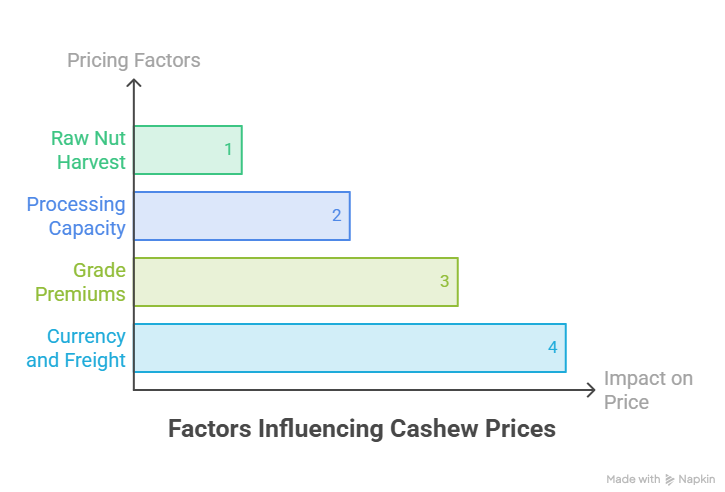
The honest takeaway? Don’t price in a vacuum. The Cashew Nut Exporters who consistently win factor in harvest cycles, grade spreads, and freight before they ever send a quote. Cashew pricing is strategy, not arithmetic.
Final Word
The cashew trade rewards people who understand the data. From the right cashew HS codes (080131 and 08013210) to the real cashew export numbers, from the top cashew exporting countries to India’s loyal cashew buyers in the Gulf and East Asia — every detail compounds into a competitive edge.
India’s position as one of the world’s leading Cashew Nut Exporters is built on something hard to replicate: decades of cashew processing skill, a quality reputation, and a workforce of over a million people who know cashews better than almost anyone. The global cashew market is growing toward $14.79 billion by 2033, and the door is open for cashew exporters who do the fundamentals right.
If you’re ready to connect with verified cashew buyers and turn your product into real orders, platforms like VyaaparOne bring Cashew Nut Exporters and serious cashew importers together — with the import export leads, cashew export leads, and cashew import leads that actually move business forward. The cashew trade data is on your side. Now go use it.
Frequently Asked Questions
Who are the top Cashew Nut Exporters in the world?
The top cashew exporting countries are Vietnam, Ivory Coast (Côte d’Ivoire), the Netherlands, India, and Germany. Vietnam leads global cashew exports with around $2.9 billion in cashew shipments, while India ranks 4th in shelled cashew kernels with a 6.6% global share. Together these top Cashew Nut Exporters account for over 72% of world cashew exports.
What is the HS code for cashew nut export from India?
Cashews fall under HS heading 0801. Raw in-shell nuts use 080131, while shelled kernels — the main export grade — use 080132. Indian customs filings use the 8-digit versions such as 08013100 (raw) and 08013210/08013220 (broken/whole kernels). Always confirm the destination’s tariff line with your broker.
Which is the largest cashew exporter in the world?
Vietnam is the largest cashew exporter by value and volume, processing and shipping more kernels than any other nation. Ivory Coast is the largest producer of raw cashew nuts, while India leads in premium and value-added cashew products.
Which countries import the most cashews from India?
India’s top buyers are the UAE, Vietnam, Japan, the Netherlands, and Saudi Arabia. The UAE alone has accounted for roughly a third of India’s cashew exports in peak years. The USA, UK, Canada, France, and Italy are also significant markets.
How do I find genuine cashew export leads and import leads?
Use verified cashew trade data platforms to identify active cashew buyers, B2B marketplaces like VyaaparOne to connect directly with intent-verified cashew importers, and CEPCI/APEDA buyer-seller meets for relationship-building. Prioritise verified, active cashew buyers over large unverified contact lists — cashew lead quality beats quantity.
What are the top 10 cashew nut-producing countries?
The top cashew-producing countries are Ivory Coast, India, Vietnam, Benin, Tanzania, Guinea-Bissau, Burkina Faso, Nigeria, Cambodia, and Mozambique. Ivory Coast and India together produce the largest share of the global raw crop.
Is exporting cashew from India profitable?
Yes, particularly in value-added and premium grades. India’s reputation for quality processing supports strong margins in markets like Japan, the UAE, and the EU. Success depends on proper certification, accurate HS classification, and verified buyer connections.