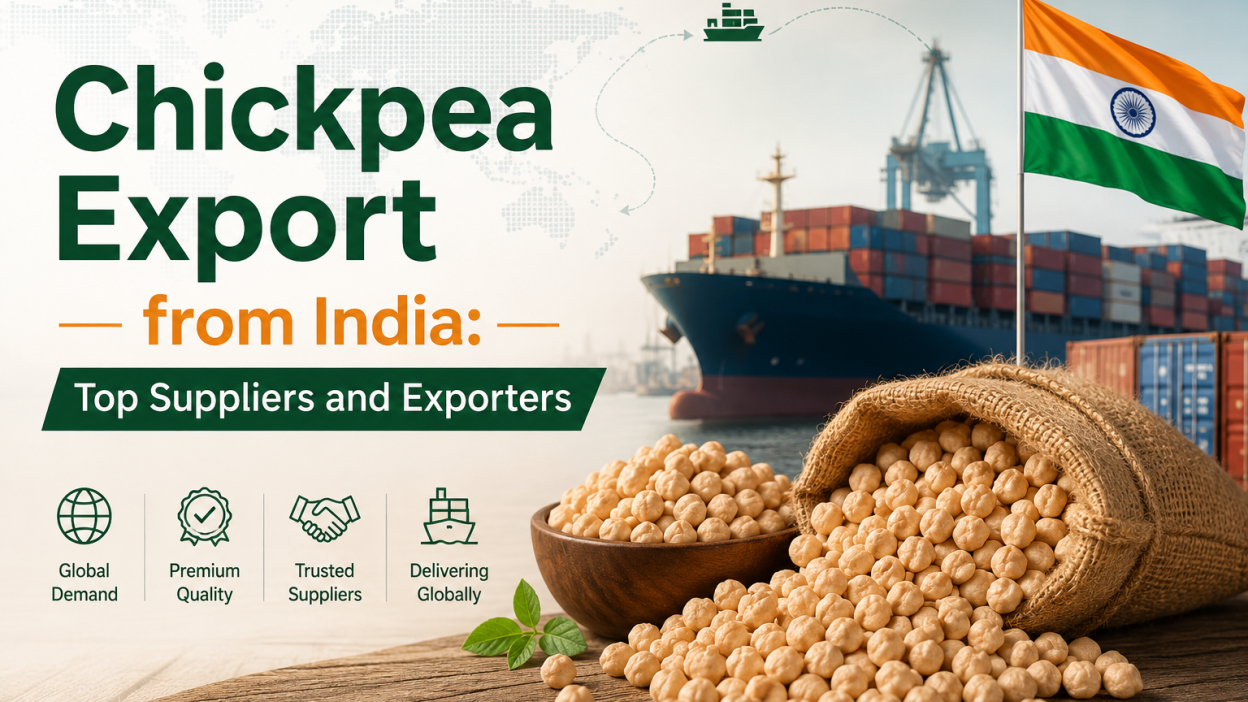
India sits at the centre of the global chickpea trade. It grows the most, it eats the most, and yet it still ships impressive volumes abroad every year. That mix of scale and demand is exactly what makes chickpea export from India such a profitable lane for serious traders. Most exporters underestimate how organised this market has become. Buyers in the Gulf, Europe, and South Asia now want verified suppliers, clean documentation, and accurate HS codes before they sign anything.
This guide breaks down the whole picture: top suppliers, leading exporters, HS codes, importing countries, the largest producer of chickpea in India, and where to find the freshest import export leads. Whether you supply chana or source it, the goal is to give you data that closes deals.
Why Chickpea Export from India Matters in Global Trade
Let’s be honest. Pulses don’t get the headlines that rice or wheat do. But chickpeas quietly drive billions in annual trade. India exported roughly $286 million worth of chickpeas in 2023, and the country ranks among the world’s top three exporters of dried, shelled chickpeas. That’s not a small footprint.
What makes chickpea export from India interesting is the seasonality. India imports heavily — especially Australian chickpeas during lean months — then turns around and exports processed and premium varieties. Desi chana, Kabuli chana, Bengal gram, besan. Each has its own buyer base. And the demand keeps climbing as plant-based protein goes mainstream across the West, which steadily widens the runway for chickpea export from India.
For Indian MSMEs, this is a real opening. The trade infrastructure exists. Ports like Kandla, Mundra, and JNPT handle steady chickpea volumes. What’s often missing is the buyer intelligence — the verified contact lists and shipment records that turn a cold lead into a closed order.
Between November 2023 and October 2024, India shipped roughly 1,499 chickpea consignments abroad through hundreds of exporters to buyers across dozens of countries. Volume swings month to month with harvest cycles and demand, but the underlying trend holds. Chickpea export from India remains a dependable revenue stream for traders who know how to read the market.
The buyer profile is shifting too. Premium retail markets in North America and Europe now place real orders, driven by the plant-protein boom. Kabuli chana exports have more than doubled in recent years. That premium tilt is where the better margins live.
The Largest Producer of Chickpea in India
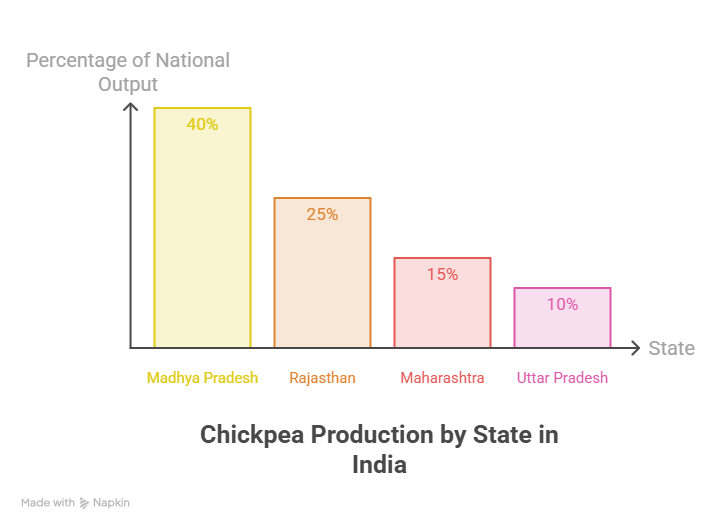
Ask any agri-trader where chickpeas come from, and one state dominates the answer. Madhya Pradesh is the largest producer of chickpea in India, contributing close to 40% of the country’s total output. That single state effectively anchors the entire supply chain.
Behind MP, a handful of states round out the production map:
- Madhya Pradesh — the clear leader, ~40% of national output
- Rajasthan — strong second, especially for Desi varieties
- Maharashtra — significant volumes, good processing infrastructure
- Uttar Pradesh — reliable contributor with established mandis
Why does this matter for chickpea export from India? Because sourcing location affects price, quality, and logistics. A buyer working with a supplier near Indore gets different freight economics than one sourcing from Maharashtra. Smart exporters map supply back to these hubs — a small detail that separates amateurs from operators.
India as a whole is the largest producer of chickpea in the world — by a wide margin. The country dominates global chickpea cultivation, which is why so much pulse trade routes through Indian suppliers.
Chickpea Varieties That Drive Export Demand
Not all chickpeas are the same, and buyers know it. Understanding the variety split is fundamental to winning at chickpea export from India, because the wrong grade sent to the wrong market means a rejected shipment.
Two big families dominate the trade. Desi chana — smaller, darker, with a thicker seed coat — feeds bulk consumption markets and gets milled into besan and dal. Kabuli chana — larger, paler, rounder — commands premium pricing in retail and food-service channels across the Gulf, Europe, and North America. Then there are the regional names buyers throw around: Bengal gram, Black chana, Kala chana, garbanzo beans. Same crop, different positioning.
Here’s why this matters for your bottom line. A UAE retail buyer wants clean, large-calibre Kabuli and will pay for it. A Bangladeshi bulk importer wants competitively priced Desi by the container. Match variety to market and your quotes convert. Mismatch them and you’re stuck explaining why your product doesn’t fit. The exporters who treat chickpea export from India as a one-size operation lose to the ones who segment carefully.
Grade matters as much as variety. Calibre, moisture content, foreign-matter percentage, and colour uniformity all factor into the price a buyer accepts. The best chickpeas exporters publish clear specs and hold to them shipment after shipment.
Chickpea HS Code: Getting Classification Right
Nothing kills an export deal faster than a wrong code. The chickpea HS code determines your duty, your export benefits, and whether customs clears your shipment without a headache.
The major chickpea HS code classifications used in Indian trade are:
| HS Code | Description | Common Use |
| 07132000 | Chickpeas (garbanzos), dried, shelled | Primary code for whole dried chickpeas |
| 07139010 | Other dried leguminous vegetables | Secondary classification |
| 2005 | Vegetables prepared/preserved | Processed chickpea products |
| 20055900 | Other beans, prepared or preserved | Value-added chickpea goods |
Worth noting: the base 6-digit code 071320 is recognised worldwide for dried chickpea seeds, with India adding two digits for tariff specificity. Get the chickpea HS code right and you protect your margins. Get it wrong and you risk penalties, delayed clearance, or lost duty drawback benefits.
This is where chickpea export from India trips up new entrants. The codes look similar. The duty implications aren’t. Always verify against the current DGFT schedule before declaring.
Top Chickpea Suppliers India and Leading Exporters
Now to the part everyone actually wants — who moves the volume. The list of established chickpeas exporters operating from India includes well-known names that consistently appear in shipment records.
Among the largest chickpeas suppliers India offers, these chickpea suppliers stand out as reliable chickpeas exporters:
- Savaliya Exports — one of the highest-volume chickpea exporters
- Vad Industries — major player in dried pulse exports
- Seasons International Pvt Limited — strong international buyer network
- K.J. International — established exporter across multiple pulse categories
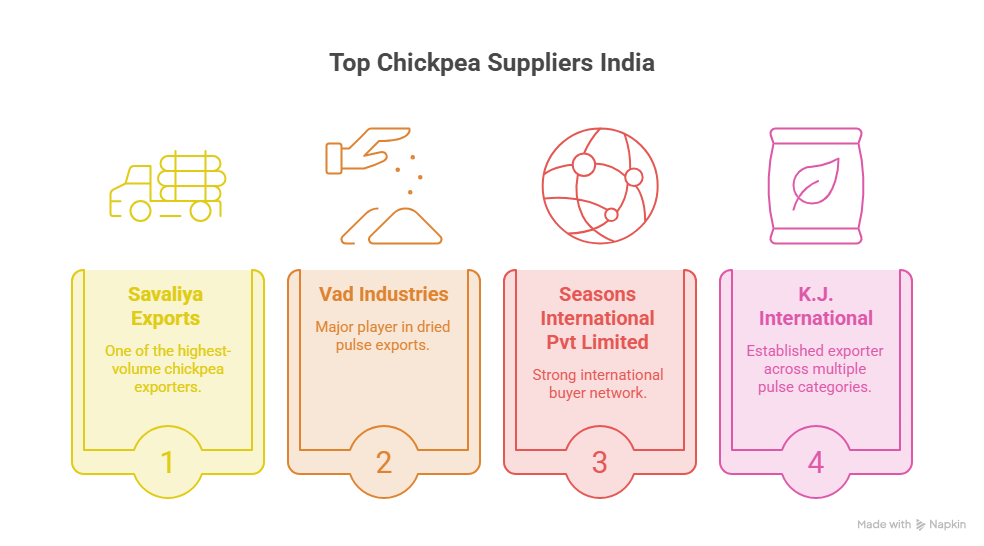
These chickpeas exporters have built reputations on consistency, and they remain reference points for anyone studying chickpea export from India. Buyers come back because the quality holds, the documentation is clean, and the shipment timelines are reliable.
But here’s the catch. Published lists go stale fast. The genuinely active chickpea suppliers shift season to season based on harvest, pricing, and demand. This is exactly why platforms tracking live shipment data matter so much — they show you who’s actually shipping right now, not who shipped two years ago. Verified, current chickpeas suppliers India data — a live list of active chickpea suppliers — is the difference between a real order and a wasted week.
When you’re evaluating chickpeas exporters for chickpea export from India, look past the name. Check shipment frequency, destination spread, and HS code accuracy.
Chickpeas Importing Countries: Where the Demand Lives
A supplier is only as good as their buyers. So where does Indian chickpea actually go?
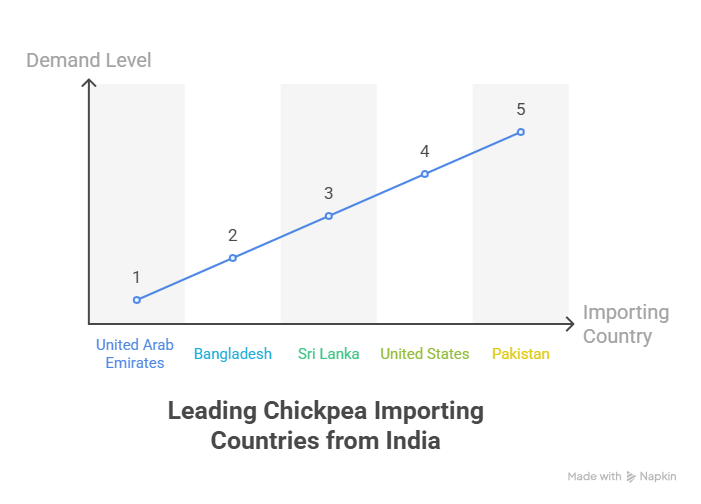
The leading chickpeas importing countries pulling product from India include the United Arab Emirates, Sri Lanka, Bangladesh, Pakistan, and the United States. Each market has its own preference — some want Desi chana, others prioritise Kabuli for retail.
| Importing Country | Primary Demand | Market Notes |
| United Arab Emirates | Re-export hub + retail | Gateway to wider Gulf and Africa |
| Bangladesh | Bulk consumption | Steady, high-volume buyer |
| Sri Lanka | Retail + processing | Consistent regional demand |
| United States | Premium + ethnic retail | Growing plant-protein market |
| Pakistan | Bulk staple demand | Large consumption base |
Globally, India is also one of the biggest chickpea importers — an unusual position. The country both feeds the world’s pulse trade and consumes more than it grows in tight years. That dual role makes chickpea export from India a uniquely two-way business. You can find buyers and suppliers within the same trade flow.
For exporters, the chickpeas importing countries list is your targeting map for chickpea export from India. Don’t spray and pray. Match your variety and grade to the markets that want it. UAE buyers behave differently from Bangladeshi importers, and your pitch should reflect that.
Australia, Turkey, and the Global Chickpea Exporters Picture
India doesn’t trade in a vacuum. The world’s leading chickpea exporters compete on price, quality, and reliability — and understanding the field helps you position your offer.
Australia is widely regarded as the largest chickpea exporter in the world. Türkiye, Russia, India, and Mexico round out the top tier. Each brings something different: Australia ships massive volumes, Turkey leans into premium Kabuli, and India offers unmatched variety plus competitive Desi pricing.
This global context shapes chickpea export from India in real ways. When Australian harvests are strong, prices soften globally. When they’re weak, Indian suppliers gain leverage. Reading these signals separates a reactive exporter from a strategic one.
The takeaway? Know your competition. A buyer comparing your quote against an Australian exporter wants to hear why Indian chickpeas suit their specific need. Variety, price, lead time, relationship. That’s your pitch — and it’s the heart of competitive chickpea export from India.
Finding Chickpea Export Leads and Import Export Leads
Let’s get practical. All the market knowledge in the world means nothing without buyers to talk to. This is where most exporters stall.
Quality chickpea export leads come from three places:
- Live shipment data platforms — showing who’s importing right now, with contact details
- B2B trade marketplaces — where active buyers post real sourcing requirements
- Trade exhibitions and verified directories — slower, but high-trust
The problem with old-school lead lists? They’re full of dead ends — inactive companies, middlemen, and unverified inquiries. Chasing those wastes time you don’t have. Genuine chickpea import leads need to be current and verified, tied to actual shipment activity — the backbone of any profitable chickpea export from India strategy.
This is the gap VyaaparOne closes. As a B2B trade platform, VyaaparOne connects verified chickpea suppliers and buyers directly, cutting the noise. Instead of cold lists, you get import export leads that reflect live demand — buyers who are actively sourcing, not browsing. For anyone serious about chickpea export from India, that verified-buyer access changes the entire economics of outreach.
Generate chickpea export leads through a verified channel and your conversion rate climbs. You stop wasting cycles on non-serious inquiries and start talking to importers who place orders. That’s the whole game.
Pricing, Margins, and Seasonality in Chickpea Trade
Money talks, so let’s talk money. Chickpea pricing moves on a few predictable levers, and understanding them gives you negotiating power.
Harvest timing is the big one. India’s rabi chickpea crop comes in around February to April. Prices typically soften right after harvest when supply peaks, then firm up as stocks deplete through the year. If you’re buying to export, sourcing close to harvest improves your margin. If you’re selling, timing shipments to lean-supply windows lifts your realised price. This rhythm shapes every chickpea export from India deal that matters.
Global competition adds another layer. When Australia posts a strong harvest, world chickpea prices ease and Indian exporters face pressure on premium grades. When Australian or Canadian supply tightens, Indian suppliers gain pricing leverage almost overnight. Watching those harvest reports isn’t optional for a serious trader — it’s part of the job.
Then there’s currency. A softer rupee makes chickpea export from India more competitive on the world market, improving your dollar realisation. Exporters who hedge thoughtfully protect those gains instead of watching them evaporate at settlement.
The practical lesson? Don’t quote in a vacuum. Price your chickpea against the current global picture, your sourcing cost, and the specific buyer’s alternative. The chickpeas exporters who consistently win are the ones who price with full market awareness, not gut feel.
Documentation and Compliance Checklist
Paperwork is where promising deals quietly die. Buyers walk when documents are messy, and customs holds shipments when codes don’t match. Treat compliance as part of the product, not an afterthought, and your chickpea export from India operation runs smoother than most competitors.
Here’s the core documentation stack every exporter needs in order:
- IEC (Import Export Code) — your licence to trade internationally, issued by DGFT
- Correct chickpea HS code declaration — 07132000 for whole dried chickpeas, verified against the live schedule
- Phytosanitary certificate — proving the consignment is pest-free, mandatory for most destinations
- Certificate of Origin — establishing Indian provenance for tariff and preference purposes
- Commercial invoice and packing list — clean, accurate, matching the actual shipment
- Quality and fumigation certificates — buyers in the Gulf and EU often require these
Get one of these wrong and the whole shipment stalls. That’s not a hypothetical — it’s the single most common reason a first chickpea export from India deal falls apart. The buyers who matter notice immediately when an exporter is sloppy with documentation, and they don’t come back.
The reverse is also true. Exporters who run tight documentation build trust fast, and trust is what converts a one-off order into a standing relationship. Combine clean paperwork with verified chickpea export leads, and you’ve removed the two biggest friction points in the entire trade. That’s how serious chickpeas exporters scale — not by chasing more leads, but by closing the ones they have cleanly and reliably.
How to Start Exporting Chickpeas from India
So you’ve got product and you want in. Here’s the realistic path.
First, get your paperwork sorted. IEC (Import Export Code) registration is non-negotiable. Then align on your chickpea HS code and confirm any phytosanitary requirements for your destination markets. Dried chickpeas typically must stay below 12% moisture — buyers will reject anything damp.
Next, nail your sourcing. Connect with reliable chickpeas suppliers India-side, ideally near major production hubs in Madhya Pradesh or Rajasthan. Quality consistency wins repeat orders.
Then the part that makes or breaks you — finding buyers. Use verified import export leads rather than scattergun outreach. A platform like VyaaparOne lets you skip the cold-list grind and reach importers who are genuinely in-market.
Finally, logistics. Partner with freight forwarders who understand pulse exports and the documentation around chickpea export from India. Clean docs, accurate codes, on-time shipping — that reputation compounds into a real business.
None of this is complicated. It’s just unforgiving of sloppiness. The exporters who win treat data and documentation as seriously as the product itself.
Comparison: Sourcing Through a Verified Platform vs. Traditional Methods
Why does the sourcing channel matter so much? Because it determines lead quality, speed, and ultimately your profit on every chickpea export from India transaction.
| Factor | Traditional Cold Lists | Verified Platform (VyaaparOne) |
| Buyer accuracy | Often outdated, many inactive | Live, verified, active buyers |
| Time to first reply | Weeks of cold outreach | Days, sometimes hours |
| Lead source | Scraped directories | Real shipment + demand signals |
| Conversion rate | Low — full of dead ends | High — buyers already in-market |
| Chickpea export leads quality | Unverified, mixed intent | Verified chickpea import leads |
| Cost per closed deal | High (wasted cycles) | Lower (focused outreach) |
Traditional cold-list outreach burns weeks. You email a hundred contacts, half bounce, a quarter are inactive, and a handful reply. Verified platform sourcing flips that ratio. You’re talking to active buyers from day one. For chickpea export from India at scale, that efficiency isn’t a nice-to-have — it’s the margin.
The same logic applies whether you’re a first-time exporter or a seasoned trader expanding markets. Verified import export leads compress your sales cycle, protect your time, and lift the quality of every conversation. That compounding advantage is why platform sourcing has quietly become the default for the smartest chickpeas exporters working out of India.
Final Word
Chickpea export from India is a genuine opportunity for anyone willing to do it properly. The demand is real, the supply base is deep, and the production engine — anchored by Madhya Pradesh as the largest producer of chickpea in India — keeps the country competitive on the world stage.
What ties it all together is access. Knowing your chickpea HS code, mapping the chickpeas importing countries, identifying the right chickpeas exporters — none of it converts without verified buyers. That’s where a platform like VyaaparOne earns its place, turning scattered chickpea import leads into closed orders.
Get the data right, get the buyers verified, and chickpea export from India stops being a gamble and starts being a business. Ready to find your next buyer? Start with verified leads on VyaaparOne.
The leading chickpeas suppliers India offers include Savaliya Exports, Vad Industries, Seasons International Pvt Limited, and K.J. International. These exporters consistently appear in shipment records for chickpea export from India.
Frequently Asked Questions
Who are the top chickpeas exporters in India?
Some of the top chickpeas exporters and chickpeas suppliers India is known for include Savaliya Exports, Vad Industries, Seasons International Pvt. Ltd., K.J. International, and several other established pulse exporters. These companies play a major role in chickpea export from India, supplying Desi and Kabuli chickpeas to buyers across the UAE, Bangladesh, Sri Lanka, the United States, and other global markets.
Who is the largest chickpea exporter in the world?
Australia is widely regarded as the largest chickpea exporter in the world based on export volume. Other major exporters include Türkiye, Russia, India, Mexico, and Canada. While Australia leads in exports, India remains the world’s largest producer and a key player in the global chickpea export market.
How can I start a chickpea export business in India?
To start a chickpea export from India business, you need an Import Export Code (IEC), GST registration, reliable sourcing from chickpeas suppliers India, knowledge of the correct chickpea HS code, and access to verified chickpea export leads. Partnering with B2B export platforms can help you connect with international buyers more efficiently.