The global chemical industry is one of the most dynamic sectors in international trade. If you are a chemical manufacturer, trading company, or sourcing agent, finding the right chemical import export leads can make or break your business growth in 2026. The challenge is not a lack of opportunity — it is knowing exactly where to look and how to use the right data tools to find verified, high-quality buyers and suppliers.
In 2026, businesses that rely on outdated lead generation methods — cold calling, trade fair directories, or random online searches — are falling behind. Today, the smartest traders use chemical import data, chemical export data, and global trade data platforms to identify active buyers and sellers with laser precision. These tools reveal real shipment records, verified company names, trade volumes, and HS codes that tell you exactly who is buying what, from whom, and at what frequency.
This comprehensive guide will show you how to use chemical import export leads strategies backed by data, helping you build a powerful pipeline of verified prospects. Whether you are searching for chemical import leads or chemical export leads, this step-by-step resource will equip you with everything you need to grow your chemical business globally in 2026.
Why Chemical Import Export Leads Matter in 2026
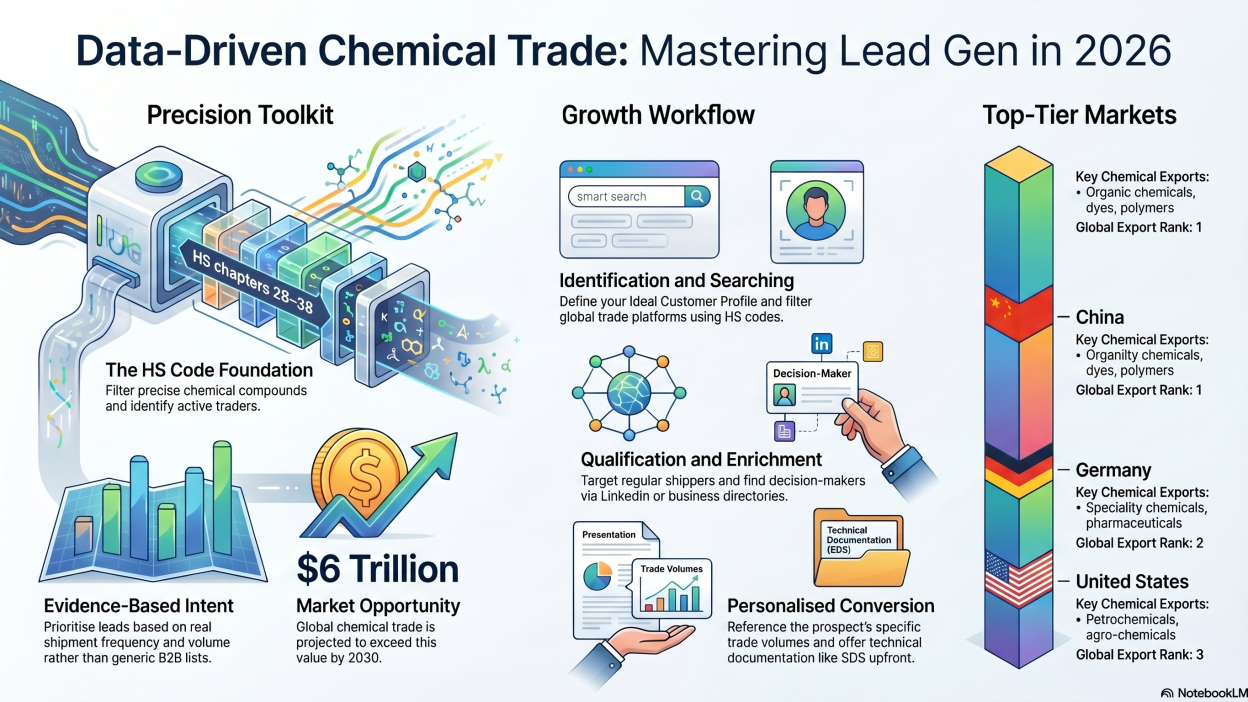
The chemical industry continues to evolve at a rapid pace. According to global trade analysts, the worldwide chemical market is expected to surpass $6 trillion by 2030, with international trade playing a central role. For businesses operating in this space, import export leads are the lifeblood of sustainable revenue.
But what exactly are chemical import export leads? Simply put, they are verified contact details and business intelligence about companies that are actively importing or exporting chemical products. These leads tell you:
- Which companies are buying specific chemicals
- How much volume they are purchasing
- Which countries they are sourcing from
- Which chemical hs code is associated with their products
- How frequently they place orders
Unlike generic B2B leads, chemical import leads and chemical export leads are rooted in actual shipment data. This means you are not guessing about buyer intent — you have evidence of real transactions.
In 2026, the competition for chemical business is global. Chinese manufacturers compete with European specialty chemical producers. Indian API exporters challenge established players in the United States. To stay ahead, you need actionable global trade data that reveals who your ideal customers are, what they are buying, and how to reach them before your competitors do.
That is exactly what this guide will help you achieve.
Understanding Chemical HS Codes and Their Role in Lead Generation
Before you can find chemical import export leads, you need to understand chemical hs codes. The Harmonized System (HS) code is an internationally standardized numerical system used to classify traded products. Customs authorities worldwide use these codes to track shipments, levy duties, and compile trade statistics.
For the chemical industry, HS codes are organized under chapters 28 to 38 of the Harmonized System. These chapters cover everything from inorganic chemicals to organic chemicals, pharmaceutical products, dyes, pigments, fertilizers, soaps, and more.
Why Chemical Product HS Code Matters for Lead Generation
When you search global trade data platforms using a specific chemical product hs code, you can instantly see:
- All companies worldwide that have imported or exported that product
- The countries of origin and destination
- Shipment quantities and values
- Supplier and buyer names (in many databases)
For example, if you are exporting ethylene glycol, you would search under chemical hs code 29053100. The database will show you every company that has imported this chemical over a selected time period. These companies become your chemical import leads — they are already buying the product you sell.
Similarly, if you are looking for chemical export leads, searching by HS code reveals companies that are exporting your target product, helping you understand the competitive landscape and potential partnership opportunities.
Using the right chemical product hs code is therefore the foundation of data-driven chemical import export leads generation. Without it, you are searching blind.
How to Use Chemical Import Data to Find Qualified Buyers
Chemical import data is one of the most powerful tools available to exporters, manufacturers, and trading companies in 2026. This data is derived from customs records filed by importers at the port of entry. It contains information such as:
- Importer company name and address
- Exporter name and country
- Chemical product hs code
- Product description
- Quantity and unit of measurement
- Shipment value (FOB/CIF)
- Port of loading and discharge
- Date of shipment
Steps to Use Chemical Import Data Effectively
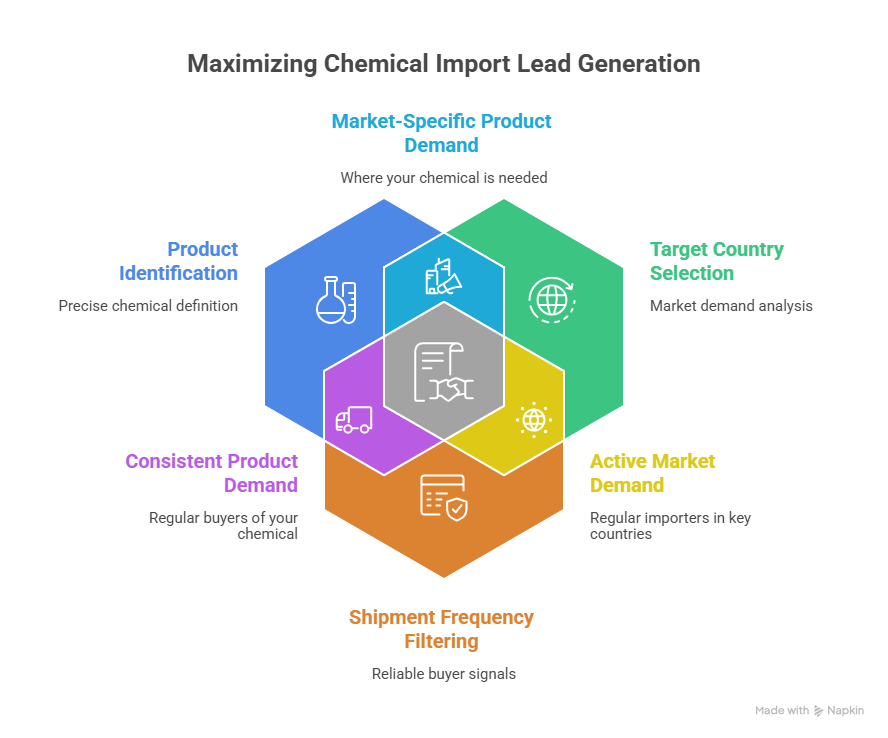
Step 1: Identify your target chemical product Know precisely what you are selling. Define it by its chemical name, trade name, and most importantly its chemical hs code. This code will be your primary search filter in any global trade data platform.
Step 2: Select your target country Decide which countries you want to export to. Use chemical exports by country reports to understand which markets have the highest demand for your product. Countries like the United States, Germany, China, India, and Brazil are historically large importers of industrial and specialty chemicals.
Step 3: Filter by shipment frequency Look for companies that import your target chemical regularly — monthly or quarterly shipments signal active buyers with ongoing demand. One-time shippers may not be reliable chemical import leads.
Step 4: Verify the buyer’s details Cross-reference the company name with LinkedIn, their official website, or business directories to confirm they are active and find the right contact person — typically a procurement manager or purchase director.
Step 5: Craft a targeted outreach message Use what you know from the chemical import data to personalize your approach. Mention the product, reference their import volume, and explain how your offering addresses their specific sourcing needs.
By following these five steps consistently, you can generate a steady pipeline of chemical import leads that are far more qualified than any generic B2B list.
Leveraging Chemical Export Data to Identify Suppliers
Just as chemical import data helps you find buyers, chemical export data helps importers and trading companies find the best suppliers. Chemical product export data is compiled from export declarations filed by manufacturers and trading companies at the port of origin.
Chemical export data reveals:
- Which companies are exporting specific chemicals
- Their production capacities and shipment volumes
- Their key markets — which countries they export to most
- Pricing trends based on declared shipment values
- Frequency and consistency of exports
How to Use Chemical Product Export Data for Sourcing
If you are an importer looking for new suppliers, chemical product export data is your most reliable discovery tool. Here is how to use it:
- Search by product HS code: Enter the chemical hs code of the product you need and filter by country of origin. For example, if you are looking for suppliers of acetic acid, search HS code 29152100.
- Analyze top exporters: Review which companies appear most frequently in the chemical export data. These are established, active exporters — your most reliable potential suppliers.
- Study their export markets: If a supplier regularly exports to markets similar to yours (same standards, regulations, packaging), they are more likely to meet your requirements.
- Evaluate shipment consistency: Look for exporters that ship regularly and in volumes that match your needs. Sporadic exporters in the chemical product export data may not be reliable partners.
- Contact verified suppliers: Use the company name and country from the global chemical export data by country to find contact details and initiate sourcing discussions.
This approach eliminates guesswork from supplier discovery, giving you chemical export leads that are grounded in real trade activity.
Top Chemical Exporting Countries You Should Target in 2026
Understanding the geography of global chemical trade is essential for any business seeking chemical import export leads. The top chemical exporting countries dominate global supply chains and represent the most productive sources of qualified trade leads.
China: The World’s Largest Chemical Exporter
China remains the undisputed leader among top chemical producing countries. With massive manufacturing infrastructure and competitive pricing, Chinese chemical exporters ship billions of dollars worth of products every year. From organic chemicals and specialty polymers to dyes, pigments, and intermediates, chemical exports by country data consistently shows China at the top.
Germany: Europe’s Chemical Powerhouse
Germany is home to global chemical giants like BASF, Bayer, and Evonik. The country is known for high-quality specialty chemicals, pharmaceutical intermediates, and advanced materials. If you are looking for chemical export leads from technologically advanced suppliers, Germany is a key market.
United States: A Major Chemical Producer and Importer
The United States is both a leading producer and importer of chemicals. US-based companies generate significant chemical import data activity, making them excellent targets for exporters worldwide. At the same time, the US exports large volumes of chemicals — particularly petrochemicals and agricultural chemicals.
India: The Rising Star of Chemical Exports
India has emerged as one of the fastest-growing top chemical exporting countries in the world. With a strong pharmaceuticals and specialty chemicals sector, Indian exporters are capturing market share globally. Organic chemicals export data shows India rising consistently in global rankings.
Other Key Markets
Other notable countries in global chemical export data by country include:
- Netherlands – major re-export hub for European chemical trade
- Belgium – significant exporter of industrial chemicals and plastics
- Saudi Arabia – leading in petrochemicals and basic chemicals
- Japan – strong in specialty and electronic chemicals
- South Korea – growing presence in fine chemicals and polymers
Table 1: Top Chemical Producing and Exporting Countries in 2026 {#table-1}
| Country | Key Chemical Exports | Global Export Rank | Annual Export Value (Est.) | Key HS Chapters |
| China | Organic chemicals, dyes, polymers, intermediates | 1 | $180+ billion | 28, 29, 32, 39 |
| Germany | Specialty chemicals, pharmaceuticals, coatings | 2 | $110+ billion | 29, 30, 32, 38 |
| United States | Petrochemicals, agro-chemicals, plastics | 3 | $105+ billion | 27, 29, 31, 39 |
| India | Pharma intermediates, dyes, specialty chemicals | 4 | $30+ billion | 29, 30, 32 |
| Netherlands | Industrial chemicals, re-exports, solvents | 5 | $55+ billion | 28, 29, 38 |
| Belgium | Basic chemicals, plastics, adhesives | 6 | $45+ billion | 28, 29, 39 |
| Saudi Arabia | Petrochemicals, methanol, ethylene | 7 | $40+ billion | 27, 29, 39 |
| Japan | Fine chemicals, electronic chemicals | 8 | $35+ billion | 29, 32, 38 |
| South Korea | Fine chemicals, polymers, resins | 9 | $28+ billion | 29, 39 |
| France | Cosmetic chemicals, specialty chemicals | 10 | $42+ billion | 29, 33, 38 |
Source: Estimated from global trade data platforms and customs records, 2026
Organic Chemicals Export Data: A Hidden Goldmine for Leads
Among all chemical product categories, organic chemicals export data represents one of the richest sources of chemical import export leads. Organic chemicals — covered under HS Chapter 29 — include thousands of compounds used in pharmaceuticals, agrochemicals, polymers, solvents, and specialty applications.
Why Organic Chemicals Export Data Is So Valuable
The organic chemicals sector has several characteristics that make its trade data especially useful for lead generation:
High trade frequency: Organic chemicals are traded in large volumes and with high frequency. This means the organic chemicals export data is rich with repeat buyers and suppliers, giving you verified, active leads rather than one-time shippers.
Diverse applications: Organic chemicals serve dozens of industries — pharma, agriculture, textiles, electronics, food processing, and more. This breadth means your potential buyer base is enormous when using chemical import data filtered under HS Chapter 29.
Trackable by specific compound: Because every organic chemical compound has a specific chemical product hs code, you can search trade data with extraordinary precision. Instead of searching broadly for “organic chemicals,” you can look up acetone (HS 291411), citric acid (HS 291814), or methanol (HS 290511) specifically.
How to Mine Organic Chemicals Export Data for Leads
- List your key compounds: Start with the organic chemical products you manufacture or trade.
- Find the exact HS code: Use the six or eight digit chemical hs code for precise filtering.
- Search global databases: Access platforms that provide global chemical export data by country filtered by HS code.
- Download the shipment records: Export the list of importers or exporters from the database.
- Build your lead list: Organize contacts by country, volume, and frequency.
This method using organic chemicals export data consistently delivers high-quality chemical import leads that convert better than any purchased contact list.
How Global Trade Data Platforms Power Chemical Lead Generation
The availability of global trade data has transformed how chemical businesses find buyers and suppliers. In 2026, dozens of platforms aggregate customs data from countries worldwide, making it possible to access chemical import data, chemical export data, and chemical exports by country breakdowns from a single dashboard.
What Global Trade Data Platforms Offer
Modern global trade data platforms provide:
- Bill of Lading data: Shipment-level records from major trading nations
- Customs import/export records: Filed declarations with product, quantity, value, and counterparty information
- HS code filters: Search by any chemical product hs code to narrow results
- Company profiles: Aggregated trade history for individual importers and exporters
- Country analytics: Global chemical export data by country showing market trends over time
- Alert systems: Get notified when new shipments match your target product or country
Key Features to Look for in a Trade Data Platform
When choosing a platform for chemical import export leads, look for:
- Coverage: Does it include chemical import data and chemical export data from your target markets?
- Freshness: How recent is the data? Look for platforms that update monthly or faster.
- Search flexibility: Can you filter by chemical hs code, country, date range, and shipment value?
- Contact information: Some platforms include buyer or supplier contact details, which saves time on manual research.
- Export capabilities: Can you download lead lists in CSV or Excel format for CRM integration?
Platforms like Vyaapar One provide access to rich global trade data specifically designed to help businesses find chemical import export leads across key markets. With powerful filters and verified shipment records, these tools dramatically reduce the time it takes to build a qualified prospect list.
Step-by-Step: Building Your Chemical Import Export Lead Pipeline
Now that you understand the data sources, let us walk through a practical, step-by-step process for building a consistent pipeline of chemical import export leads in 2026.
Step 1: Define Your Ideal Customer Profile (ICP)
Start by defining exactly who you are looking for. Ask yourself:
- Are you targeting chemical import leads (buyers) or chemical export leads (suppliers)?
- What specific chemicals or product categories are involved?
- What countries or regions are you targeting?
- What minimum order volume makes a lead worthwhile?
- What industries are your end users in?
Your ICP is the filter you apply to all global trade data searches. Without it, you will collect thousands of irrelevant contacts.
Step 2: Compile Your Chemical HS Codes
Make a list of all relevant chemical hs codes for your products. Use the six-digit international code plus any country-specific extensions. This list will be your primary search tool when filtering chemical import data or chemical export data.
Step 3: Access a Reliable Global Trade Data Platform
Subscribe to a platform that provides verified, up-to-date global chemical export data by country and chemical import data. Look for one that covers your target markets — whether that is the US, Europe, Southeast Asia, or the Middle East.
Step 4: Run Your First Search
Enter your chemical product hs code in the search field. Filter by:
- Country of import or export
- Date range (last 6–12 months for active leads)
- Minimum shipment value (to filter out small, irregular buyers)
Review the results. The companies that appear are your raw chemical import export leads.
Step 5: Qualify and Prioritize Leads
Not every name on the list is worth pursuing. Qualify leads based on:
- Shipment frequency: Regular monthly or quarterly importers are higher value
- Volume: Companies ordering larger quantities are better targets
- Geographic fit: Prioritize countries where your pricing and logistics are competitive
- Product match: Confirm the product description aligns with your offering
Step 6: Enrich Your Lead Data
For each qualified lead, enrich your data with:
- Company website
- LinkedIn profiles of key decision makers (procurement head, purchase manager)
- Email address or phone number (use platforms with contact data or LinkedIn Sales Navigator)
- Business registration and credit data if available
Step 7: Outreach and Follow-Up
Contact your chemical import leads or chemical export leads with a personalized, value-driven message. Reference the specific product, their import or export activity, and how your business can serve their needs better. Follow up consistently — chemical trading relationships take time to develop.
Step 8: Track and Optimize
Use a CRM to track every import export leads touchpoint. Measure reply rates, conversion rates, and revenue generated per lead source. Use this data to continuously refine your HS code searches, target countries, and outreach messaging.
Table 2: Key Chemical HS Codes and Product Categories for Trade Lead Research {#table-2}
| HS Code | Product Category | Common Trade Names | Key Importing Regions | Key Exporting Countries |
| HS 2801–2853 | Inorganic Chemicals | Sulphuric acid, sodium hydroxide, chlorine | Southeast Asia, Middle East | China, Germany, USA |
| HS 2901–2942 | Organic Chemicals | Methanol, ethanol, acetic acid, acetone | Europe, North America, India | China, USA, Saudi Arabia |
| HS 3001–3006 | Pharmaceutical Products | APIs, excipients, drug intermediates | USA, EU, Africa | India, China, Germany |
| HS 3101–3105 | Fertilizers | Urea, ammonium nitrate, DAP | South Asia, Africa, LatAm | China, Russia, Morocco |
| HS 3201–3215 | Dyes, Pigments, Inks | Reactive dyes, titanium dioxide, carbon black | Textile markets globally | China, India, Germany |
| HS 3301–3307 | Cosmetic Chemicals | Fragrance oils, surfactants, preservatives | Europe, USA, Middle East | France, Germany, India |
| HS 3401–3402 | Soaps and Surfactants | SLS, SLES, LAS, fatty alcohols | Africa, Asia, LatAm | India, China, Malaysia |
| HS 3801–3826 | Miscellaneous Chemicals | Adhesives, catalysts, lubricants, resins | Global | USA, Germany, China |
| HS 3901–3926 | Plastics and Polymers | Polyethylene, PVC, polypropylene, ABS | Asia, Africa, LatAm | Saudi Arabia, USA, South Korea |
| HS 2710–2715 | Petroleum Chemicals | Mineral oils, waxes, bitumen | Southeast Asia, Africa | Saudi Arabia, UAE, Russia |
Note: HS codes may vary by country at the 8-digit level. Always verify with local customs authorities.
Best Strategies to Convert Chemical Leads into Buyers
Generating chemical import export leads is only half the battle. Converting those leads into paying customers requires a structured sales and relationship-building approach. Here are the most effective strategies for 2026.
Personalize Every Outreach
Generic emails get ignored. When you contact a chemical import lead, reference what you know from the chemical import data — the specific product they buy, their import volume, and their regular shipping lane. This demonstrates that you have done your homework and positions you as a serious business partner.
Offer a Sample or Trial Shipment
Chemical buyers are cautious. They have quality specifications, regulatory requirements, and supply chain dependencies. Offering a free or low-cost sample reduces their risk and opens the door to a commercial relationship. Use chemical export data to understand what quality standards your target market expects.
Provide Technical Documentation Upfront
Chemical buyers need Safety Data Sheets (SDS), Certificates of Analysis (CoA), and relevant compliance documents. Having these ready accelerates the qualification process and builds trust.
Leverage Chemical HS Code Data in Your Pitch
When pitching to a chemical import lead, mention the specific chemical product hs code and related data. This shows technical credibility and assures buyers that your products will clear customs without issues.
Build a Follow-Up Cadence
Chemical trading decisions take time. A single email is rarely enough. Build a 6-touch follow-up sequence over 4–6 weeks:
- Initial outreach (email)
- Follow-up with product brochure (email)
- LinkedIn connection request
- Phone call or WhatsApp message
- Offer of a sample or video call
- Final follow-up with a limited-time offer or pricing incentive
Use Global Trade Data to Re-engage Lost Leads
If a prospect goes cold, revisit the global trade data to see if they are still active importers. If their shipment frequency has increased, it is a sign that they are buying more and may be looking for alternative suppliers — a perfect moment to re-engage.
Common Mistakes to Avoid When Sourcing Chemical Trade Leads
Even with access to the best global chemical export data by country and chemical import data, many businesses make avoidable mistakes that limit their lead generation results. Here are the most common pitfalls and how to avoid them.
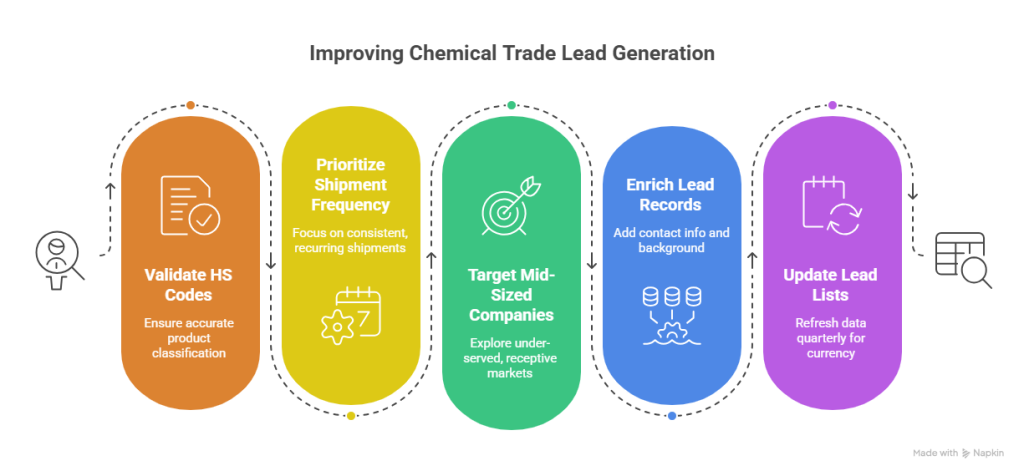
Mistake 1: Not Validating HS Codes
Using the wrong chemical hs code will give you irrelevant results. Always cross-check HS codes against the product’s official chemical classification before running a search. A two-digit error can result in completely different products showing up in your chemical import export leads results.
Mistake 2: Ignoring Shipment Frequency
Many businesses focus only on volume when reviewing chemical import data, but frequency is equally important. A company that imported a product once may not be a real buyer. Prioritize leads with consistent, recurring shipments.
Mistake 3: Targeting Only the Largest Companies
Large multinationals are attractive but highly competitive targets. Mid-sized companies in chemical exports by country data are often under-served and more receptive to new supplier conversations.
Mistake 4: Skipping Lead Enrichment
A company name from chemical export data is just the starting point. Without enriching that record with contact information, decision maker names, and company background, your outreach efforts will stall.
Mistake 5: Not Updating Lead Lists Regularly
Trade patterns change. A company that was a top importer last year may have switched suppliers. Refresh your chemical import data searches quarterly to ensure your chemical import export leads list stays current.
Mistake 6: Neglecting Compliance and Documentation
Chemical trade is heavily regulated. Failing to provide the correct documentation — including product-specific chemical hs code declarations, SDS sheets, and origin certificates — will kill deals even with willing buyers.
Conclusion
In 2026, winning in the chemical trade business requires more than relationships and gut instinct — it requires data. Chemical import export leads generated from verified global trade data are the foundation of any serious export or import growth strategy. By mastering chemical hs code searches, analyzing chemical import data and chemical export data, and understanding the geography of top chemical exporting countries, you can build a pipeline of qualified, active prospects far faster than traditional methods allow.
The key takeaways from this guide are clear: start with the right chemical product hs code, use a reliable global trade data platform, focus on shipment frequency and volume when qualifying chemical import leads and chemical export leads, and personalize every outreach based on what the data reveals about each prospect.
Whether you are tracking organic chemicals export data for niche markets or analyzing global chemical export data by country for strategic expansion, the approach is the same — let real trade data guide every decision.
Vyaapar One provides businesses with powerful access to chemical import data, chemical export data, and comprehensive import export leads across dozens of product categories. Start your free trial today and discover how data-driven lead generation can transform your chemical business growth in 2026.
Frequently Asked Questions
What are chemical import export leads?
Chemical import export leads are verified business prospects — importers or exporters — who are actively trading chemical products. These leads are generated from customs shipment data, trade databases, and global trade data platforms, giving you real evidence of buying or selling activity rather than guesswork.
How do I find chemical import leads for free?
Some governments publish limited chemical import data for free, including the US International Trade Commission and India’s DGCIS. However, for comprehensive, searchable chemical import leads with company names and contact details, a paid global trade data platform like Vyaapar One is typically necessary.
What is the best HS code for organic chemicals?
Organic chemicals are classified under HS Chapter 29, which spans codes 290110 to 294200. The specific chemical product hs code you need depends on the exact compound. For example, methanol is HS 290511, acetic acid is HS 291521, and citric acid is HS 291814. Always verify with your country’s customs schedule.
Which are the top chemical exporting countries in 2026?
The top chemical exporting countries in 2026 include China, Germany, the United States, India, the Netherlands, Belgium, Saudi Arabia, Japan, South Korea, and France. These nations collectively dominate global chemical export data by country reports and are the primary sources of chemical export leads.
How accurate is chemical export data from trade databases?
Accuracy depends on the platform. High-quality global trade data platforms source data directly from customs authorities, making the chemical export data and chemical import data highly reliable. Always choose platforms that clearly state their data sources and update frequency.
Can I use global trade data to find both buyers and suppliers?
Yes. Global trade data platforms allow you to search chemical import data to find buyers (importers) and chemical product export data to find suppliers (exporters). This dual capability makes trade data platforms the most versatile tool for chemical import export leads generation.
How do I use chemical exports by country data for market research?
Chemical exports by country data helps you understand global supply patterns, identify the dominant producing nations for specific chemicals, and evaluate market competition. For example, if organic chemicals export data shows that India is rapidly increasing its exports of a specific compound, it signals growing competition for suppliers from other regions.