Introduction:
The global pet food industry is experiencing unprecedented growth in 2026. With hundreds of millions of households adopting companion animals across Asia, Europe, Latin America, and North America, demand has surged to record highs. Businesses on both sides of the pet food trade — pet food exporters and pet food importers — are actively searching for verified, reliable import export leads that connect them to the right partners at the right time.
Whether you are a pet food manufacturer expanding into new markets, a pet food ingredient supplier seeking international buyers, a trader navigating the correct pet food HS code classification system, or a distributor looking for established pet food exporters in emerging production hubs, this guide delivers everything you need in one comprehensive resource. Vyaaparone.com has created this deep-dive article to provide actionable intelligence on the industry export, this pet food market import, regulatory requirements, HS code guidance, and real 2026 trade data.
The market is not a simple commodity sector. It spans dry kibble, wet food, freeze-dried options, raw diets, veterinary-grade preparations, and specialty items for dogs, cats, fish, birds, and exotic animals. Every category carries its own HS code for pet food, its own regulatory requirements, and a distinct set of global buyers and sellers with differing purchasing criteria. Understanding these nuances separates traders who thrive from those who struggle to find reliable counterparties.
In this article, we explore the top pet food exporters and pet food importers worldwide, break down the pet food HS code system comprehensively, highlight the remarkable growth of pet food exports from India, profile key pet food ingredient suppliers, review leading pet food manufacturers, and show exactly how Vyaaparone.com connects you to the most targeted import export leads in pet food industry for 2026.
If you are serious about growing your trade business this year, every section of this guide is designed to save you time, reduce risk, and accelerate your path to verified, productive partnerships.
The Global Pet Food Market in 2026: Size, Growth, and Opportunity
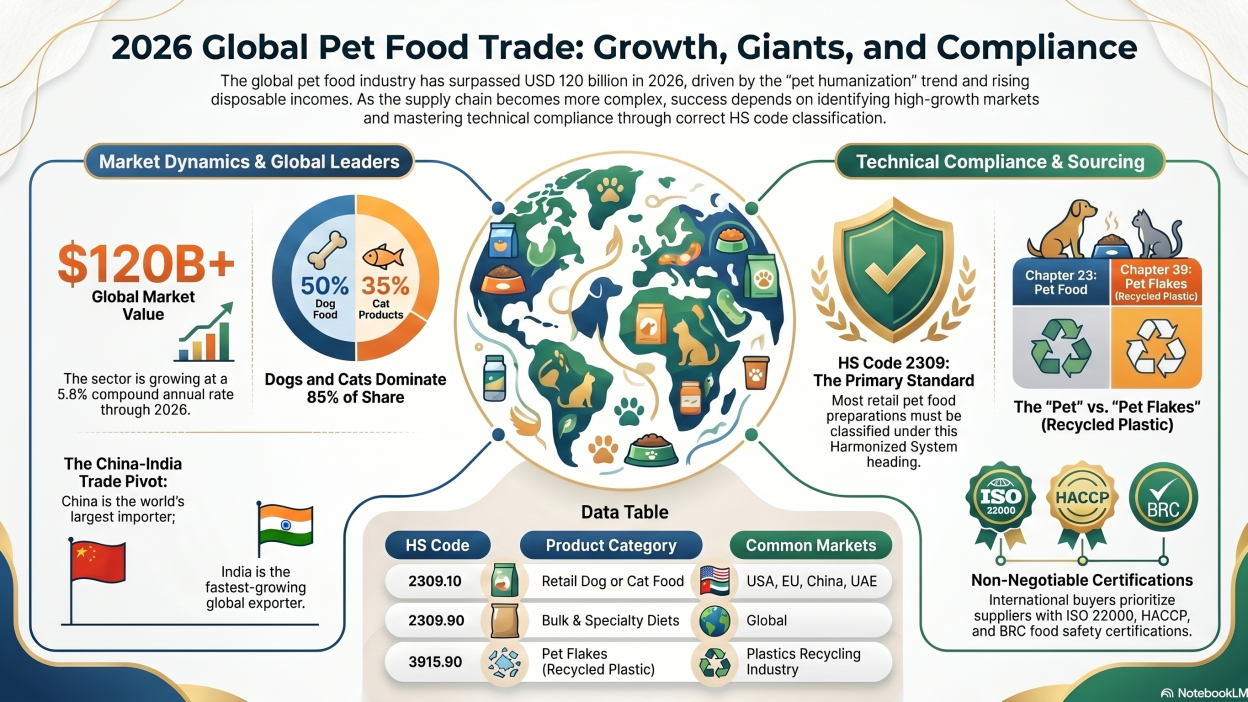
The global pet food market has crossed the USD 120 billion mark in 2026. Urbanisation, the pet humanisation trend, rising disposable incomes across emerging economies, and the growing nuclear family structure are all driving demand for premium products at an accelerated pace. This sector is now one of the fastest-growing segments in international agri-food trade, with no sign of slowdown on the horizon.
Key figures shaping trade in 2026: the market exceeds 120 billion US dollars globally, growing at a compound annual rate of approximately 5.8 percent from 2022 through 2026. The fastest-growing import markets are China, India, Brazil, the UAE, and Saudi Arabia. Top exporting nations include the USA, Germany, France, Thailand, the Netherlands, and India. Dog food accounts for approximately 50 percent of market share, cat products for 35 percent, and specialty categories for the remaining 15 percent.
The surge in pet food imports across Asia-Pacific is particularly dramatic. Countries like China, Japan, South Korea, and Vietnam are importing at rates that have doubled in four years. This opens enormous opportunities for pet food exporters who can consistently meet quality, safety, and labelling standards required by these demanding, high-value markets.
At the same time, pet food manufacturers in cost-competitive countries — especially India, Thailand, and Eastern Europe — are aggressively growing their export portfolios. They are targeting premium markets in Europe, North America, and the Middle East, competing on both quality and price. The global supply chain is becoming more interconnected and complex every year.
For buyers and sellers navigating this landscape, the key challenge is finding trusted import export leads that reduce prospecting time and eliminate unreliable counterparties. That is precisely where a platform like Vyaaparone.com adds massive value for every pet food exporter, importer, supplier, and manufacturer looking to grow internationally in 2026.
Top Pet Food Exporters in 2026: Who Is Supplying the World?
Understanding who the major pet food exporters are helps importers identify the most competitive and reliable supply sources. In 2026, the global export landscape is shaped by a blend of established Western producers and rapidly growing Asian and South Asian suppliers.
United States: The Largest Pet Food Exporter by Value
The USA remains one of the world’s dominant pet food exporters. American manufacturers produce a wide range of dry, wet, freeze-dried, and specialty items sold across more than 100 countries. Total export values exceed USD 2 billion annually, with Canada, Japan, Mexico, South Korea, and Australia being the primary destinations. American this sector exports are backed by rigorous FDA and USDA quality standards that international buyers trust explicitly.
Germany and the Netherlands: Europe’s Export Powerhouses
Europe hosts several world-class pet food exporters. Germany and the Netherlands lead the continent in volume and value. European manufacturers are globally recognised for advanced formulations, organic and natural ingredient sourcing, and veterinary-grade quality controls. Their exports target Asian markets, the Middle East, and emerging economies where premium categories are growing most rapidly.
Thailand: Asia’s Leading Pet Food Exporter
Thailand holds the position of Asia’s largest pet food exporter. Thai manufacturers specialise in canned products, pouched wet items, and premium treats. Exports from Thailand reach over 60 countries, with the USA, EU nations, Japan, and Australia being the biggest buyers. The Thai industry is underpinned by a robust network of pet food ingredient suppliers producing fish meal, poultry by-products, and specialty carbohydrates at scale.
France: Prestige and Premium Pet Food Exports
France is a globally recognised pet food exporter, home to some of the world’s most respected brands in the veterinary and premium segments. French exports include prescription veterinary diets, natural product lines, and science-backed dry formulations. French manufacturers focus on nutritional science and quality assurance, making their products highly sought-after by sophisticated pet food importers in Japan, the Middle East, and North America.
Australia: Natural and Raw Pet Food Exports
Australia exports high-quality natural and raw products that appeal to health-conscious consumers globally. Australian pet food exporters have built a strong reputation in Asian markets, particularly in China, Hong Kong, and Japan. Export growth has been driven by strong brand equity and a reputation for clean, responsibly sourced ingredients — values that premium consumers in these markets pay significantly more for.
India: The Fastest-Growing Pet Food Exporter of 2026
India deserves dedicated attention as one of the most important and fastest-growing pet food exporters in 2026. Pet food exports from India have grown substantially over the past five years, driven by low production costs, a vast agricultural raw material base, and significantly improving manufacturing quality and compliance capabilities. The dedicated section below explores this opportunity in full.
Pet Food Exports from India: A Rising Global Power
Pet food exports from India represent one of the most compelling growth stories in the global trade landscape of 2026. India has emerged as a meaningful pet food exporter due to structural advantages that competitors in higher-cost countries cannot easily replicate.
Why Pet Food Exports from India Are Growing Rapidly
India’s manufacturing sector benefits from several powerful structural advantages.
Cost-Competitive Production: Labour costs and raw material availability make production in India significantly more cost-effective than in Western countries. This allows Indian pet food exporters to offer competitive pricing without the quality compromises that once characterised lower-cost supply sources. The gap between cost and quality is closing rapidly.
Raw Material Abundance: India is one of the world’s largest producers of grains, poultry, fish, and dairy — all critical inputs for these formulations. This gives manufacturers and pet food ingredient suppliers direct access to fresh, affordable raw materials at scale, reducing both production cost and supply chain complexity significantly.
Growing Regulatory Compliance: Indian exporters have invested substantially in meeting international standards, including ISO certification, HACCP compliance, and EU- and FDA-approved facility standards. This investment in regulatory capability has opened doors for pet food exports from India to markets in Europe, the Middle East, and increasingly North America.
Expanding Product Range: Indian pet food manufacturers now produce an impressive breadth — dry kibble, wet preparations, treats, raw diets, and speciality veterinary formulations. This diversity has dramatically strengthened India’s export portfolio and positioned the country as a multi-category supplier capable of serving diverse international buyer requirements.
Government Support: APEDA (Agricultural and Processed Food Products Export Development Authority) actively supports the agri-food export sector through incentives, certification assistance, and market access programmes that benefit pet food exporters and ingredient producers alike.
Key Destinations for Pet Food Exports from India
Indian exporters primarily target markets where they can compete on both price and improving quality. Southeast Asia — the Philippines, Vietnam, Indonesia, and Malaysia — absorbs significant volumes. The Middle East, especially the UAE, Saudi Arabia, Kuwait, and Qatar, is a fast-growing destination. European markets, led by Germany, the UK, Netherlands, and Poland, are growing importers of Indian products. North American markets are an emerging but growing frontier for pet food exports from India, though regulatory requirements remain the most stringent challenge to overcome.
Indian Pet Food Ingredient Suppliers: A Global Supply Hub
India is not only a finished product exporter but also a critical source of pet food ingredient suppliers for global manufacturers. Indian companies export fish meal, poultry by-products, rice bran, soybean meal, dried egg products, and botanical extracts to manufacturers in Thailand, Europe, and North America. This positions India uniquely as both a finished pet food exporter and a key input supplier across the broader global supply chain.
Vyaaparone.com maintains verified listings of Indian pet food exporters, manufacturers, and pet food ingredient suppliers actively seeking import export leads and international trade partnerships. For traders sourcing from or exporting to the Indian subcontinent, the platform is an indispensable resource.
Top Pet Food Importers Worldwide in 2026
On the buyer side, understanding who the major pet food importers are is equally critical for exporters targeting new markets or expanding in existing ones.
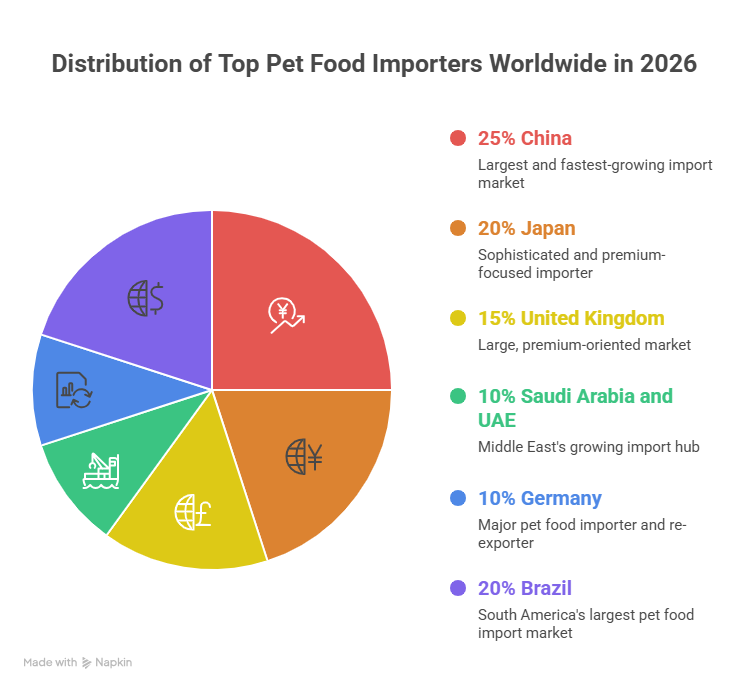
China: The World’s Largest Pet Food Import Market
China is the world’s largest and fastest-growing pet food import market in 2026. With over 100 million pet-owning households and a rapidly evolving culture of premium animal care, Chinese pet food importers are actively sourcing from the USA, Australia, New Zealand, Thailand, and Europe. Import values crossed USD 3 billion in 2025 and are projected to grow further through 2026 and beyond. China is the single most important destination market for any pet food exporter with ambitions to scale globally.
Japan: A Sophisticated and Premium-Focused Importer
Japan is one of the world’s most discerning import markets. Japanese buyers demand the absolute highest quality and pay premium prices for brands they trust. Japan imports primarily from the USA, EU countries, Australia, and Thailand, with growing openness to natural and functional products from New Zealand and India.
United Kingdom: A Large, Premium-Oriented Market
The UK remains a significant pet food segment importer. British buyers source from across Europe, North America, Thailand, and increasingly from India and Australia. The UK market is driven by premiumisation, the natural product trend, and deeply embedded pet ownership culture that makes the pet food category largely recession-resistant.
Saudi Arabia and UAE: The Middle East’s Growing Import Hub
The Middle East is a rapidly growing region for the pet food sector imports. Saudi Arabia and the UAE are importing increasing volumes as urban pet ownership rises. These markets prefer branded, Western-produced items but are increasingly open to quality products from Asian exporters who can meet Halal and certification requirements. Any pet food industry exporter targeting the Middle East must prioritise Halal compliance above all else.
Germany: A Major Pet Food Importer and Re-Exporter
Germany occupies a unique dual role as both a major market exporter and one of the world’s top importers of these products. German buyers source specialty ingredients, raw materials, and finished goods from around the world to meet domestic demand and to re-export within the EU single market.
Brazil: South America’s Largest Pet Food Import Market
Brazil is South America’s largest pet food category import market and one of the world’s fastest-growing consumption markets overall. Brazilian trade importers are expanding their sourcing from European and North American exporters, particularly for premium and super-premium segments that domestic manufacturers have not yet mastered at competitive quality levels.
Pet Food HS Code: The Complete Classification Guide for 2026
One of the most critical technical elements of international trade in this sector is the HS code for the market. The Harmonized System code is a globally standardised numerical classification used by customs authorities to identify traded goods. Every shipment must be accurately classified under the correct pet food HS code to ensure smooth clearance, proper duty assessment, and full regulatory compliance.
Using the wrong HS code for the industry can result in shipment delays, financial penalties, or seizure at customs. Both this space exporters and the goods importers must ensure all shipping documents carry the correct pet food HS code for every shipment.
Understanding the Core HS Code for Pet Food
The primary HS code for the business falls under Chapter 23 of the Harmonized System, covering residues and waste from the food industry and prepared animal fodder. Specifically, HS code 2309 is the most widely used heading globally.
HS Code 2309 — “Preparations of a kind used in animal feeding” — is the core chapter under which most of these products are classified. This covers preparations for dogs, cats, birds, fish, small mammals, and other companion animals across all formats and packaging types.
Table 1: HS Codes for the pet food category, Pet Flakes, and Related Products — 2026 Reference Guide
| HS Code | Full Description | Common Products Covered | Key Markets |
| 2309.10 | Dog or cat food put up for retail sale | Dry kibble, wet canned pet food, pouched products, treats, chews | USA, EU, China, India, UAE, Japan |
| 2309.90 | Other preparations used in animal feeding | Bird food, fish food, small animal diets, veterinary specialty diets, bulk pet food | All major global pet food markets |
| 0511.91 | Animal products for animal feeding — fish-based | Fish meal as pet food ingredient, fish by-products | EU, USA, Thailand, India |
| 2301.20 | Flours, meals and pellets of fish — fish meal | Fish meal for pet food manufacturing, fish protein concentrate | Global — used by pet food ingredient suppliers |
| 1214.90 | Other forage and plant-based animal feed products | Plant-based pet food inputs, alfalfa, vegetable proteins | EU, USA, India |
| 2302.40 | Bran, sharps and cereal residues for animal feed | Grain by-products in pet food formulations, rice bran | Global — pet food manufacturing inputs |
| 3907.60 | Polyethylene terephthalate (PET) in primary forms | PET resin, virgin PET pellets — used in pet food packaging | Global — packaging for pet food products |
| 3915.90 | Waste, parings and scrap of other plastics | Pet flakes (recycled PET), rPET material — separate from pet food | Global — plastics recycling trade |
This table serves as a reference guide. Importers and exporters must always verify the applicable pet food HS code with a qualified customs broker or their country’s customs authority, as national tariff schedules differ at the 8- or 10-digit level beyond the international 6-digit HS heading.
Pet Food HS Code in India
In India, the pet food HS code follows the ITC-HS (Indian Trade Classification) system. The primary classification is 2309.10 for retail preparations and 2309.90 for bulk and other preparations. These products imports into India also require compliance with FSSAI guidelines, Prevention of Food Adulteration regulations, and applicable DGFT import policies.
Pet Food HS Code in the USA
In the USA, the pet food HS code falls under the HTS (Harmonized Tariff Schedule). The relevant heading is 2309.10.00 for retail-packaged products. the pet food trade importers in the USA must also comply with FDA Centre for Veterinary Medicine regulations, including FSMA facility registration requirements for all foreign producers.
Pet Food HS Code in the European Union
The EU uses the Combined Nomenclature (CN) system. The HS code for these products in the EU is CN 2309.10 for retail products and CN 2309.90 for other preparations. EU pet food segment importers must ensure compliance with EC Regulation 767/2009, which governs the placing of compound feed on the European market.
HS Code for Pet Flakes: What Every Trader Must Know
Pet flakes are not the same as the sector. This distinction is absolutely critical for traders, customs brokers, and compliance managers. The term “pet” in pet flakes refers to PET plastic — Polyethylene Terephthalate — not companion animals. Pet flakes are recycled PET plastic, primarily derived from post-consumer PET bottles, and represent a major commodity in the global recycling and packaging industries.
Because both sectors use the abbreviated term “pet,” confusion around the HS code for pet flakes versus the pet food HS code is common among traders new to either industry. Understanding the clear distinction — pet food HS code under Chapter 23, pet flake HS code under Chapter 39 — is essential for accurate documentation and compliance.
Pet Flake HS Code Classification
The HS code for pet flakes falls under Chapter 39 of the Harmonized System, which covers plastics and articles thereof. The most relevant classifications include HS Code 3915.10 for waste, parings, and scrap of polymers of ethylene, and HS Code 3915.90 for waste, parings, and scrap of other plastics — this is the code most commonly applied to pet flakes derived from PET bottles. HS Code 3907.69 covers PET in primary forms and is used for virgin PET granules alongside pet flakes classifications.
The correct pet flake HS code depends on whether the material is virgin or recycled, the physical form (flakes, pellets, granules), and the specific national classification system. In India, the HS code for pet flakes under ITC-HS is most commonly 39159010 for recycled PET scrap and flakes.
Why the Pet Flake HS Code Matters
The correct pet flake HS code determines import duties and taxes in the destination country, applicable regulatory requirements — recycled materials often face additional environmental compliance rules — and documentation requirements at both origin and destination ports, including potential Basel Convention compliance for cross-border movement of plastic waste.
Using the wrong HS code for pet flakes can trigger customs examination, shipment delays, financial penalties, and compliance complications that are costly and time-consuming to resolve. Always verify the applicable pet flake HS code with a qualified customs consultant before finalising any shipping documentation.
Vyaaparone.com provides verified import export leads for both this industry traders and pet flake traders, with accurate HS code references for both product categories in all platform listings.
Pet Food Ingredient Suppliers: Understanding the Global Supply Chain
Behind every bag of the market on a retail shelf is a complex, interconnected supply chain involving dozens of these product ingredient suppliers, processors, quality controllers, and logistics partners. For manufacturers and exporters, building relationships with reliable, certified category ingredient suppliers is one of the most critical factors in maintaining product quality, supply consistency, and cost competitiveness in global markets.
Key Ingredients in the Pet Food Supply Chain
These formulations rely on a diverse range of raw materials sourced from agricultural, marine, and specialty production sectors globally.
Protein Sources: Chicken meal, poultry by-products, fish meal, fish oil, beef, lamb, and pork by-products are the traditional animal-based inputs. Plant-based proteins including soy protein concentrate, pea protein isolate, lentil flour, and chickpea flour are growing in importance as demand for alternative protein this trade increases. Protein is typically the most expensive ingredient and the one that buyers scrutinise most carefully in quality assessments.
Carbohydrates and Energy Sources: Corn, wheat, rice, barley, oats, potato flour, sweet potato flour, tapioca starch, and cassava. The choice of carbohydrate significantly affects product positioning — grain-free formulations using potato and tapioca are marketed as premium by many market manufacturers targeting health-conscious consumers.
Fats and Oils: Chicken fat, fish oil, vegetable oils including sunflower and canola, and specialty oils such as flaxseed oil. Fats are critical for palatability, energy density, coat health, and overall quality perception in finished products.
Vitamins, Minerals, and Premixes: Precisely calibrated blends supplied by specialist industry ingredient suppliers. Key minerals include calcium carbonate, dicalcium phosphate, and sodium chloride. Vitamin premixes are a critical quality differentiator between economy and premium formulations.
Functional Additives: Probiotics, prebiotics, digestive enzymes, natural preservatives such as tocopherols and rosemary extract, joint support compounds including glucosamine and chondroitin, omega-3 fatty acids, and botanical health ingredients. This fast-growing category of specialty this space ingredient suppliers supports the premiumisation mega-trend driving global demand.
Global Pet Food Ingredient Suppliers by Region
China is one of the world’s largest sources of vitamins, minerals, and amino acids used in manufacturing globally. Chinese goods ingredient suppliers export at highly competitive prices, giving manufacturers affordable access to micronutrient inputs. However, buyers must conduct rigorous quality audits given historical quality incidents that have damaged trust in certain Chinese supply categories.
The USA produces some of the highest-quality proteins, specialty grains, and functional ingredients used globally. American business ingredient suppliers command premium pricing but deliver strong brand equity in markets where clean-label and origin-based marketing matters to consumers and retailers.
India is a rapidly growing and strategically important source of fish meal, poultry by-products, grain by-products, botanical extracts, and specialty plant proteins. Indian ingredient suppliers are expanding their international footprint rapidly, offering competitive pricing alongside improving quality controls, certifications, and export infrastructure.
Brazil is one of the world’s leading exporters of soybean meal, corn, and other plant-based proteins that flow into the global supply chain at scale. Brazilian trade ingredient suppliers serve manufacturers across Europe, Asia, and North America, particularly in the protein and energy ingredient categories.
Netherlands and Belgium are recognised European hubs for specialty processing, particularly for high-quality proteins, functional additives, and veterinary nutrition ingredients. These product ingredient suppliers are known for research-backed formulations and rigorous third-party quality standards that meet the most demanding buyer requirements.
Finding and Qualifying Pet Food Ingredient Suppliers
For manufacturers looking for reliable this segment ingredient suppliers, verified trade directories and B2B platforms are the most efficient research tools available. Vyaaparone.com maintains an active, updated database of verified ingredient suppliers across India, Southeast Asia, Europe, and the Americas, with direct contact details and certification information available for registered users.
Key qualification criteria include ISO, HACCP, GMP, and BRC certifications; third-party audited facility standards; robust ingredient traceability systems from source to delivery; minimum order quantities appropriate for your production volumes; and documented history of ingredient exports with verifiable references.
Leading Pet Food Manufacturers in 2026
These industry manufacturers are the engine driving global trade. Understanding the landscape of major producers helps importers identify trusted sources and enables smaller manufacturers to benchmark their certifications, capabilities, and product portfolios against industry leaders.
Global Pet Food Manufacturers — The Market Leaders
Mars Petcare remains the world’s largest market manufacturer by both revenue and volume. Operating under brands including Pedigree, Whiskas, Royal Canin, Iams, and Nutro, Mars Petcare produces across multiple continents and exports to virtually every country. Their scale gives them unmatched leverage across the entire supply chain, from ingredient procurement through retail distribution.
Nestlé Purina PetCare is the second-largest global manufacturer of these products, producing brands such as Pro Plan, Purina ONE, Fancy Feast, and Beneful. Nestlé Purina has manufacturing facilities across North America, Europe, and Asia and participates actively in both export and import markets globally.
Hill’s Pet Nutrition, a subsidiary of Colgate-Palmolive, is a leading the category manufacturer focused on the veterinary and prescription diet segments. Hill’s exports globally, with distribution concentrated in veterinary clinics, specialty retail, and premium e-commerce channels where buyers trust the science behind the brand.
Diamond this trades is one of the USA’s largest independent market manufacturers, producing under its own portfolio and as a contract manufacturer for numerous private-label and emerging brands globally. Their contract manufacturing capabilities make them a key partner for companies entering or scaling their industry export operations without building their own production infrastructure.
Thai Union Group is the world’s leading canned this space manufacturer, producing over 300,000 tonnes annually from Thailand-based facilities. Thai Union functions as both a the goods manufacturer and a major the business exporter, supplying canned and pouched products to branded companies across the USA, Europe, Japan, and Australia.
Mid-Tier and Regional Pet Food Manufacturers: The Underexplored Opportunity
Beyond the global multinationals, thousands of mid-tier and regional category manufacturers serve specific market niches, private-label buyers, and emerging consumer segments. These manufacturers often offer greater flexibility, smaller minimum order quantities, and far more customisation than the large multinationals can provide. For buyers seeking niche specialty products — from certified organic grain-free formulations to functional health-focused diets — regional manufacturers in India, Eastern Europe, Latin America, and Southeast Asia offer compelling, underexplored sourcing opportunities.
Vyaaparone.com maintains an updated database of verified trade manufacturers across multiple countries, categorised by product type, certifications, production capacity, and export capabilities. This makes it straightforward to identify the right manufacturer for your specific sourcing requirements quickly and without wasting time on unverified directories.
How to Find Verified Pet Food Import Export Leads in 2026
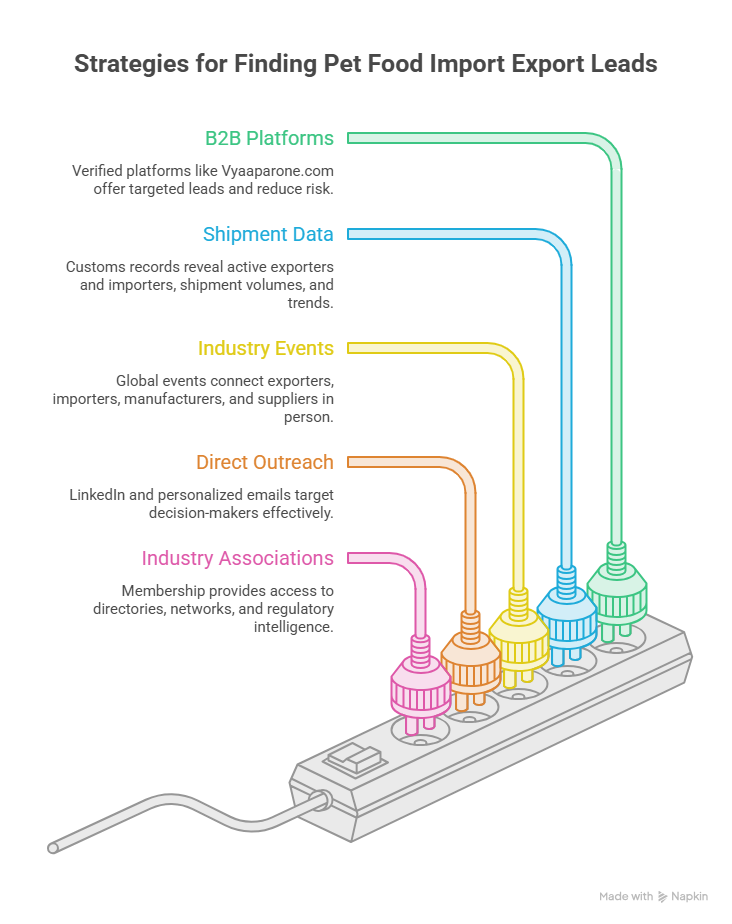
Finding high-quality import export leads in this sector requires a strategic, multi-channel approach. Scattershot prospecting wastes time and resources. The most successful buyers and sellers use verified B2B platforms, shipment data services, industry events, and targeted direct outreach in combination to build strong, sustainable trade pipelines.
Use Verified B2B Trade Lead Platforms
The most efficient method for finding targeted pet food import export leads is through specialised B2B platforms that verify the identity and trade credentials of all listed buyers and sellers. Vyaaparone.com is precisely this type of platform. It aggregates verified import export leads for these product exporters, this segment importers, manufacturers, and the sector ingredient suppliers, saving traders weeks of prospecting time and significantly reducing counterparty risk.
When evaluating any B2B lead platform, look for verified business profiles with no anonymous listings, trade history data based on actual shipment records, HS code filtering capability enabling search by pet food HS code, country-specific filtering, fresh 2026 data, and direct contact details not blocked by unnecessary intermediaries.
Leverage Customs and Shipment Data
Trade shipment databases contain actual customs records — real shipments that have physically crossed international borders. By filtering data by the relevant pet food HS code (2309.10 or 2309.90), traders can identify active industry exporters and the market importers in any given market, shipment volumes and frequency, ports of origin and destination, pricing trends where available, and seasonal trade patterns.
This shipment intelligence, combined with verified import export leads from Vyaaparone.com, gives traders a powerful, data-driven toolkit for building a targeted pipeline that converts faster than cold outreach alone.
Attend Global Pet Food Industry Events
Key industry events for trade networking in 2026 include Global Pet Expo in the USA (the world’s largest these products and pet products trade show), Zoomark International in Italy (Europe’s premier pet care trade fair), Pet Fair Asia in China (Asia’s leading sourcing exhibition), and Interzoo in Germany (one of the world’s most important biennial trade events in this sector). These events connect the category exporters, this trade importers, manufacturers, and the market ingredient suppliers in person, generating leads with significantly higher conversion rates than digital-only prospecting.
Direct Outreach and Professional Network Prospecting
LinkedIn Sales Navigator and targeted email outreach remain powerful lead generation tools when used strategically alongside platform-based approaches. Identifying decision-makers at the industry importers, manufacturers, and ingredient suppliers and sending personalised, value-driven connection requests is an effective methodology that complements Vyaaparone.com’s verified database.
Industry Associations
Joining industry associations provides access to member directories, trade event networks, and regulatory intelligence. Key associations include the Space Manufacturers’ Association (PFMA) in the UK, the American Pet Products Association (APPA) in the USA, FEDIAF (European this industry Federation), and PIJAC in North America. Member directories often contain high-quality import export leads from companies that are serious market participants.
Pet Food Suppliers: What International Buyers Look For in 2026
For companies searching for the goods suppliers — whether for finished products or ingredient inputs — understanding what international buyers prioritize is essential for positioning your offering effectively and winning supply contracts in competitive global markets.
Quality Certifications Are Non-Negotiable
Top buyers globally require their business suppliers to hold internationally recognised quality certifications as a baseline requirement, not a differentiator. These include ISO 22000 for food safety management, HACCP for hazard analysis and critical control points, the BRC Global Standard for Food Safety, GMP+ for good manufacturing practice in feed ingredients, and FAMI-QS specifically for ingredient suppliers providing additives and premix products.
the category suppliers without these certifications will find it progressively harder to enter premium markets in Europe, North America, Japan, and increasingly in Gulf markets. Certification investment is not optional for exporters with serious global ambitions in 2026.
Traceability and Supply Chain Transparency
Modern buyers demand complete ingredient traceability from source to finished product. Suppliers must provide comprehensive documentation covering every stage. This requirement has intensified in the post-pandemic environment, where buyers have become acutely aware of supply chain concentration risks and the reputational consequences of contamination or adulteration incidents — which can destroy brand equity overnight in today’s social media environment.
Competitive Pricing and MOQ Flexibility
While quality is paramount, buyers are also price-sensitive, particularly when sourcing from suppliers in cost-competitive markets. Flexible minimum order quantities (MOQs) are a genuine competitive advantage for the trade suppliers targeting smaller importers, emerging brands testing new product lines, or seasonal buyers with variable volume requirements.
Private Label and Contract Manufacturing Capabilities
Many of these product importers and branded retailers seek suppliers with private label manufacturing capabilities. The ability to produce under a buyer’s own brand and labelling requirements gives suppliers a significant competitive advantage and opens doors to higher-value, longer-term contracts with established international brands seeking to diversify their supply chains.
Vyaaparone.com: Your Platform for Pet Food Trade Leads in 2026
Vyaaparone.com is a dedicated B2B trade intelligence and lead generation platform designed for importers, exporters, manufacturers, and suppliers operating in India and global markets. The platform provides verified import export leads across hundreds of product categories, with this segment being one of the most active and fastest-growing segments in 2026.
What Vyaaparone.com Offers Pet Food Traders
Verified Export Leads: Connect with verified sector exporters from India, Thailand, the USA, Germany, France, and other major producing countries. All listings are verified with business registration details, export history, and direct contact information for key decision-makers.
Verified Import Leads: Access leads from this industry importers in China, UAE, UK, Saudi Arabia, Japan, Germany, and over 50 other countries. Find buyers actively searching for products matching your production capabilities and certifications.
HS Code Search: Filter import export leads by pet food HS code to find exactly the right buyers and sellers for your specific product type — retail packaged (2309.10) or bulk preparations (2309.90).
Ingredient Supplier Listings: Discover verified the market ingredient suppliers categorised by input type, country of origin, and relevant certifications, saving significant research time.
Manufacturer Profiles: Browse comprehensive profiles of these products manufacturers worldwide, including certifications, production capacity, private label capabilities, and active export markets.
Table 2: Comparison of Key Sources for the category Import-Export Leads — 2026
| Lead Source | Verified Profiles | HS Code Filter | Live Trade Data | India Focus | Pet Food Category | Free Access |
| Vyaaparone.com | Yes | Yes | Yes | Strong | Dedicated | Yes |
| Alibaba / Global Sources | Partial | Limited | No | Partial | Mixed | Limited |
| IndiaMART | Partial | No | No | Strong | No dedicated | Limited |
| Trade Shipment Data Services | Yes | Yes | Yes | Limited | Generic | Paid Only |
| Industry Trade Shows | In-person | No | No | No | Yes | Entry fee |
| LinkedIn / Direct Outreach | Varies | No | No | Varies | No | Time-intensive |
| Government Trade Portals (DGFT) | Yes | Yes | Partial | Yes | No dedicated | Yes |
Vyaaparone.com stands out for combining verified profiles, pet food HS code filtering, live trade data, and dedicated focus on Indian and South Asian trade flows. This makes it the most targeted and efficient tool for this trade import export leads in 2026, particularly for companies sourcing from or exporting to the Indian subcontinent.
How to Use Vyaaparone.com for Pet Food Leads — Step by Step
Getting started to find pet food import export leads on Vyaaparone.com is straightforward. Register your business profile with company details, trade credentials, and product categories. Set your category to the category (HS code 2309.10 or 2309.90) or pet flakes if applicable. Define your trade direction — whether you are a trade exporter, importer, manufacturer, or ingredient supplier. Browse and filter leads by country, product type, HS code, and trade volume. Contact verified counterparties directly using the platform’s communication tools. Track and manage your trade lead pipeline using the built-in CRM and follow-up features.
Regulatory Requirements for Pet Food Import and Export: 2026 Compliance Guide
Navigating regulatory requirements is consistently one of the biggest challenges for traders in this sector in 2026. Every country maintains its own framework of food safety, labelling, and import rules that the market exporters and the industry importers must comply with fully before goods can legally enter the market.
Key Regulatory Bodies Governing Pet Food Trade
In the USA, the FDA Centre for Veterinary Medicine (CVM) regulates safety and labelling for all these products. This space importer into the USA must register facilities under FSMA and comply with FDA labelling requirements including guaranteed analysis panels, complete ingredient lists, and nutritional adequacy statements for all these products sold.
In the European Union, products are regulated under EC Regulation 767/2009. the goods exporters targeting EU markets must ensure compliance with maximum residue levels, prohibited ingredient restrictions, and detailed labelling requirements. Imports from third countries require an official health certificate issued by the competent authority in the country of origin — a mandatory document that the business exporters must arrange before shipment.
In China, GACC (General Administration of Customs) regulates the category imports under rules that have become significantly stricter since 2021. Exporters targeting China must register their production facilities with GACC and comply with China’s national standards for ingredients, contaminant limits, and labelling. Any trade exporter targeting China without facility registration will face shipment refusal at port.
In India, these product imports are regulated by FSSAI (Food Safety and Standards Authority of India), PFA regulations, and DGFT import policies. Indian exporters must simultaneously comply with the food safety standards of their destination markets.
In the Middle East, GCC countries regulate imports through ESMA (UAE) and SFDA (Saudi Arabia). Products must comply with Halal certification requirements in most Middle Eastern markets, and country-of-origin labelling must be prominent and fully accurate on all product packaging.
Documentation Required for Pet Food Export and Import
For smooth customs clearance, the sector exporters and this industry importers typically require the following documentation package: a commercial invoice clearly stating the correct pet food HS code; a detailed packing list; certificate of origin; phytosanitary or health certificate from the relevant authority in the country of origin; full nutritional analysis report from an accredited laboratory; ingredient declaration conforming to destination country labelling regulations; label compliance documentation; and import permits where required.
Experienced freight forwarders and customs brokers who specialise in trade in this sector are invaluable partners for ensuring documentation accuracy and avoiding the costly delays that result from even minor compliance gaps.
Future Trends Shaping Pet Food Trade in 2026 and Beyond
The trade landscape is being actively reshaped by powerful market, consumer, and regulatory trends that both the trade exporters and these product importers must understand to position themselves for long-term success.
Premiumisation and Pet Humanisation
Pet owners worldwide are increasingly treating companion animals as full family members, driving sustained demand for premium and super-premium products. This mega-trend is boosting international import demand for natural, organic, grain-free, high-protein, and functional items. Manufacturers capable of credibly innovating in these categories will find the strongest demand from the sector importers in both developed and developing markets through 2026 and beyond.
Sustainability in Pet Food Supply Chains
Sustainability is becoming a primary purchasing criterion for brands, retailers, and consumers in European and North American markets. This industry ingredient suppliers and manufacturers that adopt responsible sourcing practices, reduce carbon footprint across production, and use recyclable packaging will have an increasing competitive advantage in international business export markets. This is no longer a differentiator — it is rapidly becoming a baseline expectation.
Plant-Based and Alternative Protein Pet Food
Plant-based formulations and products using alternative proteins — insect protein, algae-derived ingredients, and cultivated meat — represent one of the fastest-growing innovation segments globally. Manufacturers investing in this category are attracting significant capital and strong interest from premium market importers in Europe and North America seeking differentiated products for environmentally conscious consumer segments.
E-Commerce Reshaping Pet Food Trade Flows
The explosion of e-commerce pet retail is fundamentally reshaping trade and supply chain structures. Online-first brands are sourcing from these products manufacturers and exporters in cost-competitive countries at significantly faster velocities than traditional retail timelines required. This creates direct opportunities for the category exporters in India, Thailand, and Eastern Europe to supply growing e-commerce brands without multi-layer traditional distribution intermediaries.
Digital Trade Intelligence
Platforms like Vyaaparone.com are making import export leads more accessible, more transparent, and more accurate than at any previous point in the industry’s history. Digital trade intelligence tools are replacing the traditional model of trade show-based and cold-outreach lead generation, making it faster and far more cost-effective for the trade exporters, the market importers, and the industry ingredient suppliers to find and qualify the right trading partners at global scale.
Final words : Start Finding Your Pet Food Import Export Leads on Vyaaparone.com Today
The global market in 2026 is full of real, substantial opportunities for exporters, importers, manufacturers, ingredient suppliers, and distributors who move with speed, precision, and access to verified trade intelligence. Whether your goal is expanding pet food exports from India, finding new this space importers for your existing product range, sourcing from the world’s best the goods ingredient suppliers, understanding the correct pet food HS code for your product category, or identifying the most competitive the business manufacturers for your supply chain — this guide provides a comprehensive, actionable foundation.
This trade is competitive and fast-moving. Success goes consistently to those with access to the best import export leads, the most verified buyer and seller contacts, and the deepest real-time market intelligence. That is precisely what Vyaaparone.com is built to deliver to every category exporter, the trade importer, and related supplier in the global market.
Visit Vyaaparone.com today to access the most targeted, verified pet food import export leads in 2026. Connect directly with leading these products exporters, active this segment importers, certified manufacturers, and specialised the sector ingredient suppliers across India and the global marketplace. Use the pet food HS code filter to zero in on exactly the right trade counterparties for your business model, product type, and target markets.
Whether you are an experienced industry exporter adding new buyers or a market importer searching for cost-competitive new sources, Vyaaparone.com is your most efficient starting point for building a stronger, more profitable trade business in 2026.
Your next significant trade partnership starts with a single verified lead. Find it on Vyaaparone.com.
Frequently Asked Questions: Pet Food Import Export Leads
What is the correct HS code for pet food?
The primary HS code for the market is 2309.10 for dog and cat food put up for retail sale, and 2309.90 for other preparations used in animal feeding. The exact pet food HS code at the 8- or 10-digit level may vary by country. Always verify the applicable HS code for these products with your country’s customs authority or a qualified broker before filing documents.
What is the HS code for pet flakes — and is it the same as the pet food HS code?
No, the HS code for pet flakes is entirely different from the pet food HS code. Pet flakes are recycled PET plastic, not animal food. The pet flake HS code is most commonly 3915.90 or 3915.10 depending on the specific material. The pet food HS code falls under Chapter 23 of the HS, while the pet flake HS code falls under Chapter 39. Confusing these two codes causes serious customs compliance problems.
Who are the major pet food exporters in 2026?
The major category exporters in 2026 include the USA, Germany, France, Thailand, Australia, the Netherlands, and India. India is among the fastest-growing trade exporters globally, with pet food exports from India growing rapidly due to competitive production costs, raw material advantages, and improving certifications.
How can I find verified pet food import export leads?
The most efficient method is through dedicated B2B platforms like Vyaaparone.com, which provides verified listings of the market exporters, the industry importers, manufacturers, and this space ingredient suppliers with HS code filtering. Shipment databases, industry trade events, and targeted professional network outreach are complementary channels.
What certifications do pet food suppliers need for international export?
The goods suppliers targeting international markets need ISO 22000, HACCP, BRC Food Safety certification, and destination-specific compliance documents. For the EU, EC Regulation 767/2009 compliance and an official health certificate are mandatory. For the USA, FSMA compliance and FDA facility registration are required. For China, GACC facility registration is compulsory for all foreign the business exporters.
What are the fastest-growing pet food import markets in 2026?
The fastest-growing category import markets in 2026 are China, India, Brazil, Saudi Arabia, the UAE, and Vietnam. China remains the single largest market by import value, with demand growing at over 10 percent annually as urban pet ownership and premiumisation both accelerate simultaneously.