
Introduction
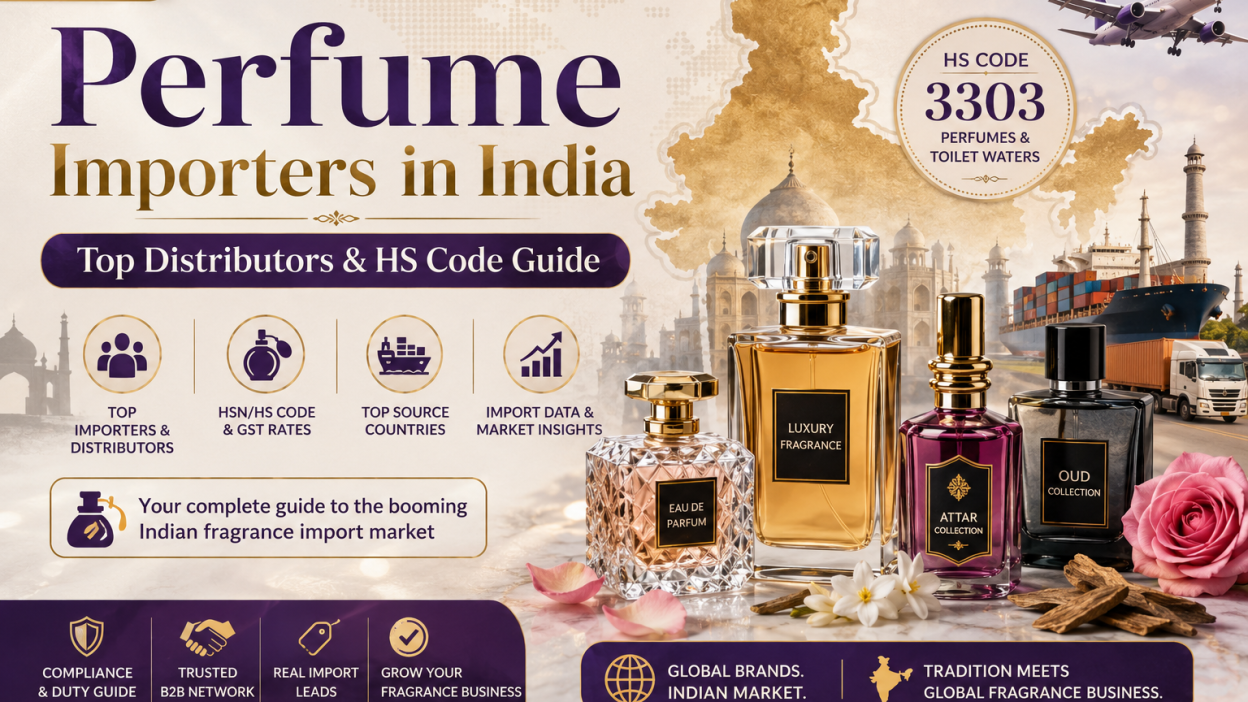
India’s fragrance import business is the largest in South Asia, and for good reason. It is rooted in deep cultural heritage, and very sophisticated. It is also fast-growing. Retailers and B2B buyers, professional or casual, need to educate themselves on this trade. From June 2024 to May 2025, India will have listed over 42000 fragrance imports. India is Asia’s fastest growing fragrance market. It is projected to grow over USD 2.19 billion (at a 17.9% CAGR) from 2024 to 2029. The Indian fragrance trade is hard to pass up. This guide covers all the booming sector info you need, from importers to distributors to wholesale B2B to HS codes to distributors and more.
Why India Is a Growing Hub for Perfume Imports
Fragrances have always been a vital part of Indian culture, and it has always been sophisticated. From the pre-Vedic period, resins, oils, and more have been used in medicine, rituals, and everyday life.
Currently, the fragrance market is booming, and several reasons are driving that:
Rising Disposable Income: The fragrance market has a growing middle class, with previously inaccessible luxury and premium fragrances.
Millennial and Gen Z Demand. Younger consumers are the dominant demographic in the expanding fragrance market. They are open to trying new scents, brand loyal, and show strong responsiveness to digital and social media marketing.
E-Commerce Penetration. The availability of imported perfumes in E-Commerce has created an increased customer base in Tier 2 and 3 cities in India.
Appetite for Niche and Artisanal Fragrances. There are increasing preferences for organic and naturally derived niche fragrances, as well as those of smaller and medium-sized brands from France, the UAE, and the UK, and those beyond mass market offerings.
Luxury Brand Expansion. There is more legitimate import activity in the Indian market due to the investments for official distribution in India by Dior, Chanel, Armani, and Versace.
These combined factors of demand have resulted in perfume import leads being one of the most requested business intelligence offerings by trade consultants, sourcing agencies, and B2B fragrance wholesalers in 2025.
Top Perfume Importers in India
Knowing who the main perfume importers in India are will help manufacturers, exporters, and distributors to identify their main business collaborators and points of entry to the Indian market.
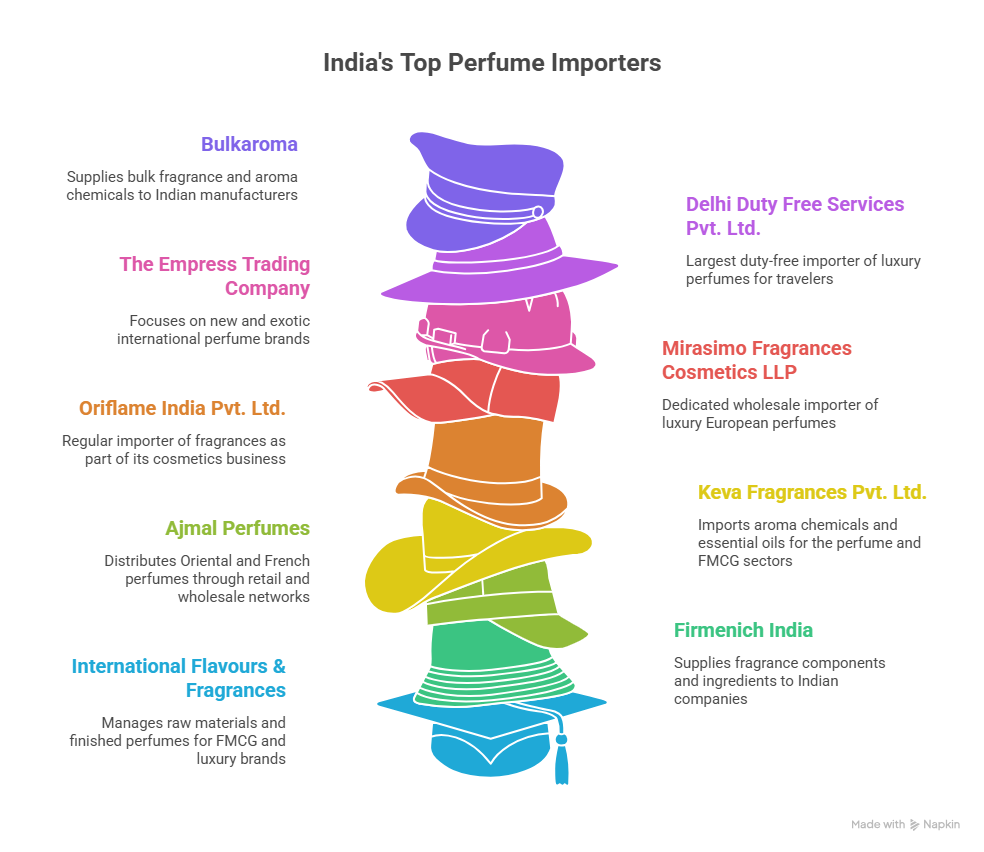
1. International Flavours & Fragrances
International Flavours & Fragrances (IFF) is a major player of the global fragrance and flavour value chain and has a significant presence in India. It manages the perfumery business from both ends, i.e., raw fragrance materials and finished perfumes. IFF caters to FMCG, Personal Care, and Luxury brands in India.
2. Firmenich India
Firmenich is a large fragrance and flavour company. They buy fine fragrance components and fragrance ingredients from suppliers worldwide and sell them to Indian companies. Their client base includes companies that sell everything from bulk versions of mass-market shower gels to formulations of limited edition designer perfumes.
3. Ajmal Perfumes
Ajmal Perfumes is primarily a distributor of Oriental and French-based perfumes. They have a retail and a larger wholesale network in most of India and the Middle East.
4. Keva Fragrances Pvt. Ltd.
Keva is one of India’s larger importers of fragrance ingredients. They bring in aroma chemicals and fragrance compounds and essential oils, all of which have a lot of demand in the Indian perfume and FMCG sector.
5. Oriflame India Pvt. Ltd.
Oriflame, the Swedish cosmetics company, is a regular fragrance importer and therefore has a permanent place in the import records of Indian perfumes.
6. Mirasimo Fragrances Cosmetics LLP
Mirasimo is India’s only dedicated and wholesale importer of luxury and designer perfumes from France and other European countries.
7. The Empress Trading Company
Focusing on new and exotic international perfume brands, The Empress Trading Company has positioned itself as a responsive importer and distributor of brands such as 24 Elixir, Berdoues, HOMME, and Soul in India.
8. Delhi Duty Free Services Pvt. Ltd. (DDFS)
Co-located at Terminal 3’s International Airport, DDFS is one of the largest duty-free importers of luxury and premium perfumes. It caters to high-volume travelers shopping for Burberry, Gucci, Calvin Klein, Bvlgari, Hugo Boss, Jo Malone, and Prada, among others.
9. Bulkaroma
Bulkaroma works with bulk fragrance and aroma chemicals. Primarily, they deal with Indian companies who wish to create perfumes. Their imports aid the nascent Indian fragrance manufacturing industry.
Perfume HS Code and HSN Code in India — Complete Guide
What is a HS Code?
Perfume importers must be aware of the accurate perfume HS code and HSN code to avoid delays during the customs clearance process as a result of misclassification. Duty assessment may also be impacted. The following is an explanation of the HS code.
Customs HS Code
The HS Code or Harmonized System Code is a term used for an international trade product classification system developed by the World Customs Organization (WCO). Countries of the world, including India, use the HS code to classify products at a standardized 6-digit level. India, however, extends this code to further classify products, thus creating an HSN (Harmonized System of Nomenclature).
Key Perfume HS Code / HSN Code List
Given below are the main HS and HSN codes for the import of perfumes and fragrances in India:
| HSN Code | Product Description | GST Rate |
| 3303 | Perfumes and toilet waters | 28% |
| 33030090 | Other perfumes and toilet waters (not elsewhere classified) | 28% |
| 3302 | Mixtures of odoriferous substances used as raw materials in industry | 18% |
| 33029011 | Odoriferous mixtures used in food and beverages industry | 18% |
| 33029019 | Other odoriferous mixtures for industry | 18% |
| 33029090 | Other mixtures of odoriferous substances | 18% |
| 33030010 | Attars of all kinds in fixed oil base (e.g. Kannauj attar) | 12% |
| 33030050 | Perfume concentrates in EDP (Eau de Parfum) form | 28% |
| 33074100 | Perfumed agarbatti and other odoriferous preparations | 12% |
Important Note: The hs code for perfume at the 4-digit level is 3303, which covers all perfumes and toilet waters. For detailed classifications, importers must use the 8-digit codes specified above and matched with India’s Customs Tariff Schedule.
What Is the HSN Code for Perfumes in GST?
As per the GST in India, perfumes and toilet waters fall under HSN 3303, with a GST of 28%. Mixtures and compounds of fragrances and other raw materials used for manufacturing in industries (HSN 3302) are subjected to a lower tax rate of 18%. Hence, to gain input tax credit, a number of importers classify their goods at this level.
Custom Duty on Perfume Imports
Along with GST, imported perfumes also incur basic customs duty (BCD) of approximately 20% for finished products of perfume (HS 3303). In addition, Social Welfare Surcharge (SWS) of 10% on BCD and IGST of 28% is applicable. The combined customs duty is significant, and so most luxury brands prefer either in-country manufacturing or contract blending.
Top Source Countries for Perfume Imports to India
Perfumes and fragrance compounds imported by India are from a highly concentrated set of countries. France is the leader for luxury and fine fragrances, whereas UAE and Singapore serve as re-exporting hubs for perfumes from the Middle East and Asia. The below table shows the countries and their significance in trade:
| Country | Type of Perfume Exported to India | Key Brands/Products |
| France | Fine fragrances, luxury EDT/EDP | Chanel, Dior, Givenchy, Guerlain |
| UAE (Dubai) | Oriental, Oud, Attar-style perfumes | Ajmal, Swiss Arabian, Rasasi |
| USA | Mass market, celebrity fragrances | Calvin Klein, Estée Lauder, Bath & Body Works |
| UK | Niche and heritage fragrances | Jo Malone, Penhaligon’s, Burberry |
| Germany | Industrial aroma chemicals, fine fragrance | Hugo Boss, Davidoff, Jil Sander |
| Singapore | Regional hub for SE Asian fragrance brands | Various ASEAN labels |
| Malaysia | Fragrance compounds, raw materials | Regional OEM suppliers |
| Italy | Luxury and designer perfumes | Versace, Prada, Bvlgari, Armani |
France continues to dominate the luxury segment. The UAE satisfies India’s demand for oud-based and Oriental fragrances which are especially popular among consumers of North India and the Gulf diaspora community.
Perfume Distributors in India — Wholesale and B2B Network
The first step for exporters and manufacturers wanting to sell fragrances in India is finding the best perfume distributors in India. The Indian fragrance distribution system is multi-tiered:
National Distributors
These businesses work across multiple states and have established connections with retail chains, department stores, and e-commerce sites. IFF India, Firmenich, and Ajmal are examples of distributors who work at this level and handle large-volume imports and redistribution.
Regional Distributors
Regional distributors work in specific states. An example is a distributor who covers Rajasthan and the neighboring states of Maharashtra and Gujarat, or one who covers the southern states of Karnataka and Tamil Nadu and Telangana. Distributors in this segment generally purchase from national distributors and national importers or import directly.
B2B Perfume Wholesalers
B2B wholesale perfume distributors work primarily through wholesale markets, such as:
Sadar Bazaar, Delhi — One of India’s largest wholesale fragrance markets.
Crawford Market, Mumbai — An important market for retail perfume sourcing.
Ritchie Street, Chennai — A wholesale market for electronics and personal care items that is rapidly developing a fragrance wholesale segment
Gariahat, Kolkata — A retail and wholesale fashion market that has a large selection of imported perfumes.
These markets cater to small retailers, boutique owners, salon chains, and hotel procurement teams looking for realistic rates on genuine imported perfume.
Specialised Duty-Free and Airport Importers
India’s position as a country with a massive international travel population has led to duty-free channels becoming a popular method for procuring perfumes. DDFS (Delhi Duty Free) and similar companies operating in Mumbai, Bengaluru, Hyderabad and Chennai capture thousands of dollars worth of perfume imports per year for international and domestic passengers.
Accessing Perfume Import Leads in India
Connecting to perfume import leads in India can be approached in a few different ways. The most common are described below:
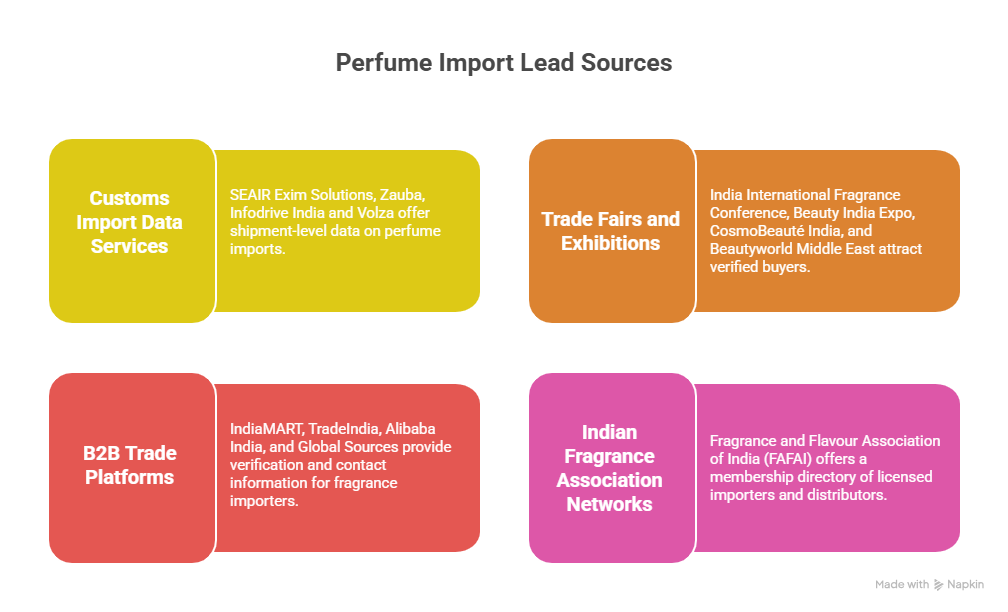
1. Customs Import Data Services
SEAIR Exim Solutions, Zauba, Infodrive India and Volza offer shipment-level data and provide information on who, what, where and how perfumes are being imported to India through Customs data. They offer monthly updates as of the release of the data.
Import leads typically contain data on:
Name and Address of Importer
Name and Country of Exporter
Product Description and HS Code
Port of Entry
CIF Value and Quantity
Date of Shipment
2. Trade Fairs and Exhibitions
A number of exhibitions and trade shows in India, such as the following, enjoy the presence of verified Buyers and Importers of fragrances and cosmetics:
India International Fragrance Conference (annual)
Beauty India Expo (Mumbai)
CosmoBeauté India (bi annual)
Beautyworld Middle East (a number of Indian buyers attend)
These shows and Exhibitions are ideal for generation of quality Import leads in Fragrances.
3. B2B Trade Platforms
Importers and distributors in the fragrance category can be found on online platforms such as IndiaMART, TradeIndia, Alibaba India, and Global Sources. These sites provide verification, contact information, trading history, and buyer intent indicators.
4. Indian Fragrance Association Networks
Fragrance and Flavour Association of India (FAFAI) is the leading network for fragrance professionals. Their membership directory is a reliable source of import leads, as you can find licensed importers, manufacturers, and distributors.
Kannauj: India’s Perfume Capital and Its Role in Import Trade
If you are searching for perfume importers in India, you must go to Kannauj (Uttar Pradesh), also known as the “Perfume City of India.” For over 400 years this city has produced traditional attars (essential oils) using methods such as deg-bhapka distillation.
Although Kannauj primarily focuses on exports (namely rose attar, kewra, and sandalwood fragrances), the city is important for imports as well. Manufacturers in Kannauj import aroma chemicals, synthetic fragrance components, and fixatives to be blended with traditional botanicals in order to modernize fragrances.
Kannauj attars are classified under HSN code 33030010 and have a lower GST rate of 12%, while synthetic fragrances attract a GST of 28%.
Regulatory Compliance for Imported Perfume in India
Tasked with managing perfume imports? You must understand relevant compliance requirements. Here are the essentials:
Bureau of Indian Standards (BIS)
BIS certification may be mandated for some cosmetic and personal care products (like some perfumes and deodorants) under the Cosmetics, Drugs and Magic Remedies Act and related instructions. You need to check if your product category needs prior BIS approval.
Central Drugs Standard Control Organisation (CDSCO)
CDSCO regulations cover cosmetics imported into India. You need a valid Import License for Cosmetics, and you will be responsible for your products’ compliance with India’s labeling requirements. Labels must disclose ingredients, the country of origin, MRP, and the contact information of the importer.
FSSAI (for Flavoured Products)
If the perfume compound, which is a fragrance, is classified in a food or drink product (HSN 33029011), the importer will need to obtain FSSAI approval.
Foreign Trade Policy (FTP 2023–28)
India’s current Foreign Trade Policy provides several benefits to importers, and particularly to imports with significant value addition. The RoDTEP (Remission of Duties and Taxes on Exported Products) and advance authorization may be relevant for companies importing perfume raw materials for the purposes of production and export.
Strategies for a Successful Trade Strategy with India for B2B Perfume Wholesalers
The following strategies are effective for B2B perfume wholesalers wanting to build business relationships with India.
Use Data Intelligence—Use customs import data to see the purchase patterns, origin preferences, and price preferences of your target Indian buyers before trying to build rapport with them.
Consider Offering Category Exclusivity—Exclusive national rights are a major offering for wholesalers of niche, specialty, and premium items. Most Indian distributors like to create exclusivity agreements.
Follow India’s Labelling Laws—Compliance of India’s customs requirements is essential for smooth clearance of your products. Ensure your offerings have Hindi and English labels, contain complete ingredient lists, display MRP, and the details of the customs importer. Otherwise, your offering will be detained.
Use Sample Approval Cycles to Your Advantage—Expect Indian buyers to take 3 to 6 months to approve your product sample before formally placing an order.
Price Your Offerings Against the Dubai Grey Market—Because of the active Dubai Grey Market, pricing structures will be an important element for importers of Indian perfumes.
Build Your Business Digitally—Having a verified listing on Vyaaparone, IndiaMART or TradeIndia, a localized product catalog, and WhatsApp to manage inquiries will lead to a large increase to your Indian B2B buyer contacts.
Perfume Import Data Snapshot: India 2024–2025
According to trade-based research for the twelve months prior to May 2025:
Total shipments: More than 42,900 perfume imports into India
Year-on-year increase: Approximately 11% increase in shipments
Key entry ports: Nhava Sheva (Mumbai), Delhi Air Cargo, Chennai Sea Port
Source countries: France, UAE, USA, UK, Germany, Italy
Average CIF value per shipment: Significant variation — some shipments are small retail imports valued at under USD 500, while others are B2B import shipments of large fragrance compounds worth over USD 50,000
India’s fragrance import market is large and growing, and offers opportunities across price points, product types, and channels.
Final words
India’s perfume import market is at an exciting intersection of modern business and tradition, and offers the highest rewards yet for perfume importers, distributors, and B2B wholesalers. The past year has seen 42,900 recorded shipments, the market is projected to grow strong through 2029, and the consumer base is broadening across price segments.
The most successful businesses in this market are those that understand, legitimately use, and get right the custom codes for perfumes (HS Code 3303 or 33030090), customs duties, and who have established import connections and distribution networks. The rest struggle to meet basic compliance and regulatory challenges.
If you’re starting your journey in the Indian fragrance business or want to enhance your existing business relationships, this is the ideal time to use reputable trade-related services to give yourself a competitive advantage in this dramatically expanding market.
Frequently Asked Questions
What is the Indian perfume HS Code?
The main Indian perfume HS Code is 3303, covering perfumes and toilet waters. The most complete 8-digit HSN Code used is 33030090, appropriate for the import of perfumes. For attar perfumes, a lower duty HSN Code is 33030010.
What is the HSN Code for perfumes under GST?
The HSN Code for perfumes is 3303 and is covered under GST at 28%. Industrial fragrances covered under HSN 3302 are taxed at 18% GST.
Which are the top perfume distributors in India?
The top perfume distributors in India include International Flavours & Fragrances (IFF), Firmenich, Ajmal Perfumes, Keva Fragrances, Oriflame India, The Empress Trading Company, and Mirasimo Fragrances Cosmetics LLP.
How do I get leads for importing perfumes in India?
Import leads for perfumes in India can be obtained from customs data platforms (SEAIR Exim, Zauba), B2B directories (IndiaMART, TradeIndia), fragrance trade shows, and the Fragrance and Flavour Association of India (FAFAI).
What is the customs duty for importing perfume in India?
The import of perfumes under HSN 3303 incurs significant total duties, including Basic Customs Duty (BCD) of 20%, a Social Welfare Surcharge at 10% of BCD, and IGST at 28%.
Is Kannauj attar an import?
No. Kannauj attar is largely a domestic and export good. However, Kannauj producers do import some raw aromatic chemicals and fragrance compounds classified as HSN 3302 and similar codes.
What is needed to bring perfume into India?
The main requirements are a Commercial Invoice, a Packing List, an Airway Bill or Bill of Lading, an Import License for Cosmetics (CDSCO), a Certificate of Origin, and a valid IEC (Importer Exporter Code) from DGFT.