Introduction
India has a centuries-old relationship with mustard oil. From the kitchens of Punjab to the mustard fields of Rajasthan, this golden oil is woven into India’s agricultural and cultural fabric. Today, mustard oil export from India has evolved from a domestic staple into a significant international trade commodity — one that global buyers are actively sourcing.
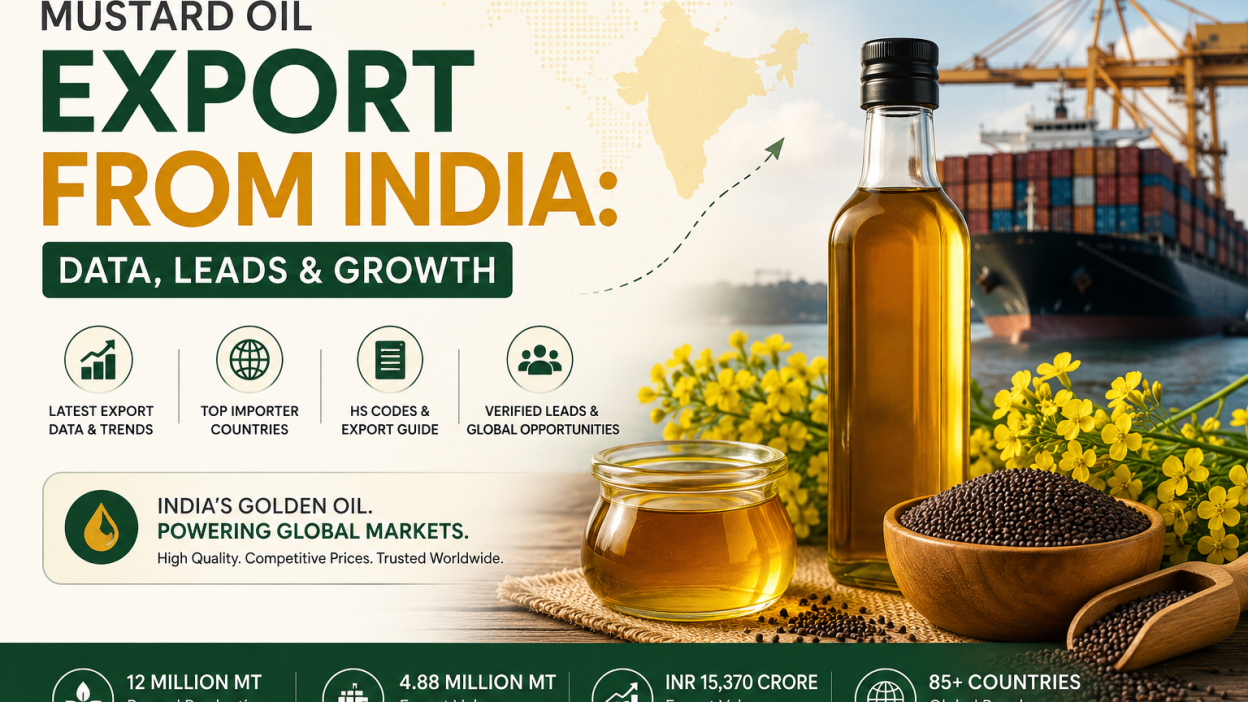
The export of mustard oil from India touched a record high in 2023–24. India produced 12 million metric tonnes of mustard oil — the highest ever recorded — and exported over 4.88 million metric tonnes worth INR 15,370 crore. That is a 13% rise in volume and a remarkable 35% rise in value compared to the previous year.
For B2B traders, importers, exporters, and procurement teams, understanding mustard oil export from India means understanding real-time trade data, verified buyer leads, and the right HS codes. This comprehensive guide covers everything: production trends, mustard oil export data from India, top mustard oil importer countries, key HS codes, business procedures, and how to access verified mustard oil export leads from India.
Whether you are a supplier looking to expand globally or a buyer seeking Indian mustard oil at competitive prices, this article is your complete resource.
India’s Position in Global Mustard Oil Trade
Largest Producer, Strategic Exporter
India is one of the five largest mustard oil-producing nations in the world. The top five — Nepal, Russia, Canada, India, and Myanmar — collectively account for approximately 90% of global mustard oil production.
Among these, Nepal holds the title of the world’s top mustard oil producer and exporter. However, India’s scale and infrastructure make mustard export from India increasingly competitive on the global stage. The country’s agricultural output, coupled with a well-established oil processing industry, positions it as a reliable and high-volume supplier.
The key distinction for India is the domestic demand factor. India consumes the majority of its mustard oil internally — mustard oil represents around 30% of the country’s total edible oil market, which processes approximately 20 million metric tonnes annually. Despite this, the surplus available for export is substantial and growing.
Record Production Fuels Record Exports
Mustard seed production in 2023-24 hit a new high at 12 million metric tons. This led to an increase in mustard oil exports. An increase in production means exporters have more raw materials to process and export, which leads to further exports and increased control in setting prices.
The increase in value was from INR ~11,385 crores in 2022–23, an increase to INR 15,370 crores in 2023–24. A higher price for Indian mustard oil means higher income for exporters, and an increase in export volumes. Compared to European suppliers, Indian mustard oil is a cheaper, wholesale, well-priced offer at ~USD 1.74 per kilogram (2025 price).
Mustard Oil Export Data from India: Key Numbers
Understanding mustard oil export data from India is essential for any B2B trader entering this market. Below are the most current and significant data points:
| Metric | Data |
| Total Export Volume (2023–24) | 4,885,437 metric tonnes |
| Total Export Value (2023–24) | INR 15,370 crore (~USD 1.84 billion) |
| YoY Volume Growth | +13% |
| YoY Value Growth | +35% |
| Total Export Shipments (Cumulative) | 52,723+ shipments |
| Active Indian Exporters | 900+ verified suppliers |
| Active Buyer Countries | 85+ countries |
| Monthly Shipments (Peak, Oct 2024) | 699 shipments |
| India’s Wholesale Price (2025) | ~USD 1.74/kg |
This mustard oil export data from India confirms that the trade is robust, multi-directional, and growing in value even when volume growth shows moderation. For importers, the data also signals that Indian suppliers are well-equipped to handle large and recurring orders.
The mustard oil export data leads from India — available on platforms like VyaaparOne — go deeper than aggregates. They include shipment-level records: exporter names, buyer details, port of loading, invoice values, and HS codes. This granularity makes it possible to identify the most active buyers and target them directly.
Top Mustard Oil Importer Countries from India
One of the most important questions for any exporter or trade intelligence user is: which countries are the top mustard oil importing countries? The most recent breakdown is as follows.
1. Bangladesh
Incursions in India shift the mustard oil market towards Bangladesh. Proximity, a shared culinary culture, and a well-established trade corridor mean India is the natural supplier for the large mustard oil demand in Bangladesh. The two countries have food import contracts.
2. United States
There is major and consistent demand for Indian Mustard oil in the US due to the Indian diaspora’s retail demand for Kachchi Ghani mustard oil as well as food manufacturers’ use of Indian mustard oil in the preparation of condiments and in food processing. The US is a top 5 mustard oil importing country, with 16-18% of total mustard oil imports.
3. Australia
Australia is placed in the top three of the importing countries of mustard oil from India. In 2023, Australia received over 134,000 metric tonnes of mustard oil from India, making it the largest country by volume. This is mainly due to the considerable Indian diaspora and the growing South Asian food retail market in Australia.
4. Bhutan
Bhutan is a consistent small volume importer. Due to Bhutan’s geographical proximity to India and Bhutan’s dependence on Indian exports for basic goods, Bhutan is able to import a consistent volume of mustard oil under the India-Bhutan trade agreement. Bhutan accounts for approximately 21-23% of the shipments made under HS code 15149120.
5. United Arab Emirates (UAE)
The UAE is a major re-export and a primary consuming market for Indian mustard oil. Due to the millions of South Asian expatriates, there is year-round demand for Indian mustard oil. In 2024, Turkey and the UAE were major destinations with India’s mustard oil exports to the Eurasian market valued at USD 18.18 million, a growth of 22.29%.
6. Turkey
Imports from India saw an impressive 37.8% year-on-year growth in 2024, making Turkey a standout market and valued at USD 5.06 million. This makes Turkey a high potential market for Indian exporters focused on non-traditional markets.
7. Russia
Russia is the second largest market in the Eurasian cluster for mustard oil, importing USD 4.59 million from India in 2024. There is a demand for both food processing and for non-edible grade mustard oil.
8. Netherlands, Germany, Norway, and Mexico
These four countries are among the top mustard oil importer countries globally. While they source from multiple origins, Indian mustard oil’s price competitiveness makes it an attractive option for European food manufacturers.
9. Canada
Mustard oil’s popularity in Canada, with its large South Asian community, makes the country one of the world’s largest importers of the product. The established diaspora retail network in Canada provides Indian exporters an opportunity.
10. Nepal
Mustard oil is both produced and imported by Nepal due to fluctuations in local production. Gaps in supply in Nepal provide trade opportunities for India.
Understanding these mustard oil importer countries is the foundation of any successful export strategy. Mustard oil export leads from India that are tied to verified buyers in these destinations have the highest conversion potential.
HS Codes for Mustard Oil Export from India
The HS code system is the backbone of international trade classification. For mustard oil export from India, the following HS codes are most relevant:
| HS Code | Description |
| 15149120 | Edible grade refined mustard oil (most commonly traded) |
| 15149920 | Other mustard/rapeseed oil, non-edible or semi-processed |
| 23069012 | Mustard oilcake and residues (by-product of oil extraction) |
| 1514 | Broader category: low erucic acid rape/colza/mustard oil |
Among these, HS code 15149120 dominates Indian exports. Under this code, India has logged over 14,500 shipments globally, with Bhutan (23%), the United States (18%), and Australia (18%) as the top three import destinations.
For anyone using mustard oil export data from India for sourcing or competitive intelligence, filtering by HS code is the most effective way to get precise, actionable leads.
Grades and Types of Mustard Oil Exported from India
Mustard oil is afforded a gradation system with three distinct grades of oil exported from India. Each of the grades attracts a different buyer group and is suited for different end uses.
Grade I — Kachchi Ghani (Cold-Pressed)
Kachchi Ghani is the premium, cold-pressed variant of mustard oil and is the most pungent and nutritious variant. This grade of oil is the most expensive and is primarily exported to the diaspora population of the US, UK, Canada, and Australia. Buyers for this grade of mustard oil include ethnic grocery and online South Asian food retailers.
Grade II — Refined Mustard Oil
Refined mustard oil is the variant of oil that has been deodorized and bleached to produce a neutral flavoured oil. This variant is preferred by food manufacturers and processors in Europe. It is also the most dominant category for large volume orders in a business-to-business context.
Grade III — Non-Edible Mustard Oil
Non-edible mustard oil, known as industrial-grade mustard oil, is used in the production of soaps, lubricants, in the textile industry, as well as in the pharmaceuticals industry. The demand for this grade is rapidly increasing by industrial buyers from Turkey, Russia, and some Middle Eastern countries.
Any mustard oil export strategy must diagnose which grade corresponds to which target market.
Top Indian Exporters of Mustard Oil
The mustard oil export industry in India is led by a mix of large FMCG brands, state cooperatives, and specialised export trading companies. Based on recent shipment data:
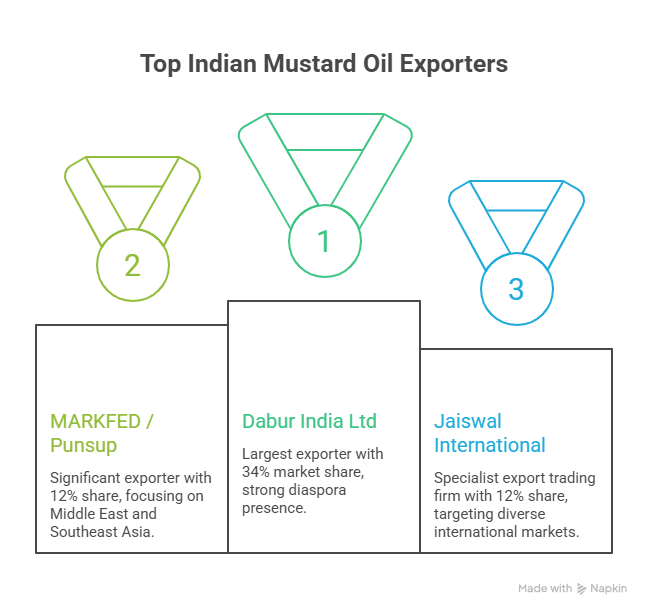
- Dabur India Ltd — the largest single exporter under HS 15149120, accounting for approximately 34% of shipments under this code. Dabur’s Mustard Oil brand is well recognised in diaspora markets.
- Punjab State Cooperative Supply and Marketing Federation (MARKFED / Punsup) — accounts for approximately 12% of export shipments, primarily for the Middle East and Southeast Asia.
- Jaiswal International — a specialist export trading firm with a ~12% share, targeting multiple international markets.
Beyond these leaders, India has 900+ active mustard oil exporters, making it a highly competitive and buyer-friendly supplier base. This competition keeps pricing attractive and ensures supply reliability.
How to Access Mustard Oil Export Leads from India
For exporters, importers, and trade analysts, accessing accurate mustard oil export leads from India is the difference between cold outreach and targeted B2B sales. Here is how to find them:
Option 1: Trade Intelligence Platforms
Platforms like VyaaparOne aggregate shipment-level customs data from government-authorised sources. A search for mustard oil export data from India on VyaaparOne returns verified records that include:
- Exporter name and address
- Buyer name and country
- HS code
- Shipment quantity and value
- Port of origin and destination
- Date of shipment
This data is far more actionable than generic market reports. Instead of knowing that “the US imports mustard oil,” you get the actual US-based buyers, their purchasing frequency, and the Indian suppliers they work with.
Option 2: DGFT and APEDA Data
The Directorate General of Foreign Trade (DGFT) and Agricultural and Processed Food Products Export Development Authority (APEDA) maintain export databases. APEDA, in particular, tracks agri-product exports including mustard oil and seed. These are useful for macro-level analysis but lack the buyer-level granularity of shipment data.
Option 3: B2B Trade Portals
VyaaparOne’s B2B marketplace also lists verified suppliers and buyers actively trading in mustard oil. For smaller exporters, this is an efficient way to connect with importers without requiring a large data subscription.
Option 4: Industry Trade Shows
Participation in Agri-export fairs and food ingredient expos — such as Anuga (Germany), SIAL (Paris), and Gulfood (Dubai) — allows direct engagement with mustard oil importers. However, the leads generated here are less data-driven than platform-based leads.
For most B2B traders, a combination of real-time mustard oil export data leads from India (via VyaaparOne) and active follow-up through LinkedIn and email is the most effective lead-generation approach.
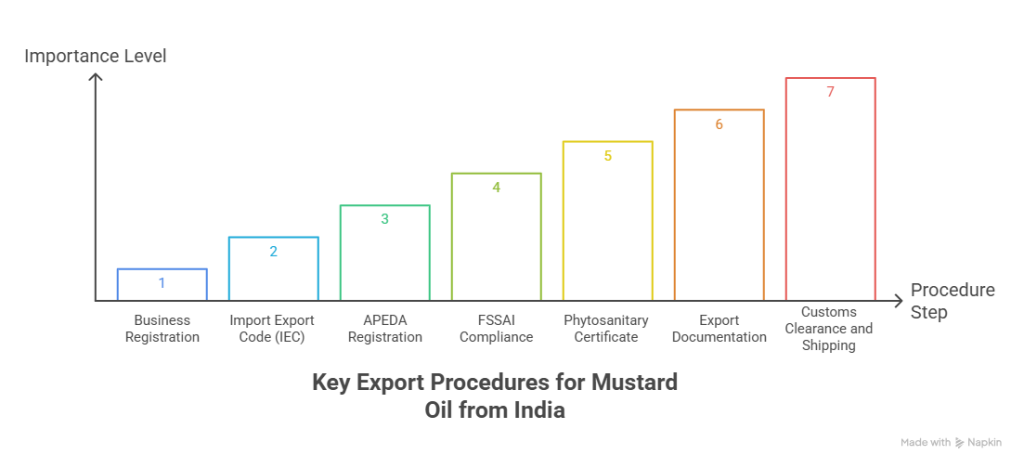
Export Procedures for Mustard Oil from India
Understanding the regulatory and logistical framework is essential for any business involved in mustard oil export from India. Here is a step-by-step overview:
Step 1: Business Registration
Register the export firm under the Companies Act, 2013, or as a proprietorship/partnership firm. For LLP or Pvt. Ltd. structures, company registration with the Registrar of Companies (RoC) is required.
Step 2: Import Export Code (IEC)
Obtain an IEC from the Directorate General of Foreign Trade (DGFT). The IEC is a mandatory 10-digit code required for all import and export transactions. Without it, no customs clearance is possible.
Step 3: APEDA Registration
Since mustard oil is an agricultural processed product, exporters must register with APEDA (Agricultural & Processed Food Products Export Development Authority). APEDA registration facilitates access to export incentive schemes and certification support.
Step 4: FSSAI Compliance
Mustard oil intended for food use must comply with FSSAI (Food Safety and Standards Authority of India) quality norms, including permissible erucic acid levels and contamination limits.
Step 5: Phytosanitary Certificate
For edible grade exports to food-sensitive markets such as the EU, US, and Australia, a phytosanitary certificate from the Plant Quarantine authority may be required. Each destination country has specific import regulations that must be verified before shipment.
Step 6: Export Documentation
Core export documents include:
- Commercial Invoice
- Packing List
- Bill of Lading / Airway Bill
- Certificate of Origin (COO)
- Phytosanitary / Health Certificate
- GST LUT (Letter of Undertaking) for zero-rated exports
Step 7: Customs Clearance and Shipping
File the Shipping Bill with Customs through the ICEGATE portal. Engage a licensed Customs House Agent (CHA) for smooth clearance. Major ports handling mustard oil export from India include Mundra (Gujarat), Nhava Sheva (Mumbai), Kolkata, and Kandla.
Growth Trends and Future Outlook for Mustard Oil Export
2024–2025 Market Trajectory
India’s mustard oil export market showed a value surge to USD 18.18 million in 2024, driven by growth in Eurasian markets. The 22.29% growth rate signals that new markets — particularly Turkey, Central Asia, and Eastern Europe — are opening up for Indian exporters beyond traditional South Asian diaspora corridors.
Global Market Context
The global mustard oil market was valued at approximately 10.2 million metric tonnes in 2023 and is projected to grow at a CAGR of 3.5% through 2034. Health trends favouring traditional cold-pressed oils and functional foods are driving renewed interest in mustard oil globally. The pungent, peppery profile of Indian mustard oil differentiates it from blander refined oils.
India’s edible oil market is simultaneously projected to reach 35 million metric tonnes by 2025, growing at a CAGR of ~15%. As domestic supply expands, the surplus available for mustard oil export from India is expected to grow proportionally.
Opportunity in Non-Traditional Markets
Turkey’s 37.8% import growth and Russia’s steady demand highlight that the mustard oil export from India story is no longer limited to South Asian diaspora. Industrial buyers, food processors, and specialty retail chains in Europe, the Middle East, and Eurasia are all exploring Indian mustard oil as a cost-effective, high-quality raw material.
Organic and Kachchi Ghani Premium Segment
The organic and cold-pressed oil segment is the fastest-growing premium category globally. Indian Kachchi Ghani mustard oil — traditionally stone-milled — is perfectly positioned for this trend. As health-conscious consumers in Western markets seek “clean label” oils, mustard oil export leads from India that target health food retailers and organic importers represent a particularly high-value opportunity.
Challenges in Mustard Oil Export from India
While the opportunity is significant, exporters must navigate several challenges:
Quality Consistency: Large-volume buyers require consistent quality across batches. Small and medium processors often lack the testing infrastructure to guarantee uniform erucic acid levels or contamination controls across shipments.
Price Competition: Ukraine and the Netherlands are formidable competitors in global mustard oil trade. Ukraine’s lower production costs and the Netherlands’ re-export advantages mean that Indian suppliers must compete aggressively on both price and reliability.
Regulatory Complexity: Different destination countries have different food safety thresholds for mustard oil. The EU, for instance, has strict erucic acid content limits. Non-compliance can lead to consignment rejection and reputational damage.
Documentation Delays: Certificate procurement and customs processing delays can make the export of mustard oil from India slower than buyers expect. Engaging experienced CHAs and pre-verifying destination-country import requirements is essential.
Logistics Costs: For landlocked destinations (Nepal, Bhutan) and distant markets (Australia, the Americas), freight costs can erode margins. Consolidation shipping and long-term freight contracts help mitigate this.
How VyaaparOne Supports Mustard Oil Trade
VyaaparOne is India’s leading import-export data and trade leads platform, with access to 50 million+ verified shipment records from 200+ countries, updated daily from government-authorised sources.
For anyone engaged in the mustard oil export from India ecosystem — whether as a supplier, importer, broker, or trade analyst — VyaaparOne offers:
- Real-Time Mustard Oil Export Data: Filter by HS code (15149120, 15149920, 23069012), country, date range, and exporter to get precise shipment records.
- Mustard Oil Export Leads from India: Buyer details with contact-level data, purchasing frequency, and shipment values.
- Importer Intelligence: Identify mustard oil importer countries and the specific companies within those countries that are actively buying Indian mustard oil.
- Competitor Analysis: See which Indian exporters are winning in which markets, their shipment volumes, and their top buyers.
- Market Trend Reports: Track month-on-month and year-on-year changes in mustard oil export data from India to spot emerging opportunities.
With 99% data accuracy and daily updates, VyaaparOne’s mustard oil export data leads from India are among the most reliable in the market. Whether you want to target Bangladesh, tap Australia’s diaspora retail channel, or explore Turkey’s growing appetite for Indian oils, VyaaparOne has the data to back every move.
Conclusion: Capitalise on the Mustard Oil Export Opportunity
Mustard oil export from India is not a niche trade — it is a dynamic, multi-billion rupee industry with growing global demand across South Asia, the Middle East, Eurasia, and Western markets. With record domestic production, a growing base of verified exporters, and price competitiveness that few origins can match, the export of mustard oil from India presents genuine opportunities for both buyers and sellers.
The key to success is information. Knowing which mustard oil importer countries are actively buying, which HS codes drive the most shipments, which Indian exporters are the most reliable suppliers, and what price points prevail in your target market — all of this is the difference between guesswork and strategy.
VyaaparOne’s mustard oil export data from India, updated daily and sourced from government-authorised customs records, gives you exactly that advantage. Whether you are chasing mustard oil export leads from India or conducting competitive intelligence on your rivals, start with data.
Explore live mustard oil trade data, verified buyer leads, and real-time shipment intelligence on VyaaparOne today. Turn trade data into trade deals.
FAQ: Mustard Oil Export from India
Q1. What is the total volume of mustard oil export from India?
In 2023–24, India exported 4,885,437 metric tonnes of mustard oil, valued at INR 15,370 crore. This represents a 13% increase in quantity and a 35% increase in value over the previous year.
Q2. Which are the top mustard oil importer countries from India?
The leading mustard oil importing countries for Indian exports are Bangladesh, the United States, Australia, Bhutan, UAE, Turkey, and Russia. The US, Lithuania, and Australia account for approximately 43% of global mustard oil imports by shipment count.
Q3. Who is the largest exporter of mustard oil globally?
Globally, the Netherlands holds the largest exporter position with a USD 617.7 million export value. However, in terms of shipment count, India leads the world with 52,723+ shipments, followed by Ukraine and Nepal. India is effectively the world’s largest exporter of mustard oil by volume of shipments.
Q4. What are the HS codes for mustard oil export from India?
The primary HS codes are 15149120 (refined edible mustard oil), 15149920 (other mustard/rapeseed oil), and 23069012 (mustard oilcake residues). The code 15149120 is the most commonly used for standard food-grade exports.
Q5. How can I find verified mustard oil export leads from India?
Platforms like VyaaparOne provide shipment-level mustard oil export data leads from India, including buyer names, countries, HS codes, and transaction values. These leads are verified, regularly updated, and accessible via the trade intelligence dashboard.
Q6. What grades of mustard oil does India export?
India exports three grades: Grade I (Kachchi Ghani / cold-pressed), Grade II (refined), and Grade III (non-edible / industrial). Each grade serves distinct market segments and buyer types.
Q7. What documentation is required for mustard oil export from India?
Key documents include the IEC code, commercial invoice, packing list, bill of lading, certificate of origin, APEDA registration certificate, and phytosanitary certificate (for specific markets like the EU and Australia).
Q8. What is the current export price of Indian mustard oil?
As of 2025, India’s wholesale mustard oil export price is approximately USD 1.74/kg, making it highly competitive compared to European suppliers.