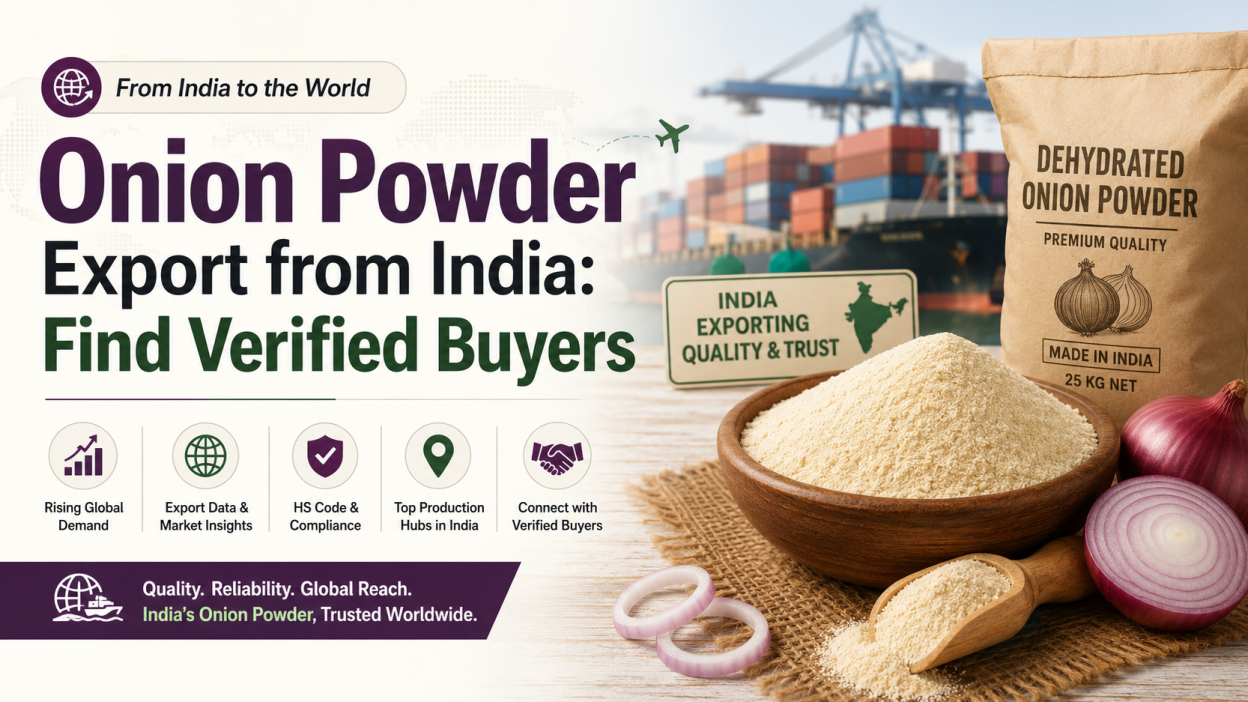
Indian exporters shipped 1,755 onion powder consignments in a single twelve-month stretch, and the number is climbing. If you’re trying to break into onion powder export from India — or already in it and looking to scale — the real question isn’t whether the opportunity exists. It’s whether you know how to find the right export data, the right buyers, and the right HS code before your competitors do.
This guide walks through everything connected to onion powder export from India: shipment data, verified leads, HS codes, buyer profiles, port-wise patterns, pricing context, and the practical steps to turn trade statistics into actual purchase orders. Whether you’re an exporter trying to scale or a buyer trying to vet suppliers, the goal here is the same — give you data you can actually act on, not generic advice.
Why Onion Powder Export from India Is Growing Right Now
Onion powder isn’t a fringe commodity anymore. Food processors, spice blenders, and quick-service restaurant chains across the world depend on it for consistent flavor, longer shelf life, and easier handling than fresh onions. That demand is exactly why onion powder export from India has kept rising year over year, and why more first-time exporters are entering onion powder export from India instead of sticking to fresh onion alone.
India’s dehydrated onion exports — which includes powder, flakes, and granules — touched roughly 83,452 tonnes in FY 2023–24, and trade analysts project that figure could reach 85,000–90,000 tonnes by 2025–26. Shipment counts back this up: India moved 1,755 onion powder shipments between March 2023 and February 2024, sold to 767 distinct buyers through 410 exporters — a 5% increase over the previous year. More recent trade databases show the number climbing past 1,900 shipments in the 2024–2025 window. That’s a meaningfully larger trade lane than it was even two years ago, and it’s still being treated by many exporters as a side category rather than a core business line — which, frankly, leaves opportunity on the table for whoever takes it seriously.
Gujarat has emerged as one of the strongest sourcing states for onion powder export from India, sitting near the country’s major dehydration units and export-ready ports. That regional concentration matters if you’re scouting suppliers — proximity to processing clusters usually means better pricing and faster turnaround. Maharashtra and Madhya Pradesh follow close behind, given their position as major fresh onion-growing belts that feed directly into dehydration capacity.
What’s Driving Demand for Dry Onion Powder Export from India
A few forces are pushing buyers toward Indian suppliers specifically, and they help explain why onion powder export from India has outpaced many other dehydrated vegetable categories:
- Cost competitiveness. Indian onion powder is priced attractively against alternatives from Egypt, China, or the US, without compromising on pungency or color.
- Year-round supply. India’s multiple onion-growing regions stagger harvests, which keeps dehydration units running and supply steadier than single-season exporters.
- Processing capacity. States like Maharashtra, Gujarat, and Madhya Pradesh host dehydration facilities that convert fresh onion into powder, flakes, and granules at scale.
- Quality certifications. Many Indian processors now hold ISO, HACCP, and FSSAI certifications, which opens doors to stricter markets in the EU and North America.
- Logistics infrastructure. Established container freight stations and dedicated agri-export corridors near Mundra, Nhava Sheva, and Kandla ports keep transit times predictable for onion powder export from India shipments, which matters enormously for onion powder export from India buyers on tight delivery schedules.
Here’s the thing — demand alone doesn’t win deals. Buyers comparing onion powder exporters in India against suppliers in Egypt or China are weighing consistency, documentation, and responsiveness just as heavily as price. A slightly higher quote from a supplier who never misses a shipment date usually beats a rock-bottom price from someone who’s inconsistent.
Onion Powder HS Code: What Exporters Need to Know
Getting the onion powder HS code right is the first technical hurdle in any onion powder export from India transaction. Misclassification causes customs delays, incorrect duty calculations, and in worse cases, shipment holds that can sour a buyer relationship before it even starts.
Onion powder falls under Chapter 07 of the Harmonized System — Edible Vegetables and Certain Roots and Tubers — specifically under Heading 0712 (dried vegetables, whole, cut, sliced, broken, or in powder form, not further prepared). The commonly used codes for onion powder export from India shipments are:
| HS Code | Description |
| 0712 | Dried vegetables (parent heading) |
| 07122000 | Onions, dried (includes onion powder under Indian customs classification) |
| 07129020 | Dried vegetables, in powder — dehydrated garlic/onion powder variants |
| 07129030 | Dried vegetable powder, other classifications |
The 6-digit core (0712.20) is standardized globally under the World Customs Organization framework, but individual countries extend it — India typically uses an 8-digit code at customs, while the US and EU apply their own extensions. If you’re shipping internationally, always confirm the destination country’s extended code before filing, because a wrong digit at the tail end can still trigger a compliance flag even when the first six digits are correct. Every serious onion powder export from India shipment should have this verified well before the container is booked, not at the last minute.
For sourcing or verifying actual shipment-level onion powder export data tied to these codes, VyaaparOne’s trade data tools let you filter by HS code, port, and exporter — which is far faster than digging through raw customs records manually.
Onion Powder Export Data: The Numbers That Matter
Numbers tell a clearer story than adjectives. Here’s what the latest onion powder export data shows for India’s position in the global onion powder export from India trade:
- 1,755 shipments moved between March 2023 and February 2024 (TTM), rising toward 1,900+ in the following year
- 767 buyers sourced from 410 Indian exporters in that same window — a fragmented but active market
- 5% year-over-year growth in shipment volume
- India, alongside China and Singapore, accounts for roughly 92% of global white onion powder exports under HS 07122000
- Indonesia (38%), Malaysia (14%), and the Philippines (13%) lead global import demand for this HS code, together making up 65% of total imports
That last point is worth pausing on. If you’re an Indian exporter still chasing only the US and EU, you might be overlooking Southeast Asia — a region absorbing nearly two-thirds of global demand for this exact product category. Anyone serious about onion powder export from India growth in the next two years should be building relationships in Jakarta and Kuala Lumpur, not just New York and Hamburg.
Top Destination Markets for Onion Powder Export from India
The leading markets for dry onion powder export from India span both the West and parts of Asia:
| Region | Key Countries | Why They Buy |
| North America | United States, Canada, Mexico | Food processing, QSR chains, retail spice blends |
| Europe | UK, Germany, Netherlands, France, Spain | Strict quality standards, premium retail demand |
| Southeast Asia | Indonesia, Malaysia, Philippines | High-volume food manufacturing, instant noodle/snack seasoning |
| West Asia | UAE, Saudi Arabia | Re-export hub demand, catering and food service |
Each of these regions has slightly different documentation expectations. The EU, for instance, is stricter on pesticide residue testing, while Southeast Asian buyers often prioritize price and bulk packaging over premium branding.
Major Ports Handling Onion Powder Export from India
Port selection affects cost, transit time, and reliability just as much as supplier choice does. The bulk of onion powder export from India moves through a small set of ports that have built up the cold-chain and container handling infrastructure this trade needs:
| Port | Region | Typical Use Case |
| Nhava Sheva (JNPT) | Maharashtra | Largest container volume, strong connectivity to US/EU routes |
| Mundra | Gujarat | Close to dehydration clusters, efficient for Gulf and European shipments |
| Kandla | Gujarat | Cost-effective for bulk and breakbulk cargo |
| Chennai | Tamil Nadu | Preferred for Southeast Asian and Far East routes |
Exporters shipping from Gujarat-based units often route through Mundra or Kandla simply because of proximity, which shaves transit time and inland freight cost off the total landed price. That’s a meaningful factor when buyers are comparing quotes on razor-thin margins.
Pricing Context for Onion Powder Export from India
Pricing for onion powder export from India fluctuates with raw onion crop output, dehydration capacity utilization, and seasonal currency movements. When fresh onion harvests are strong, raw material costs drop and dehydration units run closer to full capacity, which tends to push FOB pricing down — good news for buyers, tighter margins for exporters. Conversely, a weak harvest season pushes prices up across the board, regardless of which onion powder export from India supplier you’re working with.
Buyers comparing quotes should ask for FOB and CIF pricing separately, since freight costs vary significantly by destination port and shipping line capacity. A quote that looks cheaper on paper sometimes hides a higher freight component that evens out — or exceeds — a competitor’s all-in price.
Finding Verified Onion Powder Export Leads
This is usually where exporters get stuck. You can have great product and competitive pricing, but without onion powder export leads — actual buyer contacts who are currently importing — you’re cold-calling into a vacuum. The gap between having a good product and having a steady order book almost always comes down to lead quality, not product quality.
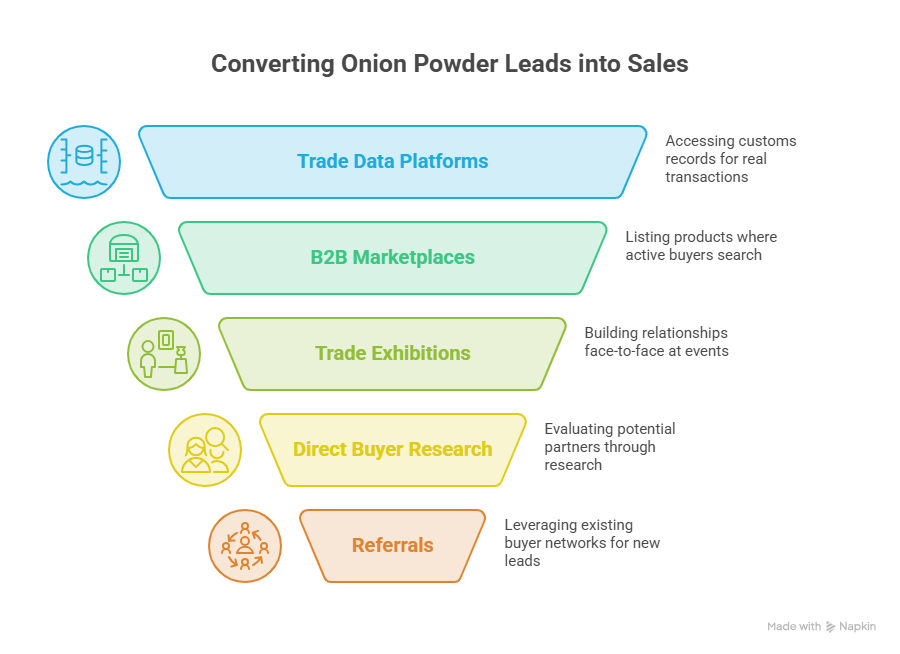
A few approaches actually work for sourcing onion powder export data leads that convert into real conversations:
1. Trade data platforms. Customs-sourced shipment records reveal which companies are importing onion powder, how often, in what quantity, and from which Indian ports. This is the most direct route to onion powder export data leads because it’s based on real transactions, not directory listings that may be outdated or unverified.
2. B2B marketplaces. Listing your products where active buyers are searching — rather than waiting for them to find you through cold outreach — shortens the sales cycle considerably. VyaaparOne connects verified exporters with import-side buyers actively sourcing spice and dehydrated vegetable products, which beats blind email blasts by a wide margin.
3. Trade exhibitions. Events like Gulfood, ANUGA, and SIAL bring buyers and suppliers face to face. They’re expensive and slow, but the relationships formed tend to be sticky, and a single good conversation at a trade show can outlast years of cold email.
4. Direct buyer research. Once you’ve identified an importer through trade data, a quick look at their company website, certifications, and recent shipment frequency tells you whether they’re a serious long-term partner or a one-off opportunistic buyer.
5. Referrals from existing buyers. Honestly, this gets underused. A satisfied importer in Germany often knows three other buyers in neighboring markets — ask. It costs nothing and converts better than almost any other lead source for onion powder export from India outreach.
Onion Powder Buyers in India: A Different Angle
Most content on this topic focuses entirely on outbound exports, but there’s a domestic angle too. Onion powder buyers in India — food processing companies, spice blending units, and packaged snack manufacturers — represent a parallel market that doesn’t require export documentation, customs clearance, or international logistics.
For smaller producers not yet ready to navigate export compliance, supplying domestic buyers is a practical stepping stone. It builds production consistency and cash flow before scaling into onion powder export from India contracts. Many exporters listed on platforms like VyaaparOne actually started this way — domestic supply first, onion powder export from India contracts second. The domestic market also acts as a buffer during slow export seasons, since Indian food manufacturers buy onion powder year-round regardless of international shipping cycles or currency swings.
Organic Onion Powder: A Premium Niche Worth Targeting
Regular onion powder export from India competes largely on price. Organic onion powder export from India competes on certification and trust — and the margins reflect that difference.
Buyers in the US and EU paying for organic-certified onion powder export from India shipments expect:
- USDA Organic or EU Organic certification (depending on destination)
- Pesticide-residue-free sourcing documentation
- Traceability back to specific farm clusters
- Often, Fair Trade or similar ethical sourcing certification
If your supply chain can support this — and a growing number of Gujarat and Maharashtra processors can — organic onion powder export from India opens a buyer segment willing to pay 20–40% more than conventional product. It’s a smaller volume game, but a noticeably higher-margin one.
Regular vs. Organic Onion Powder Export from India: A Quick Comparison
| Factor | Regular Onion Powder | Organic Onion Powder |
| Price premium | Baseline | 20–40% higher |
| Certification needed | FSSAI, basic export docs | USDA/EU Organic + traceability |
| Typical buyers | QSR chains, mass food processors | Premium retail, health-focused brands |
| Production volume | High | Lower, more controlled |
| Compliance complexity | Moderate | High |
Quality Standards Behind Successful Onion Powder Export from India
Buyers don’t just buy onion powder — they buy a specification. Every serious conversation around onion powder export from India eventually comes down to a handful of measurable quality parameters, and exporters who can hit these consistently win repeat business far more often than those who can’t:
| Parameter | Typical Buyer Requirement |
| Moisture content | Below 6–7% |
| ASTA color value | 20–30 (varies by buyer spec) |
| Mesh size | 80–100 mesh standard, finer grades for premium use |
| Microbial limits | Salmonella-negative, E. coli within food-safety thresholds |
| Pungency (allyl propyl disulfide) | Buyer-specified range, tested per batch |
Processing units that maintain tight control over these parameters — usually through proper dehydration temperature control and clean-room packing — end up commanding both higher prices and more repeat orders in onion powder export from India deals. This is one area where onion powder export from India suppliers genuinely differentiate themselves; the commodity itself is largely interchangeable, but consistency in these numbers is not.
How Onion Powder Exporters in India Actually Win Deals
Talking to enough people involved in onion powder export from India, a pattern emerges. The exporters who consistently land repeat orders in onion powder export from India aren’t necessarily the cheapest — they’re the most reliable on three fronts:
Consistent quality specs. Moisture content, color, mesh size, and pungency level need to match the buyer’s spec sheet shipment after shipment. One inconsistent batch can end a relationship that took months to build.
Documentation speed. Buyers move fast when they trust your paperwork — phytosanitary certificates, certificate of origin, lab test reports — arrives without back-and-forth delays.
Responsiveness. This sounds basic, but it’s the single biggest differentiator smaller exporters report. A buyer comparing five suppliers usually goes with whoever answers questions fastest and most completely, not necessarily whoever quoted the lowest price.
Step-by-Step: Starting Your Onion Powder Export from India Business
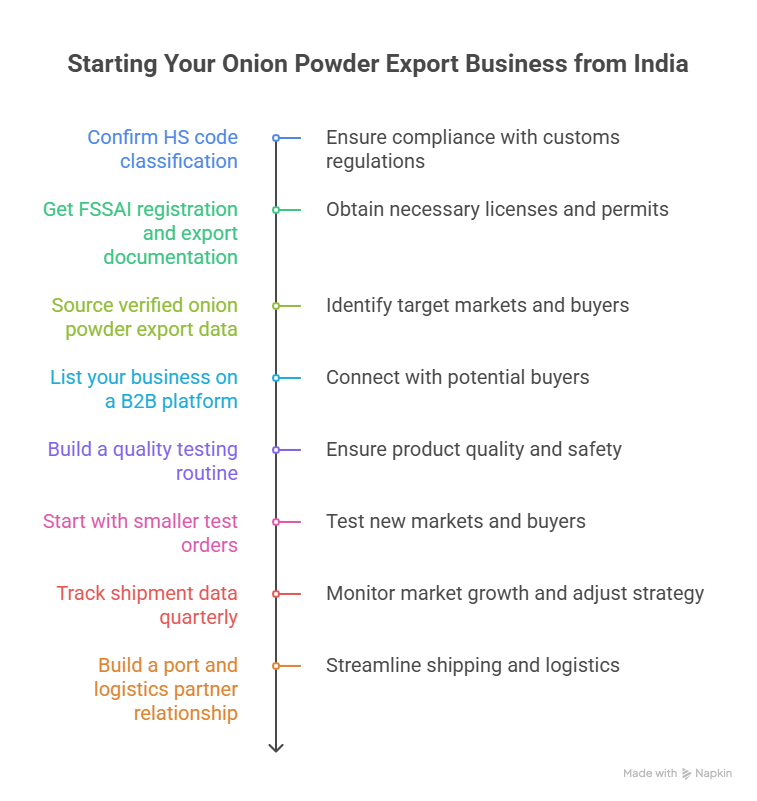
If you’re new to this and want a structured path into onion powder export from India:
- Confirm your HS code classification (0712 / 07122000) with a customs broker before your first shipment.
- Get FSSAI registration and export documentation in order — APEDA registration is also worth pursuing for agricultural exports.
- Source verified onion powder export data to identify which countries and companies are actively importing right now.
- List your business on a B2B platform where genuine buyers are searching, such as VyaaparOne’s exporter directory.
- Build a quality testing routine — moisture, ASTA color value, and microbial testing should be standard before every shipment.
- Start with smaller test orders to new buyers before committing to bulk contracts.
- Track shipment data quarterly to spot which markets are growing and adjust your onion powder export from India strategy accordingly.
- Build a port and logistics partner relationship early — a freight forwarder who understands agri-export documentation saves weeks of back-and-forth later.
Common Mistakes in Export of Onion Powder from India
A few recurring issues show up across onion powder export from India, and most are avoidable. Anyone running an export of onion powder from India operation should treat this as a checklist, not just a list of warnings:
- Quoting prices without confirming the buyer’s exact moisture and mesh-size requirements first
- Ignoring Southeast Asian demand while over-focusing on saturated Western markets for onion powder export from India
- Skipping organic certification renewal deadlines, which can freeze shipments mid-contract
- Underestimating packaging requirements — buyers in humid-climate destinations often need different moisture-barrier packaging than those in drier regions
- Relying solely on directory listings instead of cross-checking actual onion powder export data for buyer activity
- Treating onion powder export from India as a one-time transaction instead of building toward repeat, long-term buyer relationships
Final Thoughts
The data is fairly clear: onion powder export from India isn’t a shrinking niche — it’s a steadily expanding trade lane with room for both established exporters and newer entrants willing to do the groundwork on documentation and buyer research. Whether you’re chasing dry onion powder export from India contracts in North America, breaking into the underexplored Southeast Asian market, or building a premium organic onion powder export from India line, the fundamentals stay the same: verified data, reliable quality, and fast, transparent communication with buyers. Treat onion powder export from India as a long-term trade lane, not a one-off opportunity, and the numbers tend to follow.
If you’re ready to move from research to action, VyaaparOne brings together verified onion powder export from India data, qualified leads, and a direct line to active buyers and exporters — cutting out the guesswork that slows most new entrants down in onion powder export from India.
Frequently Asked Questions
1. What is onion powder export from India?
Onion powder export from India refers to the international trade of dehydrated onion powder produced by Indian manufacturers and supplied to food processors, spice companies, restaurants, and retailers worldwide.
2. What is the HS code for onion powder export from India?
The most commonly used HS Code for onion powder export from India is 07122000, which covers dried onions, including onion powder. Some shipments may also be classified under related codes depending on the product type.
3. Which countries import onion powder from India?
Major importers include the United States, Canada, Germany, the United Kingdom, France, the UAE, Saudi Arabia, Indonesia, Malaysia, and the Philippines.
4. Is organic onion powder export from India profitable?
Yes. Organic onion powder typically commands higher prices in international markets due to certification requirements, traceability, and increasing consumer demand for organic food ingredients.
5. Can small businesses start onion powder export from India?
Yes. Small businesses can begin with domestic sales, obtain the necessary export licenses, connect with verified buyers, and gradually expand into international markets through trade platforms and export data services.