Introduction
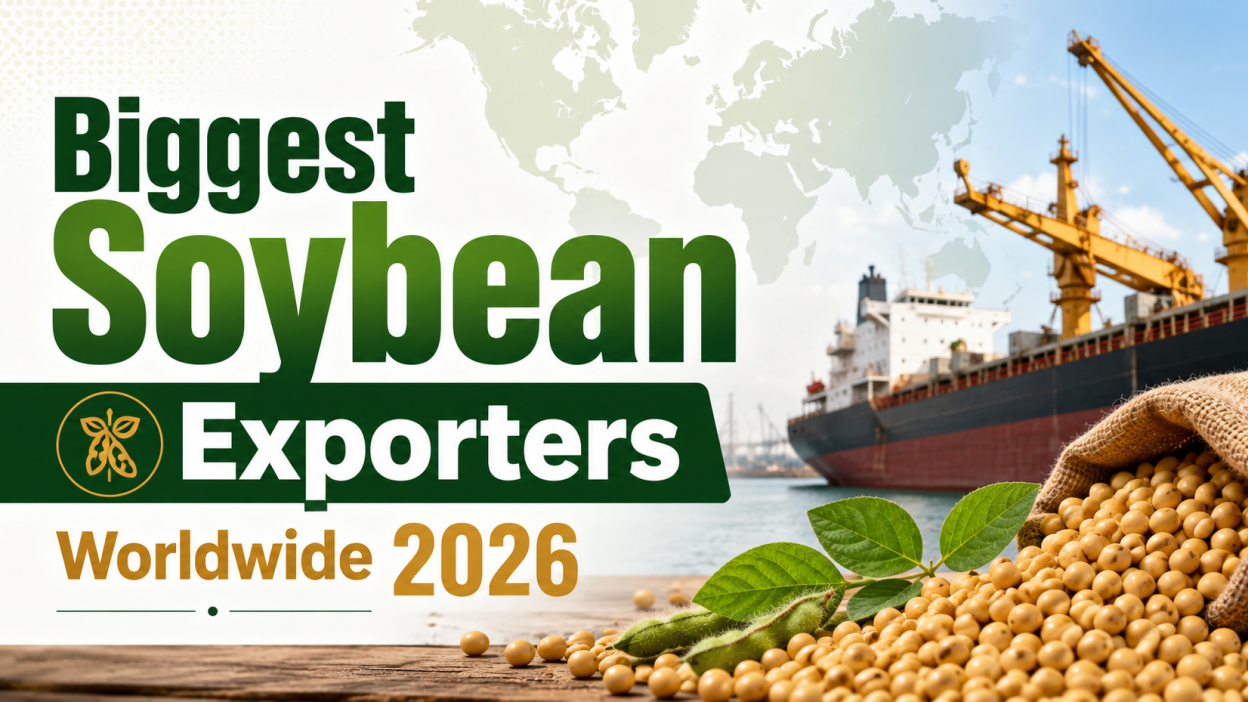
Soybean is not just a crop — it is one of the most traded agricultural commodities on earth. From crushing plants in Brazil to tofu factories in Japan, and from poultry farms in India to biodiesel refineries in the European Union, the entire soybean supply chain runs across dozens of countries simultaneously. Understanding who the biggest soybean exporters and biggest soybean producers are gives traders, importers, and agri-businesses a significant edge in 2026.
Global soybean trade is valued at over USD 65 billion annually, making it one of the top five agricultural exports in the world. The Biggest Soybean Exporters play a crucial role in meeting worldwide demand, supplying millions of tons of soybeans to international markets every year. Whether you are sourcing soybean import leads, searching for verified soybean export leads, or simply trying to understand soybean imports by country, this guide covers everything — including the correct soybean HS code, top soybean importing countries, the biggest soybean exporters, and the leading producing nations driving global supply.
VyaaparOne connects Indian and global B2B traders with active import and export leads for soybeans and hundreds of other commodities. If you are a buyer, exporter, or broker in the soybean market, this data-backed resource will help you identify opportunities and act on them fast.
What Is Soybean & Why Global Trade Matters
Soybean (Glycine max) is a legume crop native to East Asia that has become the world’s most important oilseed. It is crushed primarily into two products — soybean meal (used in animal feed) and soybean oil (used in cooking and biodiesel). Whole soybeans are also consumed directly as food in Asian markets.
The global demand for soybean is driven by three mega-trends:
- Protein demand surge — Growing middle classes in Asia and Africa are eating more meat, poultry, and aquaculture products, all of which require soybean meal-based feed.
- Vegetable oil demand — Soybean oil accounts for nearly 30% of global vegetable oil consumption.
- Biofuel mandates — The EU, US, and Brazil have aggressive biofuel mandates that keep soybean oil demand elevated.
These drivers mean that the biggest soybean producers and biggest soybean exporters are under constant pressure to increase yields and expand trade partnerships. The knock-on effect for traders is a highly liquid, always-active commodity market with predictable soybean import leads and soybean export leads flowing year-round.
Biggest Soybean Producers in the World 2026
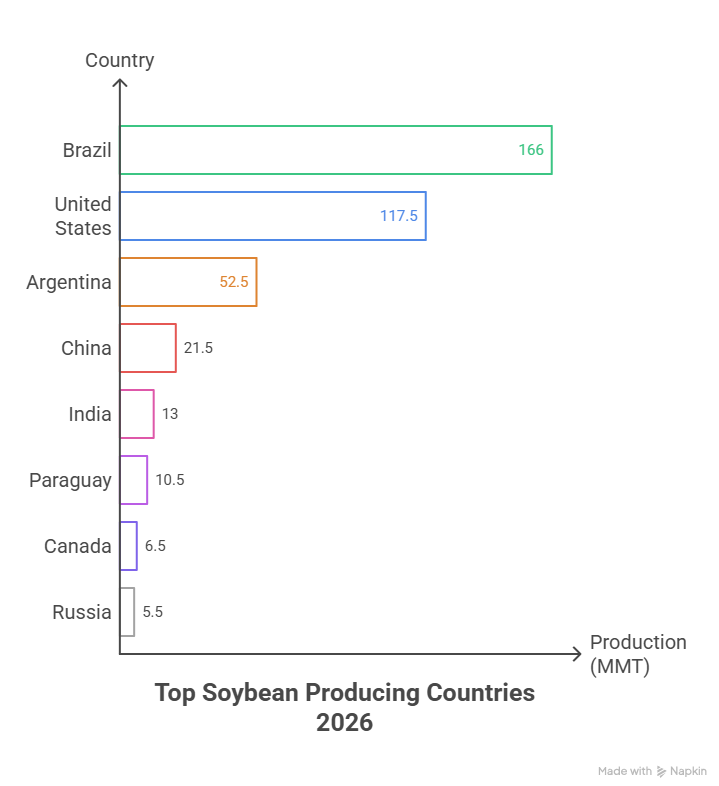
The title of the Biggest Soybean Exporters in the world is dominated by a few major agricultural economies that also rank among the largest producers. Three countries alone account for more than 80% of global soybean production and a significant share of worldwide exports. Here is a breakdown of the top soybean producing countries and Biggest Soybean Exporters for the 2025–26 crop season, based on USDA and Tridge.com estimates.
1. Brazil — The Undisputed Production Leader
Brazil produces approximately 162–170 million metric tonnes (MMT) of soybeans per season, making it the largest producer globally — surpassing even the United States. The Cerrado and Mato Grosso regions have been dramatically expanded over the past two decades. Brazil’s competitive advantage lies in year-round growing capability and massive scale of mechanised farming.
2. United States — The Technological Powerhouse
The US produces around 115–120 MMT per crop year. The Corn Belt states — Iowa, Illinois, Minnesota, Indiana — are the heartland of American soybean production. US soybeans are known for high consistency in protein content and reliable supply chains, making American exporters among the biggest soybean exporters to destinations like China, Mexico, and the EU.
3. Argentina — Crushing Capital of the World
Argentina produces roughly 50–55 MMT of whole soybeans but is particularly significant as the world’s largest exporter of processed soybean products — soybean meal and soybean oil. The country crushes most of its soybeans domestically before exporting, which affects how its trade volumes appear in soybean imports by country statistics for processed goods vs. whole beans.
4. China — The Self-Sufficiency Challenge
China produces around 20–23 MMT domestically but consumes nearly 100 MMT annually, creating an enormous import gap. This makes China the single biggest factor in global soybean import leads demand and heavily influences price movements across all top soybean producing countries.
5. India — Rising Producer with Growing Import Demand
India produces approximately 12–14 MMT of soybeans per year, primarily in Madhya Pradesh and Maharashtra. While India is among the biggest producers of soybeans in Asia, domestic consumption for oil and animal feed outpaces production, creating active soybean import leads for Indian traders.
6. Paraguay, Canada & Other Producers
Paraguay (10–11 MMT), Canada (6–7 MMT of mostly non-GMO varieties), and Russia (5–6 MMT) round out the list of significant top soybean producing countries. Non-GMO Canadian soybeans command premium pricing in Japanese and Korean specialty markets.
Biggest Soybean Exporters by Volume & Value
The distinction between biggest soybean producers and biggest soybean exporters matters because not all producing nations export at the same rate. Argentina, for instance, produces less than the US but exports more processed products. Here is how the export hierarchy looks in 2026.
Brazil — Dominant Export Leader
Brazil is the biggest soybean exporter in whole bean form. It ships over 80–90 MMT of whole soybeans annually, primarily to China (which absorbs nearly 60% of all Brazilian exports), followed by the EU, Thailand, and Mexico. Brazilian soybean exporters benefit from port infrastructure at Santos and Paranaguá and a depreciated Real that keeps their prices globally competitive.
United States — Biggest Soybean Exporters by Value
The US ships around 50–55 MMT of soybeans annually. US exporters are particularly strong in markets demanding identity-preserved, non-GMO, or high-protein beans. Major US export destinations include China, Mexico, the EU, Japan, Taiwan, and Indonesia. The US is among the world’s largest soybean exporters by value, even when Brazil leads by volume.
Argentina — Meal & Oil Export Champion
Argentina exports minimal whole soybeans but ships 30–35 MMT of soybean meal and 5–7 MMT of soybean oil per year — making it a world leader in processed soybean exports. Traders sourcing soybean meal for animal feed or soybean oil for food manufacturing actively monitor Argentine soybean export leads year-round.
Paraguay — Regional Exporter with Growing Capacity
Paraguay exports approximately 6–8 MMT of soybeans annually, largely through Argentine and Brazilian ports. It is particularly important for non-GMO conventional bean exports to specialty markets.
Canada — Premium Non-GMO Exporter
Canada exports 4–5 MMT of soybeans per year, with a heavy focus on non-GMO, food-grade varieties. Canadian soybeans are priced at a premium and target markets like Japan, South Korea, and EU food manufacturers.
Comparison Table 1: Top Soybean Producing Countries 2025–26
| Rank | Country | Estimated Production (MMT) | Share of World Output | Key Producing Region |
| 1 | Brazil | 162–170 | ~37% | Mato Grosso, Paraná, Goiás |
| 2 | United States | 115–120 | ~28% | Iowa, Illinois, Minnesota |
| 3 | Argentina | 50–55 | ~12% | Buenos Aires, Córdoba |
| 4 | China | 20–23 | ~5% | Heilongjiang, Inner Mongolia |
| 5 | India | 12–14 | ~3% | Madhya Pradesh, Maharashtra |
| 6 | Paraguay | 10–11 | ~2.5% | Alto Paraná, Itapúa |
| 7 | Canada | 6–7 | ~1.5% | Ontario, Manitoba |
| 8 | Russia | 5–6 | ~1.2% | Far East, Krasnodar |
| 9 | Ukraine | 4–5 | ~1% | Eastern Ukraine |
| 10 | Bolivia | 2–3 | ~0.6% | Santa Cruz |
Source: USDA PSD, Tridge.com estimates for 2025–26 crop season
Comparison Table 2: Biggest Soybean Exporters by Volume 2025–26
| Rank | Country | Whole Bean Exports (MMT) | Soybean Meal Exports (MMT) | Soybean Oil Exports (MMT) | Primary Destination Markets |
| 1 | Brazil | 85–92 | 17–20 | 1.5–2 | China, EU, Thailand, Mexico |
| 2 | United States | 50–55 | 10–12 | 1–1.5 | China, Mexico, EU, Japan |
| 3 | Argentina | 2–5 | 30–35 | 5–7 | Vietnam, Indonesia, India, EU |
| 4 | Paraguay | 6–8 | 2–3 | 0.3–0.5 | Russia, Turkey, Algeria, EU |
| 5 | Canada | 4–5 | 0.5–1 | 0.2–0.4 | Japan, South Korea, EU |
| 6 | Ukraine | 2.5–3.5 | 0.5–1 | 0.4–0.7 | EU, Turkey, MENA |
| 7 | Russia | 1.5–2.5 | 0.3–0.5 | 0.1–0.2 | China, Belarus, EU |
Source: USDA FAS, OEC.world, Worldstopexports.com estimates
Soybean HS Code — Classification for Import & Export
Every international shipment of soybeans requires a correct HS code for customs clearance, duty calculation, and import/export documentation. Understanding the soybean HS code is essential for traders filing shipping bills, importers claiming exemptions, and exporters completing documentation.
Primary Soybean HS Codes (HS 2022 Edition)
| HS Code | Product Description | Common Usage |
| 1201 | Soybeans, whether or not broken | Raw/whole soybean trade |
| 1201.10 | Seed-quality soybeans | Agricultural/planting purpose |
| 1201.90 | Other soybeans (non-seed) | Feed, crush, food processing |
| 1208.10 | Soya bean flour and meals | Animal feed, food industry |
| 1507.10 | Crude soybean oil | Unrefined oil trade |
| 1507.90 | Refined soybean oil | Retail cooking oil, food use |
| 2304.00 | Soybean oilcake & meal | Poultry/livestock feed trade |
| 0713.31 | Dried shelled soybeans (legume category) | Food-grade specialty trade |
India-Specific ITC HS Codes
For Indian traders specifically, the ITC HS codes under India’s customs classification are:
- 12011000 — Soybean seeds for sowing
- 12019000 — Other soybeans, whether or not broken
- 23040010 — De-oiled soya cake (expeller)
- 23040090 — Other soya bean oilcake and meal
Using the correct soybean HS code ensures smooth customs processing and accurate duty calculation. India levies a 30% basic customs duty on most soybean imports (whole beans), though the rate changes periodically under seasonal adjustments — traders should verify current rates on the DGFT portal before shipments.
Top Soybean Importing Countries 2026
On the demand side, soybean imports by country data reveals where the biggest soybean import leads originate. These are the countries actively seeking supply from the biggest soybean exporters around the world.
China — The World’s Largest Soybean Importer
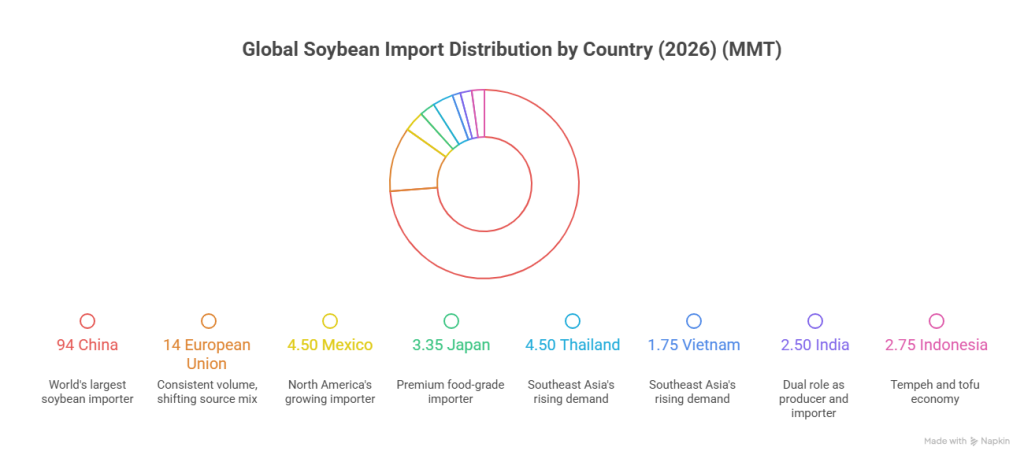
China imports 90–98 MMT of soybeans every single year — a figure that dwarfs every other importing nation. Chinese crushers process imported beans into meal for its massive pig, poultry, and aquaculture sectors. Any disruption to China-Brazil or China-US trade flows creates immediate ripple effects across soybean import leads globally.
European Union — Consistent Volume, Shifting Source Mix
EU member states collectively import 13–15 MMT of soybeans annually for animal feed, food processing, and the growing plant-protein industry. The EU has been actively diversifying away from GMO soybeans, increasing demand for certified non-GMO varieties from Canada and Ukraine.
Mexico — North America’s Growing Importer
Mexico imports 4–5 MMT per year, sourcing almost entirely from the United States due to geographic proximity and USMCA trade agreements. Mexico’s poultry and aquaculture sectors drive demand, making it a key market for US soybean export leads.
Japan — Premium Food-Grade Importer
Japan imports approximately 3.2–3.5 MMT annually, with strict standards on non-GMO, identity-preserved varieties. Japanese soybean importers pay premium prices and are among the most selective top soybean importing countries in the world.
Thailand & Vietnam — Southeast Asia’s Rising Demand
Thailand (4–5 MMT) and Vietnam (1.5–2 MMT) are fast-growing top soybean importing countries due to expanding poultry, shrimp, and fish farming industries. These markets represent active and growing soybean import leads for exporters in Brazil and the US.
India — Dual Role as Producer and Importer
India imports 2–3 MMT of soybeans and significantly larger volumes of soybean oil annually. Domestic production gaps, especially during deficit monsoon years, push Indian crushers and food manufacturers into the import market, generating substantial soybean import leads on platforms like VyaaparOne.
Indonesia — Tempeh and Tofu Economy
Indonesia imports approximately 2.5–3 MMT of soybeans per year — almost entirely for food use in tempeh and tofu production. It is a highly price-sensitive market that sources primarily from the US.
Comparison Table 3: Soybean Imports by Country 2025–26
| Rank | Country | Estimated Imports (MMT) | Primary Source Countries | Key End-Use Sector |
| 1 | China | 90–98 | Brazil (60%), USA (25%), Argentina (10%) | Crush — Feed & Oil |
| 2 | European Union | 13–15 | Brazil, USA, Paraguay | Feed, Food, Non-GMO Processing |
| 3 | Mexico | 4–5 | USA (95%+) | Poultry Feed, Food |
| 4 | Thailand | 4–5 | USA, Brazil | Poultry & Aquafeed |
| 5 | Japan | 3.2–3.5 | USA (Non-GMO), Brazil, Canada | Food (Tofu, Miso, Soy Milk) |
| 6 | Indonesia | 2.5–3 | USA, Brazil | Food (Tempeh, Tofu) |
| 7 | India | 2–3 | Argentina, Brazil, USA | Crush — Oil & Meal |
| 8 | Vietnam | 1.5–2 | USA, Brazil | Aquafeed, Poultry Feed |
| 9 | Taiwan | 2–2.5 | USA (Non-GMO focus) | Food, Feed |
| 10 | Bangladesh | 0.5–1 | India, Argentina | Poultry Feed |
Source: USDA FAS, OEC.world, Tridge.com 2025–26 trade flow estimates
Soybean Import Leads & Export Leads on VyaaparOne
For Indian traders, importers, and exporters, finding verified soybean import leads and soybean export leads is the difference between a missed opportunity and a closed deal. Whether you are targeting the Biggest Soybean Exporters, connecting with leading soybean producers, or expanding into new international markets, access to accurate trade data is essential. VyaaparOne — India’s growing B2B trade intelligence platform — is designed exactly for this purpose.
What Are Soybean Import Leads?
Soybean import leads are buyer inquiries and verified purchase requirements from companies looking to source soybeans, soybean meal, or soybean oil. These leads come from:
- Feed manufacturers needing soybean meal
- Edible oil refineries sourcing crude soybean oil
- Food companies sourcing non-GMO whole beans
- Government agencies managing strategic reserves
On VyaaparOne, soybean import leads are updated regularly and include buyer name, quantity required, specification (whole bean / meal / oil), and preferred origin.
What Are Soybean Export Leads?
Soybean export leads on VyaaparOne represent verified supplier listings and export opportunities from Indian exporters and international trading houses. These include:
- Indian soybean exporters from Madhya Pradesh and Maharashtra
- De-oiled soya cake exporters targeting Southeast Asia
- Soybean oil exporters serving the MENA region
- Brokers representing South American biggest soybean exporters seeking Indian buyers
How VyaaparOne Connects Buyers and Sellers
VyaaparOne functions as a import and export leads aggregator with real shipment data, buyer-seller profiles, and direct inquiry tools. Traders using the platform gain access to:
- Active soybean import leads from verified Indian and global buyers
- Soybean export leads from certified exporters and trading companies
- HS code-filtered search results for precise product matching
- Contact information for direct outreach to counterparties
Whether you are one of the Biggest Soybean Exporters looking for new export markets, or an Indian importer seeking competitive sourcing from the world’s Biggest Soybean Exporters, VyaaparOne’s trade data layer helps you identify, analyze, and act on global trade opportunities faster than traditional sourcing methods.
How to Use Soybean Import & Export Leads for Trade Growth
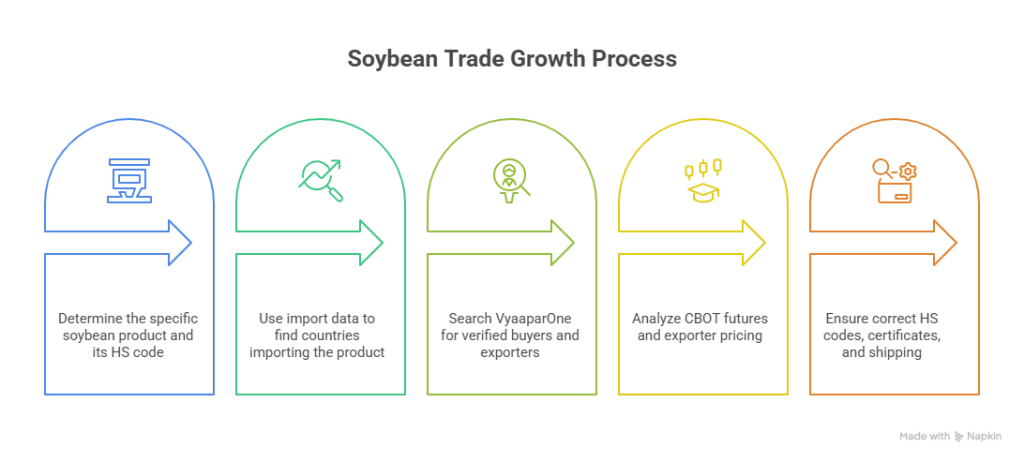
Knowing who the biggest soybean exporters are is only half the battle. The other half is building a systematic process to convert leads into purchase orders. Here is a practical framework for traders:
Step 1: Define Your Product Specification
Are you trading whole soybeans, soybean meal, de-oiled cake, or soybean oil? Each product has a different soybean HS code, different price drivers, and different top soybean importing countries as your primary markets. Clarity on specification before sourcing leads saves considerable time.
Step 2: Identify Target Markets Using Import Data
Use soybean imports by country data — like the tables in this guide — to identify which countries are actively importing and which top soybean importing countries match your product type. Food-grade whole beans go to Japan, Indonesia, and Taiwan. Meal goes to Southeast Asia and India. Oil goes to MENA and EU.
Step 3: Find Verified Leads on VyaaparOne
Search VyaaparOne’s soybean import leads and soybean export leads database using product filters and HS code parameters. Filter by country, product type, and quantity requirement. Prioritize verified buyers and exporters with trade history.
Step 4: Understand Pricing Benchmarks
Pricing for soybeans is benchmarked to the Chicago Board of Trade (CBOT) futures market. As of early 2026, soybean prices have ranged between USD 340–380 per metric tonne (FOB major ports). Biggest soybean exporters in Brazil typically price at a basis differential to CBOT; US exporters at a Gulf premium.
Step 5: Manage Logistics and Documentation
Successful soybean trading requires:
- Correct soybean HS code on all documents
- Phytosanitary certificates from exporting country
- Certificate of origin (Form A for GSP benefits)
- Quality certificates (protein/moisture/oil content)
- Insurance and shipping coordination for bulk cargo
Conclusion
The global soybean trade in 2026 is defined by a handful of dominant players. Brazil and the United States remain the biggest soybean exporters and biggest soybean producers in the world, together setting the pace for global supply. China remains the indispensable demand driver, absorbing nearly a quarter of all global production through imports alone.
For Indian traders, importers, and agri-businesses, the opportunity lies in connecting with the right counterparties across this vast supply chain — sourcing competitively from the world’s largest soybean exporters, targeting the top soybean importing countries with Indian meal and oil exports, and staying on top of soybean HS code requirements for seamless customs clearance.
VyaaparOne makes this possible by providing real-time soybean import leads, verified soybean export leads, and actionable import and export leads data that bridges Indian B2B traders with global soybean markets. Whether you are tracking soybean imports by country, identifying new buyers among the top soybean importing countries, or building your export pipeline to new markets, the platform gives you the trade intelligence edge to grow faster.
Frequently Asked Questions
Q1. Which country is the biggest soybean exporter in the world in 2026?
Brazil is the biggest soybean exporter in the world in 2026, exporting approximately 85–92 million metric tons (MMT) annually. The United States ranks second with 50–55 MMT of soybean exports. Argentina is a leading exporter of soybean meal and soybean oil.
Q2. What are the top 5 biggest soybean exporters worldwide?
The top soybean exporters in 2026 are:
- Brazil
- United States
- Argentina
- Paraguay
- Canada
These countries account for the majority of global soybean exports.
Q3. Which countries are the biggest soybean producers globally?
The biggest soybean producers are Brazil, the United States, and Argentina. Together, these countries contribute more than 75% of global soybean production. India is also among the top soybean producing countries in Asia.