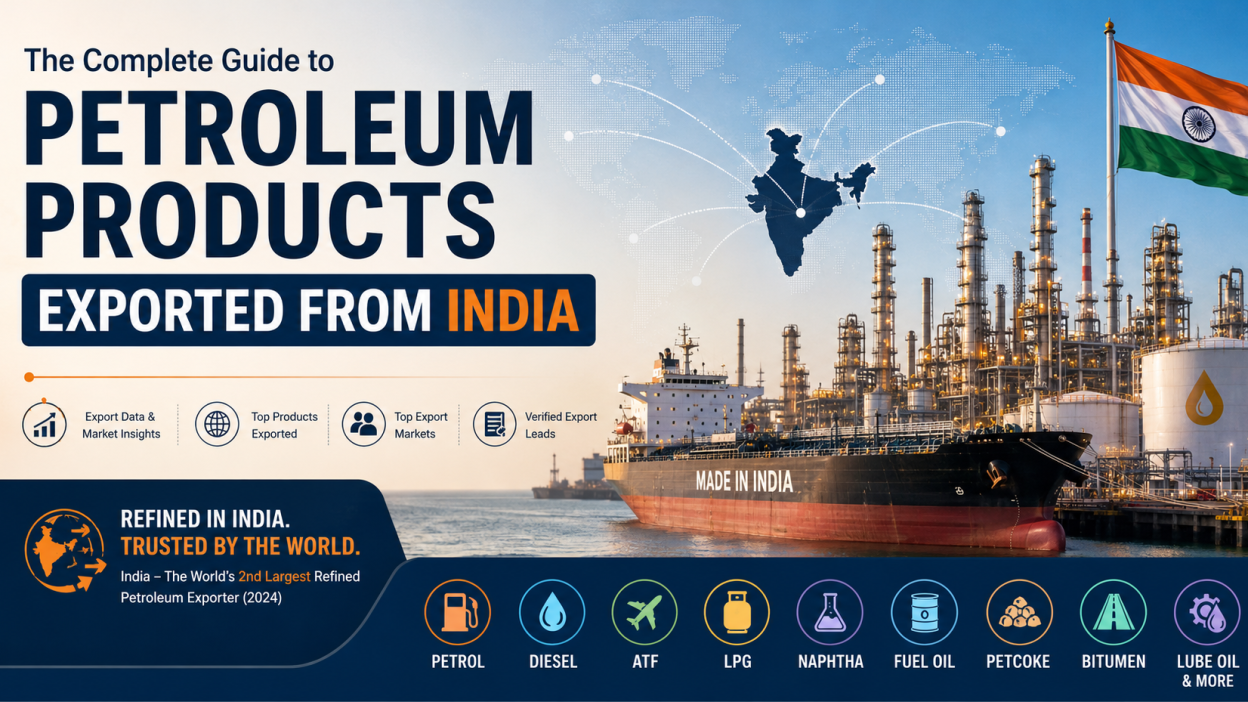
India isn’t just a massive oil consumer — it’s quietly become one of the world’s biggest refiners and a top supplier of petroleum products to dozens of countries. That’s a trade opportunity most B2B buyers and exporters haven’t fully mapped yet.
Petroleum products exported from India reached $70.2 billion in 2024, making India the second-largest refined petroleum exporter globally, right behind the United States. And the numbers keep growing. Whether you’re looking for petroleum products export data for market research, sourcing verified export leads, or just trying to understand which countries India sells petrol and diesel to — this guide covers all of it.
India’s Role in Global Petroleum Product Exports
Here’s something most people don’t realise: India doesn’t produce much crude oil domestically. It imports around 88% of its crude supply. And then it refines that crude and exports the finished products at a profit.
That model — import, refine, re-export — has turned India into a serious global player. In 2023, India was the fourth-largest exporter of middle distillates globally and the sixth-largest overall refinery product exporter at 1.2 million barrels per day, according to the International Energy Agency. By 2024, India had climbed to second place globally in refined petroleum product exports with $70.2 billion in export value.
The Jamnagar refinery run by Reliance Industries is one of the largest in the world. India’s 23 refineries collectively process hundreds of millions of metric tonnes of crude every year, with a total nameplate capacity that comfortably feeds both domestic demand and export markets.
Russia’s invasion of Ukraine in 2022 changed the game further. With European buyers cutting off Russian crude, India stepped in — buying discounted Russian crude, processing it, and selling the refined products back to Europe and other markets. The result? Between FY2021 and FY2024, India’s diesel exports to Europe surged by over 1,150%, and aviation turbine fuel exports jumped 480%. That’s not a minor uptick. That’s a structural shift.
India’s crude processing capacity is set to rise by 130,000–160,000 barrels per day in 2025, with gasoline exports expected to hit a record high of around 400,000 barrels per day, per consultancy Wood Mackenzie. The trajectory is clear.
Complete List of Petroleum Products Exported from India
Not everything refined in India stays in India. Here’s the full list of petroleum products exported from India that show significant export volumes:
Light Distillates
1. Motor Spirit (MS / Petrol / Gasoline) Petrol is one of India’s top petroleum exports by volume. India’s 20% ethanol blending mandate has freed up more domestic petrol surplus for export. In 2025, petrol exports are tracking at 387,000 barrels per day, mainly to Asian markets.
2. Naphtha About 6% of India’s petroleum production is naphtha — used as a petrochemical feedstock in countries across Asia. India’s naphtha exports in FY2024–25 totalled $196.29 million, with South Korea, China, and Singapore as the primary buyers.
3. LPG (Liquefied Petroleum Gas) LPG is a consistent export category. Companies like BPCL have strategically shifted from Middle Eastern LPG suppliers to US sources for domestic import, freeing up more LPG for export. LPG figures in the top six petroleum exports from India by value.
Middle Distillates
4. High-Speed Diesel (HSD) Diesel is historically India’s largest petroleum export by volume. It was the growth driver behind the post-2022 surge in India’s petroleum exports to Europe. Monthly diesel exports have averaged 1.86 million tonnes, with a recorded high of 3.48 million tonnes in September 2019, per Trading Economics data.
5. Aviation Turbine Fuel (ATF) Global aviation’s post-pandemic recovery has been a tailwind here. ATF exports from India were valued at $5.33 billion in FY2024–25 and rose 32.4% year-over-year in October 2024. Africa, the Middle East, and Southeast Asia are the main destinations.
6. Superior Kerosene Oil (SKO) SKO exports have gradually declined with increased domestic LPG penetration reducing kerosene dependency inside India — but it still appears in export data for certain developing-market buyers.
Heavy Ends & Others
7. Fuel Oil / Furnace Oil Used in marine vessels, power plants, and industrial boilers worldwide. India’s fuel oil exports reached $1.38 billion, making it a meaningful category for energy-intensive import markets.
8. Petroleum Coke (Petcoke) Petcoke exports have shown strong growth — it’s a residue from the refining process, widely used in cement and aluminium manufacturing. Petcoke is listed among the broad-base contributors to the 4.2% rise in India’s petroleum product exports in the first 7 months of FY2024–25.
9. Lubricating Base Oils (LOBS / Lube Oil) India exports base lube oils used in manufacturing lubricants for automotive and industrial machinery. This is a growing niche within India’s petroleum export portfolio.
10. Bitumen Used in road construction globally. India’s bitumen exports serve infrastructure projects across the Middle East, Southeast Asia, and parts of Africa.
Quick Reference Table — List of Petroleum Products Exported from India
| Product | Primary Use | Key Export Markets | HS Code |
| Motor Spirit (Petrol) | Road transport fuel | Singapore, UAE, Southeast Asia | 2710 12 |
| High-Speed Diesel (HSD) | Transport, industry | Netherlands, UAE, Africa | 2710 19 |
| Aviation Turbine Fuel (ATF) | Commercial aviation | UAE, Africa, Southeast Asia | 2710 19 21 |
| LPG | Domestic & industrial fuel | Gulf, Southeast Asia | 2711 |
| Naphtha | Petrochemical feedstock | South Korea, China, Singapore | 2710 12 20 |
| Fuel Oil / Furnace Oil | Marine, power, industrial | Global | 2710 19 51 |
| SKO (Kerosene) | Domestic fuel, industrial | Africa, South Asia | 2710 19 31 |
| Petroleum Coke | Cement, aluminium manufacturing | China, Middle East | 2713 |
| Bitumen | Road construction | Middle East, Southeast Asia | 2713 20 |
| Lubricating Oils (LOBS) | Automotive, industrial lubrication | Middle East, Africa | 2710 19 81 |
Petroleum Products Export Data — Key Numbers
Numbers are where strategy starts. Here’s the consolidated petroleum products export data that actually matters for business decisions:
- FY2024 Export Volume: 62.44 million metric tonnes (MMT) of petroleum products exported from India
- FY2024–25 (9 months): 47.5 MMT — a 1.5% year-on-year increase
- Export Value (Apr 2023 – Jan 2024): $70.13 billion total
- India’s Global Rank (2024): 2nd largest refined petroleum exporter at $70.2 billion, behind only the United States ($117.5 billion)
- ATF Growth: +32.4% YoY in October 2024
- Petrol (MS) 2025 Export Rate: ~387,000 barrels per day
- Diesel Europe Surge: +1,150% from FY2021 to FY2024
- FY2025 Export Value (INR): Over ₹5.3 trillion, per Reserve Bank of India data tracked by Statista
Month-by-Month Exports (October 2024 PPAC Data): Refined petroleum product exports rose 12% in October 2024 year-on-year, with the first seven months of FY2024–25 showing 4.2% cumulative growth — driven primarily by petcoke, petrol, and ATF.
This data matters because it tells you where the demand is coming from and where it’s going. Flat diesel volumes, rising petrol and ATF. That shift has direct implications for buyers, traders, and any business sourcing petroleum product export leads.
Top Countries India Sells Petroleum Products To
Who is actually buying petroleum products from India? Let’s break it down:
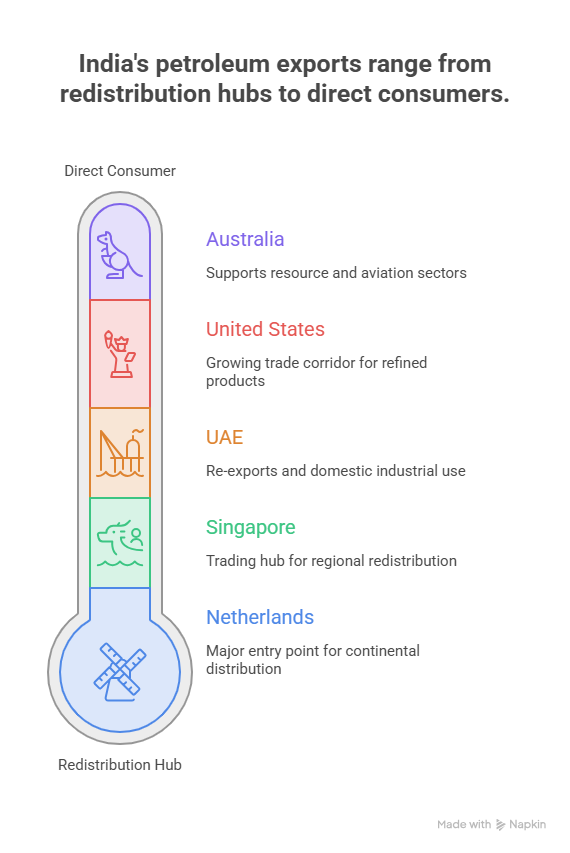
1. Netherlands — $14.9 Billion (2024) The Netherlands is India’s single largest buyer of refined petroleum exports, accounting for nearly 20.4 billion kg in volume. Rotterdam serves as Europe’s main entry point for Indian petroleum products, redistributed across the continent.
2. United Arab Emirates — $6.8 Billion (2024) The UAE imported over $6.8 billion of petroleum products from India. Despite being a major oil-producing nation itself, the UAE buys specific refined products from India for re-export and domestic industrial use.
3. Singapore — $6.4 Billion (2024) Singapore is a major trading and refining hub. It imported over $6.4 billion of Indian petroleum in 2024 — and acts as a redistribution point for Southeast Asian markets.
4. United States — $4.25 Billion (2024) The US imported $4.25 billion worth of petroleum products from India. The India–US trade corridor for refined petroleum has grown significantly post-2022, making the US a top-five buyer.
5. Australia — $3.75 Billion (2024) Australia rounds out the top five, importing $3.75 billion of Indian petroleum products — largely diesel and aviation fuel to support its resource-heavy and aviation sectors.
Other Major Buyers:
- Africa — became the largest single-region importer of Indian petroleum in December 2024, driven by rising energy demand
- South Korea — primary buyer of Indian naphtha
- China — petrochemical feedstock buyer
Comparison Table — Top Countries Importing Petroleum Products from India (2024)
| Rank | Country | Import Value (USD) | Key Products |
| 1 | Netherlands | $14.9 Billion | Diesel, ATF, Petrol |
| 2 | UAE | $6.8 Billion | Petrol, Diesel, Fuel Oil |
| 3 | Singapore | $6.4 Billion | Diesel, Naphtha, ATF |
| 4 | United States | $4.25 Billion | Diesel, Petrol, ATF |
| 5 | Australia | $3.75 Billion | Diesel, ATF |
| 6 | Africa (region) | Rising rapidly | Diesel, Petrol, ATF |
| 7 | South Korea | Significant | Naphtha, Lube Oils |
| 8 | China | Significant | Naphtha, Petcoke |
Source: World Bank WITS, Credlix, Trade Intelligence Data 2024
HS Codes for Petroleum Products Exported from India
HS codes are the backbone of petroleum products export data. Every shipment is classified, and every buyer or seller needs to know the right code to search export records, file documentation, or source buyer leads.
Chapter 27 covers all mineral fuels and petroleum products. Here are the key HS codes for petroleum products exported from India:
| HS Code | Product Category |
| 2710 | Petroleum oils (excluding crude) — the master code |
| 2710 12 | Light oils — petrol, naphtha, aviation gasoline |
| 2710 19 | Medium and heavy oil fractions — diesel, fuel oil, kerosene |
| 2710 19 21 | Aviation turbine fuel (ATF) |
| 2710 19 31 | Superior kerosene oil (SKO) |
| 2710 19 51 | Fuel oil / furnace oil |
| 2710 19 81 | Lubricating oils (LOBS) |
| 2711 | LPG and other petroleum gases |
| 2713 | Petroleum coke and petroleum bitumen |
| 2713 20 | Bitumen |
| 2709 | Crude petroleum (for reference — India imports this) |
When searching petroleum products export data on trade intelligence platforms, always filter by HS code 271000 for the broadest data, then narrow by sub-heading based on the specific product you’re tracking.
Top Indian Petroleum Product Exporters (Companies)
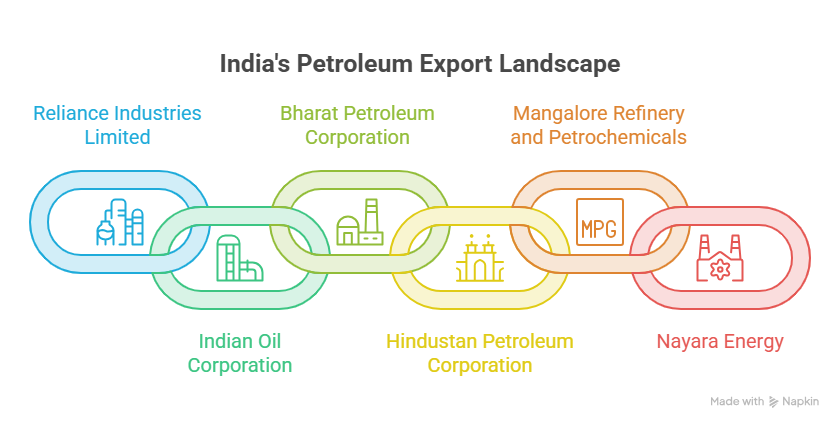
India’s petroleum export story isn’t just a government numbers exercise. These companies are the ones actually shipping product:
Reliance Industries Limited (RIL) Operates the world-scale Jamnagar refinery in Gujarat — one of the largest and most complex refineries globally. Reliance is the single biggest contributor to India’s petroleum product exports, with the refinery designed specifically to produce export-grade fuels.
Indian Oil Corporation (IOCL) The largest public-sector oil company in India. IOCL operates 11 refineries with a combined throughput capacity of 80.6 MMTPA. Major exporter of diesel, petrol, ATF, and LPG.
Bharat Petroleum Corporation Limited (BPCL) BPCL has been especially active in optimizing LPG export strategy — switching from expensive Middle Eastern LPG imports and sourcing US supply instead, then exporting refined products. Refineries in Mumbai and Kochi.
Hindustan Petroleum Corporation Limited (HPCL) Operates two refineries — Mumbai (9.5 MMTPA) and Visakhapatnam (8.3 MMTPA). Contributes to fuel exports across multiple product categories.
Mangalore Refinery and Petrochemicals Ltd (MRPL) A subsidiary of ONGC, MRPL is among the companies named in 2025 Reuters reporting as boosting gasoline exports to capitalise on rising Asian gasoline margins.
Nayara Energy (formerly Essar Oil) Operates the Vadinar refinery in Gujarat — another large-scale exporter of petroleum products.
These are the actual entities behind India’s petroleum export volumes. For buyers and trade data researchers, knowing these names helps when cross-referencing shipment data with consignee/shipper records in export databases.
How to Access Petroleum Products Export Data & Leads
Export data without verified buyer leads is just academic research. Here’s where the two converge:
What is petroleum products export data? It’s transaction-level shipment data drawn from customs filings — capturing the exporter name, buyer name, HS code, quantity, price, port of export, and destination country for every recorded shipment.
What are petroleum products export leads? They’re actionable buyer contacts extracted from this shipment data — overseas companies that have actually purchased petroleum products from India and are therefore verified active buyers in this space.
How to use this data:
- Identify which countries are actively importing your specific product type
- Find the specific buying companies in those countries
- Track your competitors’ export destinations
- Discover new markets with rising import volumes
On VyaaparOne, you can search and connect with verified B2B buyers and suppliers in the petroleum product category. The platform aggregates trade intelligence, supplier profiles, and buyer enquiries — making it easier to convert petroleum products export leads into actual deals without cold-calling into the dark.
Petroleum Product Export Trends to Watch in 2025–26
The petroleum export landscape isn’t static. A few trends are reshaping volumes and destinations right now:
1. Gasoline Exports at Record Highs India’s 20% ethanol blending mandate (up from 12% in 2023) has freed up petrol surplus. Refiners are redirecting that to Asian export markets. Wood Mackenzie forecasts India’s gasoline exports will hit a record ~400,000 barrels per day in 2025.
2. Africa Emerging as a Priority Market December 2024 saw Africa overtake other regions as the largest importer of Indian petroleum. Energy demand across Sub-Saharan Africa and North Africa is growing fast — and India’s refiners are well-positioned to meet it.
3. ATF’s Continued Rise Aviation recovery is global and sustained. India’s ATF exports rose 32.4% year-on-year in October 2024. Airlines in the Middle East, Africa, and Southeast Asia are buying Indian aviation fuel at higher volumes each quarter.
4. Europe Still Dominates by Value From April 2023 to January 2024, Europe received $18.4 billion worth of Indian petroleum — the largest regional buyer by value. The Netherlands alone accounted for 25% of transfers. Russian crude supply disruption to European refineries keeps demand for Indian products elevated.
5. Petcoke Growth Petroleum coke exports are expanding due to demand from cement industries in the Middle East and China. Petcoke was one of three primary contributors to the 4.2% growth in India’s petroleum product exports in FY2024–25.
6. India’s Upstream Expansion India targets reaching 1 million square kilometres of exploration land by 2030, with a 16% increase expected in 2025. Reducing crude import dependency while growing refining and export capacity is the long-term play.
7. IEA Forecast on Indian Demand The IEA’s February 2024 assessment confirmed India will account for the majority of global oil demand growth through 2030. More demand internally, but also more refining — and the surplus goes outward.
Final Words
India’s position in global petroleum product trade has changed permanently. What was once a volume story driven by surplus diesel and petrol has become a multi-product, multi-continent export operation built on world-scale refining, strategic crude sourcing, and rising global energy demand.
The petroleum products exported from India now span ten product categories, reach 50+ countries, and generate $70 billion-plus in annual export value. Whether you’re a buyer looking for competitive petroleum product pricing from Indian refiners, a trader tracking petroleum products export data for market entry decisions, or a business sourcing petroleum products export leads for outreach — India is the market you can’t afford to ignore.
VyaaparOne connects Indian petroleum product exporters with verified international buyers. Search supplier listings, explore B2B trade leads, and access the petroleum products export data your business needs to compete in this market.
FAQ: Mustard Oil Export from India
Q1. What is the total volume of mustard oil export from India?
In 2023–24, India exported 4,885,437 metric tonnes of mustard oil, valued at INR 15,370 crore. This represents a 13% increase in quantity and a 35% increase in value over the previous year.
Q2. Which are the top mustard oil importer countries from India?
The leading mustard oil importing countries for Indian exports are Bangladesh, the United States, Australia, Bhutan, UAE, Turkey, and Russia. The US, Lithuania, and Australia account for approximately 43% of global mustard oil imports by shipment count.
Q3. Who is the largest exporter of mustard oil globally?
Globally, the Netherlands holds the largest exporter position with a USD 617.7 million export value. However, in terms of shipment count, India leads the world with 52,723+ shipments, followed by Ukraine and Nepal. India is effectively the world’s largest exporter of mustard oil by volume of shipments.
Q4. What are the HS codes for mustard oil export from India?
The primary HS codes are 15149120 (refined edible mustard oil), 15149920 (other mustard/rapeseed oil), and 23069012 (mustard oilcake residues). The code 15149120 is the most commonly used for standard food-grade exports.
Q5. How can I find verified mustard oil export leads from India?
Platforms like VyaaparOne provide shipment-level mustard oil export data leads from India, including buyer names, countries, HS codes, and transaction values. These leads are verified, regularly updated, and accessible via the trade intelligence dashboard.
Q6. What grades of mustard oil does India export?
India exports three grades: Grade I (Kachchi Ghani / cold-pressed), Grade II (refined), and Grade III (non-edible / industrial). Each grade serves distinct market segments and buyer types.
Q7. What documentation is required for mustard oil export from India?
Key documents include the IEC code, commercial invoice, packing list, bill of lading, certificate of origin, APEDA registration certificate, and phytosanitary certificate (for specific markets like the EU and Australia).
Q8. What is the current export price of Indian mustard oil?
As of 2025, India’s wholesale mustard oil export price is approximately USD 1.74/kg, making it highly competitive compared to European suppliers.