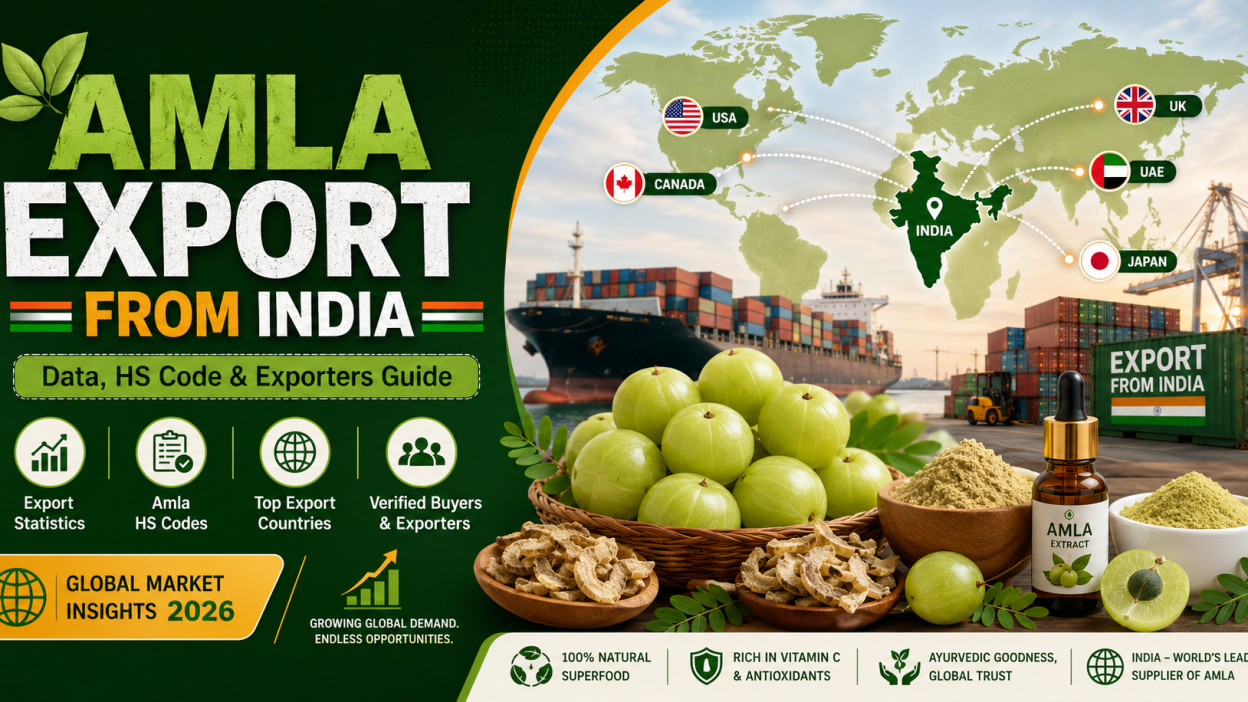
Amla export from India has quietly become one of the most interesting stories in the country’s agri-trade and nutraceutical space. The fruit is small, sour, and humble. But the global appetite for it? Anything but small. From American supplement brands to Gulf retailers stocking Ayurvedic shelves, the demand keeps climbing — and India sits right at the centre of it all.
Here’s the thing most people miss. Amla export from India isn’t a single product line. It’s a whole ecosystem — fresh fruit, dried slices, fine powder, juice concentrate, standardised extract, and finished cosmetic-grade material. Each one travels under a different HS code, lands in a different market, and fetches a wildly different price. If you want to play in this trade, you need to understand all of it.
This guide breaks down everything: the latest amla export data, every relevant amla HSN code, the leading amla exporters in India, the top amla export countries, and where to find amla export data leads that actually convert. Let’s get into it.
Why Amla Export from India Commands Global Attention
India produces roughly 75% of the world’s amla. Annual output crosses 1.2 million metric tonnes. No other country comes close. So when international buyers want Indian gooseberry — and increasingly, they do — there’s really only one origin that matters.
The numbers tell the story. India’s organic product exports for the fiscal year 2024–2025 (April 2024 to March 2025) totalled around $665.96 million, a 34.6% jump over the previous fiscal year. Amla and its derivatives form a meaningful slice of that organic basket, especially in the herbal supplement and Ayurvedic categories.
Why the surge? A few reasons, and they reinforce each other.
Global health consciousness is up. Way up. Consumers in the US, Europe, and the Gulf are hunting for natural immunity boosters, and amla — packed with vitamin C and antioxidants — ticks every box. The functional food and nutraceutical wave has been very, very kind to Indian gooseberry export from India.
Then there’s the Ayurveda effect. As Ayurvedic and herbal cosmetics gain mainstream credibility worldwide, amla rides along as a hero ingredient. Hair oils, face serums, dietary capsules — amla shows up everywhere. And buyers want it sourced from India because, frankly, the provenance story sells.
The global gooseberry market backs this momentum. At a compound annual growth rate of 4.60%, the market is projected to reach USD 1.61 billion in 2025 and roughly USD 2.02 billion by 2030. That’s a runway most exporters would kill for.
Worth noting: amla is classified in India as a minor crop, yet its production has been rising steadily. Uttar Pradesh leads domestic output, contributing close to 35% of the national total. Other significant growing belts include Rajasthan, Madhya Pradesh, Gujarat, and Tamil Nadu.
Amla Export Data from India: The Latest Numbers
Let me give you the real picture. Amla export data from India tells a layered story depending on which product form and which HS classification you pull.
Across the broad amla category, India recorded around 10,716 export shipments in the trailing twelve months from October 2023 to September 2024. In September 2024 alone, roughly 1,005 amla export shipments left Indian ports. That single month showed a sequential growth of 11% over August 2024 and a 22% year-over-year increase compared to September 2023. The trajectory is upward — not explosive, but consistent.
When you zoom into specific HS codes, the amla export data gets more granular. Under the broad amla powder HSN 1211 classification, India exported around 722 shipments from March 2023 to February 2024, made by 179 Indian exporters to 425 buyers — a 37% growth rate over the preceding twelve months. India leads the world in amla powder exports under HSN 1211 with around 4,677 shipments, dwarfing Sri Lanka (7 shipments) and Pakistan (5 shipments). India alone accounts for roughly 97% of global amla powder exports in this category.
That’s dominance. Not a polite lead — dominance.
Here’s a snapshot of amla export data from India across key segments:
| Product Segment | Key HS Code | Notable Export Volume | Top Destinations |
| Amla Powder | 1211 / 12119029 | ~4,677 India shipments (TTM) | USA, UK, Canada |
| Amla (broad category) | Multiple | ~10,716 shipments (Oct’23–Sep’24) | USA, UAE, UK |
| Amla Extract / value-added | 1302 | India 62 shipments (Jun’24–May’25) | Malaysia, Bangladesh, Sri Lanka |
| Dry Amla | 12119029 | India 10 shipments (Apr’24–Mar’25) | Bangladesh |
| Amla Powder (newer dataset) | 1211 | India 341 shipments (Jun’24–May’25) | USA, South Korea, Japan |
A quick caveat on reading trade data. Different intelligence platforms — Volza, Seair, Eximpedia, Cybex — capture different shipment windows and HS code groupings. So you’ll see numbers that don’t perfectly line up across sources. That’s normal. What matters is the directional truth: India is the world’s anchor supplier of amla in nearly every product form, and demand is concentrated in a handful of premium markets.
For exporters chasing amla export data leads, this fragmentation is actually an opportunity. The buyer who imports amla powder under HSN 1211 is often a different buyer than the one sourcing amla extract under HSN 1302. Map them separately. You’ll find more leads that way.
Amla HSN Code & Amla HS Code: The Full Classification Breakdown
This is where most first-time exporters trip up. There is no single amla HSN code. The classification depends entirely on the product form — and getting it wrong means customs delays, incorrect duty calculation, and lost export incentive claims.
So let’s be precise. Here are the amla HS code classifications you’ll actually use.
Primary Amla HSN Codes
The most commonly cited amla HSN code group includes:
- 12119029 — Dried amla and amla powder (plants and parts used in pharmacy/perfumery). This is arguably the workhorse code for amla export from India. Under HSN 12119029, Volza recorded around 2,521 amla powder shipments.
- 1211 — The broader parent heading covering plants and parts of plants used in pharmacy, perfumery, insecticidal, or similar purposes. Around 11,574 shipments fall under this wider grouping.
- 08119090 — Frozen fruit and nuts (including frozen amla), uncooked or cooked.
- 08134090 — Other dried fruit (relevant for certain dried amla preparations).
- 07099990 — Other fresh or chilled vegetables/fruit (used for fresh amla in some declarations).
Value-Added & Extract Amla HS Codes
For processed and high-value amla products, you’ll encounter:
- 1302 / 13021919 — Vegetable saps and extracts. This covers standardised amla extract, a high-margin nutraceutical input. Under HSN 1302, India shipped around 62 amla extract shipments between June 2024 and May 2025.
- 21069099 — Food preparations not elsewhere specified (amla-based functional food blends, supplement mixes).
- 2103 — Sauces and condiment preparations (gooseberry product blends, in some classifications).
- 14041061 / 14049090 — Vegetable products not elsewhere specified (certain herbal amla material).
- 33049990 — Beauty/cosmetic preparations (amla-based cosmetic formulations).
- 3004 — Medicaments (amla as part of Ayurvedic medicinal preparations).
Here’s a clean reference table for the most-used amla HSN code / amla HS code classifications:
| Amla Product Form | Amla HSN Code | Category |
| Amla powder (dried) | 12119029 | Plants/parts for pharmacy |
| Amla powder (broad) | 1211 | Pharmacy/perfumery plants |
| Frozen amla | 08119090 | Frozen fruit |
| Dried amla (other) | 08134090 | Dried fruit |
| Fresh amla | 07099990 | Fresh fruit/vegetable |
| Amla extract / sap | 1302 / 13021919 | Vegetable extracts |
| Amla food preparation | 21069099 | Food preparations NES |
| Amla cosmetic | 33049990 | Beauty preparations |
| Amla Ayurvedic medicament | 3004 | Medicaments |
My honest advice? Before you ship a single carton, confirm your amla HS code with a customs broker or licensed CHA. The difference between 12119029 and 21069099 isn’t academic — it changes your duty drawback eligibility and your phytosanitary documentation requirements. Get it right the first time.
Amla Export Countries: Where Indian Gooseberry Actually Goes
Now to the question every exporter asks first. Which amla export countries should I target?
The honest answer: it depends on your product form. But across the board, three markets dominate amla export from India — the United States, the United Arab Emirates, and the United Kingdom.
The United States — The Anchor Market
The US is, without competition, the single largest destination for Indian amla. In several amla datasets, the United States accounts for the lion’s share of shipments — in one broad amla dataset, around 75% of shipments (roughly 90 of them) headed to American buyers. For amla powder specifically, the US is consistently the top importer alongside South Korea and Japan.
Why the US? The supplement industry there is enormous and growing. American nutraceutical brands need bulk amla powder and standardised extract, and they need it consistently. If you can meet US food-safety norms — and that’s a real “if” — this is your highest-volume market.
United Arab Emirates — The Gulf Gateway
The UAE punches above its weight. It’s both a consumption market (large South Asian diaspora, strong Ayurvedic demand) and a re-export hub serving the wider Middle East and Africa. For exporters, the UAE offers shorter shipping times, simpler logistics from western Indian ports, and a buyer base that already knows and trusts Indian amla.
United Kingdom & Europe
The UK rounds out the top three amla export countries. European demand skews toward organic-certified and residue-tested amla, particularly for the cosmetic and premium supplement segments. Margins here are strong — but compliance bars are high. You’ll need organic certification, full residue testing, and often GMP/HACCP documentation.
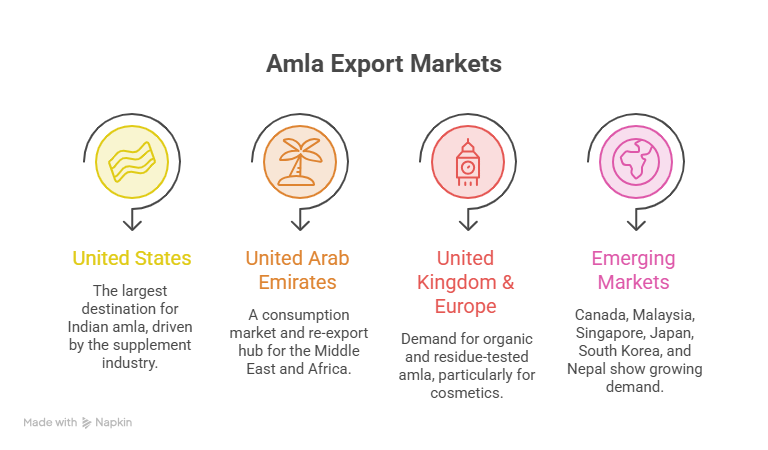
Emerging & Niche Amla Export Countries
Beyond the big three, the data reveals interesting pockets:
- Canada — steady demand in the supplement and health-food channel.
- Malaysia, Bangladesh, Sri Lanka — these dominate the amla extract trade under HSN 1302, with Malaysia taking around 30% of that specific category.
- Singapore — a re-export and premium retail node, often in the top three for the broad amla category.
- Japan & South Korea — growing amla powder importers, drawn by the clean-label functional food trend.
- Nepal — a notable regional buyer of amla powder.
Here’s a comparison of amla export countries by product focus:
| Market | Best-Fit Amla Product | Key Demand Driver | Entry Difficulty |
| United States | Powder, extract | Supplement industry | High (strict food safety) |
| UAE | Powder, fresh, juice | Diaspora + re-export | Low–Medium |
| United Kingdom | Organic powder, cosmetic | Premium, organic demand | High (organic + residue) |
| Canada | Powder, capsules | Health-food retail | Medium |
| Malaysia | Extract (HSN 1302) | Nutraceutical input | Medium |
| Japan / South Korea | Powder | Functional food trend | Medium–High |
| Bangladesh | Dry amla, extract | Regional processing | Low |
A strategic note. Most exporters chase the US first because the volumes are tempting. But the US is also the most crowded and the most compliance-heavy. If you’re a startup or first-time amla exporter, the UAE and Bangladesh offer gentler entry points where you can build a track record, refine your documentation, and prove reliability — before you take on the American giants.
Gooseberry Export from India: Understanding the Product Spectrum
When buyers say “gooseberry export from India,” they almost always mean amla — Emblica officinalis, the Indian gooseberry. It belongs to the Phyllanthaceae family and grows both wild and cultivated across India and Southeast Asia, including Sri Lanka, Malaysia, Thailand, and parts of China.
But the gooseberry export from India trade isn’t one product. It’s a spectrum, and understanding where your product sits determines your buyer, your price, and your paperwork.
Fresh amla. Whole green fruit, exported chilled or frozen. Lowest processing, lowest margin, shortest shelf life. Demand is mostly diaspora-driven (UAE, UK, Canada). Logistics are the challenge here — cold chain or fast air freight only.
Dried amla / amla flakes. Sun-dried or dehydrated amla slices. Longer shelf life, easier to ship, used as an ingredient by food processors and Ayurvedic manufacturers. Bangladesh is a notable buyer of dry amla.
Amla powder. The volume king. Finely milled dried amla, this is the most-exported value-added form. Used in supplements, capsules, hair oils, and herbal blends. The US, UK, Canada, Japan, and South Korea all import meaningfully.
Amla juice & concentrate. Liquid form, popular in the health-drink and functional-beverage space. Requires proper food-grade packaging and cold logistics.
Amla extract (standardised). The premium tier. Standardised to specific tannin or vitamin C content, this commands the highest margins. Travels under HSN 1302. Buyers are nutraceutical formulators in Malaysia, the US, and Europe.
Amla cosmetic-grade material. For the beauty industry — hair care especially. Classified under cosmetic HS codes, sold to formulators worldwide.
The lesson? Gooseberry export from India rewards specialisation. Pick a form. Master its quality spec, its HS code, and its target market. Trying to be everything to everyone is how exporters spread thin and lose buyers.
Top Amla Exporters in India: Who’s Leading the Trade
Let’s talk about the amla exporters in India who set the benchmark. The market has a mix of large processors, established Ayurvedic houses, and a long tail of specialised SME exporters.
Among the major amla export companies frequently cited in trade data:
- Vidya Herbs Pvt. Ltd. — A heavyweight in herbal extracts and standardised botanicals, including amla extract for global nutraceutical buyers.
- Dabur India Ltd. — One of India’s largest Ayurvedic and consumer goods companies, with amla deeply embedded in its product portfolio and export operations.
- Arjuna Natural Extracts Ltd. — Known for standardised herbal extracts and a strong international client base in the supplement space.
Beyond these names, the broader landscape of amla exporters in India includes hundreds of SME players. Under the amla powder HSN 1211 category alone, around 179 Indian exporters served 425 buyers in a single twelve-month window. That’s a fragmented, competitive, opportunity-rich field.
What separates the winning amla exporters from the rest? A few things, and none of them are glamorous:
Consistency of supply. Buyers hate surprises. The exporters who hold contracts are the ones who deliver the same spec, month after month, without drama.
Certification depth. Organic certification, residue testing, GMP/HACCP, ISO — the more boxes you tick, the more premium markets open up. The exporters winning US and EU business are the certified ones.
Documentation discipline. Correct amla HS code classification, clean phytosanitary certificates, valid certificates of origin. Sloppy paperwork kills deals.
Direct buyer relationships. The best amla exporters in India don’t rely solely on middlemen. They build direct relationships, often through B2B platforms and verified trade data.
Major export ports for amla include JNPT (Nhava Sheva), Bangalore (air cargo), and Cochin. The choice of port depends on your product form and destination — perishable fresh amla often moves by air, while powder and extract ship in containers.
How to Start Amla Export from India: A Practical Roadmap
Thinking of entering the amla export trade? Here’s the no-fluff sequence. I’ve seen too many new exporters skip steps and pay for it later.
Step 1 — Get your IEC. You cannot legally export from India without an Importer Exporter Code from the DGFT. This is non-negotiable and the first thing to sort.
Step 2 — Nail your product and HS code. Decide your amla form — powder, extract, dried, fresh. Then lock the correct amla HSN code. As covered above, this single decision shapes your duty, incentives, and documentation.
Step 3 — Build certification. Depending on your target amla export countries, secure the relevant certifications: organic (for EU/US), GMP/HACCP (for food-grade), phytosanitary (almost always), and certificate of origin. Don’t treat these as afterthoughts.
Step 4 — Find verified buyers. This is where amla export data leads come in. Use trade intelligence to identify active importers in your target market, then reach out directly. More on this below.
Step 5 — Sort logistics and packaging. Match your packaging to the product. Vacuum-sealed, food-grade, moisture-controlled for powder. Cold chain for fresh. Get your port and freight forwarder lined up early.
Step 6 — Comply, comply, comply. Correct HS classification, food safety certification, residue limits matching the destination country, accurate labelling. Compliance isn’t bureaucracy — it’s what gets you into premium markets and keeps you there.
One opinion I’ll stand behind: the exporters who treat compliance as a competitive advantage, rather than a cost, are the ones who win the durable contracts. Cutting corners on certification might save money today and lose you the buyer tomorrow.
Finding Amla Export Data Leads That Convert
Here’s the part that actually moves revenue. Amla export data leads — verified, current information on who’s importing amla, in what volume, from where, at what price.
Raw shipment data is everywhere. The skill is turning it into leads. A useful approach:
Filter by HS code, not just product name. Searching “amla” gives you noisy, broad results. Searching by a specific amla HS code — say 12119029 for powder or 1302 for extract — surfaces precise, relevant buyer records. Always classify first.
Match buyer to product form. An importer sourcing amla extract under HSN 1302 in Malaysia is a completely different lead than one buying bulk powder under HSN 1211 in the US. Don’t pitch the wrong product to the right buyer.
Look at frequency, not just one-off shipments. A buyer who imports amla every month is a far better lead than one with a single recorded shipment. Repeat importers signal stable, ongoing demand.
Cross-reference multiple data sources. No single platform captures everything. Combining shipment records, B2B marketplace listings, and direct buyer outreach gives you the fullest picture of amla export data leads.
This is exactly where a B2B trade platform earns its keep. On VyaaparOne, exporters can access structured trade intelligence, connect with verified amla importers across global markets, and turn fragmented shipment records into actionable amla export data leads — all in one place. Instead of scraping data from five sources and guessing, you get qualified buyer intent mapped to your product and your target amla export countries.
Challenges in Amla Export from India (And How to Handle Them)
No trade is friction-free. Amla export from India has its share of hurdles, and pretending otherwise helps nobody.
Quality consistency. Amla quality varies by region, season, and processing. Buyers want a stable spec — same vitamin C content, same moisture level, same colour. Inconsistency is the fastest way to lose a contract. Fix: standardise your sourcing and processing, and test every batch.
Residue and food-safety compliance. Premium markets — the US, EU, Japan — enforce strict pesticide residue limits. A single failed test can blacklist a shipment. Fix: residue testing before export, organic sourcing where possible, and full traceability.
Price competition. With hundreds of amla exporters in India, the bulk-commodity end of the market is brutally price-competitive. Fix: move up the value chain. Standardised extract and certified organic powder command far better margins than raw dried amla.
Logistics for perishables. Fresh amla is fragile and short-lived. Cold chain failures ruin shipments. Fix: prioritise dried, powder, and extract forms unless you have airtight cold logistics.
Documentation errors. Wrong amla HSN code, expired certificates, mismatched declarations — these cause customs delays and incentive-claim rejections. Fix: work with an experienced CHA and keep your paperwork meticulous.
The exporters who thrive aren’t the ones who avoid these challenges. They’re the ones who build systems to manage them — and then market that reliability to buyers.
The Future of Amla Export from India
Where’s this trade heading? Up, broadly — but with a shift in mix.
The volume story will keep growing as global health and wellness demand expands. But the real value growth lies in processed, certified, value-added amla. The world doesn’t just want Indian amla anymore — it wants standardised, organic, traceable Indian amla. That’s where margins live, and that’s where smart exporters are moving.
Three trends to watch:
The nutraceutical boom continues. Standardised amla extract for capsules and functional foods is the fastest-growing high-value segment, and India’s extract capacity is expanding to meet it.
Organic and clean-label demand intensifies. EU and US buyers increasingly demand certified-organic, residue-free amla. Exporters who invest in certification now will own these markets later.
Cosmetic-grade amla rises. As natural and Ayurvedic beauty goes mainstream globally, demand for cosmetic-grade amla material is climbing steadily.
India’s structural advantages — 75% of global production, deep Ayurvedic heritage, established processing infrastructure, and improving export compliance — mean it will remain the world’s anchor amla supplier for the foreseeable future. The opportunity for exporters isn’t going anywhere. The question is whether you position for the commodity end or the premium end.
My take? Go premium. The commodity race is a margin grinder. The certified, value-added, well-documented end of amla export from India is where durable businesses get built.
Amla Export from India by Product Form: Pricing, Margins & Buyer Profiles
Let’s get specific about money. Because amla export from India means very different economics depending on what exactly you’re shipping. A container of raw dried amla and a drum of standardised extract might both say “amla” on the invoice — but they live in different financial universes.
Understanding these tiers is how you decide where to compete. I’ve watched exporters chase the wrong tier for years, grinding away at razor-thin commodity margins when a small pivot upmarket would have tripled their returns. So here’s the breakdown.
Tier 1 — Raw & Dried Amla (Commodity)
This is the entry floor of the trade. Fresh fruit, sun-dried slices, basic dehydrated amla. Processing is minimal, the barrier to entry is low, and so is the margin. You’re competing on price, sourcing efficiency, and logistics.
Buyer profile: food processors, mid-tier Ayurvedic manufacturers, regional importers in Bangladesh, Nepal, and the UAE who do their own downstream processing. They buy in bulk, they negotiate hard, and they switch suppliers over small price gaps.
If you’re starting out, this tier is a reasonable place to learn the ropes of exporting — paperwork, ports, freight, buyer communication. Just don’t expect to get rich here. Treat it as training, then climb.
Tier 2 — Amla Powder (Value-Added Volume)
The sweet spot for most serious exporters. Amla powder under HSN 1211 and 12119029 is the volume backbone of amla export from India, and the margins are meaningfully better than raw forms. Buyers want consistent mesh size, stable vitamin C content, low moisture, and clean microbial counts.
Buyer profile: supplement brands in the US, UK, and Canada; functional-food formulators in Japan and South Korea; hair-care and cosmetic manufacturers globally. These buyers value reliability over rock-bottom price — which means a well-run powder operation can hold contracts and pricing power.
This is where the bulk of profitable amla export from India happens. Get your quality spec airtight, get certified, and this tier rewards you.
Tier 3 — Standardised Extract & Cosmetic-Grade (Premium)
The top of the pyramid. Standardised amla extract under HSN 1302, cosmetic-grade material under HSN 33049990, and pharmaceutical-adjacent preparations under HSN 3004. Here you’re selling to nutraceutical formulators and beauty houses who care about standardised active content — specific tannin percentages, certified vitamin C levels, full traceability.
Buyer profile: global nutraceutical labs (Malaysia, US, Europe), premium cosmetic brands, pharmaceutical ingredient buyers. Volumes are smaller, but margins are the strongest in the entire amla export from India spectrum.
The honest truth? This tier has a real moat. The certification, the standardisation equipment, the lab capability — they take investment and time to build. But once you’re in, competition thins out dramatically. Few amla exporters in India can credibly serve this segment, and that scarcity is exactly what protects your pricing.
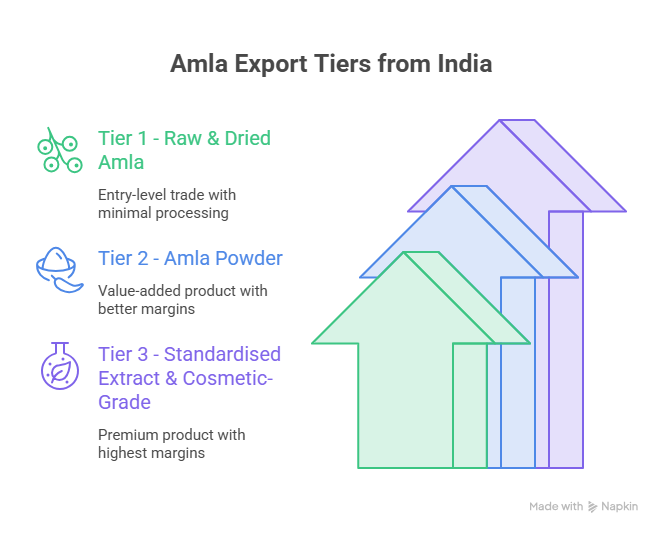
Here’s how the three tiers compare:
| Tier | Product Form | Typical Buyer | Margin Profile | Entry Barrier |
| Commodity | Fresh, dried amla | Regional processors | Low / price-driven | Low |
| Value-Added | Amla powder (1211) | Supplement brands | Medium–Strong | Medium |
| Premium | Extract, cosmetic-grade | Nutraceutical/beauty labs | Strongest | High |
The strategic read here is simple. Start where you can, but always be climbing. The commodity floor is crowded and unforgiving. The premium ceiling is defended but profitable. Your long-term plan should always point upward.
How Amla Export from India Compares to Other Agri-Exports
It helps to zoom out. Where does this trade sit relative to India’s other botanical and agri-commodity exports? Understanding the comparison sharpens your strategy — and your pitch to buyers.
Amla shares a lane with India’s other “superfood and herbal” exports — moringa, turmeric, neem, ashwagandha, and similar botanicals. What sets amla apart is the unusually high concentration of global production in India (roughly 75%) combined with deep Ayurvedic provenance. Turmeric has more competing origins. Moringa is more fragmented globally. Amla, by contrast, gives Indian exporters a near-origin-monopoly story that buyers genuinely value.
That provenance angle is underrated. When a US supplement brand markets “Indian gooseberry sourced from its native home,” that’s not just copywriting — it’s a sourcing decision driven by authenticity. Amla export from India carries a story that South African or other-origin gooseberry simply can’t match. Lean into it.
Compared to bulk grain or oilseed exports, amla operates at lower volume but higher value per kilogram, especially in extract form. That changes the game. You don’t need massive scale to build a profitable amla export from India business — you need quality, certification, and the right buyers. A focused SME can absolutely win here in a way that’s much harder in, say, wheat or rice.
The flip side: amla demand, while growing, is more niche than staple commodities. Your buyer base is the global wellness, supplement, and cosmetic industries — not mass food consumption. That’s why targeting matters so much. Generic outreach wastes effort. Precise, HS-code-filtered amla export data leads are what actually convert in this category.
State-Wise & Port-Wise View of Amla Export from India
Geography matters more than new exporters expect. This trade has clear regional anchors, both in production and in shipping.
On production, Uttar Pradesh leads decisively, contributing close to 35% of national amla output. The belt around Pratapgarh in UP is particularly famous for amla cultivation — it’s practically synonymous with the fruit. Other meaningful producing states include Rajasthan, Madhya Pradesh, Gujarat, Tamil Nadu, and Maharashtra. If you’re sourcing for amla export from India, proximity to these belts cuts your input costs and improves freshness.
On shipping, the major export gateways are:
- JNPT (Nhava Sheva), Maharashtra — the dominant container port for powder and extract heading to the US, Europe, and the Gulf.
- Cochin, Kerala — strong for South Indian processors and extract shipments.
- Bangalore (air cargo) — used for higher-value, time-sensitive amla extract and premium powder, especially to long-haul markets.
- Mundra & Pipavav, Gujarat — increasingly used for western-India sourced amla bound for the Middle East and beyond.
The takeaway: align your sourcing region, your processing location, and your export port. An exporter sourcing from UP and shipping powder via JNPT runs a tighter, cheaper operation than one fighting against geography. Small logistics efficiencies compound across a year of amla export from India shipments.
Building Buyer Trust in Amla Export from India
Data gets you the lead. Trust closes the deal. And in amla export from India, trust is built on a few unglamorous fundamentals that separate the exporters who hold long-term contracts from those forever chasing one-off orders.
First, sample integrity. Your export sample must exactly match your bulk shipment. Nothing destroys a buyer relationship faster than a beautiful sample followed by a disappointing container. Serious amla exporters in India treat sample-to-bulk consistency as sacred.
Second, transparent specifications. Share your full product spec upfront — vitamin C content, moisture, mesh, microbial limits, residue test results. Buyers in premium amla export countries respect exporters who lead with documentation rather than dodging questions about it.
Third, responsive communication. Time-zone gaps are real in amla export from India, with buyers in the US, UK, and East Asia. The exporters who answer fast, confirm clearly, and flag problems early earn repeat business. The ones who go silent lose it.
Fourth, certification proof. Don’t just claim organic or GMP — show the certificates. In the trust economy of amla export from India, verifiable proof beats every sales pitch.
None of this is complicated. But it’s astonishing how many exporters neglect it and then wonder why buyers don’t return. Get these fundamentals right and you’ll outcompete flashier rivals who can’t deliver consistency.Reading Amla Export Data Correctly: A Practitioner’s Guide
Trade data is powerful — and easy to misread. I’ve seen exporters make six-figure decisions off a single misunderstood shipment chart. So before you bet on a market, here’s how to interpret amla export data the way an experienced trade analyst would.
Start with the time window. Every dataset covers a specific period — TTM (trailing twelve months), a fiscal year, a single month. A “200% YoY change” sounds explosive until you realise the base was three shipments. Always check the absolute numbers behind the percentages. Small-base swings look dramatic but mean little. Large, stable flows mean everything.
Next, separate shipment count from value. Twenty shipments of cheap dried amla might be worth far less than five shipments of standardised extract. When you read amla export data, ask whether you’re looking at volume, count, or dollar value — they tell different stories. For margin-focused decisions, value-per-shipment matters more than raw shipment count.
Watch the HS code grouping. As we covered, amla scatters across many codes. A dataset labelled “amla” might capture only one code and miss the rest. The broad amla powder figures under 1211 look very different from the narrow 12119029 slice. When comparing across sources, confirm they’re measuring the same classification. Otherwise you’re comparing apples to — well, gooseberries.
Then there’s the concentration signal. The data repeatedly shows demand concentrated in a few markets — the US dominating broad amla, Malaysia leading extract, Bangladesh anchoring dry amla. High concentration is both a risk and an opportunity. Risk: over-reliance on one market is fragile. Opportunity: you know exactly where to aim. Smart exporters use concentration data to pick a beachhead market, win it, then diversify.
Finally, treat data as a starting point, not gospel. Shipment records have lags, gaps, and classification quirks. The best use of trade intelligence isn’t to predict the future precisely — it’s to narrow your focus, validate a hunch, and generate qualified leads worth pursuing. Combine the numbers with direct buyer conversations and you’ll make far better calls than data alone or instinct alone ever could.
Certifications & Compliance Deep-Dive
Compliance is where premium amla trade is won or lost, so it deserves more than a passing mention. Let me lay out what actually matters, market by market, because the requirements aren’t uniform.
For the United States, the FDA framework governs food and supplement imports. Your amla needs to meet food-safety standards, and for the supplement channel, buyers increasingly expect documentation around identity, purity, and contaminant testing. Heavy-metal and pesticide residue testing is effectively mandatory for serious buyers. Organic certification (USDA NOP or an equivalent recognised under the India-US organic arrangement) unlocks the premium organic shelf.
For the European Union and UK, the bar is arguably the highest. Strict maximum residue limits, comprehensive contaminant testing, and EU organic certification for the organic segment. Documentation must be impeccable. European buyers also lean heavily on traceability — they want to know which farm, which batch, which process. Exporters who can provide farm-to-port traceability have a real edge here.
For the Gulf and Middle East, requirements are generally more accessible, though Halal certification can matter for certain product categories and buyers. The UAE’s role as a re-export hub means goods may need to satisfy onward-market requirements too.
For Japan and South Korea, food-safety and residue standards are stringent, comparable to the EU in rigour. Clean-label and contaminant-free documentation is essential for these growing functional-food markets.
Across all markets, certain documents are near-universal for botanical exports: a phytosanitary certificate (confirming the goods are pest-free), a certificate of origin (establishing Indian provenance, sometimes needed for preferential duty), and for processed forms, GMP and HACCP documentation demonstrating controlled manufacturing.
The mistake I see constantly? Exporters treat certification as a box-ticking chore to be done at the last minute. Wrong frame entirely. Certification is a market-access key and a marketing asset. The exporter who walks into a buyer conversation already holding organic, GMP, HACCP, and full residue reports projects a completely different level of seriousness than one promising to “arrange it later.” Invest early. It pays.
Common Mistakes New Exporters Make
A short, blunt list — because avoiding these saves real money and heartache.
Chasing the biggest market first. Newcomers fixate on the US because the volume looks irresistible. But it’s also the most compliance-heavy and competitive arena. Cutting your teeth in a gentler market first builds the track record and systems you’ll need to eventually win American buyers.
Misclassifying the HS code. We’ve hammered this point, but it bears repeating because the cost is so high — customs delays, wrong duty, forfeited incentives. Confirm classification with a professional before your first shipment.
Underinvesting in quality control. One bad batch can end a relationship that took months to build. Batch testing isn’t optional; it’s the cost of staying in business.
Ignoring packaging. Powder absorbs moisture. Extract degrades with poor handling. Fresh fruit spoils. Packaging matched to the product form isn’t a detail — it’s the difference between a happy buyer and a claim against your shipment.
Going silent under pressure. When a problem arises — a delay, a spec issue — the instinct to go quiet is the worst possible move. Buyers forgive problems handled transparently. They don’t forgive being left in the dark. Over-communicate, especially when things go wrong.
Relying on a single buyer. One big buyer feels like security until they leave, and suddenly your whole business wobbles. Build a diversified buyer base from the start, even if it’s slower. Resilience beats a fragile windfall.
Amla Export Data from India: Turning Insight into Action
So you’ve absorbed the data, mapped the codes, and identified your markets. What now? The gap between knowing and earning is execution — and this is where most exporters stall.
Pick one product form and one beachhead market. Resist the urge to chase everything at once. If the amla export data from India points you toward powder demand in the US, commit to that. Build the spec, secure the certifications that market demands, and go deep rather than wide. Focus compounds; scatter dilutes.
Validate demand with real conversations, not just charts. Trade data shows you who imported what and when. It doesn’t show you who’s actively sourcing right now, or what spec they need next quarter. Use the data to build a shortlist, then reach out directly. A ten-minute call with a live buyer is worth more than a week of staring at shipment records.
Price for your tier, not against the floor. Newcomers reflexively undercut to win their first order, then get trapped at unsustainable margins. Anchor your pricing to the value you deliver — certified, consistent, well-documented amla commands a premium, and buyers in serious markets will pay it. Don’t race to the bottom of a market where the top is far more comfortable.
Track your own performance like you track the market. Which buyers reorder? Which markets pay best? Which product spec gets the fewest complaints? Your internal data becomes your sharpest competitive tool over time — sharper, eventually, than any external dataset.
And stay close to the numbers. Trade flows shift. New markets open, residue rules tighten, demand migrates between product forms. The exporters who keep monitoring amla export data — refreshing their buyer lists, watching destination shifts, spotting emerging markets early — are the ones who adapt before their competitors even notice the change. In a trade this dynamic, standing still is moving backward.
Final Thoughts
Amla export from India sit at a sweet spot — a product India dominates, a market growing worldwide, and a value chain with room to move upmarket. The amla export data is clear: demand is rising, the US and Gulf anchor the buyer base, and India’s supply position is unmatched.
To win in this trade, get three things right. Classify your product under the correct amla HSN code. Target the right amla export countries for your specific form. And source verified amla export data leads instead of cold-pitching blind.
Whether you’re an established processor or a first-time exporter, the gooseberry export from India opportunity is real and durable. The exporters who pair quality and compliance with smart, data-driven buyer targeting are the ones who’ll own the next decade of this trade.
Ready to find verified amla buyers and trade data? Explore VyaaparOne to connect with global importers and access the trade intelligence that turns amla export from India into a thriving business.