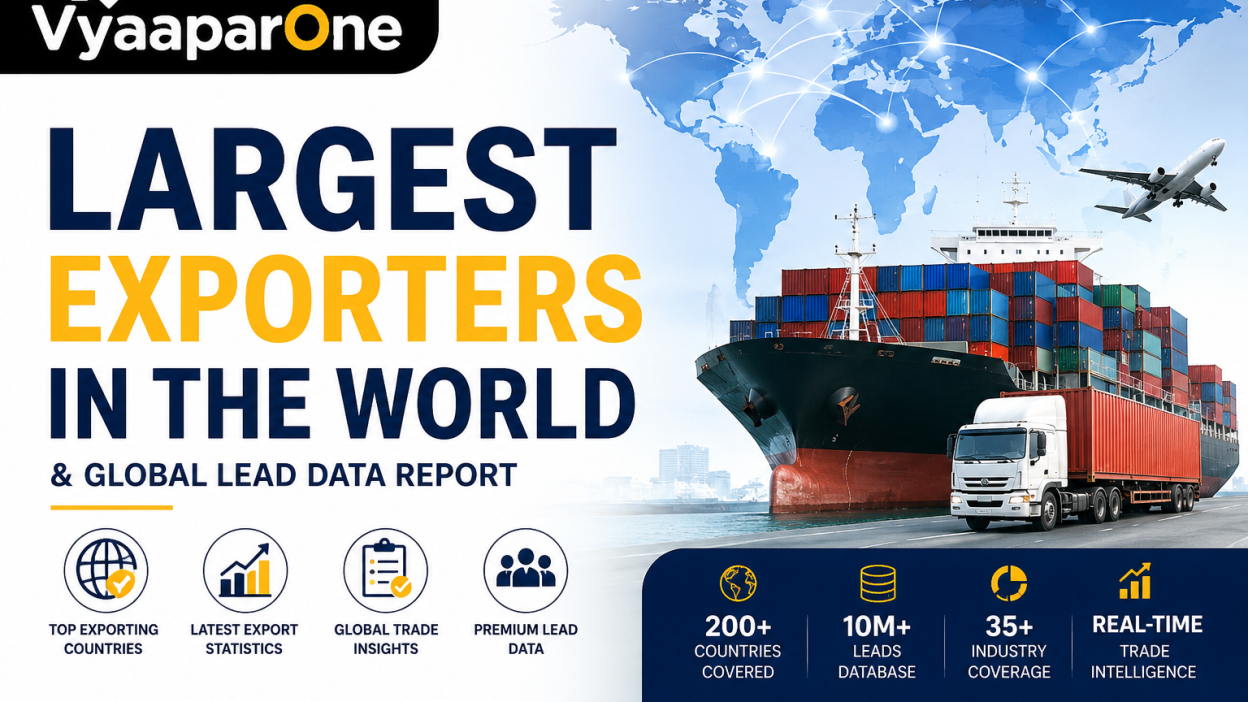
Global trade feels a lot like a giant highway system where products, machinery, electronics, chemicals, vehicles, and raw materials move across borders every second. Some countries dominate these trade highways so strongly that their exports shape the global economy itself. From China’s manufacturing power to Germany’s engineering excellence and the United States’ technology driven exports, the Largest Exporters In The World continue to influence industries, supply chains, and international business opportunities.
For importers, wholesalers, sourcing companies, logistics firms, and B2B marketers, understanding the World’s biggest exporters is more than just economic curiosity. It helps businesses identify profitable sourcing destinations, understand demand patterns, and generate accurate Lead data for international trade expansion.
Recent global trade reports show that world merchandise exports remain heavily concentrated among a few economies. China continues to lead with exports worth nearly $3.8 trillion, while the United States and Germany maintain strong positions in technology, industrial machinery, and automotive exports.
Understanding Global Export Markets
The global export market operates like an interconnected web where one country’s production powers another country’s consumption. A smartphone designed in the United States may contain semiconductors from Taiwan, batteries from South Korea, assembly operations in China, and logistics support from Singapore or the Netherlands.
Trade rankings matter because they reveal where manufacturing strength, and logistics efficiency are concentrated. Businesses looking for suppliers often analyze the world largest exporter country rankings to identify sourcing opportunities. Investors also monitor export performance because countries with strong export sectors usually attract industrial investments, infrastructure growth, and higher employment levels.
The importance of Lead data has grown rapidly alongside globalization. Companies no longer rely solely on trade fairs or local distributors. Instead, they use export databases, customs records, and B2B intelligence tools to identify verified buyers and suppliers. A furniture importer in Canada, for example, may search shipping databases to find manufacturers in Vietnam or China with proven export records.
Top 10 Largest Exporters In The World
The rankings of the Largest Exporters In The World continue to evolve, but a handful of countries consistently dominate global trade due to their manufacturing capacity, logistics infrastructure, and economic scale.
Comparison Table of Top Exporters
| Rank | Country | Export Value (USD Billion) | Major Export Sectors |
|---|---|---|---|
| 1 | China | 3,772 | Electronics, Machinery, Textiles |
| 2 | United States | 2,185 | Technology, Aircraft, Chemicals |
| 3 | Germany | 1,764 | Automotive, Machinery |
| 4 | Netherlands | 989 | Logistics, Chemicals |
| 5 | Hong Kong | 754 | Electronics Re-export |
| 6 | Japan | 738 | Vehicles, Robotics |
| 7 | Italy | 726 | Fashion, Machinery |
| 8 | South Korea | 709 | Semiconductors |
| 9 | UAE | 707 | Oil, Gold, Re-export |
| 10 | France | 683 | Aerospace, Luxury Goods |
China – The Undisputed Export Giant
China remains the leader among the Largest Exporters In The World with exports crossing $3.7 trillion. The country built its export dominance through decades of industrialization, infrastructure development, and manufacturing specialization. China exports almost everything imaginable, from smartphones and consumer electronics to industrial machinery and furniture.
What makes China unique is scale. Massive industrial zones, efficient ports, and integrated supply chains allow Chinese manufacturers to produce goods at competitive prices. Cities like Shenzhen, Guangzhou, and Shanghai have become global manufacturing hubs where innovation meets production efficiency.
China’s export relationships also extend across Africa, Europe, Southeast Asia, and Latin America. Even amid geopolitical tensions and tariffs, global dependence on Chinese manufacturing remains significant. Analysts note that China’s growing role in electric vehicles, renewable energy products, and battery technology could strengthen its export dominance even further.
United States – Technology and High-Value Exports
The United States ranks second among the World’s biggest exporters and remains a powerhouse in high-value industries. Unlike China’s volume-based manufacturing strategy, the U.S. focuses heavily on innovation-driven exports such as aerospace equipment, software-related products, pharmaceuticals, chemicals, and advanced machinery.
American companies benefit from strong intellectual property systems and research-driven industries. Firms in Silicon Valley, Texas, and the Midwest continue to shape global demand for technology and industrial products. Aircraft exports from Boeing, agricultural exports from the Midwest, and semiconductor-related technology exports remain globally influential.
The U.S. also plays a major role in agricultural exports, supplying soybeans, corn, meat products, and wheat to countries worldwide. Recent trade discussions between the U.S. and China show how agricultural exports continue to influence global trade dynamics.
Germany – Europe’s Manufacturing Engine
Germany has long been recognized as one of the top exporters in the world because of its engineering precision and industrial excellence. German products are often associated with durability, innovation, and premium quality.
The automotive industry remains Germany’s export backbone. Brands like BMW, Mercedes-Benz, Volkswagen, and Audi dominate international markets. Germany also excels in industrial machinery, chemicals, and renewable energy technologies.
One interesting aspect of Germany’s trade model is its strong connection with China and the United States. Trade data indicates that China remains Germany’s largest trading partner, although export patterns are shifting due to changing economic conditions.
Netherlands – The Trade Gateway of Europe
The Netherlands may not have the population size of China but it consistently ranks among the biggest export countries because of its logistics infrastructure. The Port of Rotterdam acts like Europe’s commercial heartbeat, processing enormous cargo volumes every year.
Dutch exports include chemicals, food products, machinery, and re-exported goods entering Europe through Rotterdam. The country’s strategic location and transportation efficiency allow it to punch far above its weight in international trade.
Japan – Innovation and Precision Manufacturing
Japan’s export economy revolves around innovation, robotics, automotive engineering, and advanced electronics. Companies like Toyota, Sony, Panasonic, and Hitachi helped establish Japan as a global industrial leader.
Japanese exports are known for precision and quality. The country also leads in robotics technology, which supports manufacturing industries worldwide. Japan’s ability to combine traditional craftsmanship with advanced technology gives it a unique export advantage.
South Korea – Semiconductor Superpower
South Korea’s export rise has been extraordinary. Semiconductor giants like Samsung and SK Hynix turned the country into a global technology hub. Electronics, semiconductors, ships, and vehicles dominate Korean exports.
The semiconductor industry especially positions South Korea among the Largest Exporters In The World because modern industries depend heavily on chips for smartphones, vehicles, AI systems, and industrial automation.
Italy – Luxury Meets Industrial Excellence
Italy blends industrial capability with luxury branding. Fashion houses, machinery manufacturers, and automotive firms contribute significantly to exports. Italian products often carry emotional value because they combine craftsmanship with heritage.
Machinery, pharmaceuticals, luxury fashion, and food products such as olive oil and wine continue driving Italy’s export performance.
United Arab Emirates – The Re-export Hub
The UAE transformed itself into a global trade gateway through infrastructure investments and business-friendly policies. Dubai’s ports and logistics systems support massive re-export operations connecting Asia, Africa, and Europe.
Oil exports remain important, but gold trading, electronics, and logistics services also strengthen the UAE’s export economy.
France – Aerospace and Luxury Leadership
France dominates aerospace exports through Airbus while also excelling in luxury goods, cosmetics, and agricultural products. French exports combine innovation with branding power, creating strong international demand.
India – Rising Export Powerhouse
India has emerged rapidly among the top exporters in the world. Pharmaceuticals, IT-related services, engineering products, textiles, and petroleum products drive export growth.
India’s expanding manufacturing sector, government incentives, and growing digital infrastructure are attracting international buyers. Export growth in electronics and smartphone manufacturing suggests India could climb higher in global rankings during the next decade.
Industries Dominating Global Exports
Certain industries dominate international trade because they connect directly with industrialization, consumer demand, and technological progress.
| Industry | Leading Exporting Countries | Key Products |
|---|---|---|
| Electronics | China, South Korea, Taiwan | Smartphones, Chips |
| Automotive | Germany, Japan, USA | Cars, Vehicle Parts |
| Oil & Energy | UAE, Saudi Arabia, Russia | Crude Oil, Gas |
| Machinery | Germany, China, Italy | Industrial Equipment |
| Pharmaceuticals | USA, India, Switzerland | Medicines, Vaccines |
Role of Lead Data in Export Businesses
Without accurate Lead data, international trade becomes like fishing in the ocean without a map. Businesses need verified buyer and supplier information to reduce risks and improve efficiency.
Global trade databases help companies identify:
- Verified importers and exporters
- Shipment volumes
- Product demand trends
- Competitor activity
- Market expansion opportunities
Emerging Trends Among Top Exporters In The World
The future of the Largest Exporters In The World will depend heavily on technology, sustainability, and supply chain adaptation.
Supply Chain Diversification
Businesses learned painful lessons from supply chain disruptions during recent years. Many companies are now diversifying suppliers across multiple countries instead of relying on a single manufacturing hub.
Vietnam, India, Mexico, and Southeast Asian countries are benefiting from this shift because businesses want alternative sourcing destinations alongside China.
Sustainability and Green Trade
Green energy products are becoming major export categories. Solar panels, EV batteries, renewable energy systems, and sustainable materials are expected to drive future export growth.
Countries leading in renewable technologies may become the next generation of world largest exporter leaders.
How Businesses Can Benefit From Global Trade Intelligence
Trade intelligence is no longer limited to multinational corporations. Small and medium-sized businesses now use export databases and market analytics to compete globally.
Businesses can benefit through:
- Better supplier verification
- Faster market expansion
- Reduced sourcing risks
- Improved pricing analysis
- Competitor tracking
- Enhanced customer targeting
Why Export Rankings Keep Changing
Export rankings shift because economies evolve constantly. Technological breakthroughs, geopolitical conflicts, free trade agreements, labor costs, currency movements, and consumer demand all influence export performance.
For example, China strengthened its position through manufacturing scale, while Germany built its export reputation through engineering precision. India’s export rise is linked to digital transformation and manufacturing growth, whereas the UAE leveraged logistics and geographic positioning.
Read This Blog Also- Cow Dung Export From India Latest Trade Data Report
After Word
The Largest Exporters In The World continue shaping global commerce through manufacturing power, logistics infrastructure, innovation, and trade strategy. China leads the rankings with unmatched manufacturing scale, while the United States, Germany, Japan, and South Korea maintain strong positions through technology and industrial expertise.
The future of global trade will likely revolve around AI-driven manufacturing, sustainable exports, and diversified supply chains.
One company helping businesses access valuable trade insights and export intelligence is VyaaparOne, which focuses on global trade data and international business solutions for import-export growth.