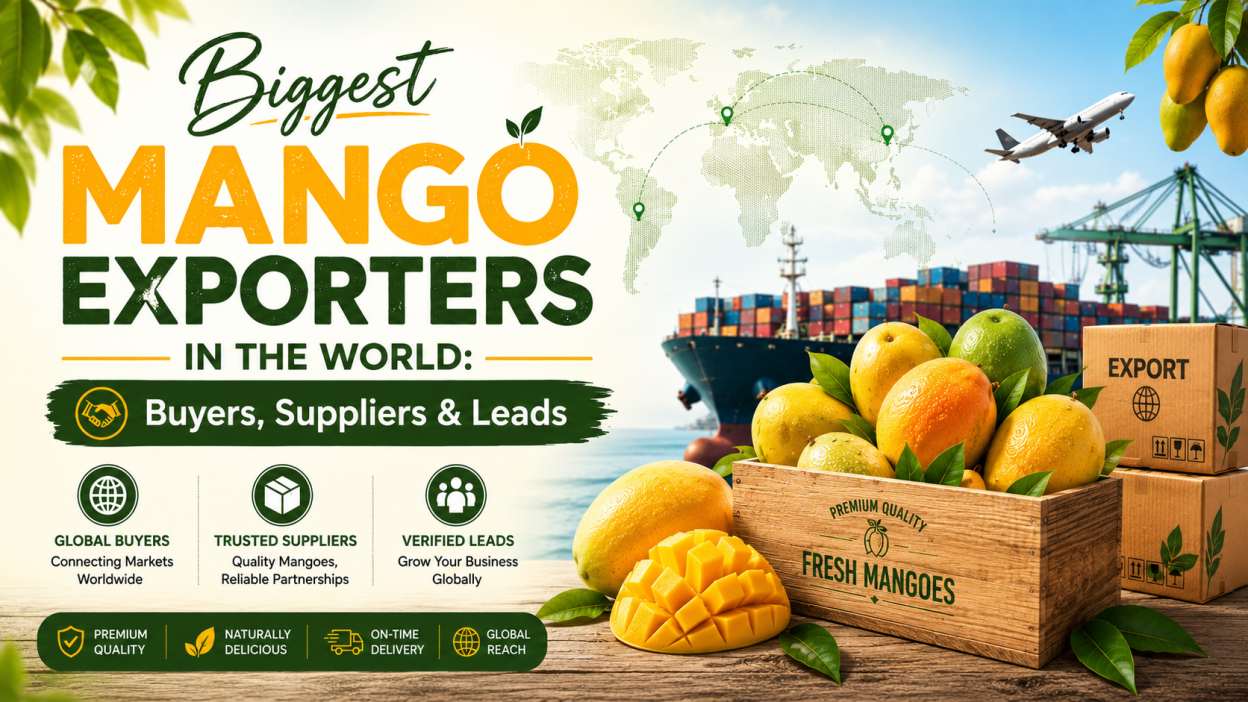
Mango exporters in Mexico, India, Thailand, Peru, and a dozen other origin countries are now chasing a global mango trade worth more than $2.5 billion, and the first question every new buyer asks is who actually holds the title of biggest mango exporter in the world. The answer shifts depending on whether you’re measuring shipped tonnage, export revenue, or premium per-kilo pricing. Mexico ships the largest physical volume to North America. India, the world’s biggest mango producer, exports a smaller volume but earns far higher prices on varieties like Alphonso and Kesar. This guide names the biggest mango exporter by both metrics, walks through verified mango export data, ranks the top mango exporter countries by volume and value, explains the mango HS code system customs authorities use worldwide, and shows both buyers and suppliers exactly where to source live mango import leads and mango export leads through a B2B trade platform like VyaaparOne.
Global Mango Trade at a Glance
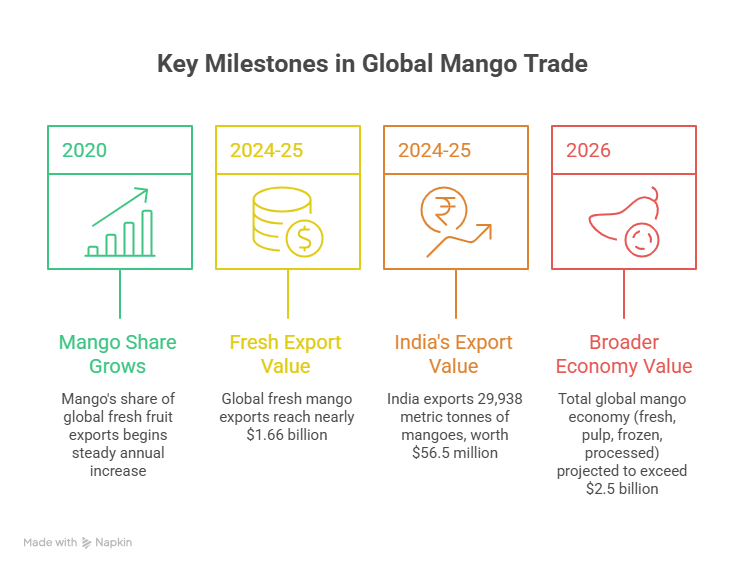
Before crowning a single biggest mango exporter, it helps to see the scale of the market these countries are competing in. The mango trade does not sit still. Total global mango trade value reached close to $1.66 billion in fresh fruit exports in 2024-25, while the broader mango economy — fresh, pulp, frozen, and processed — is now tracked at upward of $2.5 billion in 2026, according to trade intelligence platforms like Tridge and the Observatory of Economic Complexity. Mango holds roughly a 4.6% share of the global fresh fruit export market, a number that has crept up every year since 2020.
A few numbers explain why this category matters so much to importers and suppliers alike:
- India produces over 26 million tonnes of mangoes a year, more than 40% of total global supply, according to Ministry of Agriculture and FAO data.
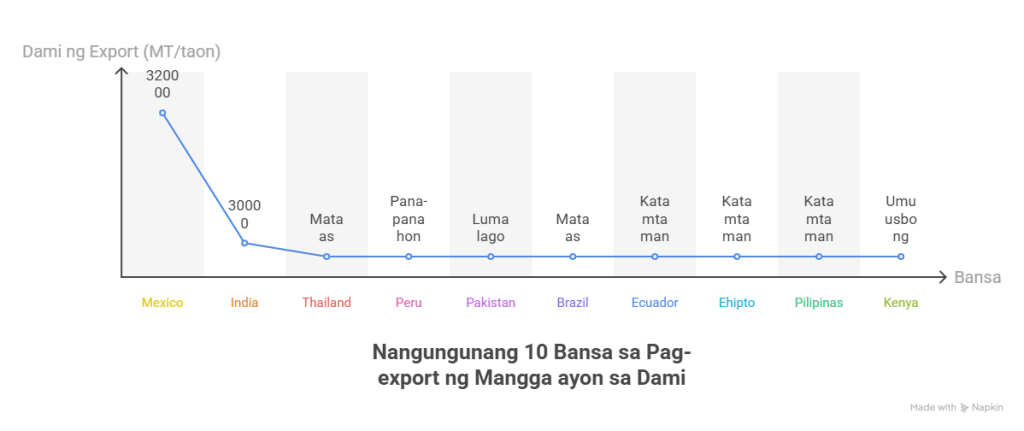
- Mexico exports close to 320,000 metric tons of fresh mangoes annually, mostly to the United States and Canada.
- The United States alone imported mangoes worth $852 million in a single year, sourced primarily from Brazil, Peru, and Mexico.
- India’s mango exports for FY2024-25 touched 29,938 metric tonnes, worth nearly $56.5 million, per APEDA and DGCIS figures.
These numbers matter because they explain the split at the heart of this guide: production leadership and export leadership are not the same thing. Mango exporters that lead on volume are not always the mango exporters who lead on price.
Logistics economics explain a lot of this gap. Sea freight keeps per-unit shipping costs low but adds 10 to 30 days of transit time depending on the route, which only works for varieties with longer shelf life or for pulp and processed formats. Air freight gets a premium fruit like Alphonso onto a London or Dubai shelf within 48 hours of harvest, but the cost per kilogram can run several times higher than sea freight. That single trade-off — speed versus cost — explains why bulk commodity origins like Mexico and Brazil lean on sea and road freight at scale, while origins selling on flavour and provenance, India chief among them, justify the air-freight premium with brand positioning rather than price competition.
Who Is the Biggest Mango Exporter in the World?
Mexico currently holds the title of biggest mango exporter in the world by shipped volume. Proximity to the US market, a mature cold-chain network, and a road-freight corridor that takes mangoes from Mexican orchards to American supermarket shelves in under three days all work in Mexico’s favour. Varieties like Ataulfo, Tommy Atkins, Kent, and Haden travel well and arrive at a price point that retailers in the US and Canada can move at scale.
That said, the gap is narrower than headlines suggest. By production, India is not in serious competition for the title — it simply produces more mangoes than the rest of the world combined ships in exports. By per-kilo export value, India’s GI-tagged Alphonso and Kesar varieties out-earn Mexican fruit several times over.
So when a buyer in Rotterdam or Riyadh asks who is the biggest exporter of mango, the honest answer is two-part: Mexico for bulk commodity supply, India for premium and branded supply. Thailand, Peru, Pakistan, Brazil, Ecuador, Egypt, the Philippines, and Kenya round out the rest of the top 10, each carrying a distinct variety profile and a distinct buyer base.
It’s also worth noting that the title of world’s largest mango exporter can move year to year. Pakistan’s Chaunsa and Anwar Ratol varieties have gained ground in the Middle East and Europe. Vietnam and Cambodia posted some of the steepest year-on-year transaction growth in 2025, according to Tridge market data, hinting at how quickly the ranking of the largest exporter of mango can shift when a new supply corridor opens.
Top 10 Mango Exporting Countries — Volume, Value & Key Markets
| Rank | Country | Export Volume (approx., MT/year) | Key Export Markets | Signature Varieties |
| 1 | Mexico | ~320,000 | USA, Canada, EU | Ataulfo, Tommy Atkins, Kent |
| 2 | India | ~30,000 (fresh) | UAE, USA, UK, Kuwait, Qatar | Alphonso, Kesar, Dasheri, Langra |
| 3 | Thailand | High (processed + fresh) | China, EU, Middle East | Nam Dok Mai, Mahachanok |
| 4 | Peru | Seasonal peak Nov–Jan | USA, Netherlands | Kent, Edward |
| 5 | Pakistan | Growing | Middle East, Europe, Central Asia | Chaunsa, Anwar Ratol, Sindhri |
| 6 | Brazil | High (off-season supplier) | USA, EU | Tommy Atkins, Keitt |
| 7 | Ecuador | Moderate | USA, EU | Tommy Atkins |
| 8 | Egypt | Moderate | EU, Gulf | Sukkary, Fagri Kalan |
| 9 | Philippines | Moderate | Asia-Pacific | Carabao |
| 10 | Kenya | Emerging | Middle East, EU | Apple, Ngowe |
This is where the biggest mango exporter conversation gets interesting for B2B buyers. A sourcing manager building a year-round supply chain rarely picks one country. Brazil and Peru fill the gap when Mexican and Indian seasons end, which is exactly why serious importers run multi-origin sourcing strategies rather than betting on a single biggest mango exporter in the world.
India’s Position: World’s Largest Producer, Premium Exporter
India is not the biggest mango exporter in the world by tonnage, but no conversation about global mango trade is complete without it. India grows more mangoes than any other country on earth, and its export strategy leans hard into quality over quantity.
In FY2024-25, India shipped 29,938.40 metric tonnes of fresh mangoes worth roughly $56.5 million, per APEDA and DGCIS figures. The UAE remains India’s single largest overseas mango market — more than 12,000 metric tonnes worth nearly $20 million moved there in 2024 alone, helped along by government-backed promotion events like Indian Mango Mania 2025 in Abu Dhabi, run in partnership with the Lulu Group and the Indian Embassy.
Two varieties dominate India’s export mix. Alphonso commands premium pricing in the US, UK, and Gulf markets, though its export volume has actually contracted at roughly a 4% CAGR as quality and shelf-life pressures bite. Kesar, priced 40–45% lower than Alphonso, has grown at close to 18% CAGR because it travels better and suits price-sensitive sea-freight corridors to the Middle East. Dasheri, traditionally grown in Uttar Pradesh, opened a new direct air corridor to Dubai in 2025 — a small but telling sign of how India’s exporters keep testing new routes rather than relying on Alphonso alone.
Even though India isn’t the biggest mango exporter by shipped volume, it earns more per kilogram than almost any other origin country on this list — a fact that matters more to premium retail buyers than raw tonnage ever will.
To export mangoes from India, a supplier needs an APEDA-approved packhouse, a phytosanitary certificate from the NPPO, and — for the US market specifically — Cobalt-60 irradiation treatment. These compliance steps are part of why buyers searching for the biggest exporter of mango in India tend to filter hard for verified, export-licensed suppliers rather than approaching growers directly.
Mango Export Data: Trade Value, Volume & Growth Trends
Reliable mango export data is the foundation of any sourcing decision, and the numbers tell a story of steady, broad-based growth rather than a single dominant winner. Global mango trade is projected to grow at a CAGR in the 6–8% range through 2029, driven by rising demand in Europe, North America, and the Gulf, plus expanding e-commerce-led fruit retail.
Tracking which country holds the biggest mango exporter position from one year to the next requires reliable, current trade figures rather than outdated rankings. A few trend lines worth watching:
- Variety-level price shifts: Kesar is gaining share over Alphonso on price; Ivorian mangoes are undercutting Peruvian supply in the Netherlands by $3–4 per kilogram.
- Tariff effects: A 50% US import duty on Brazilian mangoes is reshaping US sourcing toward Mexico and Guatemala.
- New entrants: Vietnam and Cambodia posted some of the fast
- est transaction growth of any origin country in 2025, per Tridge data, though from a smaller base.
- Market concentration: The top 10 countries account for over 85% of global mango trade by value — a useful filter for any buyer trying to shortlist the largest exporter of mango worth approaching first.
This kind of intelligence — pulled from APEDA, DGCIS, Tridge, and global trade observatories — separates a confident purchase order from a guess. Buyers who track it consistently outperform buyers who source on price alone.
Mango HS Code & Customs Classification for Exporters
Every mango shipment that crosses a border gets filed under a mango HS code, and getting it right matters for duty calculation, customs clearance speed, and trade documentation. The internationally recognised classification is 0804.50, which sits under the broader “guavas, mangoes, and mangosteens” heading in the Harmonized System.
A few practical notes for exporters and customs teams working with this code:
- Fresh mangoes, dried mangoes, and mango pulp can carry different sub-classifications depending on the destination country’s tariff schedule, so it pays to confirm the exact code with the importing country’s customs authority before shipping.
- This classification is the reference point used in nearly every trade report on the category, including those published by APEDA, DGCIS, and global trade observatories — quoting it correctly on invoices makes shipment tracking and analytics far easier downstream.
- Buyers vetting a potential supplier should always ask for HS-code-tagged shipment history. A buyer trying to confirm a supplier’s biggest mango exporter claim should ask for that record, not marketing copy. It is one of the fastest ways to tell a genuine exporter from one with no real trade history.
Getting this code wrong is a small clerical mistake that creates large delays — misclassified shipments get held at customs more often, and that single hold-up can cost an exporter its place on a buyer’s approved supplier list.
Top Mango Importing Countries — Where the Demand Sits
| Rank | Importing Country/Region | Approx. Import Value | Primary Source Countries | Notes |
| 1 | United States | $852 million+ | Mexico, Brazil, Peru, Guatemala | Largest single import market |
| 2 | Netherlands | High (EU gateway) | Peru, Côte d’Ivoire | Re-exports across the EU |
| 3 | UAE | $20 million+ (from India alone) | India, Pakistan | Hub for Gulf re-export |
| 4 | UK | Significant | India, Pakistan, Latin America | Strong diaspora demand |
| 5 | South Korea | Growing fast | Philippines, Thailand | Import tariffs recently cut |
| 6 | China | Large, growing | Thailand, Vietnam, Philippines | Domestic + import mix |
| 7 | Saudi Arabia / Qatar / Kuwait | Significant | India, Pakistan | Institutional + retail demand |
The exporter side of this trade only makes sense alongside the importer side. The US absorbs the largest single share of global mango imports, and that dynamic is a big part of why Mexico remains the biggest mango exporter serving the US market specifically. Meanwhile, the UAE’s role as both a direct consumer market and a Gulf re-export hub explains why India, Pakistan, and other South Asian exporters chase that corridor so aggressively.
How to Find Verified Mango Buyers, Suppliers & Import-Export Leads
Knowing who the biggest mango exporter in the world is only solves half the problem. The harder part — for both sides of the trade — is finding a verified counterparty. Generic web searches turn up directory listings with no shipment history, no compliance documentation, and often no real intent to trade.
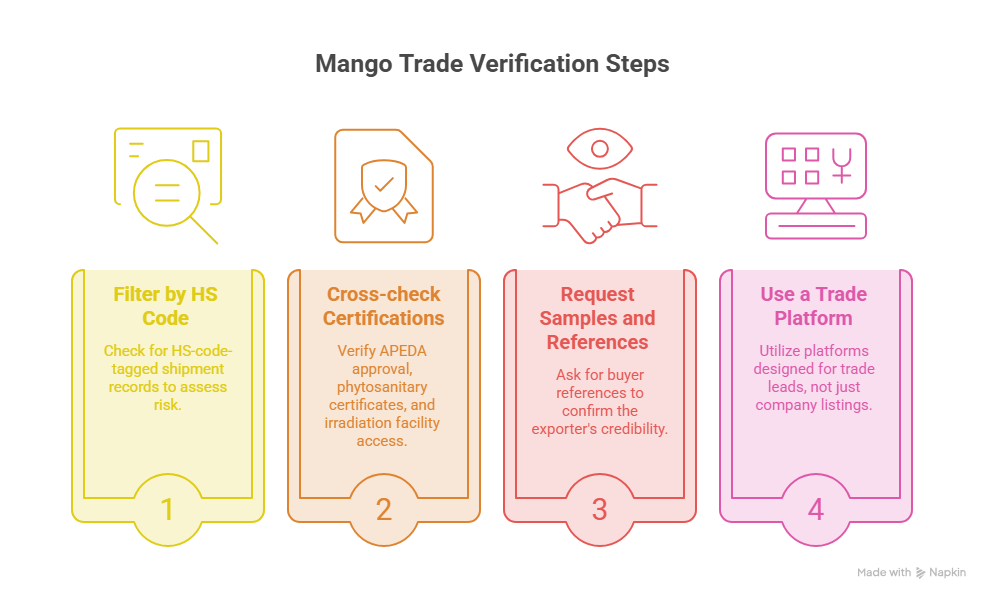
A genuine B2B sourcing process for mango trade typically runs through these steps:
- Filter by HS code and shipment history. A supplier with an actual HS-code-tagged shipment record is a different category of risk than one with no export paperwork at all.
- Cross-check certifications. APEDA approval (for Indian exporters), phytosanitary certificates, and — for US-bound shipments — irradiation facility access are non-negotiable.
- Request samples and references. Any exporter claiming to be among the top mango exporter group in their country should be able to produce buyer references without hesitation.
- Use a platform built for trade leads, not just listings. This is where most generic directories fall short — they list companies, but they don’t generate qualified mango import leads or mango export leads tied to active buying or selling intent.
Whether the counterparty is a high-volume Mexican shipper or a boutique GI-tagged grower in Maharashtra, the verification steps barely change. This is also where the search for import export leads gets genuinely difficult without the right tool. A buyer in Germany looking for the largest exporter of mango in Pakistan, or a Kenyan grower looking for verified buyers in the EU, both need the same thing: a platform that filters by product, HS code, country, and verified trade activity — not just a list of company names with phone numbers attached.
Why VyaaparOne Is Built for Mango Trade Leads
VyaaparOne is a B2B import-export marketplace designed around exactly this gap. Instead of scrolling through unverified directory pages, buyers and suppliers on VyaaparOne can search by HS code — including 0804.50 for mangoes — filter by country of origin or destination, and connect directly with trade leads tagged to real product categories.
From the biggest mango exporter in Mexico to small premium suppliers in India, VyaaparOne lists trade leads across the full spectrum of mango exporters. For a supplier in Maharashtra trying to reach UAE buyers, or an importer in the Netherlands trying to find the biggest exporter of mango in Pakistan for off-season supply, VyaaparOne’s structured listing format does the filtering work that generic search engines can’t. Mango import leads and mango export leads on the platform are organised by product, origin, and buyer intent — not just alphabetically by company name. Buyers don’t have to guess which counterparty leads their target country; verified shipment data does that work instead.
This matters more in agricultural trade than almost anywhere else, because timing is everything. A mango shipment has a shelf life measured in days, not months. A supplier who finds the right buyer two weeks late has effectively lost the deal. Platforms that generate live import export leads, rather than static directory entries, give both sides of a mango trade the speed the product itself demands.
VyaaparOne also lists exporters and suppliers across other major agricultural and processed food categories, which means a buyer sourcing mangoes today can build a broader multi-product supply chain — pulp, juice concentrate, dried fruit — on the same platform without starting a fresh search from scratch each time.
Conclusion
There isn’t a single, permanent answer to who holds the title of biggest mango exporter in the world — it depends on whether volume, value, or variety quality is the measure. Mexico leads on tonnage. India leads on production and premium pricing. Thailand, Peru, Pakistan, Brazil, and a handful of emerging origins fill in the rest of a market now worth more than $2.5 billion. What matters most for buyers and suppliers isn’t memorising the ranking — it’s having access to verified trade data, the correct HS classification, and a sourcing platform that turns that information into real mango import leads and mango export leads. That’s the gap VyaaparOne is built to close for both sides of the global mango trade.